You are here

green unionism

A new chance for climate justice?

By Nathan Thanki - Open Democracy, April 12, 2019

In the past year, concerns of civilizational collapse and unprecedented transformations of society and the economy have gone from being fringe ideas of eco-socialists to populating the mainstream debate in the Global North. The “Green New Deal” is gaining traction both amongst US Democrats and the UK’s Labour Party. There’s a growing desire for positive and visionary ideas, and a growing recognition of the scale and time frame of the challenge.

We can see the same desire in the explosion onto the scene of “Extinction Rebellion” and the phenomenal School Strike for Climate. While these initiatives represent different and internally diverse politics, they all speak to the same tendency: a profound sense of panic among people in the Global North.

There is much to praise and be heartened by in the shifting politics of the North, but there is a danger of missteps which could roll back the modest advances climate justice movements have made in the past few decades, and even contribute to the political forces we oppose. We need to debate the strategic value of the choices being made. We cannot afford to be uncritical, nor nihilistic.

Union Locals Build Support for the Green New Deal’s “Just Transition”

By Candice Bernd - Truthout, April 6, 2019

Undeterred by the Senate’s recent dismissal of the Green New Deal, Rep. Alexandria Ocasio-Cortez (D-New York) recently accepted Congressional Coal Caucus member Rep. Andy Barr’s (R-Kentucky) invitation to tour a coal mine in his district and meet with mine workers and voters in Appalachia to talk about how they could benefit from the resolution’s “just transition.”

That transition, as laid out in Representative Ocasio-Cortez’s plan, would include a federal jobs guarantee for U.S. workers. This includes former fossil fuel sector workers as they transition to build the infrastructure needed to shift the country to 100 percent renewable energy within 10 years.

Even as many of the resolution’s proponents are now turning their focus away from passing the Green New Deal on the heels of March’s procedural vote in the Senate, climate change legislation remains a priority for the Democratic Party. The resolution’s supporters are now looking at multiple bills in hopes of advancing standalone elements of the broader initiative as grassroots groups like the Sunrise Movement continue efforts to build support for the plan.

But what exactly would a Green New Deal or another piece of climate chance legislation focused on transitioning to renewables mean for the Kentucky coal workers Ocasio-Cortez is set to meet?

The plan backs union jobs and outlines commitments to “wage and benefit parity for workers” affected by the energy transition. The resolution also supports collective bargaining rights for workers while calling for “trade rules, procurement standards, and border adjustments” with strong labor protections.

Still, labor leaders like those on the AFL-CIO’s Energy Committee remain skeptical of the resolution’s call for a just transition. The Energy Committee sent an open letter to the resolution’s authors, Sen. Edward Markey (D-Massachusetts) and Ocasio-Cortez, blasting the resolution last month. “We will not stand by and allow threats to our members’ jobs and their families’ standard of living go unanswered,” wrote Cecil Roberts, president of the United Mine Workers of America, and Lonnie Stephenson, president of the International Brotherhood of Electrical Workers (IBEW).

The March 8 letter comes on the heels of a February letter sent to the chair of the House Energy and Commerce Committee, Rep. Frank Pallone (D-New Jersey), and its ranking member, Rep. Greg Walden (R-Oregon), outlining the “grave concerns about unrealistic solutions such as those advocated in the ‘Green New Deal,’” by seven unions representing workers in the building industry.

The strongest support for the plan has come from the joint executive board of the 163,000-member East Coast property service union, 32BJ SEIU, which passed its own resolution in February in support of the Green New Deal. Union President Héctor Figueroa recently condemned the Senate’s procedural vote to reject the plan, saying in a statement that, “Creating good jobs in this exciting new industry is as doable as it is necessary, but only if we work together in unity rather than giving into Washington’s divisive tactics.”

A Roadmap to an Equitable Low-Carbon Future: Four Pillars for a Just Transition

By J. Mijin Cha, JD, PhD - Climate Equity Network, April 2019

The signs that the climate crisis is already happening are clear. The most recent Intergovernmental Panel on Climate Change report detailed the evidence from more than 6,000 studies that found that over the past decade, a series of record-breaking storms, forest fires, droughts, coral bleaching, heat waves, and floods have taken place around the world in response to the 1.0 °C of global warming that has taken place since the pre-industrial era. These events, and the losses associated with them, are expected to become substantially worse with 1.5 °C of warming currently targeted by global climate agreements, and far worse if these agreements are not effective. Without major cuts in greenhouse gas (GHG) emissions, this warming threshold could be reached in as little as 11 years, and almost certainly within 20 years. Even if such cuts were to begin immediately, reaching this threshold would not be prevented, only delayed.

Any chance of staving off even worst impacts from climate change depends on significant reductions in GHG emissions and a move from a fossil fuel- based economy to a low-carbon economic future. While this transition is fundamentally necessary, the challenges it poses are great. Every aspect of our economy and our society is dependent upon fossil fuel use – from the reliance on electricity provided by fossil fuel power plants to the tax revenue local communities receive from fossil fuel extraction and facilities to the jobs held by those working in an industry that may keep their incomes high but often puts their communities at risk. The imprint of fossil fuels is so deeply embedded within our way of life that ceasing its use will require a fundamental shift in how we procure and use energy.

The good news is that this shift is possible—and California is already on a path to a low-carbon future. In addition to several ambitious climate targets, in September 2018, then-Governor Jerry Brown signed an executive order pledging the state to achieve carbon neutrality no later than 2045. As the world’s fifth largest economy, the commitment California made to reduce greenhouse gases can provide a pathway to a low-carbon future that could lay the groundwork for others to follow. But to get there, we need to aim even higher than California’s already ambitious goals.

Transitioning away from fossil fuels must be done more quickly and also in a manner that protects workers and communities economically dependent on the fossil fuel industry. Transitioning is also an opportunity to include those who have historically been excluded from the jobs and economic benefits of the extractive economy and expand the populations who have access to future jobs and economic opportunities. As we move to a low-carbon future, environmental justice communities should be prioritized for job creation and renewable energy generation. Without protecting displaced workers and expanding opportunities to other workers, transitioning to a low-carbon future will replicate the mistakes and inequalities of the extractive past and present.

Read the report (PDF).

Decent work in the management of electrical and electronic waste (e-waste)

By staff - International Labour Organization, April 2019

At its 329th Session (March 2017), the Governing Body of the International Labour Office decided that a Global Dialogue Forum on decent work in the management of electrical and electronic waste (e-waste) would be held in Geneva. During its 334th Session (October– November 2018), it decided that the date of the meeting would be 9–11 April 2019 and that all interested governments should be invited. Eight Employer and eight Worker participants would be appointed on the basis of nominations made by their respective groups in the Governing Body, and selected intergovernmental organizations and non-governmental organizations would be invited as observers.

The purpose of the Global Dialogue Forum is to discuss current and emerging issues and opportunities related to the promotion of decent work in the management of e-waste, with the aim of adopting points of consensus, including recommendations for future action by the International Labour Organization (ILO) and its Members. Taking place in the centennial year of the ILO, the Forum is also an opportunity to discuss more broadly the future of work in the circular economy.

Read the report (Link).

A Green Growth Program for Colorado: Climate Stabilization, Good Jobs, and Just Transition

By Robert Pollin, Jeannette Wicks-Lim, Shouvik Chakraborty, and Tyler Hansen - Department of Economics and Political Economy Research Institute (PERI), April 2019

This study examines the prospects for a transformative green growth program for Colorado. The centerpiece of the program is clean energy investments—i.e. investments to raise energy efficiency levels and expand the supply of clean renewable energy sources. These investments should be undertaken in combination by the public and private sectors throughout the state. This program can advance two fundamental goals: 1) promoting global climate stabilization by reducing carbon dioxide (CO2) emissions in Colorado without increasing emissions outside of the state; and 2) expanding good job opportunities throughout the state while the state’s economy continues to grow. The program is specifically designed to reduce Colorado’s CO2 emissions by 50 percent as of 2030 and by 90 percent as of 2050 relative to the state’s 2005 emissions level while the economy grows at an average annual rate of 2.4 percent. The consumption of oil, natural gas and coal to generate energy will need to fall sharply in Colorado, since CO2 emissions result through the combustion of fossil fuels.

We estimate that total investments in energy efficiency and renewable energy will need to average about $14.5 billion per year between 2021 – 2030, equal to about 3.5 percent of Colorado’s average annual GDP over those years. These investments will generate about 100,000 jobs per year in the state. New job opportunities will be created in a wide range of areas, including construction, sales, management, production, engineering and office support. At the same time, the contraction of the state’s fossil fuel related industries will generate about 700 job losses per year, of which about 600 will be non-managerial jobs. We develop a Just Transition program for workers impacted by the contraction of the state’s fossil fuel industries. The program includes: pension guarantees for retired workers who are covered by employer-financed pensions; retraining to assist displaced workers to obtain the skills needed for a new job and 100 percent wage replacement while training; re-employment for displaced workers through an employment guarantee, with 100 percent wage insurance; and relocation support as needed. We also propose a broader set of policies to meet the state’s emissions reduction goals. These include a carbon tax; strengthening the state’s existing energy efficiency and renewable portfolio standards; strengthening existing procurement programs for clean energy public investments; increasing financial subsidies for clean energy investments; expanding the state’s worker training programs for clean energy employment opportunities; and channeling a disproportionate share of new clean energy investments into communities that will be significantly impacted by the contraction of the state’s fossil fuel related industries.

Read the text (PDF).

Trading Up Equipping Ontario Trades With the Skills of the Future

By staff - Canada Green Building Council, April 2019

Equipping Canada’s labour force with the skills required for designing, constructing and maintaining low-carbon building infrastructure is critical to achieving a greener economy and to reducing Canada’s emissions by 30% below 2005 levels by 2030. We are pleased to support Canada’s green building industry with a new report, Trading Up: Equipping Ontario Trades with the Skills of the Future, aimed at facilitating a low carbon workforce transition.

This report provides an action plan to close the low-carbon building skills gap in the Ontario construction industry. Green infrastructure investments are expected to create an estimated 147,000 job openings for skilled tradespeople over the next 15 years in the Toronto region alone. The inability to close the skills gap in Ontario is estimated to have an impact of $24.3 billion of Gross Domestic Product (GDP) in foregone company revenues, with an additional $3.7 billion lost in foregone taxation.

The report identifies where shortages in low-carbon skills training currently exist, and highlights the risks to the quality of low-carbon buildings being constructed. It defines specific actions that labour, governments, post-secondary institutions and industry organizations can take to optimize green building skills training.

The “Trading Up” report was compiled by CaGBC with Mohawk College, McCallumSather, The Cora Group, the City of Toronto and the Ontario Building Officials Association (OBOA). The project was funded, in part, by the Government of Ontario. While the report examines the Ontario construction industry, its recommendations can be applied throughout Canada.

Read the text (PDF).

The Ecological Limits of Work: on Carbon Emissions, Carbon Budgets and Working Time

By staff - Autonomy, April 2019

Faced with accelerating technological progress and a deepening ecological crisis, a growing discussion sees a reduction in working hours as a multiple dividend policy, increasing, among other things, individual wellbeing, productivity and gender equality whilst simultaneously potentially contributing to a reduction in unemployment and greenhouse gas (GHG) emissions. One cannot help but feel reminded of some earlier sociotechnical visions of a society in which productivity gains would be shared broadly to allow for radically shorter working hours and thus a qualitatively better life.
Read the report (PDF).

Brothers & sisters in the building trades: Time is running out for the planet

By A WORKING CARPENTER - Socialist Action, March 25, 2019

I’ve been a carpenter my whole adult life. I worked nonunion before I joined the Carpenters’ Union—easily the smartest thing I’ve ever done. For a working-class person, a union is still the best anti-poverty program.

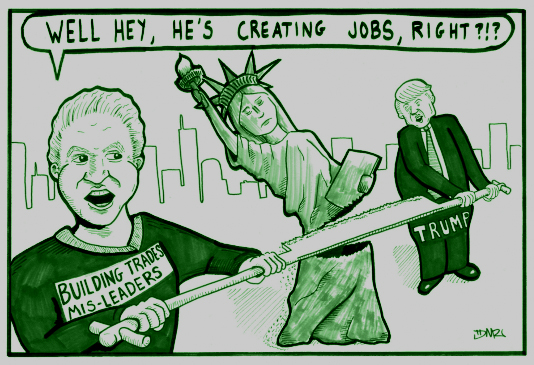
Recently, the heads of the Building Trades unions, alongside the leaders of the United Steelworkers and the United Mine Workers (UMWA), spoke out against the proposed Green New Deal. They claim that the GND will “cause immediate harm to millions of our members and their families.” Right-wing climate deniers immediately seized on union opposition to the GND as proof that proponents are out of touch with reality.

The science is irrefutable: Climate change is real. The energy companies spend millions of dollars trying to convince you that the science isn’t definitive. (Just like the tobacco companies tried to tell us that cigarettes are not a danger to your health.) Politicians crack jokes in the wintertime to downplay the seriousness of the situation.

The dangers are real. We’re already seeing the effects—melting ice caps and rising sea levels, extreme weather, flooding in the Midwest, more intense hurricanes, wildfires in the West, and refugee crises that will only become more dire. Famine is a real threat. Wars may be fought over water and arable land. Democracy could be threatened as a result of social unrest. If left unchecked, climate change could mean the end of life on Earth.

It doesn’t have to be this way. If corporate interests, and the richest 1%, are left in control of the economy and government, they will balance the cost of the climate crisis on our backs. The rich will stop at nothing to keep their wealth and power. This means playing working people against each other, inciting fear of immigrants, and fanning the flames of conspiracy theories about socialists wanting to take away your hamburgers.

Organizing to Win a Green New Deal

By Jane McAlevey - Jacobin, March 23, 2019

Demands for real climate justice got a welcome boost recently as youth walked out of schools worldwide on March 15, urged to go “on strike” by sixteen-year-old Greta Thunberg from Sweden. Images in mainstream and social media exploded with pictures of young people marching into plazas across the world, confronting intransigent elected officials and speaking truth to power. Youth have always brought two essential ingredients to social movements: moral compass and an exciting, unique form of energy. Their vision is bold, and they are uncompromising. But to halt and reverse the carbon economy, save the planet, and create a future with jobs that youth will look forward to requires far more power and a serious strategy.

In the US, discussions about the climate crisis of late have fixated on the Green New Deal proposed by Rep. Alexandra Ocasio-Cortez and Senator Ed Markey. Headlines have alternated between descriptions of the resolution’s big vision and more skeptical assessments of its prospects — including from important potential backers: “AFL-CIO criticizes Green New Deal, calling it ‘not achievable or realistic,’” reads one recent headline. The backdrop to the debates raging in the first quarter of 2019 have been a nonstop series of extreme storms predicted by climate scientists since the 1980s. So-called bomb cyclones hit the Midwest, massive rainstorms battered California after a devastating wildfire season, and killer tornadoes hit the South, with crops being wiped out. People are dying because of the lack of preparation in dealing with the crisis.

And while the recent letter from the AFL-CIO criticizing the GND may seem like a willful refusal to face the scale of the crisis, we need considerably more than a bold vision to get labor to come out swinging for the Green New Deal. It simply doesn’t matter that everyone on the Left rejects the divisive frame of jobs-versus-environment — the Left has yet to prove it can move from rhetoric to reality about green jobs.

To win, it’s crucial that we heed advice from union organizer Nato Green. In a recent article about how public service unions like the one he works for, local SEIU 1021 in California, can — and must — negotiate for climate justice, he wrote, “Any seasoned union campaigner worth her salt loves a contract fight because it has a hard deadline that focuses everyone’s attention—expiration and a strike threat. Climate science gives us a new deadline and an opportunity to show that we’re up to the task. We have 12 years.”

Green is certainly right that good union organizers love a contract fight. If we take the twelve years outlined in the recent IPCC report as our deadline for drastically cutting carbon emissions, what’s a credible plan to win by 2030?

Gulf South for a Green New Deal Policy Platform

By Colette Pichon Battle, et. al. - Gulf South Rising, Spring 2019

The Gulf South is uniquely positioned to be a national leader in the movement for a Green New Deal. With the climate crisis accelerating faster than even most scientific predictions, deep investment in Gulf South frontline communities will yield an opportunity for this region to be a global leader in equitable approaches to a socio-economic transformation that builds wealth and sustainability for the nation and the world.

Gulf South for a Green New Deal is a multi-state effort to address the impact of the global climate crisis on some of the most unique communities in the US. In May 2019, more than 800 advocates, farmers, fisherfolk, and community leaders from across the Gulf South gathered in New Orleans around a shared vision to advance regional sustainability in the face of the global climate crisis.

The creation of the Gulf South for a Green New Deal (GS4GND) Policy Platform was a six-month process anchored by the Gulf Coast Center for Law & Policy (GCCLP). Using techniques from the People’s Movement Assembly Process, GCCLP facilitated a five-state process of formalizing frontline voices. Through a broader regional organizing effort, over 100 original signatories are listed herein. Additional signatories will be updated quarterly.

This document is a collective assertion that the Gulf South must be included in the development of national policy. This platform is not a comprehensive policy vision, but rather a starting point and living tool of regional alignment and broad organizing in the Gulf South. The principles, goals, and strategies of this Policy Platform are offered to address what a Green New Deal must look like to be successful in the Gulf South.

We offer this document as a step towards climate justice, self-determination, and dignity for all people everywhere.

As goes the South, so goes the nation.

Pages

The Fine Print I:

Disclaimer: The views expressed on this site are not the official position of the IWW (or even the IWW’s EUC) unless otherwise indicated and do not necessarily represent the views of anyone but the author’s, nor should it be assumed that any of these authors automatically support the IWW or endorse any of its positions.

Further: the inclusion of a link on our site (other than the link to the main IWW site) does not imply endorsement by or an alliance with the IWW. These sites have been chosen by our members due to their perceived relevance to the IWW EUC and are included here for informational purposes only. If you have any suggestions or comments on any of the links included (or not included) above, please contact us.

The Fine Print II:

Fair Use Notice: The material on this site is provided for educational and informational purposes. It may contain copyrighted material the use of which has not always been specifically authorized by the copyright owner. It is being made available in an effort to advance the understanding of scientific, environmental, economic, social justice and human rights issues etc.

It is believed that this constitutes a 'fair use' of any such copyrighted material as provided for in section 107 of the US Copyright Law. In accordance with Title 17 U.S.C. Section 107, the material on this site is distributed without profit to those who have an interest in using the included information for research and educational purposes. If you wish to use copyrighted material from this site for purposes of your own that go beyond 'fair use', you must obtain permission from the copyright owner. The information on this site does not constitute legal or technical advice.