You are here

green unionism

Talking Shop: Burning Up

By staff - New Syndicalist, June 22, 2019

In this episode of Talking Shop, we interview Simon Pirani, the author of ‘Burning Up – A Global History of Fossil Fuel Consumption’. Simon is a writer, historian, and researcher on energy, as well as an activist involved in social and labour movements.

In ‘Burning Up’, Simon argues that, throughout the twentieth century, industrialisation, urbanisation and mass consumption were the driving forces for the technological changes and changes in energy consumption that created the current climate crisis. He also discusses the social transformations that would be needed to build fully sustainable relationships to the environment.

We asked Simon about what climate change looks like in the present day and near future, the promise of movements like the school strikes, and the climate denialism of big business. We talked about how and why unions should be mobilising their membership behind climate issues, and about moving beyond the false dichotomy of jobs vs positive environmental policies.

Iron and Earth 2-1/2 Year Progress Report

By staff - Iron and Earth, Summer 2019

Iron & Earth formed around the lunchroom tables of the oilsands in 2015. We were in the middle of an oil price crash which resulted in over 100,000 (roughly one in three) oilpatch employees losing their jobs by 2017. We knew our dependence on the fossil fuel industry was a risk to our livelihoods and so we began holding lunch-time meetings on the jobsite to discuss the potential of diversifying into the renewable energy sector. Many of us could see a clear path to reinventing ourselves as energy industry workers, not just fossil fuel industry workers. Beyond the financial benefits, we were excited about the opportunity to help build a more sustainable energy future.

So, in Spring 2016 we launched Iron & Earth to empower ourselves to create a better future for ourselves, our co- workers, and the planet. Within months we had inspired over 100 media stories and garnered a supporter base of thousands of Canadians and hundreds of fossil fuel industry workers. A powerful movement had begun.</p.

This progress report has been written to celebrate what we have accomplished in our first couple of years and share a bit about where we are going. Please share this report with any friends, family or colleagues who may be inspired by our work or interested in getting involved. Contact info@ironandearth.org with any questions or comments.

Read the report (PDF).

The Green New Deal is Only a Beginning

By WobblyBall - Open Letter, Summer 2019

A lot of friends are having conversations about the environmental movement (like XR) and environmental justice, especially focused around colonialism and environmental racism. Another aspect to it is the movement's relationship to the working class and to organized labor (and we need to understand, in this, that the makeup working class is heavily influenced by race and racism).

The environmental movement is increasingly pushing for a Green New Deal, and expecting (understandably) the labor movement to get behind this, especially the Trades. I'm a Trades worker who's a straight up anticapitalist, but who would be critically supportive of most forms of "Green New Deal" as a very partial step towards averting the climate crisis. Of course, environmentalists pushing for this need to understand that the new industries are largely non-union, and the unions (some of which don't aggressively organize) are unlikely to get behind the decline of unionized industries and the growth of non-union ones. Getting labor on board would take also building up a more aggressive, organizing current in the unions.

Then, there's a broader issue of having a Just Transition for the entire working class- not only for workers in construction or extraction, but for workers in all industries. A lot of the major protests we're seeing, such as in France, Haiti, or the Netherlands, are against attempts to make the working class pay more for fuel- a favorite solution to technocrats who figure a little Pigouvian tax on gas can internalize those external costs and knit up the climate problem neatly. For most working people, the biggest costs in our lives are food, housing, and transportation-- all areas where there needs to be transitions towards sustainability in ways that don't hit the poorest hardest.

The environmental movement could make alliances with transport workers and riders around demands for more and free public transit. Workers forced out to the fringes of the city have to make long commutes in and pay for all that gas.  If the movement fights for rail, it should also make an absolute push against reduction in train crew sizes, for the safety of everyone.
Even better than more public transit, more affordable housing near where people work. More walkability of neighborhoods and less compulsory transportation--and don't let the call for walkability be a cover for displacement of the working class into the suburbs (again, the commutes!).

The environmental movement already needs to take a strong interest in the reshaping of cities that are designed around needing a car, and that cluster polluting industries in poor (especially black) neighborhoods. Of course, be aware that all new construction, including of "green" housing, has environmental costs. Look into also supporting more funding for things like WAP conservation funding (where I work), which upgrades existing housing stock to be more energy efficient. Though be aware that this is mostly non-union, like most of residential construction, in part because of the suppression of undocumented workers.

While we're talking about urban geography, let's talk food justice from a working class perspective. Now, a lot of environmentalists try to court small farmers--and as someone from a small farming family, I'm not going to go into all the reasons that the decline of family farms can't be reversed by conscientious consumerism. My main concern is supporting farm workers and healthy food access.  Let's talk about sustainable changes in farming that are focused on changing how the food the majority of people buy and eat is grown, instead of creating a specialty expensive market. Let's take a look at the idea of co-ops not as health food stores for that niche market, but as a way to bring produce at a low price into food deserts. Let's not only support community garden space in working class neighborhoods, but also fight for a strong labor movement, living wages, and access to childcare so people living in those neighborhoods have time to do things like use a community garden. Also, when talking about urban farming, it's often good to look not just at flashy new hydroponics and vertical farms, also at the populations already doing that work, like Hmong families in St Paul.

Video: How to strike for climate in your workplace

By Ian Allinson - RS21, June 19, 2019

On Friday 21 June, youth strikers (took) action for the climate in the UK around the world again. Now they have put out a call for adults to join them in a global general strike for the climate on 27 September, and rank and file trade unionists are taking up the call. In this video, Ian Allinson gives some suggestions about how you can take part, whether you work in a unionised workplace or not.

Maximising solidarity for the youth strikers this Friday will also help build up momentum towards September. What can you do? Can you attend the protests, share solidarity photos or videos, hold lunchtime meetings or rallies outside work?

The Climate Strikes & the Social Strike: Working-Class Environmentalism and Social Reproduction

By Lorenzo Feltrin - We Are Plan C, June 18, 2019

Are the climate strikes “real” strikes? The answer to this question depends on our definition of what a strike is, which is in turn based on our political objectives. It is proposed here that the climate strikes, just like the women’s strikes, are part of the process that we call the “social strike”.

This argument rests on two theoretical assumptions:

  • An expanded conception of work and of the working-class composition;
  • A conception of working-class interests as encompassing both production (the making of commodities) and reproduction (the making of life).[1]

A strike occurs when workers withdraw their labour to pressure private employers or the state to make concessions. If we understand work as exclusively waged employment, then a strike only happens when waged employees perform a workplace-based suspension of production. However, if we adopt a broader definition of work, encompassing all activities – waged and unwaged, productive and reproductive – that are subordinated in both obvious and hidden ways to the accumulation of capital via profit-making, then work is not contained only in formal workplaces but is also diffused throughout society. It is done within households and communities (for a moment, just think of all the cooking, cleaning and caring that we call reproductive labour); through the means of communication (the production of data, emotions, entertainment, ideas that are captured and sold for profit by the internet giants); in schools (the formation of a labour-power adequate to the needs of the economy); etc. The social strike then, refers to a withdrawal of all kinds of labour, including labour in its most socially diffused forms.

A common mischaracterisation of the social strike idea is the accusation that, by giving to unwaged and reproductive labour the same “dignity” traditionally assigned to waged productive labour, it abandons all aspirations to fight the class struggle in workplaces. To the contrary! There is no reason why we should not strive for a social strike that touches upon the whole spectrum of work. The disputes about the primacy of this or that form of work appear as pointless to many of us, with the only concrete outcome of dividing us further. After all, work in capitalism is not a question of dignity but of coerced profit-making and social control, and as such it is a disgrace. Dignity is asserted by workers as resistance, overt or covert, against the toll work takes on life.

“Batshit jobs” - no-one should have to destroy the planet to make a living

By Bue Rübner Hansen - Open Democracy, June 11, 2019

For too long, we have related to climate change mainly as consumers and voters. We have been responsibilised as meat eaters and airplane travellers, we have been urged to vote for the party with the most green agenda, but we have never been addressed as workers. This fits well with the general idea that consumers and voters have power and responsibility, while workers… well, they just have to get on with their work.

However, this pattern is starting to change. First future workers started striking at their schools, now they are calling adults to join a worldwide strike for the climate. The Green New Deal has risen to prominence with its promises of a world of sustainable jobs, and a new report argues that a carbon-neutral economy requires a massive shortening of the work week. Yet there is little discussion about the work that destroys the planet, in a variety of different locations from tar sands and coal mines, over agro-industrial landscapes to downtown skyscrapers and airports, on cargo and cruise ships. Sometimes we hear of coal miners protesting pit closures, or unions demanding subsidies for steel and auto industries, but we rarely hear of the guys pushing oil stocks at Wall St., the engineers designing the next pipeline, advertising agencies pimping mass consumption, or the professors teaching the next generation of petroleum geologists. Some workers could leave their jobs fairly easily, and others are deeply dependent on the next paycheck. These workers have an interest in habitable environments, but are caught in a maddening contradiction, asked by their employers to destroy the conditions of life in order to make a living. We are habituated to think of this as normal, even rational, but it’s time to say openly that it is madness, and to start from there. No one has the right to do such work, and no-one should have to do it.

Techno-fixes and government action might come, but we would be foolish to rely on it being sufficient and timely, or even happening at all. The clock is ticking; climate emergency and species extinction are already in process, and so far every solution imagined by engineers and technocrats has been incapable of even slowing the countdown, and green growth remains a pipe dream. In this situation of urgency, we may thus ask: How can people within and outside destructive industries develop a common interest in abolishing the work that destroys the planet?

Workers and the fight for climate justice

By David Camfield - New Socialist, June 10, 2019

The push for a Green New Deal (GND) that’s become a big topic of political discussion in the US has come north. At the beginning of May 2019, the Pact for a GND was launched publicly in Canada. It was endorsed by a range of organizations and prominent individuals. Behind the scenes, staff from a number of major NGOs including Greenpeace and Leadnow are playing key roles in the initiative.

The Pact calls the GND “a vision of rapid, inclusive and far-reaching transition, to slash emissions, protect critical biodiversity, meet the demands of the multiple crises we face, and create over a million jobs in the process. It would involve the full implementation of the United Nations Declaration on the Rights of Indigenous Peoples (UNDRIP) including the right to Free, Prior and Informed Consent (FPIC), dozens of other pieces of legislation, new programs and institutions, and a huge mobilization calling on the creativity and participation of all of us.”

The Pact sets out “two fundamental principles” for a GND: “1. It must meet the demands of Indigenous Knowledge and science and cut Canada’s emissions in half in 11 years while protecting cultural and biological diversity”, and “2. It must leave no one behind and build a better present and future for all of us.”

Over 100 town hall meetings have been held in cities, towns and smaller communities to discuss what should be in a GND, and more are planned. The results of the discussions are supposed to be reported back and used to develop a package of GND policies. It seems that the contents of the package will eventually be decided by some of the people, mostly NGO staff, doing the work of the Pact for a GND Coalition. The Coalition, however, will not be campaigning publicly between June 30th and the federal election due to election advertising regulations. The GND policy package will be launched after the federal election, with the Coalition talking internally about doing some kind of mass mobilization around it.

The Strategic Importance of a Green New Deal Campaign

It does matter what the specific GND policies will be – but not only or mainly for the reason that some anti-capitalists think. Some radicals in the US have dismissively criticized the GND championed by Alexandria Ocasio-Cortez and other Democratic politicians for not targeting the capitalist system itself. In a much more constructive reflection, British socialist Richard Seymour has asked if the GND depends “on magical thinking about technology and capitalism? Are the legislative tools it looks to adequate? Is it internationalist, or can it be? Does it risk further commodifying the natural world?” Seymour suggests “we need the GND plus something else.”

We definitely need accurate assessments of the enormous scale of change needed to carry out a just transition away from a way of organizing society that spews out vast quantities of greenhouse gases. As Samuel Miller McDonald argues, “we first have to be clear-eyed about the challenges involved.”

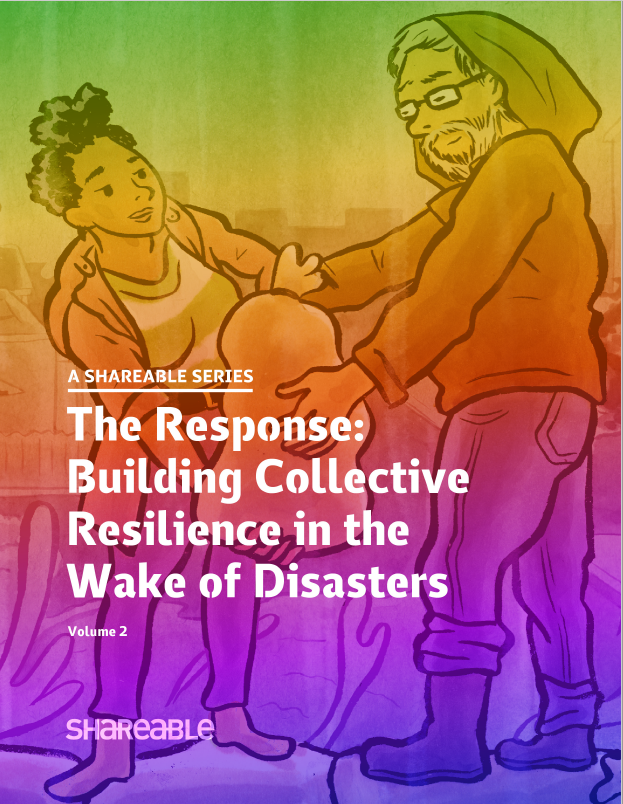
The Response: Building Cllective Resilience in the Wake of Disasters (Shareable)

By various - Sharable, 2019

When disasters occur, the majority of news coverage teeters on the edge of “disaster porn” at best, emphasizing the sheer mass of destruction in the affected area while celebrating a few token “heroes.” At its worst, the media perpetuates harmful stereotypes, casting survivors as looters and justifying the extrajudicial murder of people of color by the police and mostly white vigilantes, like what occurred during Hurricane Katrina.

But in both scenarios, news reporting routinely underplays how local communities come together to recover from the immediate devastation and collectively rebuild the community, often on a new foundation of sustainability and justice. It’s a good thing that people collaborate instead of competing during a crisis because all signs point towards an increase in climate change-fueled disasters in the coming years.

This kind of collective response is worth celebrating, but there’s no better way to respond to disasters than to anticipate them happening and prepare before they strike. And there’s no better time than right now to build resilience together. While a little preparation today can save a lot of trouble tomorrow, it can also create immediate benefits like stronger community ties, increased civic capacity, and the joy that comes from accomplishing things together.

Read the report (PDF).

Just Transition at the Intersection of Labour and Climate Justice Movements: Lessons from the Portuguese Climate Jobs Campaign

By Chrislain Eric Kenfack - University of Alberta, 2019

In the current context of climate change and its accompanying adverse effects on natural, human and social systems, the imperative of transitioning to low- and preferably post-carbon societies has become a non-negotiable reality if we want to avoid reaching the point of no return in terms of environmental and climate catastrophe. Such a transition requires that the interests and needs of workers and their communities be taken into consideration to make sure they do not bear the heaviest part of the burden in terms of loss of jobs and means of survival, and that they are prepared to face the new, post-carbon labour environment.

The concept of Just Transition was coined to describe both the socio-political project put forward by trade unions in response to climate change, and the recognition by climate activists that the livelihoods and security of workers and their communities must be ensured during the transition to a post-carbon society. However, just transition movements are divided between two quite different orientations, which are labelled “affirmative” and “transformative.” On the one hand, affirmative just transition advocates envisage a transition within the current political-economic system. Transformative just transition activists, on the other hand, envisage a post-capitalist transition.

This article, drawing upon an extensive case study of the Portuguese climate jobs campaign, goes beyond showing how these orientations shape the positions taken by union and climate activists. The article also analyses how the conflicts and cooperation between these key actors can shed light on the possibilities and/or limitations of just transition as a framework for the collective action needed to achieve rapid, deep decarbonisation of economies in the Global North context.

Read the report (PDF).

Internationalising the Green New Deal: Strategies for Pan-European Coordination

By Daniel Aldana Cohen, Kate Aronoff, Alyssa Battistoni, and Thea Riofrancos - Common Wealth, 2019

Climate politics are today bursting to life like never before. For four decades, market fundamentalists in the United States and United Kingdom have blocked ambitious efforts to deal with the climate crisis. But now, the neoliberal hegemony is crumbling, while popular climate mobilisations grow stronger every month. There has never been a better moment to transform politics and attack the climate emergency.

When the climate crisis first emerged into public consciousness in the 1980s, Margaret Thatcher and Ronald Reagan were consolidating a neoliberal doctrine that banished the most powerful tools to confront global heating— public investment and collective action.

Instead, neoliberals sought to free markets from democratically imposed constraints and the power of mass mobilisation. Thatcher insisted that there was no alternative to letting corporations run roughshod over people and planet alike in the name of profit. Soon, New Democrats and New Labour agreed. While the leaders of the third way spoke often of climate change, their actual policies let fossil capital keep drilling and burning. Afraid to intervene aggressively in markets, they did far too little to build a clean energy alternative.

Then the financial crisis of 2008 and the left revival that exploded in its wake laid bare the failures of the neoliberal project. An alternative political economic project is now emerging—and not a moment too soon. As the Intergovernmental Panel on Climate Change put it, keeping global warming below catastrophic levels will require “rapid, far-reaching and unprecedented changes in all aspects of society.” In other words: public investment and collective action.

Fortunately, movements on both sides of the Atlantic have been building strength to mount this kind of alternative to market fundamentalism. On the heels of Occupy Wall Street and Black Lives Matter, Bernie Sanders’s 2016 Democratic primary campaign breathed new life into the American left and its electoral prospects. Jeremy Corbyn’s election as leader of the Labour Party, spurred by a vibrant grassroots mobilisation, gives those of us in the U.S. hope: if New Labour could give way to Corbynism, surely Clintonism can give way to the left wing of the Democratic party. In the U.K., drawing on tactics from the Sanders campaign, Momentum has developed a new model of mass mobilisation to transform a fossilised political party. It’s restoring the dream that formal politics can be a means for genuinely democratic political organising. In turn, U.S. leftists are learning from Momentum’s innovations.

The vision of the Green New Deal that has taken shape in the United States in the past few months is in many ways a culmination of the U.S. left’s revival. The Green New Deal’s modest ambition is to do all that this moment requires: decarbonise the economy as quickly as humanly possible by investing massively to electrify everything, while bringing prodigious amounts of renewable power online; all this would be done in a way that dismantles inequalities of race, class and gender. The Green New Deal would transform the energy and food systems and the broader political economy of which they are a part.

Read the report (PDF).

Pages

The Fine Print I:

Disclaimer: The views expressed on this site are not the official position of the IWW (or even the IWW’s EUC) unless otherwise indicated and do not necessarily represent the views of anyone but the author’s, nor should it be assumed that any of these authors automatically support the IWW or endorse any of its positions.

Further: the inclusion of a link on our site (other than the link to the main IWW site) does not imply endorsement by or an alliance with the IWW. These sites have been chosen by our members due to their perceived relevance to the IWW EUC and are included here for informational purposes only. If you have any suggestions or comments on any of the links included (or not included) above, please contact us.

The Fine Print II:

Fair Use Notice: The material on this site is provided for educational and informational purposes. It may contain copyrighted material the use of which has not always been specifically authorized by the copyright owner. It is being made available in an effort to advance the understanding of scientific, environmental, economic, social justice and human rights issues etc.

It is believed that this constitutes a 'fair use' of any such copyrighted material as provided for in section 107 of the US Copyright Law. In accordance with Title 17 U.S.C. Section 107, the material on this site is distributed without profit to those who have an interest in using the included information for research and educational purposes. If you wish to use copyrighted material from this site for purposes of your own that go beyond 'fair use', you must obtain permission from the copyright owner. The information on this site does not constitute legal or technical advice.