You are here

agricultural workers and peasants

"Small really is beautiful", claims new report on England's farming

By Kathryn Hindess - The Ecologist, January 4, 2017

"Small-scale food production is more sustainable, provides work for more people, produces food which is consumed locally, has shorter supply chains, and provides greater returns to the farmers," argues author Miles King.

Post-Brexit, he believes: "An England farm support system could inject much more support into small-scale food production."

The Land Workers' Alliance (LWA) agrees. One of eight points raised in its proposed framework for British Agricultural Policy post-Brexit sounds the call: "End the discrimination against small farms".

The report states: "It is unjustifiable for Defra to continue to discriminate against small farms in the allocation of subsidies and collection of farm data."

Instead, Miles King proposes a shift to supporting "small-scale sustainable farming which benefits nature", including paying landowners for the delivery of public goods to society. Public goods "are defined as things which benefit society but do not create a private profit".

Some public goods are: features making up the fabric of the landscape (like hedges, ponds and streams); the provision of clean water, flood prevention; healthy pollinator populations; carbon storage and sequestration; as well as "the many valuable yet intangible things nature provides to people - inspiration, joy, reflection, solace, emotional and spiritual experiences."

"These features need protection and management, but it is right that landowners should be paid to carry out that protection and management on behalf of society," says King.

The EU's Joint Research Centre estimates that food accounts for around a third of the average European's impact on climate change, so policy changes will need to be coupled with awareness campaigns on the benefits of buying local, such as saving long cross-country journeys from farm to plate.

Support for this view is found in a 2013 report from the UN trade and environment review. More than 60 international experts came together to contribute to the Wake Up Before It Is Too Late report, which states that an holistic approach to agricultural management is needed, recognising that "a farmer is not only a producer of agricultural goods, but also a manager of an agro-ecological system that provides quite a number of public goods and services."

Within this approach, there should also be a significant shift from industrial production characterised by monocultures towards "mosaics of sustainable, regenerative production systems that also considerably improve the productivity of small-scale farmers."

Fruits and vegetables would be a useful place to start, suggests Miles King. Defra statistics show that 24 countries accounted for 90% of the fruit and vegetable supply of the UK (UK supplied 23%), but King argues that, "Many types of fruit and vegetable can now be grown in England both outside and under cover, on highly productive but small plots".

Worth noting though, is a point made by the EU GLAMUR global and local food chain assessment project which suggests that new policies will need to recognise the "hybridity and interconnectedness of global and local food systems".

The UK's food culture has been Europeanised since joining the Common Market in 1973, a study by City University (London) states. And nothing makes more apparent than the fact that pizza is now UK childrens' favourite food. Membership of the EU has eased the flow of food, yet at the same time local industries have been rebuilt (there are now approximately 100 more UK artisanal cheeses than in France according to the British Cheese Awards).

The study concludes, "Will the British have the confidence to move forward and accept this remarkable post-war culinary learning?"

Now, post-Brexit, this question is more pertinent than ever. Can new policies balance the need for a shift towards small-scale production (for example of pears and apples that don't need to be imported, but often are), while still satisfying consumer tastes?

Double Whammy On Farmers

By Colin Todhunter - CounterPunch, December 12, 2016

Washington’s long-term plan has been to restructure indigenous agriculture across the world and tie it to an international system of trade based on export-oriented mono-cropping, commodity production for the international market and indebtedness to international financial institutions (IMF/World Bank).

This result has been the creation of food surplus and food deficit areas, of which the latter have become dependent on agricultural imports and strings-attached aid. Food deficits in the Global South mirror food surpluses in the North. Whether through IMF-World Bank structural adjustment programmes, as occurred in Africa, trade agreements like NAFTA and its impact on Mexico or, more generally, deregulated global trade rules, the outcome has been similar: the devastation of traditional, indigenous agriculture for the benefit of transnational agribusiness and the undermining of both regional and global food security.

In the 1990s, the IMF and World Bank wanted India to shift hundreds of millions out of agriculture. India was advised to dismantle its state-owned seed supply system, reduce subsidies and run down public agriculture institutions and offer incentives for the growing of cash crops. As the largest recipient of loans from the World Bank in the history of that institution, India has been quite obliging and has been opening up its agriculture to foreign corporations.

What would it take to mainstream “alternative” agriculture?

By Maywa Montenegro and Alastair Iles - Ensia, July 25, 2016

This Voices piece is published in collaboration with the academic journal Elementa. It is based on “Toward thick legitimacy: Creating a web of legitimacy for agroecology,” a peer-reviewed article published July 20 as part of Elementa’s New Pathways to Sustainability in Agroecological Systems forum.

The industrialized food system, studies have shown, is linked to greenhouse gas emissions, algal blooms, pesticide pollution, soil erosion and biodiversity loss, to name a few ecological troubles. Add to this a long list of social ills, from escalating rates of obesity to the demise of the family farmer and deadening of rural landscapes and rural economies across much of the U.S.

In 2010, the National Academies of Science updated its seminal 1989 publication “Alternative Agriculture” with a fresh look at the state of food and farming in America. Its expert panel concluded, “Growing awareness of unintended impacts associated with some agricultural production practices has led to heightened societal expectations for improved environmental, community, labor, and animal welfare standards in agriculture.”

Yet that growing awareness and those heightened expectations haven’t led to alternative agricultural systems becoming the norm in the U.S. Organic has made some headway, but many organic growers have been forced to imitate industrial farming: grow bigger, resort to monocultures instead of truly diversified fields, and sell to large supermarkets — forgoing many of the benefits alternative agricultural systems offer, such as natural pest control, pollination from native bees, and a smaller production scale conducive to family farmers and local food economies.

So, what gives industrialized agriculture such staying power despite its adverse impacts, even as alternatives offer such benefits? And how can more wholesome food production methods such as agroecology become conventional instead of alternative? To achieve real change in how food is produced and eaten, we need to change people’s expectations of what “normal” agriculture should look like.

Together We Can Cool the Planet

By Eugenia Izquierdo and IvanZigarán - La Via Campesina and GRAIN - December 2016

Based on the video Together we can cool the planet! co-produced by La Vía Campesina and GRAIN in 2015, we have created a comic book to support training activities of social movements and civil society organisations around climate change. This comic book looks at how the industrial food system impacts our climate and also explains what we can do to change course and start cooling the planet.
La Via Campesina and GRAIN have pointed out that the industrial food system is responsible for half of all greenhouse gas emissions. In the Americas, Asia, Europe and Africa, we have been denouncing the false solutions to climate change such as GMOs, the “green economy” and "climate-smart agriculture".

We say loud and clear: it is peasants and small farmers, along with consumers who choose agroecological products from local markets, who hold the solution to the climate crisis.

We must all rise to the challenge!

Read the report (PDF).

Watch the video, too:

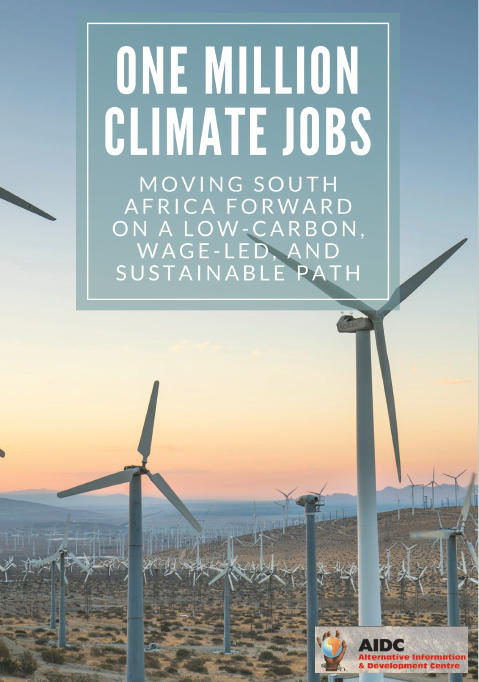
One Million Climate Jobs: Moving South Africa Forward on a Low-Carbon, Wage-Led, and Sustainable Path

By Brian Ashley, et. al. - One Million Climate Jobs - December 2016

The One Million Climate Jobs Campaign is an alliance of labour, social movements and popular organisations in South Africa that is campaigning for the creation of a million climate jobs as part of a collective approach to the crisis of unemployment and climate change. The Campaign was launched in 2011 and since then has been mobilising thousands of South Africans around real solutions to slowing down climate change, protecting the natural environment, improving the quality of life for all and moving towards a sustainable development path. Climate change will exacerbate inequality and poverty because it reduces access to food, water, energy and housing. Thus it is vital that social justice struggles around these issues incorporate struggles around climate change.

This booklet is a follow-up, six years later, to the first booklet that was produced in 2011. It is based on well- researched solutions for how South Africa can immediately begin a just transition, away from the Minerals-Energy Complex that continues to dominate the South African capitalist economy, to a low carbon economy in which the basic needs of communities are met in an equitable, sustainable and affordable way.

It recognizes that in these six years there have been many developments – for instance, renewable energy is now firmly established as part of the energy mix (although still a minor part); retrofitting buildings, and the development of environmentally friendly construction methods, is being developed, and the Rapid Bus Transit system is being slowly implemented in some municipalities.

But most of these solutions are being pursued within the logic of the market. It is not possible, we would argue, within these market parameters, to respond adequately to the enormous challenges facing us – what is needed is a publicly-driven solution for the shift to a sustainable, low-carbon future. The research that this booklet is based on begins to set out what such a transition could look like. We hope that it will be an important contribution to the ongoing work of building a political movement to struggle around these issues.

Download (PDF).

Food Sovereignty: A Strategy for Environmental Justice

By David Barkin - Climate and Capitalism, November 11, 2016

ABSTRACT:

Dominant approaches to rural development have proven unable to confront the structural challenges posed by a system where progress itself generates hunger and increasing environmental damage.

This article places its accent on the direct action of communities to organize themselves to satisfy their food and other basic needs and those of their regions with self-help strategies that could be applied in both rural and urban areas.

While generally applicable, this focus draws its inspiration from the experience of La Via Campesina, the largest social organization in the world, with chapters in more than 80 countries and 200 million members.

The food sovereignty approach offers a forward-looking strategy to social mobilization, confronting the scourge of rural disintegration while also addressing the pressing issue of environmental balance.

It proposes to direct political and social actions to the collective organization of communities to promote local mobilization and cooperation within and among communities, on a regional as well as on a much broader geographic scale.

It functions by integrating experts into a well-proven farmer-to-farmer approach for the exchange of information and materials conducive to improving productivity and promoting diversity in accordance with local customs while also creating possibilities for improving the quality of foods being produced and their nutritional impact.

Most organizations promoting food sovereignty consider agroecology to be the most effective approach to organizing production, emphasizing the use of locally available inputs and technologies as well as a diversity of cropping system adapted to local conditions.

New Report from Fair World Project Evaluates Certification Programs that Seek to Ensure Transparency and Integrity of Working Conditions for Farmworkers

By Api Podder - MySocialGoodNews, October 25, 2016

Leading Advocacy Group Evaluates Impact and Effectiveness of Seven Certification Programs in the Interest of Farmworker Justice

Press Release – PORTLAND, ORFair World Project, a project of the Organic Consumers Association, the nation’s largest network of green and ethical consumers, has released a new report titled, Justice in the Fields: A report on the Role of Farmworker Justice Certification and an Evaluation of the Effectiveness of Seven Labels. The new report evaluates seven certification programs that consumer brands use to provide a level of transparency to consumers on the social impact of their supply chain on workers. The findings in the report are based on the criteria farms must meet, how these standards are enforced and what role farmworkers and their representatives play in both program development and on-farm enforcement.

To read the Justice in the Fields report, go to: http://fairworldproject.org/campaigns/farmworker-justice/

The report details the realities of agricultural work globally: it’s difficult, dangerous, and can be poorly compensated. Farmworkers are often excluded from laws that protect other workers and even when they are included, the laws are often not well enforced. Labor unions can provide the function of negotiating better pay and conditions on behalf of workers they represent, but in reality union membership on farms is low, in part because of anti-union organizing. The report illuminates how, in recent years, certification programs have stepped in to fill the void and ensure justice and fair treatment for farmworkers on farms.

“It is tempting to see certification as a silver bullet,” says Kerstin Lindgren, Campaign Director of Fair World Project, “but any certification is only as good as its standards and enforcement mechanisms. Ultimately, any good program empowers farmworkers and works together with existing regulations and unions to strengthen their voice.”

Of the seven certification labels evaluated in the report, Fair World Project strongly recommends two of them: Agricultural Justice Project’s Food Justice Certified and Coalition of Immokalee Workers’ Fair Food Program. Two others are recommended with qualifications: Equitable Food Initiative’s Responsible Grown, Farmworker Assured, and Fairtrade International’s Fairtrade Certified.

“At their best, certification labels can raise the bar for worker justice on farms and lead consumers to purchase products that empower farmworkers,” said Dana Geffner, Executive Director of Fair World Project. “But conscious consumerism is just a small part of what’s needed—we hope that this report can inform and inspire people to engage in activism on behalf of all the people who grow our food, whether they work on a certified farm or not,” continues Geffner.

Berry Pickers’ Win Could Result in Better Conditions for Many Farmworkers

By Elizabeth Grossman - CivilEats, October 10, 2016

For over three years, the workers at Sakuma Brothers farms in Burlington, Washington have been calling for a boycott. The farm supplies strawberries, raspberries, blueberries, and more to Driscoll’s, the largest berry distributor in the world, and over the years, the workers have complained of inconsistent, piecemeal wages (that dipped below minimum wage), poor housing conditions, and the absence of paid break time.

Now, the workers have reached an important milestone: In September, they voted to be represented by Familias Unidas por la Justicia (FUJ), the first farmworker union led by workers who are indigenous to Central America. And they’ve called off the boycott for now. “This win ushers in a new era for farmworker justice internationally,” said FUJ in a statement.

Washington is the number one state in red raspberry production, number two in blueberry production, and number five in strawberries in the nation. Skagit County, where Sakuma Brothers is located, is Washington’s top strawberry producer. That crop is worth about $20 million annually. What happens in those berry fields is big business; the U.S. ranks number one in world blueberry production and number three for raspberries. Undoubtedly, labor relations in this industry can have a worldwide impact.

As FUJ spokesperson Maru Mora Villalpando told Civil Eats, “What workers wanted from day one, was to establish a process where they can negotiate directly with the management.” Now that’s what they’ll have. She also believes the group can set an example for other farms throughout the state.

“For these indigenous farmworkers, many of whom don’t speak Spanish or English, fighting for four years for the right to have a union—and winning that right—is tremendous,” said Food First executive director Eric Holt-Giménez.

Return to the Source: Guardians of Seeds Fight Monsanto and Win!

By Quincy Saul - Ecosocialist Horizons, October 12, 2016

October 29: Day of the Campesino Seed

“Nature will always prevail,” says Angel Moreno, a campesino and leader in the National Network of Popular Agroecological Schools, as he points to the grass sprouting through the sidewalk in the mountain village of Monte Carmelo in Venezuela. “But if we’re going to fight imperialism, we need seeds.”

It is October 29, 2015, the 10th anniversary of the Day of the Campesino seed, and over a thousand people from around the country and around the world have gathered in this humble village, described by the Agujero Negro media collective as “the ecosocialist capital of Venezuela.”

The people of Monte Carmelo began these gatherings in 2005, and in 2012, they hosted an international gathering from eight countries throughout Latin America. There, over multiple days of discussions and debates, they wrote the Monte Carmelo Declaration, and launched the international network of the Guardians of Seeds.

Monte Carmelo has become a center of gravity in Venezuela for the politics and practice of a movement that calls itself ecosocialist, leading a return to the land and the transcendence of the oil economy. Most big decisions in Venezuela are decided in the capital city of Caracas, but the people of Monte Carmelo and the neighboring towns are leading the way in a movement which is all at once local, national, and global – to return to the source of ancestral practices of seed saving.

This year the small farmers of Monte Carmelo once again took the lead in a struggle to fight back against the ongoing economic crisis through a program of grassroots action. “We’re in a profound food crisis globally,” said Ximena Gonzalez, an activist academic from the Venezuelan Institute of Scientific Investigations who like many others come to Monte Carmelo to participate and accompany this movement of seed savers. “We should take advantage of this conjuncture to put forward an integral plan of mobilization, legislation, and production.” And over the next several days, that is what happened.

Monsanto Facing Public Trial for Ecocide and Violation of Farmers’ Rights

By Staff - Global Justice Ecology Project, October 6, 2016

THE HAGUE – Navdanya,  the organization founded and led by Vandana Shiva, is co organizing, along with multiple civil society organizations, the Monsanto Tribunal and People’s Assembly to take place at the Hague from 14 to 16 October 2016. The Monsanto Tribunal will hold Monsanto accountable for their crimes against humanity, human rights violations and ecocide, in tandem with the People’s Assembly, a gathering of leading movements and activists working to defend our ecosystem and food sovereignty, to lay out the effects of industrial agrochemicals on our lives, our soils, our atmosphere and climate. Over 800 organizations from around the world are supporting and participating in this process while over 100 people’s assemblies and tribunals are being held across the world.

In the last century, giant agribusiness interests which came out of the war industry, have poisoned life and our ecosystem, are destroying our biodiversity and the lives of small farmers, appropriating their land, in an attempt to control and profit from these essentials for life on earth.  The risks keep increasing as these multinationals diminish in number as a result of aggressive takeovers and mega-mergers – such is the case with the recent 66 billion Bayer-Monsanto merger.  A merger which serves to further extend the control of these multinationals over agricultural and food production systems.  There is only one way to translate this process:  maximum focus on potential profit, and a minimal concern towards the environment, to the quality of our food, to consumers and to workers in the sector.

Large multinationals are lobbying democratically elected governments to take on neoliberal policies and international ‘free’ trade agreements such a TTIP and TTP:  the race towards deregulation is an unprecedented attack on biodiversity and to life itself on Earth.  Multinationals like Monsanto have already expanded their control over our seeds, our food and our freedom, depriving us of our basic human rights and our right to democracy.  With  patents and international property rights (IPRs) as their tools,  they have established monopolies and threatened the rights of farmers and consumers.

Participating at the People’s Assembly will be leading representatives of movements and associations, seed custodians, farmers and journalists from all over the world.  The aim of the Assembly is to shine the light on crimes against nature and humanity of  mega chemical and biotechnological industrial corporations which through patents on seed have opened the doors to the invasion of GMOs.  Based on the ecocide and genocide of the past century, the Assembly will lay out the necessary actions for a future based on the rights of small farmers to save and exchange seed, on self determination of food, on agroecology, the rights of consumers and workers in the sector,  on the commons and a sharing economy, as well as  on the rights of nature and a true Earth Democracy.

Pages

The Fine Print I:

Disclaimer: The views expressed on this site are not the official position of the IWW (or even the IWW’s EUC) unless otherwise indicated and do not necessarily represent the views of anyone but the author’s, nor should it be assumed that any of these authors automatically support the IWW or endorse any of its positions.

Further: the inclusion of a link on our site (other than the link to the main IWW site) does not imply endorsement by or an alliance with the IWW. These sites have been chosen by our members due to their perceived relevance to the IWW EUC and are included here for informational purposes only. If you have any suggestions or comments on any of the links included (or not included) above, please contact us.

The Fine Print II:

Fair Use Notice: The material on this site is provided for educational and informational purposes. It may contain copyrighted material the use of which has not always been specifically authorized by the copyright owner. It is being made available in an effort to advance the understanding of scientific, environmental, economic, social justice and human rights issues etc.

It is believed that this constitutes a 'fair use' of any such copyrighted material as provided for in section 107 of the US Copyright Law. In accordance with Title 17 U.S.C. Section 107, the material on this site is distributed without profit to those who have an interest in using the included information for research and educational purposes. If you wish to use copyrighted material from this site for purposes of your own that go beyond 'fair use', you must obtain permission from the copyright owner. The information on this site does not constitute legal or technical advice.