

You are here

green jobs

EcoUnionist News #111

Compiled by x344543 - IWW Environmental Unionism Caucus, July 6, 2016

The following news items feature issues, discussions, campaigns, or information potentially relevant to green unionists:

Lead Stories:

Ongoing Mobilizations:

The Thin Green Line:

Just Transition:

Bread and Roses:

Just Transition: Just What Is It?

A Joint Report by Labor Network for Sustainability and Strategic Practice - July 2016

We are now one-sixth of the way through the twenty-first century and well into the greatest economic transition ever experienced — one that will dwarf all that came before this one. This transition includes energy, creating a carbon-neutral economy, communications, manufacturing, transportation, health care, waste management, and more.

This transition has already produced road-kill with many thousands of workers thrown on the scrap heap and disintegrating communities — with no help in the offing for them. So many individuals and groups are now asking how we organize society, our economy, and our politics in such a way that our institutions serve the people, rather than capital.

The “just transition” frame is being used by an increasing number of organizing networks, grassroots organizations, groups affiliated with organized labor, and environmental organizations. This report aims to assess the notion of just transition, how it is being used, what kinds of ideas and approaches are surfacing for short and long-term strategies, and what kinds of relationships groups are developing in pursuit of a just transition. Its purpose is to open a broad and respectful discussion about the varied ways the “just transition” frame is being used, and whether they can contribute to a shared vision of how to make the transition we face a just transition.

This report is based on 17 interviews conducted between October, 2015 and March, 2016 by Christina Roessler, accompanied at times by Joe Uehlein and Richard Healey. Interviewees were offered the opportunity to revise their quotations and their revisions are included in this draft. This report represents a preliminary effort based on a limited number of interviews and a small amount of additional research. Leaders were interviewed from the following groups:

Organizing Networks

  • Climate Justice Alliance
  • GreenWave
  • National People’s Action
  • New Economy Coalition

Grassroots organizing

  • ALIGN: The Alliance for Greater New York
  • Asian Pacific Environmental Network
  • Buffalo PUSH
  • Kentuckians For The Commonwealth
  • Movement Generation

Labor

  • AFL-CIO
  • BlueGreen Alliance
  • Labor Network for Sustainability
  • Oregon AFL-CIO

Environmental

  • North Carolina League of Conservation Voters
  • Sierra Club

EcoUnionist News #110: No Coal in Oakland Prevails and other Green Union news

Compiled by x344543 - IWW Environmental Unionism Caucus, June 29, 2016

Image, right: Alameda County AFL-CIO Central Labor Council president, Josie Camacho, flanked by dozens of Bay Area union leaders and members, representing 21 Bay Area unions (including the Bay Area IWW), join in with Oakland residents to oppose coal handling, storage, shipment, and exports in the Port of Oakland at a special City Council hearing, held June 27, 2016. At the conclusion of the meeting, the City Council voted unanimously, 7-0 with one member absent, in support of the coal ban. Image by Brooke Anderson.

The following news items feature issues, discussions, campaigns, or information potentially relevant to green unionists:

Lead Stories:

Ongoing Mobilizations:

The Thin Green Line:

Just Transition:

EcoUnionist News #109

Compiled by x344543 - IWW Environmental Unionism Caucus, June 21, 2016

The following news items feature issues, discussions, campaigns, or information potentially relevant to green unionists:

Lead Stories:

Ongoing Mobilizations:

The Thin Green Line:

Just Transition:

Bread and Roses:

An Injury to One is an Injury to All:

Whistleblowers:

Just Transition: Joint Proposal of PG&E, Friends of the Earth, NRDC, IBEW Local 1245, et. al. to Retire Diablo Canyon Nuclear Power Plant

By Various - June 20, 2016

This document is an example of an actual "Just Transition" agreement hammered out through negotiations after years of organizing by environmental organizations and dialog with unions. While it's no doubt far from perfect, it still represents a starting point for similar campaigns elsewhere, and like a union contract, it's the product of negotiations following struggle. To secure better deals, the unions and ecological movements need to keep organizing and building their collective power.

Read the report (PDF).

Why work and workers matter in the environmental debate

By Caleb Goods - Green Agenda, March 19, 2016

It is not hard to imagine that the world of work is a place of deep ecological impact that will be fundamentally changed by endeavours to green the economy. The implications of climate change for all workers and employers are enormous: the International Labour Organisation (ILO) suggests that 80 per cent of Europe’s CO2 emissions come from industrial production. Thus, the world of work is a critical site of ecological harm and therefore needs to be a site of deep environmentally focused transformation. The interconnection between work and climate change has lead Professor Lipsig-Mumme to conclude, ‘[g]lobal warming is likely to be the most important force transforming work and restructuring jobs in the first half of the twenty-first century’.1 The reality is all work and industries must fundamentally change, and will be changed by the climate we are creating as we enter a new geological epoch – the Anthropocene2 Climate change is challenging the future of work in highly polluting industries, such as coal, and climate change related events are already impacting workers. For example, a 2015 heat wave in India resulted in taxi unions in Kolkata urging drivers to avoid working between 11am and 4pm to reduce the risk of heat exhaustion.

The question of how work-related environmental impacts could be reduced is urgent. It is clear that all jobs and all workplaces will need to be significantly greener to preserve a liveable planet. I am not suggesting that jobs in highly polluting fossil fuel industries can be greened, greening work will require industry restructuring and transformation, but it will demand the closing down of some industries in the medium to longer term. Thus, the transition I am referring to here, the “greening” of our economy, is a societal transformation whereby economic, social and political processes are shifted away from an economic growth imperative to an ecological feasibility focus that demands work, and all that this encompasses, is both environmentally and socially defensible.

Unfortunately, the complexity around transitioning the Australian economy and work to a greener future is currently skirted over in political discussions, and tends to be presented as a straightforward transition via environmental efficiency, greener consumer lifestyles and technologies, or overlaying broad environmental aims onto existing industries and jobs. More particularly, the challenges for workers in this transition are rarely dealt with adequately. In what follows I argue that continuing to leave workers’ concerns aside is an unacceptable option for workers, the environment, the environment movement and government.

A Climate Plan that Works for Workers

By James Hutt - Our Times, Summer 2016

For the first time in over a decade, Canada has a government that is not ideologically opposed to even talking about climate change. Instead of criminalizing environmentalists, muzzling scientists and actively lobbying on behalf of the oil industry, Trudeau has promised a new age of cooperation.
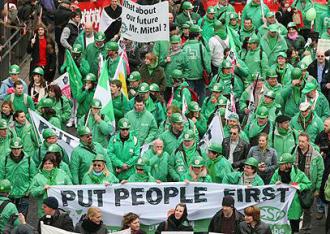
Before the election, he committed to developing a national climate strategy by the end of 2016. Last March, all 13 provincial and territorial leaders met in Vancouver to develop that framework.

As the next step, Trudeau has promised to hold countrywide consultations to give people input into the development of the strategy. This is the perfect moment for the labour movement to lead the fight for a solution that tackles unemployment and catastrophic climate change.

By tackling inequity and creating good, unionized jobs, a climate strategy could represent a giant leap forward for the labour movement — but only if we force politicians to act.

Toronto Teach-In Poses Climate Justice Alternative

By John Riddell - East End Against Line 9, June 6, 2016

The People's Climate Plan Teach-in, held in Toronto June 4,[1] took great strides forward in presenting a forceful alternative to the inadequate and deceptive climate action proposals of Canada's federal government. In the opening session, five leading climate activists presented a coherent, unified climate justice strategy, proposing effective action to save the world from climate disaster interlocked with practical measures to assist working people and the poor who are the first victims of global warming. Displayed in the meeting, held in the University of Toronto, were the banners: “Pipelines = Climate Change”; “Stop Line 9”; and (in French) “Leave Fossil Fuels in the Ground.”

After lunch, the more than 100 participants split up into training groups of half a dozen to develop skills for effective intervention in the “public consultation” meetings the Trudeau government proposes to hold over the coming three months.

People's Climate Plan

The proposed framework for this intervention is the People's Climate Plan (PCP),[2] a simple structure of three principles (or “pillars”) to guide those taking part in such gatherings.

“We've been to three of these consultations, and we know how they're organized,” PCP activists explained. “Government facilitators divide participants into small groups and then give each group a topic designed to force discussion into a channel favourable to government policy. “For example, they ask ‘How can we combine economic growth with emissions reductions?’ – implying that tar sands expansion is part of the bargain. If you accept the question on their terms, you've already lost the argument.”

If environmentalists argue at cross purposes or try to make too many different points, their voices can be sidelined and ignored. Those speaking for climate justice need to unite around a common focus and strategy. The PCP proposes three principles to assure this focus:

  • Science: keep fossil fuel reserves in the ground.
  • Economics: a rapid transition to a clean energy economy.
  • Justice: for Indigenous peoples, workers affected by the transition, and victims of climate change.

When government facilitators pose inappropriate themes, the PCP spokespersons suggested that we use an “ABC” approach:

  • A: Acknowledge the question posed by the organizers.
  • B: Bridge over to the question you wish to address, which should be aligned with one of the three PCP principles.
  • C: Provide Context to sustain your view, preferably with a personal anecdote or insight that illustrates why you care so much about the issue.

Achieving this degree of focus may seem a tall order for environmental and social activists. Often we use discussion periods to express a broad and seemingly chaotic range of personal viewpoints. We rightly prize our diversity. Yet when entering a discussion structured by a government with quite alien goals, PCP activists suggested, we must harmonize and unify our approaches.

Why Trade Unionists Should March for a Clean Energy Revolution

By Joe Uehlein - March for a Clean Energy Revolution, June 14, 2016

Labor Network for Sustainability is calling on trade unionists to go to Philadelphia to march for a  Clean Energy Revolution on Sunday, July 24. Why?

We face the reality of climate change around the world as we digest shocking new data gathered by climate scientists in just the past six months. Climate chaos is upon us and it’s far worse than anyone ever thought.

It is not evident that we, as a society, will meet this challenge.  It’s even less clear that the labor movement will rise to this challenge.  However, the transition is still happeningthe clean energy train left the station a decade ago and many are working to keep it moving.

It is time for those of us in the labor movement to rise to the challenge and become a central player in the movement to build a sustainable future for the planet and its people – not only for the survival and well-being of all but also for organized labor’s own self-interest.

Workers need jobs.  The Labor Network for Sustainability’s (LNS) report “The Clean Energy Future: Protecting the Climate, Creating Jobs, Saving Money” outlines a path to 80% greenhouse gas (GHG) reductions by 2050 while creating a lot of high quality jobs in construction and manufacturing at no new costs. It is part of our new  Climate, Jobs, and Justice Project. We consider the Clean Energy Future plan a baseline.  If we are willing to spend more money, we can achieve a lot more.

In fact, organized labor needs to develop its own, worker-friendly plan to protect the climate. Ron Blackwell, former Chief Economist at the AFL-CIO joined with Jeremy Brecher and myself to outline such a plan:  If Not Now, When? A Labor Movement Plan to Address Climate Change. It calls for a massive national program- on the scale of economic mobilization for World War II- to address income inequality and climate change.

Of course, naysayers are fond of repeating that jobs dedicated to fixing the climate aren’t “real jobs,” or good jobs with security, family-supporting wages and benefits. They also like to point out that if these jobs are real, they are mostly non-union. And this is true. We — the labor movement — really need to get busy with strategies to make climate-fixing jobs unionized and part of that is working hard to make them real.

EcoUnionist News #108

Compiled by x344543 - IWW Environmental Unionism Caucus, June 14, 2016

The following news items feature issues, discussions, campaigns, or information potentially relevant to green unionists:

Lead Stories:

Ongoing Mobilizations:

The Thin Green Line:

Just Transition:

Bread and Roses:

An Injury to One is an Injury to All:

Whistleblowers:

Pages

The Fine Print I:

Disclaimer: The views expressed on this site are not the official position of the IWW (or even the IWW’s EUC) unless otherwise indicated and do not necessarily represent the views of anyone but the author’s, nor should it be assumed that any of these authors automatically support the IWW or endorse any of its positions.

Further: the inclusion of a link on our site (other than the link to the main IWW site) does not imply endorsement by or an alliance with the IWW. These sites have been chosen by our members due to their perceived relevance to the IWW EUC and are included here for informational purposes only. If you have any suggestions or comments on any of the links included (or not included) above, please contact us.

The Fine Print II:

Fair Use Notice: The material on this site is provided for educational and informational purposes. It may contain copyrighted material the use of which has not always been specifically authorized by the copyright owner. It is being made available in an effort to advance the understanding of scientific, environmental, economic, social justice and human rights issues etc.

It is believed that this constitutes a 'fair use' of any such copyrighted material as provided for in section 107 of the US Copyright Law. In accordance with Title 17 U.S.C. Section 107, the material on this site is distributed without profit to those who have an interest in using the included information for research and educational purposes. If you wish to use copyrighted material from this site for purposes of your own that go beyond 'fair use', you must obtain permission from the copyright owner. The information on this site does not constitute legal or technical advice.
