You are here

divestment

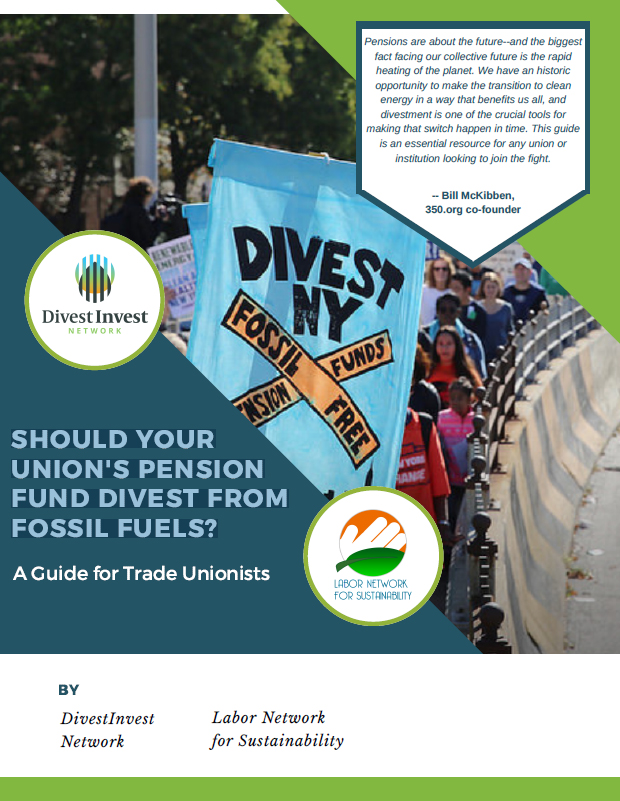
Should Your Union’s Pension Fund Divest from Fossil Fuels?

By staff - Labor Network for Sustainability, November 2018

This guide is designed to help you and your union consider whether you should divest from fossil fuels.

Working people collectively own an enormous amount of capital in our pensions. As a sector, pensions are the largest source of investment in financial holdings, even larger than standard investment houses and banks! Pensions constitute over $40 trillion! Our pension funds are invested in stocks and bonds that may not be serving our interests as working people and may be harming our families’ futures. Imagine what we might be able to support and build, imagine the great jobs we could create, if we use more of our pension funds to directly benefit our members and our families.

The Guide Contains:

  • An introduction to pension fund divestment and links to further information about it
  • Whether failure to divest can constitute a failure in fiduciary responsibility
  • How you can respond to divestment proposals and what questions need to be answered to reach a decision
  • How to start a divestment campaign yourself and answers to questions you may encounter from union members and divestment opponents

Download and Read the PDF Here.

Just cuts for fossil fuels? Supply-side carbon constraints and energy transition

By Philippe Le Billon and Berit Kristoffersen - Economy and Space, November 2018

Reducing greenhouse gas emissions has generally been approached through demand-side initiatives, yet there are increasing calls for supply-side interventions to curtail fossil fuel production. Pursuing energy transition through supply-side constraints would have major geopolitical and economic consequences. Depending on the criteria and instruments applied, supply cuts for fossil fuels could drastically reduce and reorient major financial flows and reshape the spatiality of energy production and consumption. Building on debates about just transitions and supply constraints, we provide a survey of emerging interventions targeting the supply of, rather than the demand for, fossil fuels. We articulate four theories of justice and selection criteria to prioritize cuts among fossil fuel producers, including with regard to carbon-intensity, production costs, affordability, developmental efficiency, and support for climate change action. We then examine seven major supply-constraint instruments, their effectiveness, and possible pathways to supply cuts in the coal, oil and gas sectors. We suggest that supply cuts both reflects and offers purposeful political spaces of interventions towards a 'just' transition away from fossil fuel production.

Read the text (PDF).

NYC Public Pension Funds Fossil Fuels Divestment Campaign

By Nancy Romer - Labor Network for Sustainability, November 22, 2017

New York City Public Worker Pension Funds are on the cusp of selling off or divesting from their fossil fuel stocks.  How and why are NYC workers and climate activists so intent on achieving this?  What will it mean if they win this?  First some background.

Pension Funds are the Capital of US Workers

American workers too often feel overwhelmed by the power of capitalism in general and financial corporations in particular.  We may feel we have few economic resources with which to exert our opinions and defend our needs in a system based on money.  We may want to challenge “fossil fuel capitalism” that threatens the future for our grandchildren, but how?

Most American workers do own capital in the form of their own homes and, especially, in their pension funds.  Often the pension funds are managed with the support and participation of their unions or, more specifically, their union leaders. What if union members were to look closely at our pension funds and see how we could use them to create the kind of world we want:  investments in renewable energy, public transportation, affordable housing, public education, regenerative agriculture?

As a sector, pension funds are the single largest institutional investor followed by banks, investment firms, and insurance companies (Global Pension Statistics Project, GPS).  Approximately $40 trillion was invested by pension funds in financial markets in 2015 and that gives workers much more financial punch than we realize or use.

Pensions represent deferred compensation to workers and are negotiated through contracts on behalf of union members.  The intention is to provide income during retirement years. Workers have the potential financial power through collectively using their pension funds to both protect us through financially insecure times such as these and to have an impact on the world we want to see, the world we want to leave to our children and future generations.  Too often the second part of this formula—having an impact on the world we want to see—is totally ignored.

A growing number of American workers are questioning the wisdom of keeping their hard-earned deferred income in fossil fuel holdings.   Some unions, particularly public service unions, are joining the other financial entities, like universities, faith organizations, and foundations, which have divested their funds from fossil fuel holdings. Pension funds committed to divestment comprised 12% of all divestment commitments. Globally, a full $5.2 trillion in assets has been pledged to divest from fossil fuels. [Arabella Global Divestment Report, 2016]  That’s a huge start!  We are denying funds from the fossil fuel industry, devaluing their stocks, stopping to “feed the beast”, making fossil fuel corporations pariahs, like we did with tobacco companies that caused cancer.

First U.S. City to Ban Fossil Fuel Expansion Offers Roadmap for Others

By Kevon Paynter - Yes! Magazine, February 5, 2018

On a clear July morning three years ago, dozens of environmental activists pushed their kayaks into the Willamette River in Portland while others rappelled 400 feet from the top of St. Johns Bridge in an attempt to block a Shell Oil ship and its drilling equipment from leaving the port and entering Alaskan waters.

A key piece of Shell’s arctic drilling fleet, the vessel had arrived in Portland for repairs but its departure was delayed by protesters chanting “coal, oil, gas, none shall pass!” during two days of civil disobedience that became known as Summer Heat.

By the time the vessel finally sailed, the stage had been set for what would be a yearlong battle, culminating in an ordinance that banned construction and expansion of fossil fuel infrastructure in the city.

Last month, the Oregon Court of Appeals upheld Portland’s ban as constitutional, affirming the city’s power to regulate the safety and welfare of its residents and sending a powerful signal to cities that they too can take the lead to limit fossil fuel use.

nd while the court ruling could set precedent for similar climate action elsewhere, how Portland passed the nation’s first fossil fuel infrastructure ban holds important lessons for how other communities can use grassroots activism to implement the renewable energy transition in their cities.

Think Globally, Act Locally: Bill McKibben & PERI Tell You How

By Steve Hanley  - Clean Technica, February 2, 2018

A report published January 31 by The Hill claims the budget the Trump administration will release later this month will take an ax to renewable energy funding and carbon reduction research. Specifically, its sources say the administration intends to slash the Department of Energy’s energy efficiency and renewable energy programs by a whopping 72%. In addition, the proposed budget would cut research on fuel efficient vehicles and bio-energy by 82%. Funding for solar energy technology research would suffer a 78% cut. In the process, 250 DOE employees would lose their jobs.

Sun, Sit, and Sell/Sue

Bill McKibben, author of Oil & Honey and founder of 350.org, told The Guardian on February 1 that any hope the federal government will take the lead on climate change or renewable energy was dashed by the State of the Union speech and the Democratic response. Both utterly failed to address climate change, arguably the most serious existential threat ever to humanity and all the species currently sharing the planet with us.

McKibben writes, “If we’re going to make progress on climate change, it’s not going to come through Washington DC — not any time soon. The strategy that’s been evolving for US climate action — and for action in many other parts of the planet — bypasses the central governments as much as possible. That’s because the oil industry is strongest in national capitols — that’s where its money is most toxically powerful. But if frontal attack is therefore hard, its flanks are wide open.”

Channeling Timothy Leary, the 60s era counterculture guru who told us all to “Turn On, Tune In, Drop Out,” McKibben has a three part prescription for what we as individuals can do to move toward a renewable energy future without fossil fuels and carbon emissions. He calls it Sun, Sit, and Sell/Sue and it works like this.

Sun: “The first — joining in work pioneered by groups like the Sierra Club — is to persuade towns, cities, counties, and states to pledge to make the transition to 100% renewable energy. This is now easy and affordable enough that it doesn’t scare politicians. Cities from San Diego to Atlanta have joined in, and they will help maintain the momentum towards clean energy that the Trump administration is trying so hard to blunt.”

Sit: “Job two is to block new fossil fuel infrastructure. In some places, that will be by law. Portland, Oregon, recently passed a bill banning new pipes and such, over the strenuous objections of the industry. In other places it will take bodies — tens of thousands have already pledged to journey to the upper Midwest if and when TransCanada decides to build out the Keystone XL pipeline that Trump has permitted.”

San Francisco Prepares for Historic Vote on Fossil Fuel Divestment

By Thanu Yakupitiyage and Dani Heffernan - Common Dreams, January 18, 2018

San Francisco - On January 24, the San Francisco Retirement Board will vote on a long-awaited resolution to divest San Francisco’s pension fund from fossil fuel companies.

The decision will be seen as an early indication of whether or not the fossil fuel divestment movement can build on the momentum from last week’s historic announcement that New York City would be divesting its pension funds and suing Big Oil for damages caused by climate change.

"This is a definitive moment for San Francisco in the fight for a fossil free world. As the city prepares to host a climate convening of the world's local leaders later this year, it's time to put their money where their mouth is,” said May Boeve, Executive Director of 350.org. “Tackling the climate crisis means that cities everywhere will need to stand up to the fossil fuel industry, specially when federal leaders are slow to act. By divesting their more than $20 billion pension fund from fossil fuels, the City by the Bay will show Big Oil billionaires and communities around the globe that they're serious about real climate action."

Since the campaign launch six years ago, the fossil fuel divestment movement has succeeded in securing commitments from over 800 institutions in over 77 countries representing more than $6 trillion in assets.

In San Francisco, it’s been a long path to next week’s vote. The San Francisco Board of Supervisors voted to endorse fossil fuel divestment in April 2013. Last December, hours before he passed away, Mayor Ed Lee published a piece in Medium endorsing divestment, writing, “By taking the bold step to divest from fossil fuel assets, we are once again taking a strong stand on the essential issue of the environment.”

Meanwhile, many Bay Area institutions have been at the forefront of the divestment campaign. San Francisco State University became the first community college district in the nation to divest from fossil fuels. In the South Bay, the Santa Clara Valley Water District became the first such entity to make a commitment, while Stanford University made an early commitment to divest from coal in 2014.

Divestment has proved an effective tool to help stigmatize the fossil fuel industry and increase investor worries that as the world moves towards renewable energy, coal, oil and gas reserves could become “stranded assets” and drive down the share price of fossil fuel companies. A report from the University of Michigan concluded that the divestment campaign has successfully shifted the conversation around fossil fuels and institutional responsibility to act on climate.

According to many investment advisors and financial experts divesting from fossil fuels poses no significant risk to the portfolio performance. In fact, many are now arguing that as fossil fuel companies become an increasingly risky bet, divestment may be safer than holding onto coal, oil and gas stocks.

"The time to divest from all fossil fuels is now. Our pension board needs to listen to city workers and union members who have testified, written letters, and, presented the facts on the fossil fuel industry for years. SEIU 1021, that counts over 54,000 members in Northern California, publicly supports total divestment,” said Martha Hawthorne, retired RN from the Department of Public Health. “Our hard work built this pension system and we want an end to investments in a system of life killing extraction that endangers our future. We know climate crisis is upon us. This is evident by the drought, record pollution, extreme heat, catastrophic fires and deadly mudslides in just the last few months. We are in a race against time. Divestment is a clear way for San Francisco's pension board to make a difference now."

The nation’s largest environmental groups, notable figures such as Nobel Peace Prize Winner Desmond Tutu and former UN Secretary General Ban Ki-Moon, have all endorsed fossil fuel divestment as a key strategy in fighting climate change.

On January 24, San Francisco has the opportunity to take a bold step forward by announcing that it will join New York City and institutions around the world by divesting from fossil fuels.

Was 2017 the year that the tide finally turned against fossil fuel projects?

By Suzanne Dhaliwal - Open Democracy, December 21, 2017

Last week AXA announced its sell off of €700m of tar sands investments from its balance sheets, covering 25 tar sands companies and 3 major pipelines projects. Thomas Buberl, the company’s chief executive, called the projects “not sustainable and therefore also not insurable.”

This was a significant win for activists like the UK Tar Sands Network and the Indigenous Environmental Network, who have been calling on financial institutions to end investments in the tar sands projects and pipelines since 2009, and who have most recently taken their campaigning efforts to the insurance industry.

The AXA decision comes just weeks after BNP Paribas broke the news that it will no longer finance new shale or tar sands projects, nor work with companies that mainly focus on those resources. Last Friday, Norway’s largest life insurer, KLP announced that it would exclude from its portfolio any firms that derive 30 percent or more of revenues from the extraction of tar sands. In the same week the World Bank announced it would cease financing upstream oil and gas after 2019.

It’s welcome news. Based on the financial risks, climate impacts and indigenous rights violations, we have seen a significant shift in financial institutions backing fossil fuels. The Bank of England now recognizes the monetary risks associated with climate change and is advising the central banks and governments to get out of highly polluting fuels due to the pending carbon bubble and the bad business associated with ‘extreme’ energy extraction. As a result BP, Shell, Exxon and others have pulled out of major tar sands projects and pipelines.

And now the insurance industry is beginning to act more meaningfully. As early as the 1970s, the insurance industry acknowledged the risk of climate change and the need for the sector to take meaningful action. Insurers have already seen the costs of climate related catastrophes and extreme weather events skyrocket, compelling them to be among some of the first movers divesting from coal and also develop policies to stop the underwriting of new fossil fuel projects. But they have massive holdings in fossil fuels. And so they need public pressure to push them to divest.

So despite last week’s news, we must be careful not to pop those champagne corks too fast. Significant action and commitment has yet to be seen by Asian and American insurers. Moreover, regenerative steps need to be taken to ensure that the communities whose livelihoods depend on fossil fuels benefit from the transition to the clean energy economy. Simply put, who will be responsible for the massive clean-ups of stranded projects and direct the green energy transition?

Trade unions in the UK engagement with climate change

By Catherine Hookes - Campaign against Climate Change Trade Union Group, August 15, 2017

Despite being faced with many immediate battles to fight, it is to the credit of many trade unions that they are also addressing the long term wellbeing of their members, and of future generations, by introducing policies to tackle climate change. A new report providing the first ever overview of the climate change policies of 17 major UK trade unions could help raise wider awareness of this important work.

The author, Catherine Hookes, is studying for a masters degree at Lund University, Sweden, and her research drew on a comprehensive web review of policies in these unions, going into more depth for many of the unions, interviewing key figures and activists. The research was facilitated by the Campaign against Climate Change.

For anyone within the trade union movement concerned about climate change (or for campaigners wishing to engage with trade unions on these issues) this report is of practical use in understanding the context, the diversity of different trade unions' approaches, and the progress that has been made in the campaign for a just transition to a low carbon economy.

While every attempt was made to ensure the report is comprehensive, and accurately reflects union positions, there are clearly controversies and different viewpoints over issues such as fracking and aviation. Trade unions with members in carbon intensive industries will always have a challenging task in addressing climate change, but their engagement in this issue is vital. And, of course, this is a rapidly changing field. It is very encouraging that since the report was written, Unison has voted to campaign for pension fund divestment. This is an important step in making local authority pension funds secure from the risk (both financial and moral) of fossil fuel investment.

Anyone attending TUC congress this September is welcome to join us at our fringe meeting, 'Another world is possible: jobs and a safe climate', to take part in the ongoing discussion on the role of trade unions in tackling climate change.

Read the text (PDF).

Ecologist Special Report: Divesting from investment in fossil fuels gains momentum in the UK

By Remo Bebié, Finance Dialogue - Ecologist, May 15, 2017

Bill McKibben, Author and co-founder of 350.org is categoric that one of the key ways to tackle climate change is through financial channels: "There is no question we are currently in a state of emergency on climate change. Day in day out people are dying from the effects of climate change. There are many ways to confront this emergency and divestment allows us to get in the way of the money financing the fossil fuel projects behind this crisis.

"The fact that the fossil fuel divestment movement has grown exponentially in the last few years is the best news ever. From the Pacific Islands to South Africa, from the United States to Germany, people are standing up and challenging the power of the fossil fuel industry."

And in the UK too, the divestment movement is now gathering momentum.

Only last week, 50 MPs announced their backing of a campaign calling on parliament's £612m pension fund to divest from fossil fuels.

Faith groups too are also increasingly moving out of fossil fuel investments. Earlier this month, more than a quarter of Britain's Quaker meetings pledged to divest and the Catholic Church is also taking stand ("the Catholic fossil fuel divestment movement has gained further momentum as nine more institutions pull out of fossil fuels, citing a "political impasse" around US withdrawal from the Paris Agreement." )

In late January, the Irish Parliament voted in favour of a law requiring the country's £6.8 billion Ireland Strategic Investment Fund to divest from all fossil fuels over the next five years. The story went viral on social media.

Three weeks ago, Norway's largest private pension fund, Storebrand, launched two new fossil free funds, bringing their fossil free fund portfolio to $1.2 billion. Storebrand also warned that the Norwegian government is overly exposed to fossil fuels through its $900 billion sovereign wealth fund, even though it has already taken significant steps to reduce exposure in the past.

Momentum is gathering at such a speed in the UK it appears to be approaching a tipping point: Waltham Forest and Southwark, two local government pension schemes for boroughs in London, have pledged to fully divest from fossil fuels within the last year, while Hackney's pension fund committed to cut its exposure by 50 percent, as the FT reported recently. Among the UK's Local Government Pension Schemes, these three are on the smaller range, each managing assets between £0.74 and £1.26 billion.  

But examples also include the £2.73 billion Environment Agency's Pension Fund, which is currently ranked second in the Asset Owner Disclosure Project's 2017 ranking (first in 2016) among the world's 500 largest asset owners. The fund is widely considered a global leader in terms of aligning investment strategies with the goals called for in the Paris agreement and reducing financial risks associated with the energy transition.

UK workplace pension scheme NEST, already progressive in terms of integration of Environment, Social and Governance (ESG) issues, has recently added a specific climate tilted fund to it's portfolio. NEST cited "addressing risks and capturing opportunities associated with the move to fight climate change" as reasons for launching the fund. 

Private institutions are taking note too: Last fall, HSBC Bank UK Pension Scheme chose a new climate tilted fund as the equity default option for its £2.6 billion defined contribution (DC) scheme. The scheme's CIO, Mark Thompson, expects the move to deliver "better risk-adjusted return, protection against climate change risks, and a more powerful ESG engagement policy within a passive mandate".

Furthermore, by April 2018, most UK local government schemes are due to be integrated into eight pools, each managing between £12 and £36 billion of pooled assets (see here for a good pooling overview by IPE). Implementation of divestment pledges for individual schemes will depend on the pool structure. The schemes of the London boroughs are already being pooled through London CIV, which recently wrote that it is "focusing on investment strategies the pension fund authorities have shown most demand for, namely: global equity income; sustainable equities; emerging markets and value strategies." 

Many other pools are now in the process of hiring executives: Brunel, the pool which contains the Environment Agency's Pension Fund, and LGPS Central have named new chairs within the last month. The London Pension Fund Authority (LPFA) is currently "seeking to recruit additional Board Members with knowledge and experience of either: 1) Environmental Social and Corporate Governance issues in a pension fund, with a strong commitment to delivering divestment from fossil fuels; or 2) strategic and sustainable infrastructure investment by pension funds, with a breadth of experience across all forms of infrastructure investment." 

All this indicates that more activity may be expected from the UK's public and private institutional investors. And public pressure is rising as well as various UK local government pension schemes are engaged by campaigners as part of the Global Divestment Mobilisation (GDM) with calls for fossil fuel divestment (see here for complete list of LGPS engagements within the Mobilisation).

Council Nurses Urge San Francisco To Divest from DAPL

By staff - California Nurses Association, March 15, 2017

Nurses from the San Francisco (SF) Metro Council attended an SF Board of Supervisors meeting to urge the city to divest from any banks and financial institutions who have investments in the Dakota Access Pipeline. The SF Metro Council nurses joined other activists present from the SF NoDAPL Coalition.

After 5 1/2 hours of other agenda items and public comment, The Board of Supervisors voted unanimously to pass the resolution to direct the treasurer/tax collector to update the social responsibility investment matrix to include a screen for all DAPL related investments.  This is a significant victory for our ongoing fight to get San Francisco to fully divest from DAPL and pull out their $10 billion from Bank of America.

Kaiser SF RN, Julilynn Carter spoke during public comment about her role as a nurse and how nurses care about public health and the impact climate change has had on public welfare. She also spoke about our collective need to recognize indigenous rights.

Pages

The Fine Print I:

Disclaimer: The views expressed on this site are not the official position of the IWW (or even the IWW’s EUC) unless otherwise indicated and do not necessarily represent the views of anyone but the author’s, nor should it be assumed that any of these authors automatically support the IWW or endorse any of its positions.

Further: the inclusion of a link on our site (other than the link to the main IWW site) does not imply endorsement by or an alliance with the IWW. These sites have been chosen by our members due to their perceived relevance to the IWW EUC and are included here for informational purposes only. If you have any suggestions or comments on any of the links included (or not included) above, please contact us.

The Fine Print II:

Fair Use Notice: The material on this site is provided for educational and informational purposes. It may contain copyrighted material the use of which has not always been specifically authorized by the copyright owner. It is being made available in an effort to advance the understanding of scientific, environmental, economic, social justice and human rights issues etc.

It is believed that this constitutes a 'fair use' of any such copyrighted material as provided for in section 107 of the US Copyright Law. In accordance with Title 17 U.S.C. Section 107, the material on this site is distributed without profit to those who have an interest in using the included information for research and educational purposes. If you wish to use copyrighted material from this site for purposes of your own that go beyond 'fair use', you must obtain permission from the copyright owner. The information on this site does not constitute legal or technical advice.