You are here

decarbonization

Trade Union Papers and Positions

By staff - European Trade Union Institute, June 14, 2022

IndustriAll policy brief on the energy crisis

In a policy brief, IndustriAll union analyses the causes and effects of the recent energy price increases with a thorough criticism of the response measures being taken at the EU level. The policy brief notes that the observed rise in energy prices in the EU in 2021 was mainly driven by price developments in EU and international commodity markets, while the gas price on wholesale markets has reached unprecedented levels. It also adds that the impact of the commodity price increase on electricity goes beyond the share of the related commodities in the power generation due to the applied price-setting mechanism. This means that an electricity mix made of a majority of decarbonised sources, but requiring fossil-based sources to ensure part of its supply, is also exposed to the price increase of fossil-based electricity. Europe`s structural dependence on energy imports has even increased in the last decades, as in 2019, 61% of its gross energy consumption relied on imported energy products. IndustriAll also points to the investment challenge the EU is facing: beyond the electricity grid investment needs, reaching the EU 2030 emission reduction target would require €438 bn of additional annual investment, equivalent to 2.7-3% of GDP, while current investment commitments are massively falling short of this. The paper also claims that, not least due to market liberalisation, the EU has a fragmented energy supply chain where final consumers bear risk. An overview is provided about the response measures member states have undertaken to alleviate the effect of the price increases on consumers, from the temporary reduction of energy-related taxes and levies to handouts and `energy cheques`. The EU has recently published a toolbox to tackle energy prices. This document lists the initiatives that Member States can implement within the framework of the EU Energy and Single Market rules. Compensation measures and direct support for poor end-users, safeguards against disconnections, tax reductions, reform of the renewable support schemes, and the provision of state aid to companies and industries are among the most important recommendations to Member States.

IndustriAll argues that while reaching climate neutrality must remain the EU’s main objective, the current geopolitical situation and its impact on energy supplies and costs demand the mobilisation of all available means to secure affordable energy for all in the coming months.

IndustriAll Just Transition Manifesto

IndustriAll Europe launched a Just Transition Manifesto as the measures of the Fit for 55 package that implement European Green Deal objectives are taking their final shape. The union stresses that 25 million industrial workers in Europe potentially face restructuring and job losses due to the green transformation - exacerbated by the COVID-19 crisis, digitalisation, trade and market developments and a volatile geopolitical situation.

The manifesto is calling to policymakers Europe to ensure a transition to a green economy that is fair and just to ALL workers, and that does not destroy but preserves and creates good quality jobs. It speaks out for a transition that is anticipated, managed and negotiated with workers for every aspect that concerns them. For achieving this, the union demands a comprehensive Just Transition framework that provides guarantees for adequate resources, is based on effective policy planning, promotes and strengthen workers’ rights, and involves trade unions through intense social dialogue. 

The main demands of the manifesto are:

  • An industrial policy fit for ambitious climate goals and good quality jobs.
  • Adequate resources to fund the transition.
  • Stronger collective bargaining and social dialogue to negotiate the transitions.
  • A toolbox of workers’ rights and companies’ duties to anticipate and shape the change.
  • Tackling new skills needs and a right to quality training and life-long learning for every worker to support the Just Transition.

TUC Cost of Living Demo: Nationalise to De-Carbonise Energy and Transport

By various - London Green Left Blog and Red Green Labor, June 10, 2022

This is the text of Ecosocialist Alliance leaflet which will be circulated on the TUC demo on Saturday18 June, 11am start, Portland Place, London, W1. Come along and support us if you can, look out for the banner pictured above. Ecosocialism not Extinction!

The media is full of headlines about crises: cost of living, energy prices, health and social care, pandemics - and, less frequently, climate collapse. Mainstream politicians see these as separate crises, while ecosocialists recognise these are interrelated crises of the capitalist system itself.

Insulate Britain activists have been jailed for trying to get the Westminster government to begin a massive programme to insulate homes and Just Stop Oil activists also face jail for their protests outside the Kingsbury oil depot.

Simple measures like insulation and renewable energy would take millions of people out of fuel poverty and would greatly reduce the numbers dying each year because they cannot afford to heat their homes. Britain has the worst record in Europe for this: in 2020, fuel poverty charities estimated such deaths as around 10,000 a year.

Government funded insulation programmes, combined with putting taxpayers' money into renewable energy, would greatly reduce our carbon emissions as well as create thousands of good green jobs.. In addition, our reliance on the profiteering and polluting fossilfuel giants – posting record profits, while continuing to drive the climate and ecological crises – would be massively reduced.

The Tories' record is appalling with millions of working families living below the poverty line. The hike in energy prices will see well over 25% of UK households – 15m people – in fuel poverty. Johnson and Sunak’s subsidies and rebates barely touch the sides.

The British government gives the fossil fuel industry £10 billion a year in tax breaks and subsidies.

The Tories finally bowed to pressure for a windfall tax on dirty fuel producers but we would go much further. All subsidies to oil and gas companies must end now and be switched to renewables. We must take energy companies and road and rail infrastructure into public ownership and rapidly de-carbonise the whole economy. We stand for a rapid ecosocialist transition led by, and in the interests of, working people.

Ecosocialist Alliance is a network of organisations and individuals. We campaign for ecosocialist and ecofeminist solutions to the multiple crises of the system. We are internationalist: the climate crisis will not be solved by any one country, but by collective global action.

We stand firmly with the global south in seeking ecological and social justice.

We reject green capitalist “solutions”, which are unworkable under a capitalist system of infinite growth and accumulation. The planet will only be saved by disposing of this system and replacing it with ecosocialism.

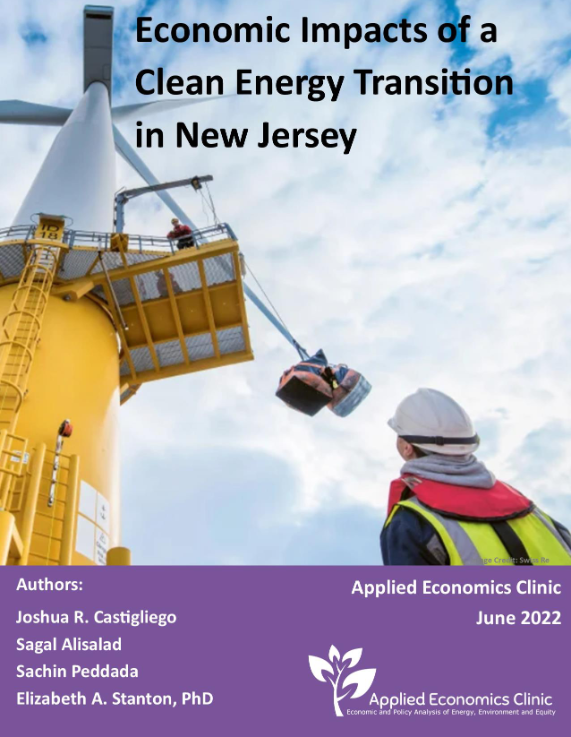
Economic Impacts of a Clean Energy Transition in New Jersey

By Joshua R. Castigliego, Sagal Alisalad, Sachin Peddada, and Liz Stanton, PhD - Applied Economics Clinic, June 7, 2022

Researcher Joshua Castigliego, Assistant Researchers Sagal Alisalad and Sachin Peddada, and Senior Economist Liz Stanton, PhD prepared a report on the economic impacts associated with a clean energy transition in New Jersey that aims to achieve the State’s climate and energy goals in the coming decades. AEC staff find that adding in-state renewables and storage, and electrifying transportation and buildings creates additional job opportunities, while also bolstering the state’s economy. From 2025 to 2050, AEC estimates that New Jersey’s clean energy transition will result in almost 300,000 more “job-years” (an average of about 11,000 jobs per year) than would be created without it. AEC also identifies a variety of additional benefits of a clean energy transition, including several benefits that are conditional on the design and implementation of the transition.

In a companion publication to this report—Barriers and Opportunities for Green Jobs in New Jersey—AEC discusses equity, diversity and inclusion in New Jersey’s clean energy sector along with barriers that impede equitable representation in New Jersey’s green jobs.

Download a copy of this publication here (PDF).

Barriers and Opportunities for Green Jobs in New Jersey

By Bryndis Woods, PhD, Joshua R. Castigliego, Elisabeth Seliga, Sachin Peddada, Tanya Stasio, PhD, and Liz Stanton, PhD - Applied Economics Clinic, June 7, 2022

Senior Researcher Bryndis Woods, PhD, Researcher Joshua Castigliego, Assistant Researchers Elisabeth Seliga and Sachin Peddada, Researcher Tanya Stasio, PhD, and Senior Economist Liz Stanton, PhD prepared a report that assesses New Jersey’s current clean energy workforce, identifies barriers to green jobs that impede access to—and equitable representation within—the clean energy sector, and provides recommendations regarding how the State of New Jersey can shape policy and regulations to enhance the equity, diversity and inclusion of its clean energy jobs. AEC staff find that there are important barriers to green jobs that reinforce existing inequities in New Jersey’s clean energy workforce, including: educational/experience barriers, logistical barriers, equitable access barriers, and institutional barriers. Achieving a future of clean energy jobs in New Jersey that is diverse, equitable and inclusive will require overcoming barriers to green jobs with intentional efforts targeted at marginalized and underrepresented groups, such as racial/ethnic minorities, women, low-income households, and people with limited English proficiency.

In a companion publication to this report—Economic Impacts of a Clean Energy Transition in New Jersey—AEC assesses the job and other economic impacts associated with achieving a clean energy transition in New Jersey over the next few decades. 

Download a copy of this publication here (PDF).

Labour movement agendas in conflict over decarbonisation pathways

By Les Levidow - Greener Jobs Alliance, June 7, 2022

The Just Transition concept has sought to avoid socially unjust means and consequences of a low-carbon transition. Alternatives could provide the basis for a common agenda of the labour movement. Yet trade unions have had divergent perspectives on decarbonisation pathways, especially as regards the potential role of technological solutions. 

Such conflict has focused on Carbon Capture & Storage (CCS). This is favourably called ‘carbon abatement’ or pejoratively called a ‘technofix’. As one reason for US trade-unions supporting CCS and thus the fossil fuel industry, often they have achieved relatively greater job security and wages there; such gains may seem jeopardised by substituting renewable energy.

UK CCS agendas focus on the prospect to decarbonise natural gas into hydrogen. This agenda unites the UK ‘energy unions’ with their members’ employers, as a cross-class alliance for a CCS fix. From a critical perspective, this seeks to accumulate capital by perpetuating natural gas, while undermining or delaying its renewable competitors.

Trade-union divergences have arisen in many ways. For a Just Transition, ITUC has advocated phasing out ‘unabated coal’, implying that coal with CCS could continue indefinitely. In the name of climate justice, the TUC has advocated CCS as a means to continue fossil fuels within a ‘balanced energy’ policy. By contrast, according to the PCS, CCS ‘is not yet a proven technology at scale’, and we don’t have the luxury to wait; it counterposes a strategy of energy democracy.

Such political divergences within the labour movement have arisen around Just Transition proposals at TUC conferences, likewise around agendas for a Green New Deal. In 2019 these were promoted within the US Democratic Party and UK Labour Party. Both underwent internal conflicts over decarbonisation pathways, expressing conflicts within the labour movement. 

Decarbonizing energy intensive industries: what are the risks and opportunities for jobs?

Multiplying Labor's Power

For a Living Wage and a Habitable Planet, We Need Climate Jobs Programs

By Paul Prescod - Jacobin, June 2, 2022

Climate and labor activists are coming together to hammer out ambitious but realistic plans for massively expanding the clean-energy sector in a way that also creates good union jobs. For both paychecks and the planet, it’s the only path forward.

The stalling of President Joe Biden’s “Build Back Better” agenda raises serious concerns for those looking to the federal government for strong action on climate change. Much of the more ambitious climate-related aspects of the legislation have already been gutted — and the fact that it still can’t pass a Congress with a Democratic majority is a worrying sign for the future.

But despite the dysfunction at the federal level, there are encouraging developments occurring at the state level. Increasingly, climate and labor activists are coming together to hammer out ambitious but realistic plans for massively expanding the clean-energy sector in a way that creates family-sustaining union jobs.

These state-based efforts are often facilitated by the Climate Jobs National Resource Center. States like New York, Connecticut and Maine have managed to get real buy-in from the building trades on a vision that defies the false jobs versus environment dichotomy. Recently, the Illinois legislature passed landmark climate legislation that puts the state on a path to reaching 100 percent clean energy by 2050, all with the full support of the Illinois AFL-CIO.

Rhode Island has now joined the party. Earlier this year Climate Jobs Rhode Island, a broad labor-environmental coalition, released a report titled “Building a Just Transition for a Resilient Future: A Climate Jobs Program for Rhode Island.” The report, compiled in partnership with the Worker Institute at Cornell, takes a comprehensive approach to limiting carbon emissions — containing recommendations on retrofits, public transportation, renewable energy, and climate resilience.

The Rhode Island initiative is a good model for activists in other states to consider. In addition to meaningfully addressing climate change, there’s no doubt that this program would result in the creation of tens of thousands union jobs. It points the way forward for both the climate and labor movements, which must join together in order for the working class to have any hope of a sustainable future.

A Child Shall Lead Them: to Heat Pumps for Europe

By staff - Labor Network for Sustainability, June 2022

While the Russian military continues to devastate Ukraine and the US sends billions for military aid to Ukraine, European countries continue to support the Russian war effort by purchasing Russian oil and gas. Meanwhile, fossil fuel companies reap a bonanza on shortages that are impoverishing American consumers at the gasoline pump. And even as climate catastrophe is causing still more devastating heatwaves, droughts, and floods those companies are planning to expand fossil fuel production to exploit the Ukraine crisis still more.

Why not starve the Russian war machine by a crash program to replace fossil fuels with renewable energy? Among those asking that question is Lillian Fortuna, an 11-year-old activist who started this petition to President Joe Biden:

Dear President Biden:

Right now your administration is taking advice from big fossil fuel companies regarding what to do about Europe’s dependency on Russian oil and gas. These companies want to increase production of natural gas here and ship it to Europe as a replacement for Russian gas, which, surprise, happens to be enormously profitable for them. Sadly, your administration has granted more drilling leases than the Trump administration just as data has emerged showing the industry was undercounting its methane emissions by 70%. It is really surprising that you are choosing this solution instead of using this moment as an opportunity to help Europe switch to ever-cleaner electricity, which is what will really undercut Putin’s power. Environmentalist Bill McKibben has an amazing plan to do just that.

We are writing to ask you to immediately invoke the Defense Production Act to get American manufacturers to start producing electric heat pumps in quantity, so we can ship them to Europe where they can be installed in time to dramatically lessen Putin’s power.

To read and sign the full petition: https://www.change.org/p/joseph-r-biden-stop-putin-by-sending-heat-pumps-to-europe

To read Bill McKibben’s “Heat Pumps for Peace and Freedom”: https://billmckibben.substack.com/p/heat-pumps-for-peace-and-freedom?s=r

AFT and UAW Call for Electric School Buses

Pages

The Fine Print I:

Disclaimer: The views expressed on this site are not the official position of the IWW (or even the IWW’s EUC) unless otherwise indicated and do not necessarily represent the views of anyone but the author’s, nor should it be assumed that any of these authors automatically support the IWW or endorse any of its positions.

Further: the inclusion of a link on our site (other than the link to the main IWW site) does not imply endorsement by or an alliance with the IWW. These sites have been chosen by our members due to their perceived relevance to the IWW EUC and are included here for informational purposes only. If you have any suggestions or comments on any of the links included (or not included) above, please contact us.

The Fine Print II:

Fair Use Notice: The material on this site is provided for educational and informational purposes. It may contain copyrighted material the use of which has not always been specifically authorized by the copyright owner. It is being made available in an effort to advance the understanding of scientific, environmental, economic, social justice and human rights issues etc.

It is believed that this constitutes a 'fair use' of any such copyrighted material as provided for in section 107 of the US Copyright Law. In accordance with Title 17 U.S.C. Section 107, the material on this site is distributed without profit to those who have an interest in using the included information for research and educational purposes. If you wish to use copyrighted material from this site for purposes of your own that go beyond 'fair use', you must obtain permission from the copyright owner. The information on this site does not constitute legal or technical advice.