You are here

decarbonization

Justice40: Strategies and Successes

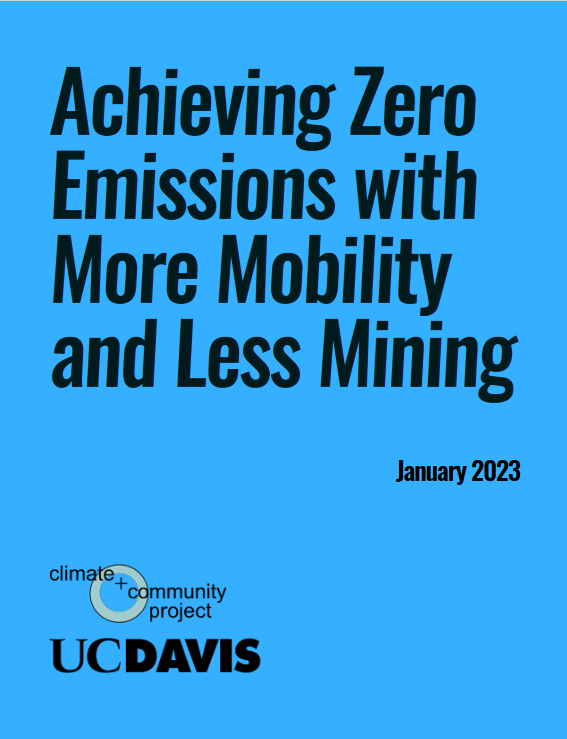
Achieving Zero Emissions with More Mobility and Less Mining

By Thea Riofrancos, Alissa Kendall, Kristi K. Dayemo, Matthew Haugen, Kira McDonald, Batul Hassan, and Margaret Slattery in partnership with the University of California, Davis - Climate and Community Project, January 2023

Transportation is the number one source of carbon emissions in the United States– making the sector crucial to decarbonize quickly to limit the climate crisis. States like New York and California banned the sale of gas cars by 2035 and the 2022 Inflation Reduction Act made major federal investments in electrifying transportation. As a result, US consumers are embracing electric vehicles (EVs), with over half of the nation’s car sales predicted to be electric by 2030. This is a critical juncture. Decisions made now will affect the speed of decarbonization and the mobility of millions. Zero emissions transportation will also see the transformation of global supply chains, with implications for climate, environmental, and Indigenous justice beyond US borders.

A crucial aspect of electrified transportation is new demand for metals, and specifically the most non-replaceable metal for EV batteries– lithium. If today's demand for EVs is projected to 2050, the lithium requirements of the US EV market alone in 2050 would require triple the amount of lithium currently produced for the entire global market. This boom in demand would be met by the expansion of mining. 

Large-scale mining entails social and environmental harm, in many cases irreversibly damaging landscapes without the consent of affected communities. As societies undertake the urgent and transformative task of building new, zero-emissions energy systems, some level of mining is necessary. But the volume of extraction is not a given. Neither is where mining takes place, who bears the social and environmental burdens, or how mining is governed. 

This report finds that the United States can achieve zero emissions transportation while limiting the amount of lithium mining necessary by reducing the car dependence of the transportation system, decreasing the size of electric vehicle batteries, and maximizing lithium recycling. Reordering the US transportation system through policy and spending shifts to prioritize public and active transit while reducing car dependency can also ensure transit equity, protect ecosystems, respect Indigenous rights, and meet the demands of global justice. 

Read the rest of the summary here.

Read the report (Link).

A Clean Energy Pathway for Southwestern Pennsylvania

By Joe Goodenbery, Eliasid Animas, and Jennifer Gorman - Ohio River Valley Institute, December 12, 2022

This report describes the development and analysis of a clean energy pathway for a 10-county region in southwestern Pennsylvania. Due to its abundance of fossil fuel resources, the region has a long history of substantial energy production, often at the expense of local environmental quality and economic diversity. A transition to clean energy provides a compelling opportunity to transform the local energy profile, while ending the region’s overreliance on fossil fuels, to reduce emissions and pursue a path of sustainable growth.

To date, the prevailing narrative for decarbonizing this region has centered around the perpetuation of the natural gas industry and costly investments in carbon capture and storage (CCS) technologies and infrastructure. Strategen’s analysis provides an alternative focused primarily on zero emissions resources, energy efficiency, increased electrification, and leveraging clean energy imports from outside the region, while minimizing the local need for fossil fuels.

Key Takeaways from this study:

  • A renewables-based pathway, including energy efficiency and clean energy imports from the PJM market, is more cost-effective than continued reliance on fossil fuels. A strategy focused on natural gas and carbon capture will be 13% more costly than the clean energy pathway, which avoids expensive investments in CCS technologies to reduce emissions, while limiting the region’s exposure to fuel price volatility and mitigating the risk of stranded fossil fuel assets.
  • In the developed decarbonization pathway, all coal plants and a significant portion of natural gas plants in the region will retire or reduce output by 2035, drastically reducing emissions going forward. A limited portion of natural gas plants may be kept online as capacity or peaking resources and to ensure reliability, though clean dispatchable resources could potentially serve this role in the future, as technology progresses.
  • The clean energy pathway results in a 97% reduction in CO₂ emissions from the power sector by 2050, leading to environmental benefits of nearly $2.7 billion annually. These benefits are greater than those associated with strategies built around natural gas and CCS, furthering the case for the clean energy pathway as a least cost option for energy transition.
  • Deep electrification of the transportation and buildings sectors can directly lower regional CO₂ emissions from these sectors by 95%. The total annual value of environmental and health benefits associated with combined reductions from the power, buildings, and transportation sectors reaches $4.2 billion in 2050, through avoided social costs.
  • Through reduced reliance on natural gas for power generation and in buildings, Strategen’s decarbonization pathway will decrease natural gas consumption by 96% and 98%, respectively, for two these sectors by 2050. Lower consumption provides an opportunity to reduce emissions associated with natural gas extraction. The value of these avoided emissions would surpass $1 billion in 2050 alone.
  • Energy efficiency is projected to increase over time, reducing regional electricity load by an average of 2.6% each year of the study period. Combined with electrification, the clean energy pathway results in overall load growth of 33% by 2050.
  • Efficiency measures not only reduce load, emissions, and the need for additional generation, but also lead to local job creation and savings for consumers. Expenditures on efficiency and resulting residential bill savings support 12,416 total jobs in 2035, and 15,353 total jobs by 2050. Compared to both power generation and fossil fuel extraction, energy efficiency has a greater potential for local economic development, leading to more, higher-paying jobs served by workers and suppliers within the region.

Download a copy of this publication here (Link).

Los Angeles Just Transition Strategy

Real Climate Solutions are No Mystery

A Zero-Carbon Future for the Aviation Sector

By staff - International Transport Workers' Federation, November 15, 2022

Aviation workers are facing the twin threats of the climate emergency and the global jobs crisis. Criticism of aviation greenhouse gas (GHG) emissions has created job-loss fears for many aviation workers. Although it is understood that decarbonisation will involve many changes, and that some jobs and functions may change, it is important to mitigate this as far as possible with long-term planning. Recent experience demonstrates how harmful short-term thinking can be. An average of 40 percent of aviation workers lost their jobs during the Covid-19 pandemic. As the industry recovers, it is now facing critical labour shortages with vast amounts of expertise being lost to the industry forever. Employment security for all workers can be built around a long-term employment road map.

An aviation jobs plan that assesses the industry’s long-term employment requirements must be completed as a matter of priority. It must model the mix of skills and number of workers required to implement decarbonisation measures. On workforce numbers, it should take into account retirement rates and also additional workforce demands that could create future employment opportunities, for example from proposed climate measures such as reducing flight distances and slower cruising speeds. The assessment must also include quantifiable equality measures that consider the specific needs of women and young workers, such as equal opportunities for career development, quality entry-level jobs and training pathways.

The assessment will also provide the basis for employment security, skills upgrading, and career development. Every effort must be taken to retain workers in their existing roles. Where this is not possible, the assessment must provide a road map for retraining workers for different roles within the industry. Where redeployment is necessary, it must come with equal levels of pay, skill levels, and trade union representation.

The results of the long-term employment assessment must be built into all industry road maps for decarbonisation. This is vital that the industry can retain the necessary skills and expertise and avoid short-term job cuts that will harm the industry’s ability to conduct the transition most effectively.

Download a copy of this publication here (PDF).

Our plan to achieve a Just Transition for seafarers: from the Maritime Just Transition Task Force

Understanding the Impacts of Hydrogen Hubs on EJ with The Equity Fund

What Is Needed For A Just Transition To Renewables?

By Carolyn Fortuna - Clean Technica, November 2, 2022

Big Oil is trying to get climate liability lawsuits moved from state to federal courts, where they believe they’d be more likely to prevail against efforts to make them pay for damaging the environment. Key communities are laying out explicit steps to help move their economies away from coal. Debates are taking place in the tech sector that analyze the social and political changes inevitable to implement renewable energy at scale. These are all dilemmas within what’s called a just transition, and it’s at the core of renewable energy activism.

In its original incarnation, a just transition pointed to workers’ rights, but, over the past few years, the concept expanded into relevance for fields beyond the labor market. A just transition is a future-oriented concept, guided by principles of sustainability and climate justice.

Unfortunately, these concepts don’t always work in concert.

What is a Just Transition, Anyway?

The transition to a clean energy economy is escalating, yet it takes thoughtful planning and robust resources. There are several dimensions to a just transition to move economies and regions away from fossil fuels and towards creating sustainable value and solving issues of climate injustice.

An opposition point of view claims that the shift to clean energy will spur gaps in well paying jobs with good benefits, loss of health insurance, reduced property values, gaps in local tax revenues, unfunded liabilities for environmental cleanup, and uncertainty around future community economic development.

Include social and political participation of affected groups: A just transition is about focusing on support for communities that bear a disproportionate burden of industrial and fossil fuel pollution. These citizens suffer tremendous health effects and are denied commensurate economic benefits. Locations where deep pockets of industrial fossil fuel pollution occur are known as “sacrifice zones,” where toxic air inflicts health problems such as asthma and high rates of cancer. They’re also typically where low income communities of color live and where institutional barriers have afflicted generations of citizens.

Assist workers in unsustainable sectors whose jobs will get lost in the economic reorganization: For many advocates, a just transition encompasses not only support for displaced fossil fuel workers and front-line communities but also a tectonic shift in the design of the economy. For example, workers who engage with toxic materials face the likelihood of illness and death, yet these provide the world with the energy and the materials it needs to recreate energy systems.

Recognize where benefits are accumulated by only a small part of relevant stakeholders: A just transition considers less wealthy countries that depend on fossil fuels for a major part of their GNI. Many advocates are calling upon wealthier nations to help countries with less total domestic and foreign input to switch to clean energy.

Create reskilling and new opportunities for workers whose jobs are lost due to restructuring: A just transition means taking an extractive economy — one that exploits workers and resources — and transforming it into a regenerative economy — one that relies on renewable resources and puts people’s well-being before profit. Just transition initiatives shift the economy from climate polluting fossil fuels to energy democracy. No longer do highways receive mass federal funding; instead, an emphasis on public transit takes place. Costs for discarding waste in landfills skyrockets as do incentives to compost and purchase compostable packaging. Ecosystem destruction halts and ecosystem restoration becomes a huge focus. All of these will create new job opportunities.

Realizing the Green Jobs Promise

By Raul Alfaro-Pelico, Charlie Bloch, Nick Pesta, and Madeline Tyson - Rocky Mountain Institute, November 2022

The switch to a carbon-free economy is the biggest economic opportunity of our era. The International Energy Agency and other analysts have predicted that this wave of market-driven innovation will create two to six “green jobs” for each fossil fuel job lost. The promised jobs are already arriving — the 2022 Annual Review by the International Labour Organization and the International Renewable Energy Agency reported that renewables alone had created more than 12 million jobs as of 2021.

But as well-researched and credible as such studies are, unfulfilled promises of prosperity have left many people skeptical about clean energy job claims, a skepticism that is commonly accompanied by the belief that the future holds less opportunity than the past. Even before COVID-19, two out of three people felt pessimistic that the gap between the rich and poor in their own country would ever improve. In fact, the U.N.’s World Social Report 2020 identifies four megatrends that are contributing to growing inequality for more than 70 percent of the global population: climate change, technological innovation, urbanization, and international migration. As a result, narrowly framing job numbers as a direct tradeoff between fossil fuel jobs lost and clean energy jobs gained risks undermining political and popular support for the clean energy transition.

A clean energy focus also misses the bigger picture of our rapidly changing global economy, obscuring the “hidden” costs and risks within our current economic system as well as the nascent opportunities embedded in a shift to a more sustainable economy. Compounding forces — pandemics and supply chain fragilities, new technologies and networked intelligence, and climate change and environmental degradation — are creating unprecedented rates of change in the global economy. Workers, communities, and companies cannot afford to ignore the big picture of what the future holds.

Read the report (Link).

Pages

The Fine Print I:

Disclaimer: The views expressed on this site are not the official position of the IWW (or even the IWW’s EUC) unless otherwise indicated and do not necessarily represent the views of anyone but the author’s, nor should it be assumed that any of these authors automatically support the IWW or endorse any of its positions.

Further: the inclusion of a link on our site (other than the link to the main IWW site) does not imply endorsement by or an alliance with the IWW. These sites have been chosen by our members due to their perceived relevance to the IWW EUC and are included here for informational purposes only. If you have any suggestions or comments on any of the links included (or not included) above, please contact us.

The Fine Print II:

Fair Use Notice: The material on this site is provided for educational and informational purposes. It may contain copyrighted material the use of which has not always been specifically authorized by the copyright owner. It is being made available in an effort to advance the understanding of scientific, environmental, economic, social justice and human rights issues etc.

It is believed that this constitutes a 'fair use' of any such copyrighted material as provided for in section 107 of the US Copyright Law. In accordance with Title 17 U.S.C. Section 107, the material on this site is distributed without profit to those who have an interest in using the included information for research and educational purposes. If you wish to use copyrighted material from this site for purposes of your own that go beyond 'fair use', you must obtain permission from the copyright owner. The information on this site does not constitute legal or technical advice.