You are here

green unionism

The Global Climate Strike: Why We Can't Wait

By Ben Manski and Jill Stein - Popular Resistance, September 24, 2014

Disclaimer: The views expressed here are not the official position of the IWW (or even the IWW’s EUC) and do not necessarily represent the views of anyone but the author’s.

The world’s capitals will not end the old economy or deliver the new one.  We can’t wait any longer because every day of waiting reduces our window for action. We need not wait because we already hold the knowledge needed for creating the new economy. And because a global climate strike can stop the machine responsible for creating the climate crisis, the most powerful person may be you.

You may think that Wall Street will change course and lead our economy in a new, climate-neutral direction. Or you may expect Washington D.C. — or Beijing, New Delhi, Brussels or Moscow — to decisively reduce greenhouse gas emissions and protect people and the planet.

If so, read no further.

But if you are unwilling to entrust your future to the money men and the political class, then consider this: Regardless of who you are, the person who holds the most power in the world to end the climate crisis may be you.

One way to guarantee an end to the climate crisis is to stop doing the things that are heating the planet. Stop  fossil fuel production and use. Stop greenhouse gas emissions. Stop rainforest devastation. And since the corporate and political capitals of the world are unwilling to stop themselves, we must stop them ourselves.

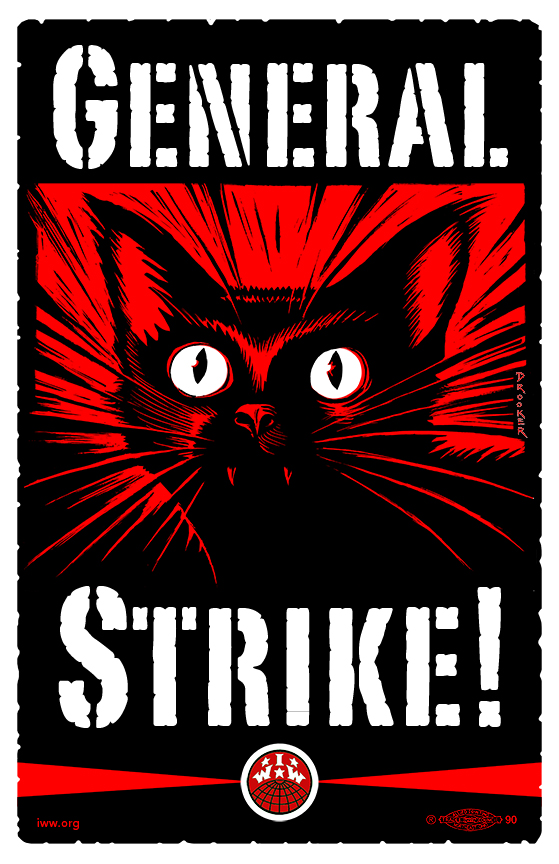
We can stop them by refusing our participation and cooperation. We can stop them by withholding our labor. By folding our arms we can halt the machine responsible for the climate crisis and create the space for the new, green economy to take root. We should go on strike.

The Greening of the Labor Movement

By Gregory N Heires - The New Crossroads, September 22, 2014

Disclaimer: The views expressed here are not the official position of the IWW (or even the IWW’s EUC) and do not necessarily represent the views of anyone but the author’s.

Thousands of union members participated in Sunday’s People’s Climate March, which is believed to be the largest demonstration by environmental activists ever to take place in the United States.

National, statewide and local unions played a big role in organizing the New York City march, and unions contributed significant resources to guarantee its success.

A New Movement?

Green activists are hopeful that the march marks the beginning of a movement that will unite a broad alliance of labor, community and traditional environmental groups dedicated to protecting the environment. Unionists who marched say the demonstration shows that the decades-old division between environmentalists and labor over the issue of jobs is finally breaking down.

“I would hope that a new movement will grow out of this,” said Jon Forster, a vice president of District Council 37, the largest public-employee union in New York City. Forster, who heads the union’s newly formed Climate Change Committee, worked with the 70 unions that helped organize the march.

“Building new community alliances is important, not only for creating jobs to but also to address social justice issues,” he said. “Climate change discriminates. Hurricane Sandy hurt the city’s minority and poor communities disproportionately.”

“This is really a class issue,” said Joshua Barnett, who works for the New York City Pubic Housing Authority. “The communities of New York City are unequally affected by asthma and pollution. The highest percentage of garbage dumps, sewage treatment plants and lead paint are in poor communities.”

Labor activists gathered for a lively rally at Broadway and 57th Street before the march kicked off in the late morning. Organizers estimated 350,000 workers, parents and children, human rights and peace advocates, youths, students, people of faith, politicians, celebrities and community activists participated the march, which filled dozens of blocks and extended over 2 miles until the demonstrators gathered between 34th and 38th streets for a block party.

Union leaders and rank-and-file members underscored how climate change is an existential issue for workers.

“Our members work and live in the coastal cities of the East of the United States,” said Hector Figueroa, who is the president of Local 32BJ, which has 145,000 members, who work in the city’s buildings as cleaners, maintenance laborers, security officers, window cleaners, building engineers and doormen. “They all are at risk with climate change.”

As noted by Figueroa, buildings account for a significant part of the city’s gas emission and electrical output. The local, an affiliate of Services Employees International Union, set up a training program for its supervisors to make the buildings they work in more environmentally friendly by conserving water and using electricity more efficiently.

Henry Garrido, an associate director of DC 37, which is an affiliate of the American State, Federation of State, County and Municipal Employees, recalled how Hurricane Sandy devastated the union’s downtown headquarters, which was closed for nine months because of damage. Many DC 37 members were among the thousands of residents displaced by the hurricane.

But while DC 37 members were direct victims of the storm, they also were on the frontlines in helping residents, Garrido said.
EMS workers tended to people injured in the storm. Members in the public hospitals evacuated patients. Social workers and clerical employees ran shelters. And mobile libraries became outposts to help residents of storm-ravaged communities charge their cell phones, learn about emergency services, and find shelter and shower facilities.

Unions Join Global Calls for Climate Change Action

By staff - International Transportworkers Federation, September 24, 2014

Disclaimer: The views expressed here are not the official position of the IWW (or even the IWW’s EUC) and do not necessarily represent the views of anyone but the author’s.

Global unions including UNI, PSI, the ITF and their affiliates were among over 650,000 people around the globe who took to the streets on 21 September to inspire world leaders to take ambitious action on climate change.

The 2,000 or so people’s climate events around the world preceded the historic UN summit on climate change in New York taking place today (23 September). The marchers and activists were demanding cuts in carbon emissions and a just transition to a green economy.

Representatives from the ITF, US affiliates including the ATU (Amalgamated Transit Union) and Teamsters, and UK affiliates including the GMB and PCS, joined some 400,000 people at the New York march, thought to be the largest climate change march in history.

David Hansen Miller, ITF strategic research, said from New York: “It was a really impressive trade union presence and an extraordinary march to witness. The events here and in Australia, London and around the world gave the marchers an unprecedented opportunity to demand a global society that works for people and the planet. We hope world leaders will act courageously.”

More than 700 ATU members at the New York march promoted public transit as one of the best and easiest ways to combat climate change.

At a fringe meeting at the ITF’s first paperless congress, in August, transport workers renewed their commitment to act on climate change and took stock of their recent actions. These included the ITF signing a memorandum of understanding with the international body of employers in public transport, which commits both parties to extend public transport in order to reduce carbon emissions and create green, decent jobs.

The ITF has launched a survey of unions on climate change and urges all affiliates to respond.  You can also view the ITF’s climate change video.

They Go Wild, Simply Wild, Over Me!

By x344543 - IWW Environmental Unionism Caucus, September 25, 2014

Disclaimer: The views expressed here are not the official position of the IWW (or even the IWW’s EUC) and do not necessarily represent the views of anyone but the author’s.

On Monday, September 22, 2014, over 2,500 demonstrators punctuated the 400,000 strong People's Climate March, with a more in-your-face, anti-capitalist protest called "Flood Wall Street". Channeling the IWW soapboxers of the Pacific Northwest during the lumber strikes of the late 1910s, IWW EUC member and cofounder Morgen Hughes was the first to engage in civil disobedience (and the first arrestee). Thanks to one of the demonstrators we have ample, albeit very muddy, video and audio footage of the instance. here (as best we can manage) is a transcript of the audio (the video is imbedded below). Fellow Worker Hughes begins soapboxing at 4:48 into the video:

Mic Check!!! (mic check!)

I'm doing a civil disobedience right now! (etc.)

I'm a member of the Industrial Workers of the World!

We want all workers to rise up!

Take control of all industry!

(inaudible)

And dismantle anything that is unsustainable!

And through Workers' power

(inaudible)

We need to dismantle all forms of oppression!

Including sexism...racism...homophobia...transphobia...speciesism...

Together, we can build, an ecological, general strike!

To take over, all industries, and dismantle capitalism once and for all!

(inaudible)...indigenous people, who are on the front line, and join in the struggle against capitalism!

Utilize your privilege, and support (those on) the front lines!

...at this point (7:43) Fellow Worker Hughes began leading the crowd in a chant. After about a minute, the police began demanding that Morgen step down. At approximately 9:49 into the video, having committed no significant crime, FW Hughes stepped down, where police were waiting to detain her.

Railroad Worker Jen Wallis: "The Fence is Capitalism...It's Time to Take it Down!"

By Jen Wallis - exclusive, September 21, 2014

Disclaimer: The views expressed here are not the official position of the IWW (or even the IWW’s EUC) and do not necessarily represent the views of anyone but the author’s.

Editor's note: Jen Wallis meant to give the following speech at the People's Climate March in Seattle on Sunday, September 21, 2014, but had to abbreviate it due to time constraints. Here is the entire speech she would have given:

Hi my name is Jen Wallis, and I’m a founding member of Railroad Workers United. We are a rank-and-file caucus of the various national and international railroad unions. A few of us started this organization to respond to the decades of infighting created by the carriers to keep us divided.

I've been a conductor with BNSF Railway for over ten years. In 2008, I was injured on the job through no fault of my own. I was one of the first workers to file a whistleblower suit against a major railroad for retaliation for reporting a work-related injury. After 6 years of litigation, I won my case in Federal Court this past March, so I know a little bit about what it takes to fight corporations and what they will do to you and your family. I lost much of my support system, and I lost my house to foreclosure. And just as a side note, I first met Kshama Sawant when she showed up and got arrested for those of us fighting foreclosure. She is amazing!!! Over 1,000 railroaders who filed similar complaints have lost. I’m one of a handful to have won. The railroads have a lot of money to fight you, and they usually win.

I’ve taken it upon myself to use my victory to speak out for safety on the railroad because I’m one of the few people who can and not get fired for it, and I was actually in San Francisco speaking at a labor conference this past July when I got word that a group of unelected union officials from the conductor’s union had been meeting in secret with BNSF for 18 months, and unleashed a proposal that would have ended the job of the conductor on freight trains right here in my territory. My job. One person running trains at least a mile long through our communities where there have always been at least two, and engineer and a conductor. 140 years of railroading tradition gone with one contract. All the railroads would follow that precedent.

So we at Railroad Workers United went into what I can only call DEFCON 1 organizing. We had less than a month to mount a campaign to vote no before ballots were to be sent out. There were plenty of carrots in the agreement being dangled for the huge numbers of new hires we have, with things like “worker retention board” which claimed if you can’t hold a job, we’ll pay you to sit at home and not work, ending pay scale for new hires, and huge buy-outs for those getting close to retirement anyway. It was the standard concessionary agreement. Now those of us who have been in the game long enough knew these were only empty promises. We’ve seen enough of these broken in our careers, but the massive numbers of new hires did not, and we saw what scare tactics do at places like Boeing. Unions usually don’t defeat concessionary contracts, even when those companies are swimming in profits.

We knew we had to be bold, as bold as they were. I immediately started a FB group to protest the meeting in Sea-Tac where the officers would be to give us the hard-sell pitch. Now railroaders aren’t allowed to strike, and we haven’t done much in terms of organizing anything since 1894. You won’t find many of us who have ever so much as held a sign on a picket line. So I invited people who are more comfortable with holding signs - I invited my environmentalist friends I’d been trying to build alliances with these last couple of years - people from Backbone, from 350.org, Rising Tide, and members of the more radical unions like the Teamsters and Teachers and ILWU, and they showed up for us. Jess Spear showed up for us. The media we got in Seattle from that little picket inspired towns all across the country to follow suit. In places like Greybull, Wyoming and Creston Iowa, we got the spouses and families out there holding signs, (probably for the first times in their life), because they know our jobs and how terrifying it would be to have their loved ones out on these dangerous trains by themselves working under extreme fatigue in every kind of weather. We added over 2,000 new members to our facebook group in a month, distributed thousands of stickers and flyers and talking points. Many of us put our lives on hold and spent every waking moment organizing around this.

Finally, on September 10th, less than two months after we first got wind of it, the results were in. From the Gulf Coast to the Great Lakes to right here in the Pacific Northwest, our members voted that proposal down. It was one of the proudest moments of my life. But as sweet as that victory was, none of that means anything compared to this fight against climate change. I have a 9 year-old son. I read recently that by the time he is my age, at the rate we’re going, this planet will experience a mass extinction. Extinction! And I can’t help but wonder If I’ve really done enough to protect him from that future.

Now our recent victory was a huge inspiration to all of us. We now know what we have to do, and we know what it takes to do it. We understand completely now that we are fighting an industry that cares as much about us as they do the environment, which is not at all...It might seem a little scary for environmentalists to approach labor, and sometimes the feeling is mutual, but when my co-workers saw that tripod up in Everett with the sign that said “Cut Oil Trains, Not Conductors”, they were blown away. Nobody has stood up for us in a very long time. America has what I call an epidemic of fence-straddling. Most people like to be perched up there, listening to information from both sides and occasionally hopping down from one to the other based on the news we get or the friends we know or which side has the most money or slickest campaign. But my friends, the fence is an illusion. If we could all just step back for a minute and notice that big field we’ve been in together this entire time. The fence is capitalism and corporate plutocracy, and it’s time to take it down!!!

Climate Change Knows No Borders - Peace Arch Rally

Press Release - Vancouver IWW, September 21, 2014

Disclaimer: The views expressed here are not the official position of the IWW (or even the IWW’s EUC) and do not necessarily represent the views of anyone but the author’s.

Members of the Vancouver, BC and Bellingham, WA branches met at the Peace Arch on the BC/WA border on Saturday to participate in this weekend's international Climate Action.

It was a great opportunity to discuss labour issues and organizing in our region.  It was inspiring to hear from a diverse group of speakers, several of whom directly tied industrial capitalism to the climate crisis.  Another world is possible.

A special thanks to The Wilderness Committee for organizing transportation to the event.

Capital and Climate Catastrophe

By Paul Messersmith-Glavin - The Portland Radicle, November 21, 2012

Disclaimer: The views expressed here are not the official position of the IWW (or even the IWW’s EUC) and do not necessarily represent the views of anyone but the author’s.

Capitalism is changing the weather.  More fundamentally, it is changing the climate.  This is the byproduct of an economic system that relies primarily on burning oil and coal to fuel production and enable the transportation of people and goods.  In looking at capitalists’ responsibility for the climate crisis, a central question is whether capitalism must impact the environment in this way, or if it is capable of changing its mode of production so its continued operation does not change the climate.
A new report estimates that before the year 2030, 100 million people will die as a result of the changing climate.  Ninety percent of these deaths will occur in poor countries.   The ‘climate crisis’ should now be spoken of as the climate catastrophe, because this is what it is for the majority of the peoples of the earth.  The droughts, melting icecaps, tropical storms, and bizarre weather we have been experiencing is just the beginning.

The dominant economic system is the driving force of climate change.  It is based upon the exploitation of oil and coal, which contributes greenhouse gases to the environment, resulting in increasing global temperatures.   The innermost logic of this economic system is the accumulation of capital.  Whatever serves profit thrives.  Currently a large part of the capitalist machine is fueled by oil and coal.  The vast majority of scientific investigation points directly to the burning of oil and coal as having already raised the temperature of the Earth by 1.5 degree Fahrenheit, with the possibility of raising it over ten degrees by the end of this century.  To do this would make life on earth unrecognizable, like something out of a science fiction movie. This may happen by the time today’s infants enter old age.

At one time reformists called for a Green Capitalism, for developing Green technologies and the like.  Major unions, who have reconciled themselves with capital, call for Green Jobs. Reformists and unions suggest that capitalism could be ecological, that it does not have to do things like pollute the air and water and change the climate.  This may be true.  It may be possible to have an exploitative economic system like capitalism, based upon renewable, alternative energy.  After all, the slave trade and early colonial conquest were based upon wind-powered ships and mills.  A central question then is whether the logic of capitalism is inherently ecologically destructive; will capitalism continue to play chicken with our future, or will it revolutionize its mode of production to not change the nature of the environment so much that the future of civilization is put into question?

There is a debate amongst members of the ruling class, the so-called 1%, about which way to go.  Some argue for the development of “carbon markets,” in which the right to put carbon into the environment is bought and sold, thus continuing to profit from the emission of greenhouse gases, while slowly decreasing them.  They argue for developing alternative energy, such as wind and solar, to replace coal and gas.  They promote ‘lifestyle changes’ and taxing coal and oil companies for their emissions.  Right now, this section of the ruling class is losing.  No real change is coming from above to respond to climate catastrophe.

It seems that if the fundamental driving force of capitalism is the further accumulation of capital, it would make sense not to change the ecology so much that you severely reduce the number of producers and consumers, threaten food production, and endanger the future of humanity.  Without civilization, how can capitalism continue?  Right now, the most potent anti-civilizational force on the planet is capitalism.

The Largest Climate March in the History of the Planet…

By the Coalition of Immokalee Workers - CIW Online, September 21, 2014

Disclaimer: The views expressed here are not the official position of the IWW (or even the IWW’s EUC) and do not necessarily represent the views of anyone but the author’s.

This afternoon, over a dozen CIW members joined people from all over the globe — New York families, Superstorm Sandy survivors, indigenous groups, Chinese farmworkers, and everyone in between — in what is being called “the largest mobilization against climate change in the history of the planet”  Organizers estimate that a record-breaking 310,000 individuals came out to join the People’s Climate March, filling the city’s streets from the heights of Central Park down to lower Manhattan.  

The experience spurred this powerful reflection from CIW’s Lupe Gonzalo:

As farmworkers, we are deeply affected by climate change and environmental degradation.  First, it affects our work — extreme temperatures and other impacts of climate change have a direct impact on farmworkers.  Second, and most importantly, we are all connected.  We all must fight for a better future, and in order for us to leave a better world for our children, we must have clean air, clean water, and sustainable energy.  It is time the major corporations contributing to climate change to take responsibility for their actions and to start protecting the environment.  The planet is the most important gift that we have. 

The Climate Justice Call Echoes Across the Globe

By Danny Katch and Nicole Colso - Socialist Worker, September 22, 2014

Disclaimer: The views expressed here are not the official position of the IWW (or even the IWW’s EUC) and do not necessarily represent the views of anyone but the author’s. The image depicted here was not part of the original article.

ORGANIZERS HAD hoped it would be the largest climate justice demonstration in history. It was definitely that--and more.

People filled Central Park West in New York City from 59th Street past 86th Street for the People's Climate March on September 21--a massive crowd estimated to be as large as 300,000, maybe more.

Dozens upon dozens of contingents, representing indigenous activists, unions, students, community organizations, political groups and more, showed the broad range of people who want real action against climate change--before it's too late. For some of the marchers, it was three hours before their part of the demonstration stepped off.

And it wasn't just New York City that was in the streets. The main U.S. protest was one of more than 2,600 events held in over 150 countries on the same day. From India to Tanzania to South Africa to Brazil to Germany and Taiwan, people across the globe raised their voices against ecological destruction.

But this expression of dissent and determination is in stark contrast to the attitude of those who preside over the system that is causing climate change.

The demonstration in New York City was organized to issue a challenge from the streets in the run-up to a United Nations climate summit. Such meetings have been little more than a show--with the world's most powerful governments, in particular the U.S., frustrating attempts to set substantive targets for the reduction of greenhouse gas emissions that cause climate change.

The consequences of putting profits before the fate of the planet are becoming increasingly clear--ever more so by the month.

Meteorologists at the National Oceanic and Atmospheric Administration announced last week that the months of June, July and August marked the hottest summer on record for the planet as a whole. 2014 is on track to break the record for the hottest year, set in 2010.

At a solidarity demonstration held in rural Papua New Guinea, primary school students marched to a lighthouse that has become partially submerged as a result of rising sea levels. In other threatened spots across the Pacific Islands, solidarity marches calling for "Action, Not Words" had a similar message of real urgency.

Naomi Klein: ‘We Can’t Dodge This Fight’ Between Capitalism and Climate Change

Naomi Klein interviewed by Micah Utrecht - In These Times, September 18, 2014

Disclaimer: The views expressed here are not the official position of the IWW (or even the IWW’s EUC) and do not necessarily represent the views of anyone but the author’s.

That the clock on climate change is ticking—and louder by the day—is not news to anyone. Like many people, journalist Naomi Klein spent years feeling overwhelmed by scientists' increasingly apocalyptic pronouncements about impending planetary doom, and largely opted to ignore them. She had her hands full exposing the abuses of multinational corporations like Microsoft and Nike in her first book, No Logo (1999), and the imposition of free market policies and expanding inequality on unwilling populations around the globe in her 2007 book, The Shock Doctrine.

But Klein came to realize not only that climate change was so all-encompassing and urgent that it couldn’t be ignored, but also that it creates a unique opportunity. Climate change “could be the best argument progressives have ever had,” she says, to create the kind of bottom-up mass movements that can not only force action on the environment, but fight economic inequality, create more democratic societies, rebuilding a strong public sector, addressing historical gender and racial injustices, and a litany of other issues.

Doing so, however, won't simply require changing a few lightbulbs. “We have not done the things that are necessary to lower emissions because those things fundamentally conflict with deregulated capitalism,” Klein writes. In This Changes Everything: Capitalism vs. the Climate, she explores the failures of “Big Green” environmental groups and supposedly benevolent CEOs, the right-wing climate deniers who actually understand the stakes of climate change better than many progressives, and the grassroots movements coalescing to fight climate change. Klein spoke with In These Times from her home in Toronto.

Pages

The Fine Print I:

Disclaimer: The views expressed on this site are not the official position of the IWW (or even the IWW’s EUC) unless otherwise indicated and do not necessarily represent the views of anyone but the author’s, nor should it be assumed that any of these authors automatically support the IWW or endorse any of its positions.

Further: the inclusion of a link on our site (other than the link to the main IWW site) does not imply endorsement by or an alliance with the IWW. These sites have been chosen by our members due to their perceived relevance to the IWW EUC and are included here for informational purposes only. If you have any suggestions or comments on any of the links included (or not included) above, please contact us.

The Fine Print II:

Fair Use Notice: The material on this site is provided for educational and informational purposes. It may contain copyrighted material the use of which has not always been specifically authorized by the copyright owner. It is being made available in an effort to advance the understanding of scientific, environmental, economic, social justice and human rights issues etc.

It is believed that this constitutes a 'fair use' of any such copyrighted material as provided for in section 107 of the US Copyright Law. In accordance with Title 17 U.S.C. Section 107, the material on this site is distributed without profit to those who have an interest in using the included information for research and educational purposes. If you wish to use copyrighted material from this site for purposes of your own that go beyond 'fair use', you must obtain permission from the copyright owner. The information on this site does not constitute legal or technical advice.