You are here

green unionism

Dangerous Working Conditions and Lack of Reasonable Workplace Accommodations Concern Unions

Contributed by Emma Hartley - October 21, 2014

Disclaimer: The views expressed here are not the official position of the IWW (or even the IWW’s EUC) and do not necessarily represent the views of anyone but the author’s.

There are key sectors of the economy and workforce where unions--like the Industrial Workers of the World (IWW)--are rarely present, due the isolated or remote nature of some workplaces that effectively function as camps. Yet the need for union representation in some of the most difficult and dangerous working conditions is perhaps the greatest, especially where temporary and contract labor is widely used. Those contract workers, for instance who are employed in oil refineries often get only minimal safety training and were sent from one work site to another by the employment agencies who hired them out at far below union rates to major multinational oil companies. One such worker told the IWW of how at his work site, even his team's supervisor was unclear about safety regulations concerning hazardous materials and expected workers to evacuate the work site using a path and area that were both heavily contaminated. The oil industry, as well as those sectors of the economy that rely on employment agencies to offer cheap, temporary labor are often black holes for workers, where there remains much work to be done in terms of workers' rights.  

Can We Earn a Living on a Living Planet? The need for jobs, and the ecological limits to growth

By Chuck Collins - American Prospect, October 13, 2014

Disclaimer: The views expressed here are not the official position of the IWW (or even the IWW’s EUC) and do not necessarily represent the views of anyone but the author’s.

It has been a tough couple of years in the effort to unite labor, community, and environmental groups, an alliance that has always been strained.

The extractive energy sector—coal, gas, oil—has historically had strong union representation and well-paying jobs. Tensions rose in 2011 after the Sierra Club escalated their campaign to close coal plants and 350.org, the climate protection group led by activist Bill McKibben, called for a halt to the Keystone XL Pipeline project.  Even Obama’s relatively mild order this past June on reducing pollution from power plants was opposed by the International Brotherhood of Electrical Workers (IBEW) and the Mineworkers.

At a February 2013 meeting of labor and environmental activists, Damon Silvers, the AFL-CIO’s director of policy and special counsel, yelled and pounded the table, “Where is the transition plan for workers? Why isn’t this part of your demands?”

Divisions will increase in the coming years, as two competing urgencies collide. Labor and community justice organizations will demand jobs, economic growth, and reductions in inequality. And environmental activists will increase pressure to curtail fossil fuel production in the face of climate disruptions. Both the politics and the policies of these goals seem to diverge. But must they?

“Pitting jobs versus the environment is a false choice,” says Joe Uehlein, a longtime trade unionist, now board president of the Labor Network for Sustainability, which builds alliances between environmental and labor sectors. “We need to figure out how to make a living on a living planet.”

Women Lead Sanitation Strike at Massive Education Complex in China

By Yi Xi - Labor Notes, October 13, 2014

Disclaimer: The views expressed here are not the official position of the IWW (or even the IWW’s EUC) and do not necessarily represent the views of anyone but the author’s.

For two weeks, sanitation workers gathered daily on the lawns of Guangzhou’s Higher Education Mega Center—a complex of ten universities serving 200,000 students that has taken over Xiaoguwei island—in the latest of a series of Guangzhou sanitation strikes.

The strike erupted August 26 after the sudden replacement of a contractor jeopardized the jobs of 212 sanitation workers, jobs many had held for a decade.

By the time it came to an end September 9, workers had won an agreement that included severance pay of 3,000 yuan (about $489 U.S.) per year of service.

Tensions are still simmering over whether the new company will rehire all veteran workers as promised. But although the dispute isn’t settled yet, its significance is clear.

This strike, a symptom of the increasing privatization of basic urban services, sets a promising precedent for solidarity between locals and migrants, for women workers' leadership, and for student-worker collaboration.

National Gallery workers mobilise against pay cuts, oil sponsorship and privatisation

By Morgan Meaker - Red Pepper, October 17, 2014

Disclaimer: The views expressed here are not the official position of the IWW (or even the IWW’s EUC) and do not necessarily represent the views of anyone but the author’s.

Back in July the gallery announced plans to privatise up to 400 of its 600 staff positions, blaming government cuts for leaving them with no other option.

Staff went on strike on Wednesday morning to coincide with the opening of the Rembrandt exhibition, which was manned entirely by private security forces. However the industrial action succeeded in closing the gallery’s East Wing.

The protest formed part of the national dispute over job losses, pay cuts and pension increases. More than 200,000 Public and Commercial Services Union (PCS) members took part in the strike outside government offices, museums, galleries and court buildings across the UK.

Paul Bemrose, an officer for PCS told me, 'National Gallery staff are living on very low income. Costs are going up but wages aren’t. Ultimately we blame the government. They dictate wages here but their pay restraints are not stimulating the economy.'

Outside the entrance to the Rembrandt, two striking gallery workers said they felt undervalued seeing a private company do their job without the same knowledge or passion in art. 'It’s a strange feeling' one said. 'It’s like have squatters in your house. We’ve been turfed out'.

Many gallery workers were reluctant to talk to Red Pepper and refused to be named, fearing repercussions.

Bemrose said, 'Management are frightened that the gallery’s reputation will be damaged and there’s a threat of disciplinary action if staff speak to the press. There are elements of management who see PCS as a blocker. We want our members to be treated fairly but their primary focus is the exhibitions.'

Another PCS member at the Gallery told Morning Star that 'when the privatisation package was announced, the head of human resources told us that we couldn’t speak to the press, and that it was an infringement of the confidentiality agreement. On a basic principle of free expression I don’t think it’s right to gag union reps.'

Building Trades Chief Lauds Fracking Boom, Shrugs Off Environmental Concerns

By Cole Stangler - In These Times, October 17, 2014

Disclaimer: The views expressed here are not the official position of the IWW (or even the IWW’s EUC) and do not necessarily represent the views of anyone but the author’s.

Web Editor's Note: the IWW Environmental Unionism Caucus has already written about the class collaborationist and extractivist fundamentalism expressed by BCTD president Sean McGarvey, most recently in this article.

In its quest for jobs, the Building and Construction Trades Department (BCTD) of the AFL-CIO hasn’t shied away from taking on environmentalists and progressives. The latest flashpoint is fracking, the controversial drilling practice propelling the nation’s fossil fuel energy boom.

On this issue, public tolerance is waning, but the trades unions aren’t backing down.

On Tuesday, the Oil and Natural Gas Industry Labor-Management Committee released a report by Dr. Robert Bruno and Michael Cornfield of the University of Illinois which found that from 2008 to 2014, oil and gas development created 45,000 new jobs in the Marcellus Shale region—an area that includes parts of Ohio, Pennsylvania and West Virginia. The data came from the BCTD; the National Maintenance Agreements Policy Committee, a joint labor-management committee that oversees collective bargaining agreements in the construction industry; and Industrial Info Resources, a third party specializing in “global market intelligence.”

Two days later, BCTD president Sean McGarvey, who also serves as chair of the Oil and Natural Gas Industry Labor-Management Committee and whose union is a member of the committee, praised the report and defended the thriving industry.

Mapping Climate Justice

By Dr Joanna "Jody" Boehnert - EcoLabs, October 16, 2014

Disclaimer: The views expressed here are not the official position of the IWW (or even the IWW’s EUC) and do not necessarily represent the views of anyone but the author’s.

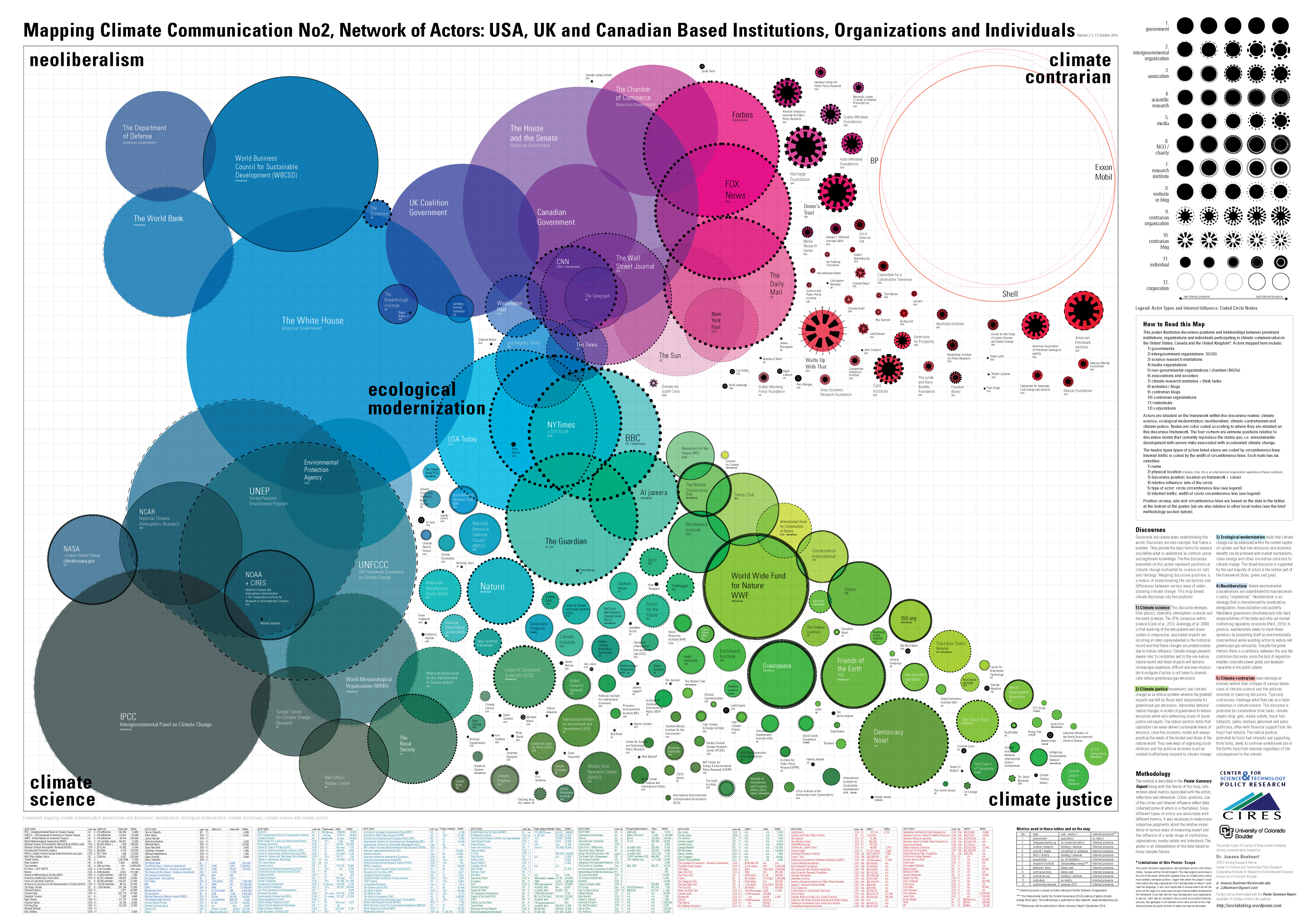
Web Editor's Note: The IWW Environmental Unionism Caucus is featured on the climate map as one of the "climate justice" organizations.

The Mapping Climate Communication Project illustrates key events, participants and strategies in climate communication.

1) Climate Timeline visualizes the historical processes and events that have lead to various ways of communicating climate change. Key scientific, political and cultural events are plotted on a timeline that contextualizes this information within five climate discourses. These reveal very different ideological, political and scientific assumptions on climate change.

2) Network of Actors displays relationships between 237 individuals, organizations and institutions participating in climate communication in Canada, United States and the United Kingdom.

Details about this project can be found in the Mapping Climate Communication: PosterSummary Report. This report can be downloaded here:


The maps reveal how specific details in climate communication are contextualized within complex debates. For example:

  • How does a climate march impact the volume of media coverage of climate change?
  • How does the work of the climate denial industry potentially impact climate policy?
  • Do popular movies and books on climate result in activity in the climate movement?
  • What are the relationships between organizations active in climate communication?

By illustrating key events and actors over time and within five discourses this work makes links between disparate factors and reveals dynamics that contribute to public understanding of climate change.

The project also explores politicised issues in climate communication by using a discourse approach to analyse the various strategies and ideologies held by those organizations, institutions and individuals participating in climate communication in the public realm. This report describes the impact of neoliberal dogma and modes of governance on climate communication as one of the central problems preventing a global response to climate change. Theorizing the impact of neoliberalism on climate change communication and policy is key to an understanding of why emissions continue to rise despite the significant work by the climate science community and the environmental movement over the past four decades.

Green Unionism and the IWW

By Martin Zehr - IWW Environmental Unionism Caucus, October 14, 2014

Disclaimer: The views expressed here are not the official position of the IWW (or even the IWW’s EUC) and do not necessarily represent the views of anyone but the author’s.

“Every union should have a vision of the future,” stated Jock Yablonski as he announced his candidacy for the UMWA presidency. “What good is a union that reduces coal dust in the mines only to have miners and their families breathe pollutants in the air, drink pollutants in the water, and eat contaminated commodities?”  

This presentation by Jock Yablonski presents a concise analysis of the relationship between the working class and the environment. Because the environmental issue has been dominated for so many years by NGOs and advocacy groups, there remains a fundamental schism in substance and politics between the working class and sound environmental and resource planning advocates. The much celebrated blue-green unity of Seattle is a fading memory. In the age of the increasing role of the AFL-CIO in promoting corporate profits for jobs, we have seen how unions like the Mineworkers, Boilermakers, Steelworkers and others have adopted a pro-corporate militarization stance. This significance of this collaboration goes beyond simply environmental issues. In fact, it threatens an independent class role for all unions, whether it's quality of life issues or shop floor issues.  

To date, the IWW’s reputation remains in geographical locales and in small retail or commercial local unions. Our presence within the labor movement remains marginal. The re-emergence of an active IWW presents a new stage for workers in the class stage. More than a revival of the sixties mass struggles and beyond the single issue advocacies of the late 20th century, the IWW can play an leadership role given our willingness to consciously analyze our role, our strategies  and our tactics. For example, the drive to organize in basic industry is a task that remains ahead of the IWW. The service economy will provide certain in-roads needed to establish our validity and are important in establishing real credentials that workers can see. But, the task ahead remains in steel, electrical, maritime, auto and other industries that have become open shops, or even non-union (such as auto). Likewise, organizers and political education of organizers need to be developed to a generation that has minimal experiences in the class struggle.  

HSUS’ Paul Shapiro Discusses Alliances With Labor

By Jon Hochschartner - Species and Class, October 9, 2014

Disclaimer: The views expressed here are not the official position of the IWW (or even the IWW’s EUC) and do not necessarily represent the views of anyone but the author’s.

Paul Shapiro is the vice president of farm animal protection at the Humane Society of the United States. He recently agreed to an interview with Species and Class in which he discussed alliances with the workers’ movement, among other things.

Species and Class : You recently coauthored a piece with the vice president of the United Farm Workers. How can the animal movement develop a better relationship with the labor movement, so we might work together on issues we agree on?

Paul Shapiro: Factory farms are terrible places to be a farm animal, and they’re also bad places to be a farm worker. There’s a reason turnover is so high at these facilities. Not only is it physically draining to work inside animal factories, but the mental toll which comes from being around such violence all day long is also quite serious. One need only peruse Human Rights Watch’s report on the working conditions for slaughter workers, for example, to know that these are very dangerous jobs.

So there should be a good amount of common ground between those seeking to help farm animals and those seeking to help farm workers. That’s one reason The Humane Society of the United States regularly works with the United Farm Workers on joint efforts. We’ve also partnered with other workers’ rights organizations to challenge a particularly inhumane poultry slaughter method that also causes traumatic injury to workers.

These are just a couple examples, but certainly there are more.

Railroad Workers United Steve Klak speaks to Pullman, IL Labor Day 2014

By Steve Klak - Railroad Workers United Blog, October 8, 2014

Disclaimer: The views expressed here are not the official position of the IWW (or even the IWW’s EUC) and do not necessarily represent the views of anyone but the author’s.

120 years ago Eugene Victor Debs stood six blocks from here at Langley Park and pledged the support of his brand new union, the American Railway Union to the struggle of the Pullman car builders. The ARU had just decisively defeated the Great Northern Railway in 18 days preventing a 10% wage cut. Now, this same company the Burlington Northern Santa Fe, is demanding concessions just as drastic. I came here today to ask you to help these present day rail workers in this fight.

Progressive Union Busting

By The Angry Syndicalist - October 9, 2014

Disclaimer: The views expressed here are not the official position of the IWW (or even the IWW’s EUC) and do not necessarily represent the views of anyone but the author’s.

Grassroots Campaigns Inc is in the process of being unionized by the newly formed United Campaign Workers who have canvassed for the progressive non-profit organization. The canvassers have been denied paychecks owed by the organization and have been running a campaign for the regulation and restoration of hemp. Apparently these progressives have bounced checks before as well, since management wasn't willing to discuss these problems, the workers walked off the job.

The UCW was formed in concert with the help of the IWW. A phone blast was the first response to the liberal organization, with supporters calling in for the UCW. The demands were simple, $15.00 an hour and the overtime pay they were owed. When these were handed in to the director, he apparently thought the word grassroots and the IWW were strangers, naivety abound.

The campaign has been gathering signatures for I-21, the Oregon Cannabis Amendment, which would end all legal penalties for marijuana products and extend growing permissions to Oregonians. It’s paired with the Oregon Cannabis Tax Act, I-22, which would override existing laws to create a new regulatory framework and funnel money from marijuana sales into state programs.

The crew pulls 600 signatures a day and it would make sense since they are in favor of the campaign they'd be brought back to work? No. The canvassers have support in the community in the form of Jobs for Justice and other union members.

Nonprofits have been using methods normally reserved for the conservative wing of liberal politics to bust unions i.e. Sisters Camelot, which has left a sour taste in many Wobblies mouths. Who resorted to a lawyer whose goal was to destroy the union, despite the fact the NLRB recognized them as workers.

I do not put it past progressives to have the not in my backyard mentality if it affects them. So much so, they hired scabs who ironically were offered $15.00 an hour. Since then the workers have done what they can to get management back to the bargaining table, including demanding enough dignity from the work they perform in the payment of bonuses so they can feed their children.

A confused liberal called this heteronormative, however I question if this liberal has ever had to starve before.

Part II: Boston Wobblies in Solidarity.

GCI has had their reputation for union busting spread throughout the local community in Boston(where their HQ is). Their quotas were unrealistic and union busting isn't a thing a labor democrat would do would they? Anyways, they resorted to hiring private security who were too cowardly to show their faces to the world.

Grassroots Campaigns was founded in December 2003. By April 2004 Grassroots Campaigns had opened offices in 40 cities throughout the country. By July 2004 they had over 2,000 staff knocking on doors and fund raising on behalf of the  Democratic National Committee With continued work on behalf of MoveOn PAC to run "Leave No Voter Behind," (LNVB). This was a "get out the vote" (GOTV) program intended to give Democratic candidate John Kerry an edge in the swing states. 

Grassroots Campaigns, Inc clients are a who's who for those who like to name drop, from the ACLU to the SPLC to the Sierra Club. It's one big club and the canvassers aren't in it. Praise be to the liberal elite with college degrees and Starbucks addictions.

Pages

The Fine Print I:

Disclaimer: The views expressed on this site are not the official position of the IWW (or even the IWW’s EUC) unless otherwise indicated and do not necessarily represent the views of anyone but the author’s, nor should it be assumed that any of these authors automatically support the IWW or endorse any of its positions.

Further: the inclusion of a link on our site (other than the link to the main IWW site) does not imply endorsement by or an alliance with the IWW. These sites have been chosen by our members due to their perceived relevance to the IWW EUC and are included here for informational purposes only. If you have any suggestions or comments on any of the links included (or not included) above, please contact us.

The Fine Print II:

Fair Use Notice: The material on this site is provided for educational and informational purposes. It may contain copyrighted material the use of which has not always been specifically authorized by the copyright owner. It is being made available in an effort to advance the understanding of scientific, environmental, economic, social justice and human rights issues etc.

It is believed that this constitutes a 'fair use' of any such copyrighted material as provided for in section 107 of the US Copyright Law. In accordance with Title 17 U.S.C. Section 107, the material on this site is distributed without profit to those who have an interest in using the included information for research and educational purposes. If you wish to use copyrighted material from this site for purposes of your own that go beyond 'fair use', you must obtain permission from the copyright owner. The information on this site does not constitute legal or technical advice.