You are here

just transition

Winds of Change: Public Opinion on Energy Politics in Saskatchewan

By Andrea Olive, Emily Eaton, and Randy Besco - Canadian Centre for Policy Alternatives - April 2018

Energy politics are controversial in Canada. Debates over pipelines, from the Kinder Morgan Trans Mountain expansion to TransCanada’s Keystone XL, are often splashed across newspaper headlines. In Saskatchewan, however, the Saskatchewan Party government and the official NDP opposition have rarely disagreed about the importance of defending the province’s oil industry from anti-pipeline activists and federal climate change policies. Most recently, the interim leader of the NDP sided with Alberta Premier Rachel Notley in the dispute between Alberta and British Colombia over Kinder Morgan.1 Although Saskatchewan produces no bitumen itself, the NDP joined Premier Notley in condemning BC Premier Horgan’s announcement that British Colombia will place restrictions on the shipment of bitumen through its territory.

Given the seeming political consensus that defending the oil industry is consistent with defending the province’s interests, one might assume that Saskatchewan people are relatively united in their support for fossil fuel extraction. In this report we present some surprising results of public opinion polling that we conducted on issues of oil extraction, environment, and climate change in the province. Our results show that people living in Saskatchewan support a transition away from fossil fuels and agree that the government should invest more in solar and wind power while strengthening environmental regulations.

Read the report (PDF).

Bringing Back The Lucas Plan

By Felix Holtwell - Notes from Below, March 30, 2018

“We got to do something now, the company are not going to do anything and we got to protect ourselves”, proclaimed a shop steward at Lucas Aerospace when filmed by a 1978 documentary by the Open University.

He was explaining the rationale behind the so-called Alternative Corporate Plan, better known as the Lucas Plan. It was proposed by shop stewards in seventies England at the factories of Lucas Aerospace. To stave off pending layoffs, a shop steward committee established a plan that outlined a range of new, socially useful technologies for Lucas to build. With it, they fundamentally challenged the capitalist conception of technology design.

Essentially, they proposed that workers establish control over the design of technology. This bottom-up attempt at design, where not management and capitalists but workers themselves decided what to build, eventually failed. It was stopped by management, sidelined by struggling trade unions and the Labour Party, and eventually washed over by neoliberalism.

The seventies were a heady time, the preceding social-democratic, fordist consensus ran into its own contradictions and died in the face of a triumphant neoliberalism. With it, experiments such as the Lucas Plan died as well. Today, however, neoliberalism is in crisis and to bury it we should look back to precisely those experiments that failed decades ago.

Aviation expansion: the global cost of the carbon jet set

By staff - Reel News, February 9, 2018

Film Length: 21:46 A new global network has been launched to combat and coordinate action against the frightening expansion plans of the aviation industry. The plans are driven by the super rich flying increasingly frequently to their tax havens – and if they go ahead there is no chance of stopping runaway climate change. Fortunately there is growing resistance everywhere from a coalition of local residents, environmentalists and trade unionists, determined to stop the plans while protecting the futures of the workers who work in the industry – from hunger strikes in South Korea to the stunning victory in Notre-Dame-Des-Landes, Nantes.

The Case for Nationalizing Elon Musk

By Kate Aronoff - In These Times, February 8, 2018

On Tuesday, Elon Musk launched some stuff into space. The SpaceX Falcon Heavy rocket was shot into the Solar System, tailed by a Tesla Roadster blasting David Bowie songs, reportedly the fastest car ever to be released into orbit. Each Falcon launch is only expected to cost around $90 million—a bargain in the world of extraterrestrial exploration. 

Scientific American gawked, “Elon Musk Does It Again,” praising the “bold technological innovations and newfound operational efficiencies that allow SpaceX to not only build its rockets for less money, but also reuse them.” That view—shared by several other outlets—fits comfortably with the Tony Stark-like image Musk has crafted for himself over the years: a quirky and slightly off-kilter playboy genius inventor capable of conquering everything from outer space to the climate crisis with the sheer force of his imagination.

One of Musk’s long-term goals is to create a self-sustaining colony on Mars, and make humanity an interplanetary species. He hopes to shoot two very wealthy people around the moon at some point this year. Musk has invested an awful lot of public money into making those dreams a reality. But why should Americans keep footing the bill for projects where only Musk and his wealthy friends can reap the rewards? Enter: the case for nationalizing Elon Musk, and making the U.S. government a major stakeholder in his companies.

The common logic now holds that the private sector—and prodigies like Musk, in particular—are better at coming up with world-changing ideas than the public sector, which is allegedly bloated and allergic to new, outside-the-box thinking. Corporations’ hunt for profits and lack of bureaucratic constraints, it’s said, compel cutting-edge research and development in a way that the government is simply incapable of. With any hope, more of these billionaires’ breakthroughs than not will be in the public interest.

The reality, as economist Mariana Mazzucato argues in her 2013 book The Entrepreneurial State: Debunking Public vs. Private Sector Myths, is very different. Many of the companies that are today considered to be headed by brilliant savants—people like Steve Jobs and, yes, Elon Musk—owe much of their success to decades of public sector innovation, through repackaging technologies developed over the course of several decades into new products. Take the iPhone, essentially a collection of Defense Department research and National Science Foundation-grant projects packed into one shiny machine.

“The prospect of the State owning a stake in a private corporation may be anathema to many parts of the capitalist world,” Mazzucato writes, “but given that governments are already investing in the private sector, they may as well earn a return on those investments.”

More to ‘pumped storage’ than meets the eye

By Lydia Graves - Appalachian Voices, February 7, 2018

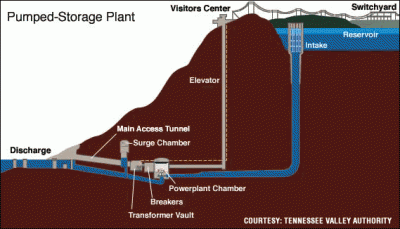
Dominion Energy has been eyeing far Southwest Virginia for its latest project — a giant, hydroelectric battery, also called pumped storage. The facility would use cheap or excess power to pump water into an elevated reservoir during off-peak hours. By holding the water until peak demand hours and releasing it to run turbines when energy is needed the most, electricity is effectively captured and stored.

Although using energy to pump water uphill may sound counterintuitive, this project could be a way to make our power usage more efficient. Often, pumped storage facilities reduce energy waste by using excess energy from coal or nuclear facilities, so-called baseload plants that generate the same amount of power around the clock. The world’s largest pumped storage facility is in Bath County, Virginia, and is owned by Dominion.

Local solar is best

It is critical that any project Dominion constructs in Southwest Virginia benefits local people directly by generating the power onsite using cost-effective solar, drawing from the existing workforce and maximizing local economic impacts. The two potential projects Dominion is considering in the coalfield counties are forecasted to be roughly ten times smaller than the 3,003-megawatt Bath County site, so using small, onsite solar installations would be appropriate.

Solar is now the cheapest form energy generation worldwide and employs more people in the U.S. than coal, gas and oil electrical generation combined. Solar panels at the proposed pumped storage facility would capture and store the sun’s energy until the power is needed most by customers.

First U.S. City to Ban Fossil Fuel Expansion Offers Roadmap for Others

By Kevon Paynter - Yes! Magazine, February 5, 2018

On a clear July morning three years ago, dozens of environmental activists pushed their kayaks into the Willamette River in Portland while others rappelled 400 feet from the top of St. Johns Bridge in an attempt to block a Shell Oil ship and its drilling equipment from leaving the port and entering Alaskan waters.

A key piece of Shell’s arctic drilling fleet, the vessel had arrived in Portland for repairs but its departure was delayed by protesters chanting “coal, oil, gas, none shall pass!” during two days of civil disobedience that became known as Summer Heat.

By the time the vessel finally sailed, the stage had been set for what would be a yearlong battle, culminating in an ordinance that banned construction and expansion of fossil fuel infrastructure in the city.

Last month, the Oregon Court of Appeals upheld Portland’s ban as constitutional, affirming the city’s power to regulate the safety and welfare of its residents and sending a powerful signal to cities that they too can take the lead to limit fossil fuel use.

nd while the court ruling could set precedent for similar climate action elsewhere, how Portland passed the nation’s first fossil fuel infrastructure ban holds important lessons for how other communities can use grassroots activism to implement the renewable energy transition in their cities.

Grassroots Movement Wins Millions In Fare Reductions For Portlanders

By Shawn Fleek - Inequality.Org, February 7, 2018

An Oregon environmental group secured its new discount program for low-income riders by organizing in the communities most likely to face barriers to civic participation.

Policymakers often overlook the people they’re meant to serve. When people aren’t fairly treated or meaningfully involved in the decisions which impact them, it leads to environmental injustice.

We see environmental injustice frequently in Portland, Oregon. The city is in a housing crisis of rapid gentrification, skyrocketing rents, and a record numbers of evictions. Portland’s transportation system is in critical condition, as a booming population chokes streets with traffic while transit ridership declines. We have some of the worst air quality in the country, and regulators seem less interested in cleaning it up than making polluters happy.

Yet OPAL, our small grassroots group in Portland, has spent the last ten years winning millions of dollars for low-income people and people of color, changing federal, state and local policy, and directly confronting environmental injustice. In January, we saw our biggest win to date: a fare reduction program that will save $10 million for low-income bus riders in the city. The program will serve individuals who earn less than 200 percent of the federal poverty line, providing a discount of more than 75 percent on the cost of a monthly bus pass, and 50 percent off an individual ride.

How do we do it? Grassroots organizing in the communities most likely to face discrimination and barriers to participation in civic life. Since 2010, OPAL has organized Portland’s transit riders under the banner Bus Riders Unite (BRU). At OPAL, organizing means bringing together the people and resources to win campaigns.

“At OPAL, low-income people and people of color make the rules,” says Executive Director Huy Ong, who leads OPAL Environmental Justice Oregon. “Our staff are all people of color from low-income backgrounds. We organize our communities to achieve a safe and healthy environment in the places where we live, work, learn, pray, and play.”

“We get on the buses and ask people about their experiences, not to meet a quota of signatures but because we genuinely care about these stories. We help people see that telling their stories to decision makers can change the decisions.”

BRU’s most recent victory became official on January 24th, 2018. BRU launched a campaign in late 2016 demanding a fare reduction for low-income people. TriMet, the regional transit agency, recently installed $22 million worth of new electronic fare equipment. BRU found out about the plan — which added costs to bus rides, limited ticket options in certain areas, and proposed to eliminate cash transfers — and fought back, hard.

TriMet quickly agreed to preserve the use of cash, and to hand out hundreds of thousands of free electronic fare cards to make the transition smoother. BRU then launched a campaign demanding a fare reduction for low-income people, based off of similar programs in Seattle and San Francisco.

Trump's Policies Won't Bring Back Coal Jobs -- They Will Kill More Miners

By Michael Arria - Truthout, February 4, 2018

On the campaign trail, Donald Trump consistently claimed that he would revive the coal industry, and since becoming president, he has consistently declared victory. "Since the fourth quarter of last year until most recently, we've added almost 50,000 jobs in the coal sector," Donald Trump announced last June. "In the month of May alone, almost 7,000 jobs."

Trump was presumably repeating a number he had heard mentioned by EPA Administrator Scott Pruitt, who proudly touted the 50,000 figure in various media appearances last year. Pruitt's numbers are, in fact, way off. According to data from the Bureau of Labor Statistics, from the beginning of 2017 through that May, about 33,000 "mining and coal" jobs were created. That's obviously much lower than 50,000. Plus, most of those 33,000 jobs actually came from a subcategory called "support activities for mining." When Trump made that statement, the actual number of new coal jobs was about 1,000. Now it's about 1,200. Preliminary government data recently obtained by Reuters shows that Trump's efforts to increase mining jobs have failed in most coal-producing states.

In addition to coal production dropping off, solar and wind power are now a cheaper option, and more Americans are becoming aware of coal's devastating environmental impact. Even early Trump supporter Robert Murray, CEO of Murray Energy, the country's biggest privately held coal company, admitted that the president "can't bring mining jobs back."

Mutual Aid Disaster Relief Marks End of Convergence Center

By Mutual Aid Disaster Relief - It's Going Down, February 4, 2018

This following report from Mutual Aid Disaster Relief marks the closing of their autonomous space in Florida. To hear more about the community center and free clinic that they organized in the wake of hurricane Irma, check out our podcast interview with them here.

Last week marked the end of our Tampa Mutual Aid Disaster Relief Post-Irma Convergence Center, the space was generously offered to us by St. Paul Lutheran Church. This space was artful, accessible, warm and creative. Like larger social experiments where collectives have free reign to create, projects zipped in and out, ideas flourished and plans were encouraged to fruition.

From prisoner letter writing nights, to documentary screenings, to food prep, to the hundreds of care packages sent out from on site, to reportbacks, to workshops, to skillshares, to group meetings, to open mics, to radical caroling practice, and of course, the launching of relief teams doing disaster mutual aid to Puerto Rico, Immokalee, the Keys, Apopka, Jacksonville, and even refugee solidarity work in Belgium and France. We used those four walls to break down other walls and it worked. The space was opened for houseless friends to shower, do laundry and even for a houseless couple to have a romantic anniversary dinner.

We shared the space with Tampa Food Not Bombs, Love Has No Borders, Tampa Bay DSA, Restorative Justice Coalition, Black Lives Matter Tampa, Tampa Anarchist Black Cross and other liberatory movements. The space held a free clinic, a free library, a children’s playroom, a community kitchen, and an open space for people to share art and literature. The walls held revolutionary Zapatista quotes, portrait-stories, other messages of support and solidarity, and photos in memory of Andrew Joseph III, Meg Perry and Alonso Guillen – people we have lost along the way. The clinic treated emotional and physical trauma, provided acupuncture, reiki, massage, herbal teas and tinctures, diabetes care, treated dehydration and launched many, many mobile clinics.

Hakim Bey, the originator of the term temporary autonomous zone says they are “like an uprising which does not engage directly with the state, a guerrilla operation which liberates an area (of land, of time, of imagination) and then dissolves itself, to re-form elsewhere/else when, before the state can crush it.” The goal of these zones is not permanence or confrontation, and its lapse is not defeat, but a seed planted that will be carried to another time and place to be recreated again.

The aim is to spread these autonomous zones far and wide, so that everywhere and every-when, not just in disasters, people share goods and services freely, connect deeply and authentically with one another, have agency, self-determination and meaning in their chosen work, live in the moment, and are free to imagine with minds, but also with hands and feet, the better world we know is possible. These moments, when our bodies are sung electric by the possibilities taking wing inside and all around us, need not be fleeting. Most of human history has been spent in communities whose foundation was mutual aid, and our future can be likewise if we have the strength and courage to follow our vision through to where it leads.

Another example of temporary autonomous zones are the 12 Centros de Apoyo Mutuo (CAMs) located throughout Puerto Rico. These constitute an intricate web of people-powered, locally rooted recovery efforts that are proving revolutionary self-governance is not a utopian dream, but can actually be a natural response to the absence of authoritarian, statist means of control. We are currently raising funds to get the CAM in Caguas its own micro-grid solar photovoltaic system – an autonomous alternative to the bankrupt and perhaps, soon to be privatized, Puerto Rico Electric Power Authority. You can donate to this project here.

Some of us are still in Puerto Rico assisting with projects whenever and wherever we are needed and plan to continue doing so for the forseeable future. Some of us are busy preparing for a multi-state tour. And look forward to seeing many of you in person over the coming weeks and months and strategizing on how to build the movement for mutual aid together. To check out locations, visit our website. If we aren’t making it to your town yet, we apologize and thank you in advance for your patience. We have had far too many requests to meet them all at once, but we will continue booking spots for the Fall.

Dandelions lose their minds in the wind, and spread their seeds in a thousand directions. We are a result of one of those seeds. And we know that every end is a beginning. Wherever you go, may you carry a piece of a liberated zone with you. Wherever you stand, may you be the heart and soul of that place.

Until next time.

Labor and climate groups support Transit Equity Day

By Bill Onasch - Socialist Action, February 1, 2018

On Feb. 5, civil rights, trade union, student, church, and environmental activists in communities across North America will come together in a variety of events to call attention to a looming crisis in public transit.

The diversity of these groups indicates that they recognize not only the urgent need to save what we have but also the potential crucial role transit expansion can play in providing affordable transportation that is accessible to all, that can reduce traffic fatalities and congestion—and that can curtail greenhouse gas emissions driving climate change.

But today, New York City’s subways—moving a record 5 million passengers a day—are on the verge of collapse, a major line is being shut down for renovation lasting for more than a year, and their buses aren’t doing much better. Washington, D.C., has neglected even routine maintenance, leading to accidents and delays on the Metro.

Transit-union contract negotiations remain highly contentious in Washington and Chicago. Some public agencies continue to contract work out to non-union penny-pinching private outfits who can do it cheaper only by providing inferior service and paying substandard wages. Washington, D.C., is moving to privatize the Red Line subway. More of the same—and even worse—are in store.

This is not the first crisis for transit. After setting record ridership numbers during World War II, when there was full employment, no new cars were being built, and tires and gasoline were rationed, the ruling class took America into a very different postwar development scheme. From the end of World War II on, highly subsidized urban sprawl promoted a massive exodus of residents and jobs to new suburban areas. The streetcar and bus lines in the urban cores did not follow them.

In many cases, such as in Los Angeles and Kansas City, consortiums of auto, oil, and tire companies became silent owners of transit properties. They dismantled their impressive electrified streetcar and trolley bus networks—which would require many billions to replicate today—replacing them with diesel buses produced by General Motors, as they steadily slashed service. One result in Los Angeles was the introduction of a new word to our vocabulary—smog. Out of sprawl an important new division in the working class soon emerged—either car dependent or transit dependent.

Because a high percentage of the transit-dependent population remaining in the depleted urban cores are African Americans, transit has often been on the agenda of the Civil Rights movement. The chosen date in February marks the birthday of the late Rosa Parks, who became famous for an act of civil disobedience that launched the well-planned boycott campaign to end racial segregation on Montgomery, Ala., buses in 1955. This pivotal action, initiated by Black trade unionists led by E.D. Nixon, is credited with launching the revival of the mass Civil Rights Movement in the South—and propelling Dr Martin Luther King into national prominence.

Pages

The Fine Print I:

Disclaimer: The views expressed on this site are not the official position of the IWW (or even the IWW’s EUC) unless otherwise indicated and do not necessarily represent the views of anyone but the author’s, nor should it be assumed that any of these authors automatically support the IWW or endorse any of its positions.

Further: the inclusion of a link on our site (other than the link to the main IWW site) does not imply endorsement by or an alliance with the IWW. These sites have been chosen by our members due to their perceived relevance to the IWW EUC and are included here for informational purposes only. If you have any suggestions or comments on any of the links included (or not included) above, please contact us.

The Fine Print II:

Fair Use Notice: The material on this site is provided for educational and informational purposes. It may contain copyrighted material the use of which has not always been specifically authorized by the copyright owner. It is being made available in an effort to advance the understanding of scientific, environmental, economic, social justice and human rights issues etc.

It is believed that this constitutes a 'fair use' of any such copyrighted material as provided for in section 107 of the US Copyright Law. In accordance with Title 17 U.S.C. Section 107, the material on this site is distributed without profit to those who have an interest in using the included information for research and educational purposes. If you wish to use copyrighted material from this site for purposes of your own that go beyond 'fair use', you must obtain permission from the copyright owner. The information on this site does not constitute legal or technical advice.