You are here

jobs

Why We Need a Federal Job Guarantee

By Mark Paul, William Darity Jr, & Darrick Hamilton - Jacobin, February 4, 2017

Universal basic income (UBI), an annual government-sponsored payment to all citizens, has been gaining traction across the American political landscape. Andy Stern, former Service Employees International Union president, believes the program will counteract the “acceleration of technology” that he thinks will likely create “work but not reliable jobs or incomes.” On the Right, the American Enterprise Institute’s Charles Murray argues that we should replace the “entire bureaucratic apparatus of government social workers” with a UBI.

Other heavy-hitters agree it’s worth discussing. Robert Reich’s recent video calls on the government to provide a minimum payment for every citizen. President Obama told Wired that the United States will have to debate UBI and similar programs “over the next ten or twenty years.”

The renewed attention makes sense: UBI would cover workers who, thanks to technological progress, have lost their jobs. One often-cited report tells us that 47 percent of all jobs are at risk of being automated. Yet existing social insurance programs are insufficient. The current array of programs — such as unemployment insurance, the earned income tax credit, and the Supplemental Nutrition Assistance Program — help many Americans, but over forty-three million people still live below the poverty line. Children are among the most vulnerable, with nearly half living at or near poverty.

The UBI represents one way to fight increasing deprivation. But another potential intervention — the federal job guarantee (FJG) — might be a far more promising demand.

A job guarantee is not a new idea. It has been part of the American conversation at least since populist governor Huey Long put forth his Share Our Wealth Plan. In 1934, he argued that the United States should use public works to ensure “everybody [is] employed.” These calls were echoed by politicians from Roosevelt in his Economic Bill of Rights to George McGovern during his 1972 presidential bid. Martin Luther King also stumped for a job guarantee, demanding immediate “employment for everyone in need of a job.” He saw “a guaranteed annual income at levels that sustain life and decent circumstances” as the second-best option.

Here are five reasons to agree with him.

Still a new trade unionism in the making?

By David Ridley - Post 16 Educator, 2017

On 26th November 2016, a conference was held to celebrate The Lucas Plan, ‘a pioneering effort by workers at the arms company Lucas Aerospace to retain jobs by proposing alternative, socially useful applications of the company’s technology and their own skills. It remains one of the most radical and forward thinking attempts ever made by workers to take the steering wheel and directly drive the direction of change’.

The day began with a screening of Steve Sprung’s documentary The Plan, a work in progress which tells the story through interviews and archival footage of the Lucas Plan. Already the film cleverly and and emotionally conveys both the social and historical context within which the Lucas Plan was created, and its ongoing importance for today’s situation.

The 52-page summary of the Lucas Plan report show Harold Wilson, Labour Prime Minister from 1964 to 1970, ‘lubricated’ the ‘white heat of technological change’ in heavy industries, leading to the ‘burning up’ of thousands of jobs and to structural unemployment. In his plenary speech, Phil Asquith, a key member of the Lucas Aerospace Combine, described how the trade union movement at the time failed to offer effective resistance to the two major threats of structural unemployment and globalisation.

The Combine Committees were a direct response to the corporate mergers and rationalisations of the 1970s. These mergers and rationalisations were making it easier to overcome existing forms of workplace organisation, which were at that point still based on geographical and craft divisions. Mick Coomey recounted the situation at that time as one in which different unions all negotiated at different times, often undermining each other, all operating with their own immovable, often undemocratic, structures.

The Combine was an attempt to overcome these divisions by appealing to the common interest of workers within Lucas Aerospace. They ‘set up a series of advisory services’ including advice on pensions provisions and safety in the use of new equipment. The Combine also produced its own ‘four page illustrated newspaper’ which was distributed bimonthly to 13,000 manual and staff workers.

But the most significant achievement of the Combine was the creation of the Corporate Plan. Formulated after a meeting with the late Tony Benn, who suggested its creation, the ‘object of the Corporate Plan [was] twofold. Firstly to protect our members’ right to work by prioritising a range of alternative products on which they could become engaged in the event of further cutbacks in the aerospace industry. Secondly to ensure that among the alternative products proposed are a number which would be socially useful to the community at large’.

Now Hiring: The Growth of America’s Clean Energy and Sustainability Jobs

By Eskedar Gessesse, et. al. - Blue Green Alliance, January 2017

The following text is by Elizabeth Perry, Work and Climate Change Report, February 3, 2017:

Following on the January 2017 report US Energy and Employment  from the U.S. Department of Energy, more evidence of the healthy growth of the clean energy industry comes in a report by the Environmental Defense Fund Climate Corps and Meister consultants.  Now Hiring: The Growth of America’s Clean Energy and Sustainability Jobs compiles the latest statistics from diverse sources, and concludes that “sustainability” accounts for an estimated 4.5 million jobs (up from 3.4 million in 2011) in the U.S. in 2015. Sustainability jobs are defined as those in energy efficiency and renewable energy, as well as waste reduction, natural resources conservation and environmental education, vehicle manufacturing, public sector, and corporate sustainability jobs.

Statistics drill down to wages and working conditions – for example, average wages for energy efficiency jobs are almost $5,000 above the national median, and wages for solar workers are above the national median of $17.04 per hour. Comparing clean energy with the fossil fuel industry, the report states that the 1.4 million jobs in energy efficiency construction and installation alone is more than double the number of workers in fossil fuel mining, extraction and electric power generation combined. Now Hiring states that for every $1 million invested in building retrofits and industrial efficiency, 8 direct or indirect jobs are created; in comparison, 3 are created by a comparable investment in the fossil fuel industry. This final comparison of job multiplier effect is based on “Green versus brown: Comparing the employment impacts of energy efficiency, renewable energy, and fossil fuels using an input-output model” by Heidi Garrett Pelletier at PERI, and appears in the February 2017 issue of Economic Modelling.

Read the report (Link).

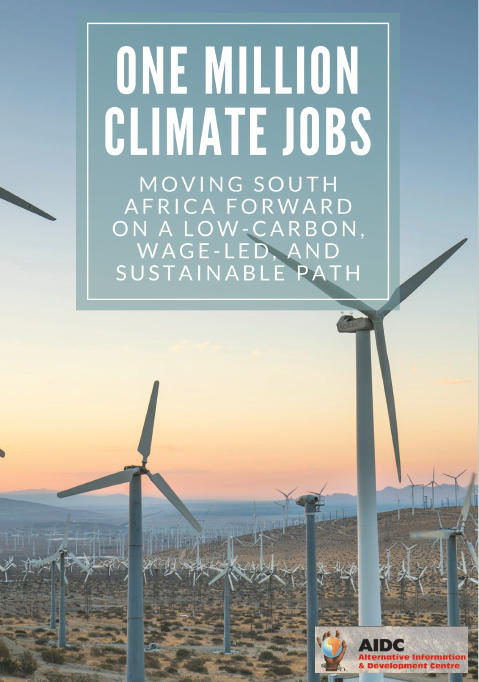
One Million Climate Jobs: Moving South Africa Forward on a Low-Carbon, Wage-Led, and Sustainable Path

By Brian Ashley, et. al. - One Million Climate Jobs - December 2016

The One Million Climate Jobs Campaign is an alliance of labour, social movements and popular organisations in South Africa that is campaigning for the creation of a million climate jobs as part of a collective approach to the crisis of unemployment and climate change. The Campaign was launched in 2011 and since then has been mobilising thousands of South Africans around real solutions to slowing down climate change, protecting the natural environment, improving the quality of life for all and moving towards a sustainable development path. Climate change will exacerbate inequality and poverty because it reduces access to food, water, energy and housing. Thus it is vital that social justice struggles around these issues incorporate struggles around climate change.

This booklet is a follow-up, six years later, to the first booklet that was produced in 2011. It is based on well- researched solutions for how South Africa can immediately begin a just transition, away from the Minerals-Energy Complex that continues to dominate the South African capitalist economy, to a low carbon economy in which the basic needs of communities are met in an equitable, sustainable and affordable way.

It recognizes that in these six years there have been many developments – for instance, renewable energy is now firmly established as part of the energy mix (although still a minor part); retrofitting buildings, and the development of environmentally friendly construction methods, is being developed, and the Rapid Bus Transit system is being slowly implemented in some municipalities.

But most of these solutions are being pursued within the logic of the market. It is not possible, we would argue, within these market parameters, to respond adequately to the enormous challenges facing us – what is needed is a publicly-driven solution for the shift to a sustainable, low-carbon future. The research that this booklet is based on begins to set out what such a transition could look like. We hope that it will be an important contribution to the ongoing work of building a political movement to struggle around these issues.

Download (PDF).

Job Growth in Clean Energy: Employment in Alberta’s emerging renewables and energy efficiency sectors

By Binnu Jeyakumar - Pembina Institute, November 2016

Alberta has a meaningful plan to enable the growth of a clean energy industry, with commitment to 30% of electricity generated by renewable sources by 2030, and phasing out pollution from coal-fired generation. A portion of the anticipated revenues from the province’s economy-wide carbon levy will be used to enable these efforts. This provides a great opportunity for sustainable employment growth in the clean energy sector. This is in line with the global trends of declining investment and employment in the coal industry, while investment and employment in the renewable sector expands.

The Pembina Institute has conducted an analysis of the employment potential in the renewable energy and energy efficiency sectors in Alberta. Data was collected through literature reviews and from organizations involved in development of projects. The analysis used conservative estimates where there was uncertainty. The results are nevertheless encouraging and paint a positive picture for Albertans.

  • In Alberta, investing in renewable sources of electricity and energy efficiencyalone would generate more jobs than those lost through the retirement of coalpower ( Figure 1).
  • With a high and sustained pace of renewables growth, there are sustained levelsof employment for those engaged in related equipment installations.
  • Additional investment in community energy can increase the employmentpotential by 30-50%.
  • Long-term investments in modernizing infrastructure, the grid and ourelectricity system will result in further job creation with a wide diversity of skills,and in fields that are likely to see sustained growth.

Read the report (Link).

Sharing the challenges and opportunities of a clean energy economy: Policy discussion paper A Just Transition for coal-fired electricity sector workers and communities

By staff - Australian Council of Trade Unions - November 2016

The ACTU is primarily concerned with workers, their rights, their welfare and their future. A just and civil society is one where everyone shares in the wealth of the nation but it is also one where economic costs are equally shared.

Transitioning an industry is a massive economic and social disruption. History shows that this has often been done poorly in Australia, with workers and communities bearing the brunt of such transitions - suffering hardship, unemployment and generations of economic and social depression.

Research in the textiles, clothing and footwear (TCF) and car manufacturing industries shows, for example, that only one third of workers find equivalent full time work following their retrenchment, while one third move into lower quality jobs (lower wage, lower job status or into part-time and casual work) and one third are locked out of the labour force altogether.

International experience however shows that a transition can be done equitably, achieve positive outcomes for workers, save communities and forge new areas of industrial growth and prosperity.

Australia is currently facing one such transition in the coal-fired electricity sector. If Australia manages this transition well, the nation would have a structured and equitable approach that could apply to any industry undergoing similar change in the future.

At last year’s Paris climate conference, Australia alongside 194 countries, committed to limit global warming to less than 2°C above pre-industrial levels. As part of this historic agreement, unions successfully achieved recognition of the need for a ‘Just Transition’ that supports the most affected workers obtain new decent and secure jobs in a clean energy economy.

While Australia’s international obligations will require a range of complementary policies that focus on emission reduction across a number of sectors of the economy, as the largest contributor to Australia’s emissions, effective reform of the electricity sector has been identified as a key step in tackling climate change.

Download (PDF).

Just transition of the workforce, and the creation of decent work and quality jobs

By secretariat - United Nations, October 26, 2016

This technical paper provides an overview of the work undertaken under the Convention on a just transition of the workforce, and the creation of decent work and quality jobs (hereinafter referred to as just transition) in the context of the impact of the implementation of response measures. The paper also presents the general concept of just transition, including the drivers and objectives of such transitions, andthen discusses the linkages between just transition and the impacts of the implementation of climate change mitigation policies. It also provides guidance on how to approach just transition at the national level. This technical paper draws upon relevant information contained in:

  • (1) reports on the work of the forum on the impact of the implementation of response measures, as well as submissions, presentations and statements made by Parties and observer organizations during previous sessions of the Conference of the Parties and the subsidiary bodies from 2008 to 2015;
  • (2) national inventory reports, national communications, biennial reports and biennial update reports submitted by Parties;
  • (3) publications by experts, international organizations and research institutes; and
  • (4) inputs from the International Labour Organization

Read the report (PDF).

Trade unions and the climate change fight

By Julie Douglas and Peter McGhee - Briefing Papers, July 5, 2016

We [unions] have to stop running away from the climate crisis, stop leaving it to the environmentalist, and look at it. Let ourselves absorb the fact that the industrial revolution that led to our society’s prosperity is now destabilizing the natural systems on which all of life dependsNaomi Klein

Climate change is perhaps the greatest existential threat humanity has ever faced. Indeed, this year is predicted to be the hottest on record since pre-industrial levels. The signing of the Paris COP21 agreement in March in 2016 behoves all countries to take urgent action to reduce carbon emissions. New Zealand is a signatory to the agreement, which clearly accepts that climate action is not the responsibility of governments alone and that all affected parties have a role in developing a response to climate change. Aside from environmental impacts from climate change there will be significant social, economic and political impacts as well. Work and workplaces, at the centre of the economy and social life, are important sites for responding to climate change. Employment is core to providing a livelihood and prospects on an individual level, and contributing to society as a whole.

There needs to be a tripartite approach to climate action in the workplace. Of the key direct stakeholders (state, employers and unions), unions represent around 18.6 percent of all workers (359,782 members) in New Zealand and therefore also constitutes our largest democratic body. A body of this size which has the structure in place to educate and organise through both the peak union body, the New Zealand Council of Trade Unions (NZCTU), and individual unions, must logically become an important partner in strategic discussions at both a government, industry and firm level.

The union movement in New Zealand has a long history of leading debate and resistance around issues of social justice, from taking a stand against Spain’s fascist Franco to refusing to assist in the loading of ships carrying New Zealand police officers to Samoa in 1929 who went on to kill many Samoans in the Mau movement. With this pedigree of social conscience and history of taking action it should follow that the union movement and its members would again rise and offer leadership to the latest challenge to social order and justice, and indeed potential catastrophic change to the planet.

Not only will jobs, occupations and industries disappear or change but the health and safety of workers will be threatened and more broadly, food and water security compromised. The initial challenge to unions then, is to see these threats as core to union work and why action is imperative to ensure their unions are ready to respond, educate members, and also to work with firms to develop strategies which allow for a just transition to a more sustainable workplace and world.  Unfortunately, such transformation does not appear to be forthcoming.

A recent study we conducted interviewed leaders from eleven of the affiliated unions to the NZCTU (representing 75 percent of all members in affiliated unions). These interviews sought information on what actions, if any, the unions had put in place to respond to climate change, and also the role they saw unions having in climate action and just transition. All of the interviewees articulated a strong personal position of concern about impending climate change and need for action. They all saw the union movement and the NZCTU as important stakeholders and leaders in the action required. However, when looking at the unions themselves the results were sobering. None were in a well-prepared position to face the future regarding climate change. Two had begun to develop some basic policies and plans but did not consider themselves in anyway ready; seven respondents indicated that they personally saw the issue as important but that their unions had done nothing in this area yet and that there were no conversations within the formal structure of their organisation about this issue; and the remaining two union respondents clearly articulated that climate change was not on their union’s radar and there was no indication this was likely to change. Across these unions only two respondents indicated that there had been interest raised by their membership.

This is a fairly bleak outlook for society especially if it places its hope of action on the largest democratic body in the country. Why are unions so unprepared? There are some identifiable reasons, but not excuses, for this. Firstly, we must look at the current socio-political environment unions operate under in New Zealand. As a result of the neo liberal paradigm shift in the 1980s and consequent legislation changes (such as the Employment Contracts Act 1991), union membership dramatically fell, and since 2008 unions have sustained a consistent undermining of rights such as workplace access. The role that unions play in the lives of workers – including their members – has narrowed as a result.

Secondly, unions’ core work is the preservation and enhancement of workers’ wages and conditions. It is for this reason that workers join unions and many of the union leaders we interviewed indicated they were concerned that a shift towards long-term social issues such as climate change could affect membership numbers. The irony being that the continued focus on the short gains of wages and conditions will be pointless if in the middle to long term members’ jobs ceased to exist. That said though, research from the US indicated that union members were more likely to be concerned with environment issues and therefore may well embrace their union engaging with climate change strategies[1]. Despite this finding, it is perhaps unsurprising that none of the unions interviewed had actively surveyed or begun widespread conversations about climate change within their unions and therefore were unaware of their members’ position or wishes on the issue. While it was true that some unions had improved sustainability measures in specific firms and, in one instance, got an organisation to divest in fossil fuel investment, this still stopped well short of a unified approach.

System justification theory postulates that human’s tend to view the wider systems on which they depend in a favourable light. As Johnson notes, upholding the status quo encourages feelings of security, purpose and relatedness through a shared reality. Unions, and their members are no different. They advocate for improved employment outcomes within a capitalist system that rewards self-interest and promotes economic growth as central to human well-being (usually at the expense of the environment). Unfortunately, climate change is a consequence of that same system. Perhaps this explains unions’ reluctance to engage in any meaningful way. To embrace climate change shifts the focus from short-term economic benefits for workers to that of uniting ‘all labouring men and women for a truly different order of things’.[2] Such a move could help unions become truly social democratic movements contributing to the flourishing of all.

[1] Vachon, T., & Brecher, J. (2016). Are union members more or less likely to be environmentalists? Labor Studies Journal. Doi:10.1177/0160449×16643323

[2] Leeson, R. (1971). United We Stand: British Trade Union Emblems (p. 32). London: Adams and Dart.

An Energy Revolution is possible: Tax havens and financing climate action

By Patrick Hearps and Sam Cossar-Gilbert - Friends of the Earth, September 2016

This report is the technical report that supports Friend of the Earth International’s summary report with recommendations and general analysis, also entitled ‘An energy revolution is possible’.

The aim of this analysis is purely to calculate an investment cost of providing several regions of the developing world with 100% renewable electricity, and to compare those amounts with government revenue lost through tax havens globally, in order to highlight the need for economic and climate justice.

Read the report (PDF).

(Preliminary) Workers' Climate Plan

By Lliam Hildebrand, et. al. - Iron and Earth, September 2016

Iron & Earth, a Canadian non-profit organization led by skilled trades workers with experience in Canada’s oil industry, is developing a Workers’ Climate Plan. This preliminary report describes how Canadacan become a leader in renewable energy, and a net exporter of renewable energy products, services and technology, by harnessing the industrial trade skills of current energy sector workers. A growing number of oil and gas trades people support a transition to renewable energy so long as it provides a just transition for current energy sector workers. By utilising Canada’s existing energy sector workforce, organizations and infrastructure, Canada can accelerate the transition to renewable energy, decrease the cost, and make Canada’s renewable energy sector globally competitive.

Throughout September and October, Iron & Earth will continue to reach out to energy sector workers over the phone and in person to speak about the Workers’ Climate Plan in more detail. Iron & Earth is consulting with a range of energy sectors take holders in partner ship with the Alberta-based EnergyFutures Lab in order to devise a set of recommendations based on worker demands. This will informan expanded Workers’ Climate Plan which we will release in November 2016 ahead of The 22nd session of the Conference of the Parties (COP 22). In this preliminary, abridged version of the Workers' Climate Plan, we share insights from current energy sector workers for the consideration of the Working Group on Clean Technology, Innovation and Jobs, as they compile their reports for the ministerial tables in September 2016.

Read the report (PDF).

Pages

The Fine Print I:

Disclaimer: The views expressed on this site are not the official position of the IWW (or even the IWW’s EUC) unless otherwise indicated and do not necessarily represent the views of anyone but the author’s, nor should it be assumed that any of these authors automatically support the IWW or endorse any of its positions.

Further: the inclusion of a link on our site (other than the link to the main IWW site) does not imply endorsement by or an alliance with the IWW. These sites have been chosen by our members due to their perceived relevance to the IWW EUC and are included here for informational purposes only. If you have any suggestions or comments on any of the links included (or not included) above, please contact us.

The Fine Print II:

Fair Use Notice: The material on this site is provided for educational and informational purposes. It may contain copyrighted material the use of which has not always been specifically authorized by the copyright owner. It is being made available in an effort to advance the understanding of scientific, environmental, economic, social justice and human rights issues etc.

It is believed that this constitutes a 'fair use' of any such copyrighted material as provided for in section 107 of the US Copyright Law. In accordance with Title 17 U.S.C. Section 107, the material on this site is distributed without profit to those who have an interest in using the included information for research and educational purposes. If you wish to use copyrighted material from this site for purposes of your own that go beyond 'fair use', you must obtain permission from the copyright owner. The information on this site does not constitute legal or technical advice.