You are here

jobs

Promises! Promises! Promises!

By Joe Womack - Bridge the Gulf, October 6, 2014

Disclaimer: The views expressed here are not the official position of the IWW (or even the IWW’s EUC) and do not necessarily represent the views of anyone but the author’s.

Back in the 60's I could always tell when election time was near. First, city equipment would show up to clean the streets and clear out vacant lots. Then the politician would make an appearance at the Elks and buy a round of drinks for everyone in the place. The next day he would sponsor a chicken and fish fry for the community. At the height of the community outing he would make a speech. That speech would always promise everything but deliver nothing.

One thing I have learned over time is numbers never lie. During the late 1960's through the mid-1970's there existed a large governmental project to widen and deepen the Tennessee-Tombigbee Waterway, which stretches 234 miles to connect the Tennessee River to the Tombigbee River in Alabama. It was a multi-million dollar project that most Northern politicians considered a waste of government money. However, the Southern politicians banned together and yelled “jobs, jobs, jobs!” They argued that completion of this project would mean jobs for years to come for Alabama and Tennessee residents. They said that this project would take business away from the Mississippi River and barges would run up and down the Tennessee-Tombigbee Waterway 24/7/365. In addition, they said that Mobile would be the “New Atlanta. That the completion of the Tennessee-Tombigbee Waterway project would do for Mobile the same thing that the completion of the International Atlanta Airport did for the economy of Atlanta, when it turned Atlanta into the "economic hub of the south".

At that time I was in college in Virginia and upon graduation spent time in the Marine Corps in Quantico, Virginia near Washington, D.C. For six years living near the nation’s capital, I followed the national debate about the Tenneessee-Tombigbee Waterway. When my active duty period ended, I listed three places I wanted to live, all in the South: Mobile, Alabama; Atlanta, Georgia; and Huntsville, Alabama, in that order. Mobile was at the top of the list because it was home and also because I believed promises made by politicians from my hometown. I listed Atlanta next because Atlanta was becoming the place to be. Good jobs, good people and good fun. Huntsville was next because I had friends there and they all had good jobs. NASA had moved there and so had Hughes and Boeing Aircraft Companies as well as other Fortune 500 Companies. I arrived back in Mobile on a Friday. I spent the entire weekend partying with my high school friends and learned that a position was available with the company that my best friend was employed with. He told me to give him one day to talk to personnel, put on a suit and tie and come for an interview on Tuesday. I did and went to work on Wednesday. That job and company had nothing to do with the Tennessee-Tombigbee Waterway. The plant had been constructed years before the Tennessee-Tombigbee Waterway had begun. The jobs promised from the Waterway did not materialize for my community.

It became a running joke that the Tennessee-Tombigbee Waterway was “the biggest man-made fishing hole in the United States”. Today, there are places along the waterway where you can barely get one barge through, let along barges traveling in opposite directions. The Mississippi River is still considered the waterway of choice for barges traveling north to south and vice-versa. Politicians that pushed that project through got their rewards and are now living the “life of Riley” in retirement. Construction jobs were available during the 10-year project, however those jobs all went away with the completion of the project. A project considered to be a job creator must create jobs that are sustainable years after project completion.

How the Walton Family is Threatening Our Clean Energy Future

By Stacy Mitchell - Institute for Local Self-Reliance, October 2014

Critical fights over the future of our energy system are underway in dozens of states, with far-reaching implications for both climate change and our economy. At issue is the recent, rapid expansion of rooftop solar, which is revolutionizing who owns and profits from electricity generation. Rather than power production being monopolized by utilities, more and more households are becoming energy producers themselves. This transition is saving families money and driving the creation of tens of thousands of well-paying jobs.

But rooftop solar threatens the profits of utilities and the companies that supply them with energy. These powerful interests have gone on the offensive and are campaigning to weaken policies that enable rooftop solar in multiple states. They have begun to score wins, including a pivotal victory in Arizona, where regulators granted the state’s largest utility, APS, the right to impose new fees on households with rooftop solar. The fees have undermined the economics of rooftop solar, dramatically slowing installations and causing widespread job losses.

Read the report (PDF).

Jobs and the Planet: is it Really Either/or?

By Jean Parrey and Carole Ramsden - Socialist Worker, September 18, 2014

Disclaimer: The views expressed here are not the official position of the IWW (or even the IWW’s EUC) and do not necessarily represent the views of anyone but the author’s.

WHO HAS the power to stop climate change?

Demonstrations like the People's Climate March in New York City on September 21 are important in showing the determined and growing opposition to a system that is driving the planet toward ecological devastation. But protests--while they can bring together and galvanize a growing movement--aren't enough by themselves.

One group in society with more potential leverage is workers in the energy and transportation industries, and those employed in sectors (like health care, for instance) directly impacted by climate change. Especially if they are members of unions, these workers can affect the operations of the fossil fuel industry by taking actions related to their work.

If this power were utilized, even if only partially, such actions could dramatically increase the pressure on the political and business establishment to do something to stop the carbon industry.

Yet organized labor has a notorious reputation for opposing measures to reduce greenhouse gas emissions and pollution. Union leaders insist these initiatives will cost union jobs--that it is a zero-sum game between jobs and the environment.

Therefore, the role of labor in the People's Climate March is a particularly important question.

At Least Some Unions Step Up for Big Climate March!

By Abby Scher - Truthout, September 14, 2014

Disclaimer: The views expressed here are not the official position of the IWW (or even the IWW’s EUC) and do not necessarily represent the views of anyone but the author’s.

New York City and key national unions like the Service Employees International Union and Communication Workers of America are stepping up to support the People's Climate March in NYC September 21, in a broad coalition. But some green radicals from labor groups say unions need to create their own climate protection strategy that democratizes the energy sector.
There is a grinding nature to labor solidarity. Having never been active in a union before, I never experienced it until becoming the National Writers Union rep to organizing meetings for the Sept 21 Climate March happening in New York City right before a UN summit. Now I'm feeling it. It's not enough to get your union on board; has your president signed a statement? It's not enough to get your local; how about your international? And of course, words are cheap, so how many members are you mobilizing, and how are you doing it? Everyone in the room knows that grunt work feeds whatever power labor has. Astonishing for people who haven't been watching the labor movement in the last few years, New York's unions are digging deep to support the march that calls on world leaders to take action to avert catastrophic climate change.  

The march takes place just two days before President Obama and world leaders gather for an emergency Climate Summit at the United Nations called by UN Secretary General Ban Ki Moon. Moon wants to ensure they sign a new international climate treaty when they gather again in Paris in December 2015.

The unions are among 1,000 endorsers of the People's Climate March challenging the big corporations and governments that have stymied any real agreement. It's been 26 years since the UN launched the Intergovernmental Panel on Climate Change and then the treaty process two years later, but we're stuck - even as scientists educate us on the urgency to act.

Will unions be part of the problem or part of the solution? The International Trade Union Federation endorsed the march, as has the Canadian Labour Congress and the Connecticut and Vermont labor federations. But in New York, local and state unions are the ones stepping up - including some of the building trades, which, on a national level, help block the AFL-CIO from showing any climate leadership.

How the Fracking Industry Undermines Labor

By Sydney Baldwin, Ryanne Waters and Katherine Cirullo - Food and Water Watch, August 28, 2014

Disclaimer: The views expressed here are not the official position of the IWW (or even the IWW’s EUC) and do not necessarily represent the views of anyone but the author’s.

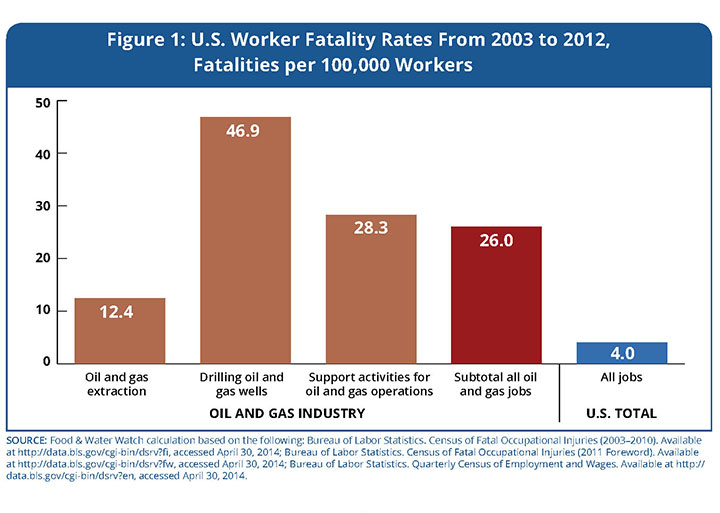
Is there a salary worth risking your health or even your life? Big Oil and Gas might think so, but the ex-industry workers with whom we spoke aren’t so convinced.

Today, Food & Water Watch released Toxic Workplace: Fracking Hazards on the Job, a research brief that exposes the dangers of working in the fracking industry. Subject to long hours on the job, sloppy safety regulations and reporting, lack of injury compensation and close contact with hazardous chemicals, former industry laborers agree that the fracking workplace is a toxic one. As we reflect on the social and economic successes of the labor movement over this holiday weekend, it becomes more evident that the fracking industry may have missed the memo.

The practice of hydraulic fracturing involves drilling down to a targeted rock formation and injecting large volumes of water, sand and toxic chemicals at extreme pressure to create fractures in the rock and release tightly held oil and gas. The chemicals used in the fracking process can cause cancer and damage the nervous system, immune and cardiovascular systems and upset the endocrine system.

At the site, workers can be exposed to volatile organic compounds, including benzene and toluene, as well as fugitive methane, which are often released during fracking and can mix with nitrogen oxide emissions from diesel-fueled vehicles and stationary equipment to form ground-level ozone. Workers can also be exposed to silica sand, which is often used in the fracking process, and is a known human carcinogen. Long term exposure to silica, a component that makes up as much as 99 percent of frac sand, increases the likelihood of developing silicosis, which damages lung tissue and inhibits lungs function. Breathing it can make a person more susceptible to tuberculosis and is also associated with autoimmune disorders and kidney disease.

Interview - The Politics of Going Green

Chris Williams and Robert Pollin interviewed by Jessica Desvarieux - The Real News Network, July 30, 2014

Disclaimer: The views expressed here are not the official position of the IWW (or even the IWW’s EUC) and do not necessarily represent the views of anyone but the author’s.

Biography

Chris Williams is a long-time environmental activist and author of Ecology and Socialism: Solutions to Capitalist Ecological Crisis. He is chair of the science department at Packer Collegiate Institute and adjunct professor at Pace University, in the Department of Chemistry and Physical Science. His writings have appeared in numerous publications, including TruthOut, Z Magazine, Green Left Weekly, Alternet, CommonDreams, ClimateAndCapitalism, ClimateStoryTellers, The Indypendent, Dissident Voice, International Socialist Review, Socialist Worker, and ZNet. He reported from Fukushima in 2011 and was a Lannan writer-in-residence in Marfa, Texas over the summer of 2012, where he began work on his second book. He was awarded the Lannan 2013-4 Cultural Freedom Fellowship to continue this work. He has just returned from four months in Vietnam, Morocco and Bolivia, examining the impact of economic development and climate change in relation to energy, food and water issues.

Robert Pollin is professor of economics at the University of Massachusetts Amherst. He is the founding co-director of the Political Economy Research Institute (PERI). His research centers on macroeconomics, conditions for low-wage workers in the US and globally, the analysis of financial markets, and the economics of building a clean-energy economy in the US. His latest book is Back to Full Employment. Other books include A Measure of Fairness: The Economics of Living Wages and Minimum Wages in the United States and Contours of Descent: US Economic Fractures and the Landscape of Global Austerity.

(Working Paper #1) Global Shale Gas and the Anti-Fracking Movement

By Sean Sweeney and Lara Skinner - Trade Unions for Energy Democracy, June 2014

This paper has been prepared to assist unions and their close allies who wish to better understand the impacts of shale gas drilling, or “fracking,” and want to develop a position or approach to fracking that protects workers, communities, and the environment. It begins with a summary of the shale gas industry’s global expansion, and then looks at the opposition to fracking that has emerged in a number of key countries. A preliminary profile of the anti-fracking movement highlights the goals and characteristics of this movement as well as the issues that lie at the heart of the resistance.

The paper concludes by attempting to bring together the available information on unions’ perspectives and positions on this increasingly important issue. It also raises for discussion the prospect of unions giving support to a global moratorium on fracking based either on the precautionary principle (the health and environmental effects are not fully understood or have still to be adequately addressed) or on the more definitive assessment that fracking can never be sufficiently safe in terms of its impact on health and the environment and should therefore be stopped altogether.

Read the report (PDF).

Coal Miners and the Green Agenda

By Robert Pollin - New Labor Forum, Winter 2014

From 2014...

In June 2012, President Obama announced his “Climate Action Plan.” This is his administration’s major second-term initiative to re-energize its agenda around fighting climate change and supporting major new investments in clean energy.

The primary focus of the Action Plan is the administration’s program to dramatically reduce carbon emissions from the country’s electricity utility plants. These emissions result primarily from burning coal, but also natural gas, to produce electricity. Carbon emissions from electricity generation represent about one-third of all greenhouse gas emissions produced by all sources within the U.S. economy today. It is evident that these emissions need to be cut dramatically if we are going to stop playing Russian roulette with the environment.

New Regulations and Technologies Are Not Enough

The administration’s strategy for achieving these emissions cuts is to begin strictly enforc-ing the existing air pollution regulations estab-lished as part of the 1990 Clean Air Act.

The administration is taking this approach because it allows them to avoid asking Congress to either spend more money or pass new regulations.The administration expects that the utility companies can achieve the needed emissions reductions through a technological fix: the introduction of carbon capture and sequestra-tion (CCS) processes, through which, they believe, coal and natural gas could burn cleanly. This is how the phrase “clean coal” has begun to emerge on billboards and TV commercials. CCS encompasses several specific technolo-gies that aim to capture carbon emissions from power plants and other industrial facilities. The captured carbon is then transported, usually through pipelines, to locations where it is then stored permanently—that is, for all time—in subsurface geological formations.

Opponents of the administration’s Action Plan claim that CCS remains unproven and, even if it becomes technically feasible, would impose heavy new costs on utilities.

In this instance, the administration’s critics have the weight of evidence on their side. As such, the Action Plan faces two fundamental problems. First, as there is no proven technol-ogy for delivering clean coal—or, for that mat- ter, clean oil or natural gas—the only viable path for dramatically reducing carbon emis-sions is to sharply reduce fossil fuel consump-tion. This, in turn, means that workers and communities dependent on the fossil fuel indus-tries will face job losses and retrenchment. It is therefore no surprise that even Democratic pol-iticians representing the affected communities are actively opposing Obama’s initiative.

Read the report (PDF).

One Million Climate Jobs: Tackling the Environmental and Economic Crises

By Jonathan Neale, et. al. - Campaign against Climate Change, 2014

This booklet is about hope in the face of crisis. The economy is not working. Mass unemployment has lasted for years, and will last for many more. And at some point gradual climate change is going to turn into swift catastrophe. Dangerous climate change is a consequence of the work of the hands and brains of many men and women. It will take the hands and brains of many men and women to undo the damage. So many climate activists, and several trade unions, have decided to fight to make the government create one million climate jobs. This report sets out our case. To halt climate change we need drastic cuts in the amount of carbon dioxide and other greenhouse gases we put into the air. That means leaving most of the existing reserves of high carbon fuels – coal, oil and gas – in the ground. There are thousands of things we need to do to make that a reality. But three of them will make most of the difference.

We need workers to build enough wind power, solar power, wave power and tidal power to meet all our energy needs. We need workers to insulate and retrofit all our existing homes and buildings in order to conserve energy. And we need workers to run a massive public transport system powered by renewable electricity. We have people who need jobs, and jobs that must be done. So we want the government to hire a million people to do new climate jobs now in an integrated National Climate Service.Our estimate is that those workers could cut our CO2 emissions by 86% in twenty years. We can also create another half a million jobs in the supply line. And we can guarantee a new job to anyone who loses their job because of these changes.

This booklet explains how we can do all of this, and why we must. ‘Climate jobs’ are not the same as ‘green jobs’. Some green jobs help the climate, but ‘green jobs’ can mean anything – park rangers, bird wardens, pollution control, or refuse workers. All these jobs are necessary, but they do not stop climate change. Climate jobs are jobs that lead directly to cuts in emissions of greenhouse gases, and so slow down climate change. For instance, workers who build wind farms replace power stations that burn coal or oil. Workers who insulate buildings reduce the oil and gas we burn. Bus drivers reduce the amount of oil we burn in cars. We want a million new jobs. We don’t want to add up existing jobs and new jobs and say that now we have a million climate jobs. We don’t mean jobs that will be ‘created’ by some mysterious market process by 2030. We want the government to hire 90,000 new workers each month to do new climate jobs. In a year we will have a million new jobs.

Read the report (PDF).

Fracking Capitalism: Action plans for the eco-social crisis

By staff - A World to Win, November 2013

The message has gone out to corporations everywhere: Britain is open for fracking. In response, campaign groups now exist the length and breadth of Britain in opposition to the plans to industrialise the countryside with tens of thousands of drilling sites. They are taking legal action, lobbying their representatives and protesting and occupying sites at considerable risk of police brutality.

But this grass roots movement is up against formidable adversaries. Corporations have the backing of the state and a public relations campaign led by the government is promoting the lie that fracking is safe and will lead to cheaper energy.

Yet public support for shale gas extraction continues to fall while backing for renewables grows. Government claims about jobs and lower gas prices are exposed for the grand deceptions they are. None of this will deter the Cameron government, however, which has thrown the weight of the state behind the frackers.

Read the report (Link).

Pages

The Fine Print I:

Disclaimer: The views expressed on this site are not the official position of the IWW (or even the IWW’s EUC) unless otherwise indicated and do not necessarily represent the views of anyone but the author’s, nor should it be assumed that any of these authors automatically support the IWW or endorse any of its positions.

Further: the inclusion of a link on our site (other than the link to the main IWW site) does not imply endorsement by or an alliance with the IWW. These sites have been chosen by our members due to their perceived relevance to the IWW EUC and are included here for informational purposes only. If you have any suggestions or comments on any of the links included (or not included) above, please contact us.

The Fine Print II:

Fair Use Notice: The material on this site is provided for educational and informational purposes. It may contain copyrighted material the use of which has not always been specifically authorized by the copyright owner. It is being made available in an effort to advance the understanding of scientific, environmental, economic, social justice and human rights issues etc.

It is believed that this constitutes a 'fair use' of any such copyrighted material as provided for in section 107 of the US Copyright Law. In accordance with Title 17 U.S.C. Section 107, the material on this site is distributed without profit to those who have an interest in using the included information for research and educational purposes. If you wish to use copyrighted material from this site for purposes of your own that go beyond 'fair use', you must obtain permission from the copyright owner. The information on this site does not constitute legal or technical advice.

