By Peter Sheldon, Raja Junankar, and Anthony De Rosa Pontello - CFMMEU Mining and Energy, December 3, 2018
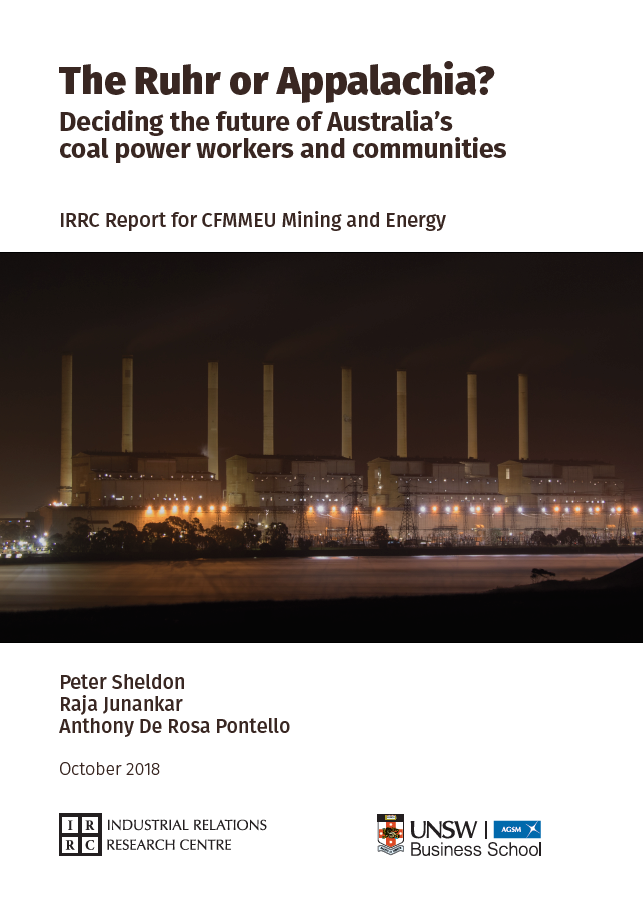 Australia’s coal-fired power stations will all close in the next two or three decades. We know this because the companies that operate the 23 power stations currently operating nation-wide have told us so.
Despite the empty rhetoric of some, it is unlikely that the economic case for investing in new coal-fired power stations in Australia will stack up. Those who currently own and operate coal power stations have no plans to build new ones.
The bad news is that the transition in how we produce power will bring great change to the workers and communities we have relied on to provide Australian homes and industry with reliable energy over many decades.
The good news is that we have the lead time to make smart decisions about what that change looks like—or at least, we now have the lead time after being caught unprepared by earlier closures, including Hazelwood in 2017.We have the choice to manage this structural economic change so that individuals, families and regions aren’t abandoned to unemployment, low-value jobs, poverty and associated health and social decline. Even better, we have the evidence about what works to deliver just transitions for coal power workers and communities, with skills, jobs, opportunities and hope for the future.
Communities grow around power stations and the mines that supply them. They are unique communities bonded in many cases by history, geography, difficult and dangerous working conditions and good unionised jobs. They are also uniquely vulnerable in their heavy dependence on the coal power industry.
This analysis of transitions in resource economies internationally and here in Australia provides valuable insights into the ingredients of success and the wide scope of outcomes.The Appalachian region in the United States is a heart-breaking story of industry transition characterised by short-term, reactive and fragmented responses to closures of coal mines, resulting in entrenched, intergenerational poverty and social dysfunction.
Compare this with the transition away from a heavy reliance on coal mining in Germany’s Ruhr region, where forward planning, investment in industry diversification, staggering of mine closures and a comprehensive package of just transition measures delivered a major reshaping of the regional economy with no forced job losses.
Central to these vastly different outcomes is the presence of a national, coordinated response. To this end, a major recommendation of this report is the establishment of a national, independent statutory authority to plan, coordinate and manage the transition.
In the energy debate to date, the impact of the transition on workers and communities has been almost completely ignored. This is an omission we can’t afford. After all, the costs of investing in a Just Transition need to be balanced against the costs of doing nothing and abandoning whole communities to a bleak future.
While global trends suggest that Australian export coal for steelmaking and energy production will be in demand for decades to come, coal-fired power generation in Australia is winding down. On the information available, there are no excuses for not taking action to protect the best interests of those affected.</p.
I thank Peter Sheldon and the team at UNSW Sydney’s Industrial Relations Research Centre for this important piece of work. I call on all power industry stakeholders to engage with its findings and consider how we can work together to deliver a Just Transition for coal power workers and communities.
Read the report (PDF).






 A July 2017
  July 2017 saw the release of
  Whenever the government fumbles around desperately for the story they can sell as success, they often reach for the following statistic: that since the Conservatives took power in 2010, unemployment has dropped, and more people than ever are in work. But this simple story conceals a much more worrying truth – that work simply doesn’t guarantee a decent standard of living any more. Official statistics gloss over the effects of semi-employment, self-employment, self-unemployment, zero-hours contracts and a shrinking in real wages, leaving four million people in in-work poverty. The sluggish growth of the apparent recovery is distorted by financial markets, and concentrated largely in the hands of the wealthy – particularly in the South of England. What growth does trickle down to the average worker is eaten up by inflation and falling wages. In other words, UK workers are in dire need of radical change to deliver a more just economy. And with automation promising to turf more jobs onto the scrapheap, maybe it’s time to stop thinking about how to “Get Britain working” – but how to share out labour more fairly across the workforce.
 The role of trade unions and social dialogue is key in demonstrating the major differences between coal-based energy generation and the automobile industry. This book presents two faces of a just transition towards a net-zero carbon economy by drawing lessons from these two carbon-intensive sectors. The authors regard just transition not as an abstract concept, but as a real practice in real workplaces. While decarbonisation itself is a common objective, particular transitions take place in work environments that are themselves determined by the state of the capital-labour relationship, with inherent conflicts of interest, during the transition process.
 The certainty of an Appalachian transition has become self-evident. The questions that remain are “What shape will that transition take?” and “Will our region seize the opportunity to establish just and sustainable economic models that invest in our strengths and set the region up for meaningful and healthy participation in the new economy?” Foundational to our coalition’s work is the understanding that specific, targeted intervention is necessary to ensure that an equitable vision becomes reality.
 The need for urgent and more intensive actions against climate change is broadly recognized. In support of this agenda, this report presents a simple yet profound vision: a circular, responsible and just battery value chain is one of the major near- term drivers to realize the 2°C Paris Agreement goal in the transport and power sectors, setting course towards achieving the 1.5°C goal if complemented with other technologies and collaborative efforts.
 It appears we face a low- carbon transition dilemma. On the one hand, climate change solutions, like greenhouse gas regulation and carbon pricing, raise concerns about potential job displacement for workers in traditional energy sectors like oil and gas production and fossil-fuel generated electricity. Hence the calls for just transition. Our research, however, suggests that this blame may be at least partially misplaced. Energy workforce changes are currently affected by broader societal changes relating to fuel-cost differentials (i.e., natural gas cheaper than coal), automation, and the societal transition to non-unionized, unstable and lower-paying work. Greenhouse gas regulations and carbon pricing are certainly not the only driver of workforce change, and likely not, at least currently, not the primary driver.
 Much of the argument advanced in support of expanding Canada’s fossil fuel production centres on job creation and economic benefits. Politicians, pundits and corporate spokespeople who support fossil fuel infrastructure projects—such as new oil and gas pipelines—often evoke this rhetoric when they appear in the media.
 This site is not the official webpage of the Industrial Workers of the World.