You are here

Railroad Workers United (RWU)

RailCon 15 coming to Chicago

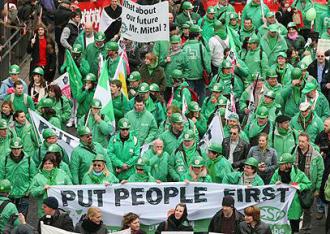
By Ron Kaminkow and Mark Burrows - Railroad Workers United, August 24, 2015; image by Jon Flanders

Disclaimer: The views expressed here are not the official position of the IWW (or even the IWW’s EUC) and do not necessarily represent the views of anyone but the author’s.

On Saturday, September 19th, the cross-craft solidarity group Railroad Workers United (RWU) will sponsor a conference on rail safety. RWU is partnering with other labor, citizens and environmental groups to organize this innovative and cutting edge conference, entitled “Railroads Safety, Workers, Community and the Environment.” The Chicago conference is a follow up to two earlier conferences held in March of this year in Richmond, CA and Olympia, WA. All interested parties concerned about the safety and the future of railroads are invited to attend.

In the past two years, public attention has focused on the railroad in a way not seen for decades. In the wake of Lac Megantic and other train derailments, resulting fires and explosions, the public is alarmed about the movement of trains through their communities. Environmental activists are up-in-arms about the amount of fossil fuels moving by rail. Farmers and other shippers are concerned about the recent oil train congestion. All this attention gives railroad workers an invaluable opportunity to educate the public about the railroad, its inherent efficiencies and value to society, its great potential, and also the challenging situation that railroad workers face on the job every day.

The public has little idea what railroads are all about. These conferences will shed light on worker issues such as crew fatigue, single employee train crews, excessively long and heavy trains, short staffing, limited time off work and more. These are safety concerns not just for railroaders, but for society in general. Non-railroaders in attendance at the conference will come away with a deeper understanding and a greater appreciation of the issues facing rail and railroad workers. Railroaders will gain insight into the environmental movement and learn how to forge alliances with public citizens. And all participants will come away with a better understanding of how all of us can work together to build a safer, greener and more just railroad that meets the needs of current and future generations.

Tentative workshops and discussion topics at the conference include:

  • Single employee train crews and the hazards they pose for workers, communities and the environment.
  • Excessively long and heavy trains and their inherent problems and dangers.
  • Crew fatigue and “task overload” and the need for well-rested, well-trained, alert and safe train crews.
  • Building worker-to-worker alliances along the supply chain of all transport workers and communities.
  • Chicagoland citizen efforts to deal with the dangers and hazards of trains moving through their community.
  • A history of worker-community-environmental alliances and how to build one around the railroad industry.

The conference is planned for Saturday, September 19th at the United Electrical (UE) Union Hall at 37 South Ashland Avenue, Chicago, Illinois 60607. Registration Fee is $20.00 and includes a healthy lunch. For those interested, a banquet at a nearby restaurant will follow in the evening. Scholarships are available. For more information and/or to register, check the official conference website at www.railroadconference.org; and the RWU website at www.railroadworkersunited.org.

The Struggle Of Japanese Railway Workers Against Privatization and Union Busting/Nuclear Power And The Threat Of Imperialist War In Asia: Report By Doro-Chiba International Support Committee

Announcement - Transport Workers Solidarity Committee, August 7, 2015

Disclaimer: The views expressed here are not the official position of the IWW (or even the IWW’s EUC) and do not necessarily represent the views of anyone but the author’s.

The Japanese Abe government is working to crush all political opposition. It is reopening NUKE plants such as the Sendai nuclear plant, passing secrecy laws and also is attacking labor and all working people with economic attacks and increased repression. Doro-Chiba is a militant railway union based in Chiba,, Japan that has been fighting privatization of Japan rail for decades, opposing nuclear power and also linking up with Korean workers including the Korean Railway Workers Union who had a national strike against privatization of the Korea Rail.

The US government and US politicians both Democrat and Republicans are pushing for militarization of Japan and the elimination of clause 9 which prohibits offensive wars. Despite mass opposition of the people of Japan the government continues to push ahead with reaming, selling weapons to other countries and towards war with China and other countries of Asia. The revision of Japanese textbooks to censor the role of the sex slaves by the Japanese government and military during the 2nd WW is part and parcel of encouraging nationalism and a racist campaign against the people of other countries in Asia.
This delegate of the Doro-Chiba International Support Committee will report on the struggle of the railway workers, the fight against nuclear power and against a new imperialist war in Asia.

The need for US railway and transportation workers as well as all working people to oppose the opening of Japan’s 48 nuclear plants, the continued attacks on Japanese workers and war in Asia is critical. The working people have the power to halt these growing threats.

Sponsored by Transport Workers Solidarity Committee and United Public Workers for Action.

COIL (coal & oil) Forum held @ Gonzaga Law Library

By Dancing Crow Media - Dancing Crow Media, June 23rd, 2015

Disclaimer: The views expressed here are not the official position of the IWW (or even the IWW’s EUC) and do not necessarily represent the views of anyone but the author’s.

COIL (coal & oil) Forum held @ Gonzaga Law Library, June 23rd, 2015 - Full version from Dancing Crow Media on Vimeo.

Featuring Eric DePlace from the Sightline Institute, Spokane City Council President Ben Stuckart, Twa-le Abrahamson-Swan from the Spokane Tribe, Jen Wallis from Railroad Workers United and Jace Bylenga from the Sierra Club.

Railroad Workers United's Jen Wallis and Greenpeace's Kim Marks on We Do The Work radio

By Jen Wallis and Kim Marks - We Do the Work Radio, July 28, 2015

Disclaimer: The views expressed here are not the official position of the IWW (or even the IWW’s EUC) and do not necessarily represent the views of anyone but the author’s.

How the Labor and Environmentalist Movements Can Put Workers at the Center of Climate Justice

By Trish Kahle - In These Times, July 1, 2015

Disclaimer: The views expressed here are not the official position of the IWW (or even the IWW’s EUC) and do not necessarily represent the views of anyone but the author’s.

2015, only halfway over, has already been an extreme year for both labor and the climate: the Midwest and Texas are experiencing record rainfall while California is in a record-breaking drought, and 2015 is the hottest year on record so far (the standing record is from 2014), including a heatwave in India that left more than 2,300 people dead. The Obama administration continues to try and push through the Trans-Pacific Partnership on fast-track, with millions of workers livelihoods hanging in the global balance and attacks on unions like the United Steelworkers continue to threaten worker, community and environmental safety. Meanwhile, energy companies insist that drilling in the soon-to-be ice-free summertime arctic will create jobs—even as it may mean game over for the climate.

There has perhaps never been a more prescient moment to emphasize what a growing number of people already know: the fate of labor and the climate are linked. In his most recent piece for The Nation, Jeremy Brecher notes how well suited the traditions of the labor movement are to the fight for climate protection: "The labor movement's most essential value is solidarity ... that we will survive and prosper only if we look out for one another. Climate protection is the new solidarity." Brecher, a founder of the Labor Network for Sustainability and author of Climate Insurgency: A Strategy for Survival as well as the classic labor history Strike! is at the forefront of the struggle to break down the false dichotomy of "jobs versus environment" and to fight for a just transition that puts workers at the center of a vision of climate justice. 

EcoUnionist News #55

Compiled by x344543 - IWW Environmental Unionism Caucus, July 7, 2015

Disclaimer: The views expressed here are not the official position of the IWW (or even the IWW’s EUC) and do not necessarily represent the views of anyone but the author’s.

The following news items feature issues, discussions, campaigns, or information potentially relevant to green unionists:

Lead Story:

Bread and Roses:

An Injury to One is an Injury to All:

Just Transition:

Other News:

For more green news, please visit our news feeds section on ecology.iww.org; Twitter #IWWEUC; Hashtags: #greenunionism #greensyndicalism #IWW

Dr. StrangeWeather, or How I Learned to Stop Worrying and Love The Bomb-Train

By Stephyn Quirke - Earth First! Newswire, June 24, 2015

Disclaimer: The views expressed here are not the official position of the IWW (or even the IWW’s EUC) and do not necessarily represent the views of anyone but the author’s.

Is our weather getting funny?

Some bushes and flowers started to bloom near the end of January this year, and in the spring cherry blossoms were blooming weeks early. This capped a winter with extremely low snowfall in the Cascade Mountains. The abnormal heat, combined with the drought now covering 80% of Oregon, has actually raised temperatures in the Willamette River above 70 degrees, recently killing chinook salmon as they made their way up-stream to spawn.

In March, tribal leaders from the Affiliated Tribes of Northwest Indians converged in Portland to discuss this ongoing phenomenon of strange weather, which they cannily dubbed “climate change”. These changes, they said, were related to a pattern of global warming, and were creating unique hardship on Northwest tribes. In 2013, the ATNI also passed a resolution opposing all new fossil fuel proposals in the Northwest, citing harm to their treaty rights, cultural resources, and land they hold sacred. Now the Affiliated Tribes are discussing plans for adaptation and mitigation, and asking how to undermine the root causes of climate change.

In addition to the sudden onset of strange weather, Portland has also seen the abrupt arrival of strange, mile-long trains loaded with crude oil – a very unusual sight in the Northwest until just two years ago. In the event of a derailment or crash, these trains are known to increase the temperature of surrounding areas by several hundred degrees – a strange weather event by any standard. This phenomenon has become so common that the train engineers who run them actually call them “bomb trains”.

While the danger of unplanned explosions is universally recognized, the risks of strange weather, and the planned explosions that take place in our internal combustion engines, are typically less appreciated. But the connections are becoming more obvious as the figure of the oil train valiantly pulls them together.

The sudden appearance of oil trains in the Northwest is one effect of the unprecedented crusade for oil extraction in North America – one that has produced a massive wave of opposition from residents and elected officials. In Washington state alone, nine cities representing 40% of the state’s population have passed resolutions that oppose oil trains. In Alberta resistance to oil politics recently replaced a 44-year ruling party with socialists. And in Portland, anger against oil trains just smashed a city proposal to bring propane trains into the port.

In recent months rail workers have become increasingly vocal about the industry-wide safety problems that lead to fiery train accidents. They are also critical of the latest safety rules that allegedly protect the public from accidents. Rail Workers United, a coalition of rail workers and their unions, says that the best way to make trains safer is to increase worker control and self-management; they propose a host of reforms that profit-obsessed rail companies are not interested in hearing. For many rail-side communities there is a parallel interest in community control over the railroads: no fossil fuel trains are safe for them as long as trains derail and the climate unravels. Together, the two movements are calling for a better future for our railroads and our environment, and demanding more public influence to safeguard both.

Who's Really to Blame for Train Wrecks?

By Ron Kaminkow - Labor Notes, June 16, 2015

Disclaimer: The views expressed here are not the official position of the IWW (or even the IWW’s EUC) and do not necessarily represent the views of anyone but the author’s.

The news media have been full of speculation about what caused an Amtrak train to derail east of Philadelphia on May 12, killing at least eight people and injuring hundreds.

Train #188, operated by lone engineer Brandon Bostian, entered a curve with a speed limit of 50 miles per hour, at over 100.

Was this excessive speed the result of fatigue, inattentiveness, a projectile that hit the train (and possibly the engineer), or some other factor? The investigation may eventually pinpoint the cause—or we may never know.

But we do know this: had there been a second crew member in the cab, it’s very likely that person would have taken action to prevent the tragedy when, for whatever reason, the engineer at the controls could not.

And blaming a worker just distracts the public from eliminating the real hazards. There exists simple, affordable technology that Amtrak could and should have implemented years ago—which could have prevented this terrible wreck.

Railroad Workers United to Observe 7th Annual Railroad Workers Memorial Day On Friday, June 19th 2015

By John Paul Wright - Railroad Workers United Blog, June 9, 2015

Disclaimer: The views expressed here are not the official position of the IWW (or even the IWW’s EUC) and do not necessarily represent the views of anyone but the author’s.

On Friday, June 19th 2015 railroad workers are encouraged to wear black to work as a sign of remembrance and recognition of our fallen brothers and sisters who were killed on the job over the course of the previous year. Sponsored by Railroad Workers United, each year the event focuses on a specific theme. Because of the large number of contract and non-union railroaders who were killed the past 12 months, this year’s Railroad Workers Memorial Day will focus on these workers and their plight.

Those non-union and contract workers killed this past year include: a contract worker involved in track work on Canadian Pacific near Forreston, IL; a train crew member of The Western Group, while operating a train near Roswell, NM on former BNSF territory; two employees of a contract railcar servicing outfit while performing service in Omaha, NE; a trainman spotting cars at an industry in Pine Bluff, AR; a contract worker for BNSF unloading rail cars in Kansas City, KS; a conductor making a switch move for Alabama Warrior Railway in Birmingham, AL.

Throughout our history, railroad workers have organized into unions to improve our wages, benefits and working conditions. Improved safety has always been a major reason for railroad workers to organize. Rail carriers – like other corporations - have historically resisted employee organization and the associated demands for better wages, benefits and working conditions.

In recent decades, rail carriers – once again like many modern corporations – have devised a means by which they can circumvent the largely unionized railroad workforce. It is known as “contracting out”. Rather than keep the work in-house, the big rail carriers have opted to farm out all types of jobs to smaller, mostly non-union outfits that all-too-often offer their employees low pay, few benefits, and miserable unsafe working conditions.

Class I railroads have contracted out everything from locomotive servicing to track construction, weed spraying and brush trimming to car repair, rail inspection and train crew transport. It is hard to say just how many jobs have been contracted in this manner, in the tens of thousands perhaps. This is bad news for all railroad workers and it is an issue of grave concern to the future of our industry, our working conditions, pension, and crucially, our safety and health.

The railroad industry proudly touts its safety programs, the declining numbers of on-the-job “reportable” injuries and so forth. However, this disingenuous posturing ignores the fact that the railroad is engaged in contracting out work to outfits that often have poor safety standards and records. These contract companies employ workers – usually on the railroad’s property -- to perform the exact same work that was once performed by railroad employees. But now cynically, the railroad takes no responsibility for these workers because they are no longer in the railroad’s direct employ. The rail carriers’ attitude towards these workers is that the company is not responsible for their health and safety – even though they are on railroad property, performing the same essential work that was once done by our own employees, working in safety sensitive jobs, and making profit for the company’s bottom line. Also, the carriers know that many accidents and injuries of contract workers do not have to be reported to the FRA.

Just because the people servicing the locomotives, cutting the brush or driving the train crews are no longer directly employed by the railroad does not mean that union railroaders should turn our backs on them. Not only are they our fellow workers who work right alongside us, but our very ability to thrive and prosper is intrinsically linked to theirs! The rail labor unions must resist this “de-unionization” of these jobs, and begin to aggressively organize these contract workers.

Therefore, RWU will continue to reach out and support the efforts of all contract railroad workers to organize into a union, and we hope that all railroad union members understand that our safety is directly linked to the safety of our brothers and sisters in the contract sector.

IWW Mobile Rail Workers Win AGAIN!

Press Release - Mobile Rail Workers Union, May 20, 2015

Disclaimer: The views expressed here are not the official position of the IWW (or even the IWW’s EUC) and do not necessarily represent the views of anyone but the author’s.

The workers from the Mobile Rail Workers Union have won ONCE AGAIN another round of ULP's in 2015 (Unfair Labor Practices) The full settlement details are below. We continue to fight and bargain for our first contract.

UNITED STATES GOVERNMENT NATIONAL LABOR RELATIONS BOARD SETTLEMENT AGREEMENT IN THE MATTER OF Mobile Rail Solutions, Inc.

  • Case 13-CA-129684
  • 13-CA-130242
  • 13-CA-130243
  • 13-CA-132704
  • 13-CA-137168

Subject to the approval of the Regional Director for the National Labor Relations Board, the Charged Party and the Charging Party HEREBY AGREE TO SETTLE THE ABOVE MATTER AS FOLLOWS:

POSTING AND MAILING OF NOTICE — After the Regional Director has approved this Agreement, the Regional Office will send copies of the approved Notice to the Charged Party in English and in Spanish. A responsible official of the Charged Party will then sign and date those Notices and immediately post them at the following Mobile Rail Solutions, Inc locations: Chicago (Storage Bay), G1 – Chicago (locations where notices to employees are regularly posted), G2 – Melrose Park (Storage Container), G3 – Rochelle (Storage Container).

The Charged Party will keep all Notices posted for 60 consecutive days after the initial posting. The Charged Party will also copy and mail, at its own expense, a copy of the attached Notice to all current employees and former employees who were employed at any time since December 1, 2013. Those Notices will be signed by a responsible official of the Charged Party and show the date of mailing.

The Charged Party will provide the Regional Director written confirmation of the date of mailing and a list of names and addresses of employees to whom the Notices were mailed.

COMPLIANCE WITH NOTICE — The Charged Party will comply with all the terms and provisions of said Notice.

PAYMENT OF WAGES AND BENEFITS — Within 21 days from approval of this agreement, the Charged Party will make whole the employee(s) named below by payment to each of them of the amount opposite each name. The amount payable to Ahern is for back pay and front pay wages, and as consideration, Ahern has agreed to waive any right to reinstatement.

The Charged Party will make appropriate withholdings for each named employee. No withholdings should be made from the interest portion of the backpay.

The Charged Party will also file a report with the Social Security Administration allocating the payment(s) to the appropriate time periods.

Pages

The Fine Print I:

Disclaimer: The views expressed on this site are not the official position of the IWW (or even the IWW’s EUC) unless otherwise indicated and do not necessarily represent the views of anyone but the author’s, nor should it be assumed that any of these authors automatically support the IWW or endorse any of its positions.

Further: the inclusion of a link on our site (other than the link to the main IWW site) does not imply endorsement by or an alliance with the IWW. These sites have been chosen by our members due to their perceived relevance to the IWW EUC and are included here for informational purposes only. If you have any suggestions or comments on any of the links included (or not included) above, please contact us.

The Fine Print II:

Fair Use Notice: The material on this site is provided for educational and informational purposes. It may contain copyrighted material the use of which has not always been specifically authorized by the copyright owner. It is being made available in an effort to advance the understanding of scientific, environmental, economic, social justice and human rights issues etc.

It is believed that this constitutes a 'fair use' of any such copyrighted material as provided for in section 107 of the US Copyright Law. In accordance with Title 17 U.S.C. Section 107, the material on this site is distributed without profit to those who have an interest in using the included information for research and educational purposes. If you wish to use copyrighted material from this site for purposes of your own that go beyond 'fair use', you must obtain permission from the copyright owner. The information on this site does not constitute legal or technical advice.