You are here

strategy and tactics

Climate Crisis: Which Transitional Demands Should Ecosocialists Campaign For?

By Mike Shaughnessy - London Green Left Blog, April 20, 2021

The concept of transitional demands will be familiar to traditional socialists, particularly those followers of Leon Trotsky’s theories of socialism, although, I hasten to add, Trotsky was no ecosocialist. These demands are designed to appear to sound reasonable to the average citizen, and not directly lead to the overthrow of capitalism, but instead to create a pathway to socialism. They are more than just asking for reforms to the capitalist system, although they would be reforms, but they are not ends in themselves.

Much as I would like to see the overthrow of the capitalist system, and as an ecosocialist, I believe that this is necessary if we are to solve the climate crisis and the many other bad effects, both ecological and social, that capitalism creates. But there just isn’t enough time left.

If we are brutally honest with ourselves, a revolution to replace capitalism with ecosocialism is not on the horizon, and the well-being of the earth and all those (human and non-human) who inhabit it are in such deep peril now, we really can’t afford to wait until those conditions arise, as they surely will at some stage. We need mitigating action now. 

So, which sort of demands should ecosocialists be making? Given the urgency of the situation on climate change particularly, with the Intergovernmental Panel on Climate Change (IPCC) in its latest assessment saying that we need to cut carbon emissions by 45% by 2030, to avoid catastrophic changes to the environment, this is the main goal that we need to pursue. But not the only one. 

The Kaleidoscope of Catastrophe: On the Clarities and Blind Spots of Andreas Malm

By Bue Rübner Hansen - Viewpoint Magazine, April 14, 2021

The course of history, seen in terms of the concept of catastrophe, can actually claim no more attention from thinkers than a child’s kaleidoscope, which with every turn of the hand dissolves the established order in a new way. There is a profound truth in this image. The concepts of the ruling class have always been the mirrors that enabled an image of order to prevail. - The kaleidoscope must be smashed. 

- Walter Benjamin, Central Park1

Recently, I announced my intention to write a long essay about Malm to a circle of degrowth communists. One, a researcher and activist of US pipeline struggles, was exasperated at Malm’s apparently contradictory embrace of a strategy of pushing the capitalist state to do the right thing in Corona, Climate and Chronic Emergency (2020) and his stringent support of sabotage in How to Blow up a Pipeline (2021). Another friend, who is a veteran leader in the climate justice movement, responded that Andreas Malm has “single-handedly saved Marxism from irrelevance over the past few years”. High praise for Malm and a harsh reproval of Marxism.

The frustration with Malm’s lack of clarity and the praise for his ability to bring together Marxism and environmentalism are of a piece: they both attest to the enormous expectations generated by his work, and his willingness to place himself in a position of intellectual leadership. More substantially, they testify to the difficulty and importance of the synthesis he is working towards. 

Among environmentalists, a deep disillusionment with Marxism is common. The critiques are by now familiar: Marxism’s commitment to the unfettered development of the forces of production is attached to the idea of human domination over nature. Malm, as we will see, comes out of a very different tradition of Marxism, and one that has done much to demonstrate that Marx - unlike most of his 20th century readers - was an ecological thinker. Malm extends the theoretical and philological groundwork of John Bellamy Foster and Paul Burkett, and more recently Kohei Saito2, into a more empirical engagement with contemporary ecological problems, profused with a profound sense of political urgency.3

Malm is one of too few Marxists to center the question of what needs to be done in the climate crises, and certainly the most prominent. In short, Malm presents as a man of action, both in theory and in practice. His books detail organizing for the 1995 COP1 climate summit in Berlin, deflating SUV tires in Southern Sweden in 2007, and occupying a German coal mine with Ende Gelände in 2019. For Malm the academic, the question of action is also front and center: 

Any theory for the warming condition should have the struggle to stabilize climate - with the demolition of the fossil economy the necessary first step - as its practical, if only ideal, point of reference. It should clear up space for action and resistance (The Progress, 18). 

Malm’s practice may be described with a paraphrase of Gramsci’s old formula: optimism of the will, catastrophism of the intellect. “The prospects are dismal: hence the need to spring into action” (FC 394). It is this approach that has made his name as more than a scholar, but as a militant thinker, and it is this reputation that frustrates readers looking for strategic clarity. Is Malm a Leninist (and therefore authoritarian) or is he a movementist who is ready to try anything from lobbying the capitalist state to blowing up pipelines? The work of any prolific and wide-ranging writer will contain ambivalences, even one as committed to clarity and decisiveness as Andreas Malm. Not all these ambivalences are Malm’s alone: In our current ecological predicament unanswered questions abound: How can we come to want the abolition of the energetic foundation of our everyday life? How do we feel about the end of growth and progress? Is the state part of the solution or the problem? Such questions entail ambivalence because of the gap between what needs to be done, and what we want to do - given our attachments to the present state of things.

Malm develops a method designed to abolish ambivalence: herein lies the clarity of his work. His approach may best be described as kaleidoscopic: it orders the heterogeneous shards of history through the mirrors of his theory of history, while a singular eyepiece provides focus, and the basis for a unified political perspective. But this method only avoids ambivalence in theory. When it comes to practice, ambivalences reappear – but in the blindspot of theory. Reviews of Malm’s individual works may miss these blindspots and ambivalences, but once we read them side by side, we can begin to understand that they are structural to his work.4

Lobbying politicians is holding back the climate movement

By Alex James - ROAR Mag, April 13, 2021

In early January, Labour leader Keir Starmer tweeted about his commitment to tackling the climate emergency, sharing an image of him meeting with several climate groups. The screenshot revealed all the Zoom meeting attendees: the Queen’s Council and several other Shadow Cabinet members, alongside figures from all the major wildlife and environmental charities, from Greenpeace to the WWF. The tweet showed a motley crew — a collection of old and pale smiling faces, confident in their ability to tackle the climate crisis.

The tweet was quickly ridiculed. Many from the UK Student Climate Network, the group coordinating climate strikes, pointed out the advanced age of the participants, and contrasted this with the Labor leader’s refusal to meet with the student strikers. Others pointed out the audacity of a meeting on the climate crisis — which is itself a racist crisis enfolding in forms of racialized violence — comprised of only white “climate leaders.” Another point was the exclusion of Labour’s own climate leadership, and the Party’s refusal to include the Labour for a Green New Deal coalition. The charge was clear: these people did not represent the climate movement.

This is a clear reflection of Starmer’s lack of ambition on climate change, and his wider refusal to engage with grassroots groups. As Chris Saltmarsh, co-founder of Labour for a Green New Deal, rightly points out, many of these NGOs backed climate targets in 2019 which were embarrassingly small in ambition, effectively excluding serious climate justice concerns. These organisations have repeatedly fallen short on issues of global justice and have been outflanked in mobilization by groups like Extinction Rebellion and the UK Student Climate Network, who take a much more ambitious stance on the need for urgent decarbonization.

Yet against many who responded to the tweet and as someone who has worked and volunteered for several climate NGOs, I am skeptical whether the inclusion of grassroots voices and organizations would be a political improvement for the climate justice movement.

The obsession to engage with elected officials that permeates many organizations — from small to big, new to established NGOs — is detrimental to the political horizon of the climate movement. Instead, the strategic focus should be on the building of alternative institutions of collective power and decision making, outside of the state.

The Future of People Power in the Coronavirus Depression

By Jeremy Brecher - Labor Network for Sustainability, March 25, 2021

What can we learn from the role of people power in the Great Depression and in the first year of the Coronavirus Depression? Based on the seven preceding commentaries on the New Deal and the popular movements of 2020, this commentary maintains that popular direct action can play a significant role in shaping the Biden era. It examines the emerging political context and suggests guidelines for navigating the complex landscape that lies ahead. To read this commentary, please visit this page.

Class Power can Remake Society: Remembering Australia’s "Green Ban” Movement

By Ben Purtill - Organizing Work, March 24, 2021

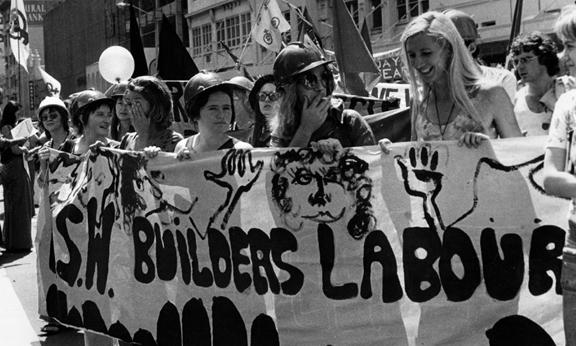
Ben Purtill recounts when building laborers in Australia stopped work, first over wages and working conditions, and then to protect the environment, among other “social” causes. Image: Jack Mundey, Building Labourers’ Federation members and local residents at a Green Ban demonstration, 1973.

Jack Mundey, who died aged 90 in May 2020, first made his name as the union leader associated with one of the most inspiring moments of class struggle of the last 50 years: Australia’s green ban movement. As a secretary of the New South Wales Builders Labourers’ Federation (BLF) from 1968, Mundey — a member, then president, of the Australian Communist Party (CPA) – was widely credited with coining the term “green ban” to describe a form of strike action undertaken in defense of environmental causes. Members of the NSW BLF also downed tools in defense of the gay community, indigenous Australians, and feminists, at a time when these causes were far from the mainstream of Australian society.

Reviled and vilified at the time, Mundey received a State Memorial Service in March 2021. Attended by the great and the good of Sydney, Mundey was hailed as a savior of the city — a renegade who broke with the base concerns of economistic trade unionism to focus on more refined issues than wages or workplace conditions, while prefiguring a social liberalism the nation would only begin to embrace decades later, and a green politics that it has yet to.

While the perceived content of Mundey’s unionism now sits quite comfortably with liberal — even conservative — values and principles, the form of unionism pursued by the NSW BLF at their peak in the early 1970s would undoubtedly be condemned were it revived today. Militant, democratic and regarded as quasi-syndicalist by critics and supporters alike, the story of the Mundey and the NSW BLF is one of both the power of the rank and file and the limits of leadership, no matter how left-wing.

Black Bans, Green Bans and everything in between

Most historical accounts suggest the green ban movement for which Mundey is best remembered began in 1971 at Kelly’s Bush, an area of parkland in Sydney’s affluent Hunter’s Hill suburb. A group of local women contacted the BLF having exhausted all conventional means of halting the development of the area by construction firm AV Jennings. With luxury houses set to be built on what was the last remaining patch of native bush in the suburb, the BLF called a community meeting attended by over 600 local residents and announced a ban, meaning no work would take place on the site. Unions had been using the term “black ban” to designate disputes aimed at an economic end, for example a wage increase, but since this action was being taken to defend the environment, “green ban” was decided to be more appropriate.

Over forty green bans followed until 1974, when the NSW BLF was deregistered as a union, resulting in billions of dollars worth of development being prevented in Sydney; the tactic was also deployed in other towns and cities across Australia, most notably Melbourne. All green bans were declared in a similar manner as a point of principle: the union did not decide to initiate a ban, local residents did so through a public meeting. If it was decided that a site would not be developed, BLF members would not work on it. In following this tactic, large areas of the historic centre of Sydney were saved from development, and the union joined alliances with an unlikely range of characters: early environmentalists, heritage campaigners, and middle-class homeowners.

The NSW BLF also applied the tactic to other causes and concerns, for example the expulsion of a gay student from Macquarie University, the demolition of houses occupied by indigenous Australians in the Redfern suburb of inner-city Sydney, and the right of two women academics to teach a women’s studies course. In each case, the campaigns were won. More broadly still, the BLF campaigned against apartheid South Africa and the war in Vietnam. As union secretary of the NSW branch during this period, Mundey is now typically remembered as the brainchild of this movement, even earning him a speaking slot at the United Nations Conference on the Built Environment, but it reflected much wider changes occurring both within the Australian left and among rank and file union members.

Green Syndicalism in the Arctic

By Jeff Shantz - LibCom, March 30, 2021

On February 4, 2021, a group of Inuit hunters set up a blockade of the Mary River iron ore mine on North Baffin Island. The mine is operated by Baffinland Iron Mines Corporation and has been extracting iron ore since 2015. Mine operations are carried out on lands owned by the Inuit.

Blockade organizers arrived from communities at Pond Inlet, Igloolik and Arctic Bay over concerns that Inuit harvesting rights are imperiled by the company's plans to expand the mine and associated operations. Solidarity demonstrations have been held in Pond Inlet, Iqaluit, Igloolik, Naujaat, and Taloyoak. In -30C degree temperatures.

Baffinland Iron Mines Corporation is seeking to double its annual mining output to 12 million metric tonnes. This would also see the corporation build a railway and increase shipping traffic through its port at Milne Inlet. These expansions would threaten land and marine wildlife along with food sources essential to Inuit people. The waters surrounding the port are an important habitat for narwhal and seals in the Canadian Arctic. The expansion also threatens caribou and ptarmigans.

A fly-in location, Inuit blockaders shut down the mine’s airstrip and trucking road, closing off access to and from the site for over a week. Notably this has meant that 700 workers have been stranded at the mine site and food, supply and worker change flights have been suspended. Workers have been on site for at least 21 days.

This could, obviously, have posed points of contention, even hostility, between workers and blockaders. Certainly, the company tried to stoke these tensions in its efforts to go ahead with mining operations. In a letter filed with the Nunavut Court of Justice on February 7, Baffinland told the protesters that their blockade is against federal and territorial law, and the Nunavut Agreement. In classic divide and conquer fashion, the company asserted: “You are causing significant harm by blocking a food supply and keeping people from returning to their families.” The company has also gotten the RCMP involved.

Yet an important development occurred a week into the blockade, and after the company’s court theatrics, as stranded workers issued a powerful statement of solidarity with Inuit people and communities and the blockaders specifically. The open letter is signed by a “sizeable minority” of Mary River mine workers currently stranded at the mine site (with 700 workers it represents a sizeable number). They have remained anonymous due to threats of firing leveled against them by the company. In their letter they assert that they recognize the Inuit, not the company, as “rightful custodians of the land.”

The letter represents a significant statement of green syndicalism. One that should be read, circulated, and discussed. It is reproduced in full here.

The Great Depression and the Coronavirus Depression

Workers and the Green New Deal Today

One of the Best Places to Fight for the Environment Is in Your Workplace

By Libronaught - Medium, February 24, 2021

One of the biggest roadblocks standing in the way of practical, cooperative solidarity between social movements is the idea of “separate issues.” In recent years people have begun chipping away at this shibboleth, but we still have a ways to go. One significant problem within the problem of the single-issue silo effect is that labor is sometimes mistakenly viewed as just another issue.

Labor is not just an issue. Labor is a power base. Labor organizing can be more effective at winning social gains on a range of “single issues” than weekend demonstrations, conscious consumerism, electioneering or lobbying.

In the US, we are often taught to view voting, lobbying and mass demonstrations as ways to participate in democracy. They all are, of course, but it’s not the full picture. As Jane McAlevey persuasively explains in her extraordinary book, A Collective Bargain, US democracy as we know it today would not exist if not for the labor movement. The organizing and solidarity efforts among US workers that eventually won the 8-hour day and the weekend began right after the American Revolution. Labor solidarity and organizing among women has put a driving force behind demands for gender equality for over 150 years. From the 1910s to the 1940s, a massive swell of labor solidarity and organizing crossed race and gender lines, won the current US Labor Rights laws, and led the country out of the Great Depression. Labor unions went on to participate in the 60s Civil Rights movements.

Overwhelming odds, unexpected alliances and tough losses: how defeating Keystone XL built a bolder, savvier climate movement

By Nick Engelfried - Waging Nonviolence, January 29, 2021

When President Biden rescinded a crucial permit for the Keystone XL pipeline last week, it marked the culmination of one of the longest, highest-profile campaigns in the North American climate movement. The opposition to Keystone XL included large environmental organizations, grassroots climate activist networks, Nebraska farmers, Texas landowners, Indigenous rights groups and tribal governments. Few environmental campaigns have touched so many people over such large swaths of the continent.

The Keystone XL resistance was part of the ongoing opposition to the Canadian tar sands, one of the most carbon-intensive industrial projects on the planet. Yet, it came to symbolize something even bigger. Many activists saw stopping Keystone XL as a measure of success for the climate movement itself.

“Keystone XL isn’t just any project,” said longtime activist Matt Leonard, who coordinated several major protests against the pipeline. “Its defeat is a testament to what movement building and direct action can accomplish.”

A stroke of President Biden’s pen finally killed Keystone XL. But paving the way for this victory were countless battles at the grassroots level, where activists tested new tactics and organizing strategies that built a bolder, savvier climate movement. Some of the groups involved took radically different approaches to politics, leading to unexpected alliances and occasional bitter feuds. And there were losses — other major oil pipelines, including the southern leg of Keystone XL itself, were completed even as the fight over the more famous northern half dragged on.

Yet, resistance to the Keystone XL’s northern leg succeeded against overwhelming odds. While there is always a possibility it could be resurrected someday, chances of that happening anytime soon seem slim. Understanding how this victory happened — and what it means for the climate movement — requires examining how 10-plus years of tar sands resistance played out in far-flung parts of North America.

Pages

The Fine Print I:

Disclaimer: The views expressed on this site are not the official position of the IWW (or even the IWW’s EUC) unless otherwise indicated and do not necessarily represent the views of anyone but the author’s, nor should it be assumed that any of these authors automatically support the IWW or endorse any of its positions.

Further: the inclusion of a link on our site (other than the link to the main IWW site) does not imply endorsement by or an alliance with the IWW. These sites have been chosen by our members due to their perceived relevance to the IWW EUC and are included here for informational purposes only. If you have any suggestions or comments on any of the links included (or not included) above, please contact us.

The Fine Print II:

Fair Use Notice: The material on this site is provided for educational and informational purposes. It may contain copyrighted material the use of which has not always been specifically authorized by the copyright owner. It is being made available in an effort to advance the understanding of scientific, environmental, economic, social justice and human rights issues etc.

It is believed that this constitutes a 'fair use' of any such copyrighted material as provided for in section 107 of the US Copyright Law. In accordance with Title 17 U.S.C. Section 107, the material on this site is distributed without profit to those who have an interest in using the included information for research and educational purposes. If you wish to use copyrighted material from this site for purposes of your own that go beyond 'fair use', you must obtain permission from the copyright owner. The information on this site does not constitute legal or technical advice.

