You are here

United Steelworkers of America (USW)

8 Unions Have a Plan for Climate Action—But It Doesn’t Mention Fighting the Fossil Fuel Industry

By Rachel M. Cohen - In These Times, August 26, 2019

On June 24, the BlueGreen Alliance — a national coalition which includes eight large labor unions and six influential environmental groups—released an eight-page document laying out its vision to curb climate change and reduce inequality. The report, dubbed Solidarity for Climate Action, marks a significant development in the world of environmental politics. It argues the needs of working people must be front-and-center as the U.S. responds to climate change, and rejects the ​“false choice” between economic security and a healthy planet.

While the report’s focus on public investment, good jobs and justice shares much in common with the federal Green New Deal resolution introduced in February, it also stands in tension with environmentalists who demand the U.S. work to transition more quickly away from oil, coal and natural gas. ​“We’d really like them to be stronger and more concise about what it means to move away from fossil fuels and transition to renewables,” said José Bravo, executive director of the Just Transition Alliance and speaking on behalf of the Climate Justice Alliance. Members of the BlueGreen Alliance say the ultimate goal should be to decarbonize the economy — to reduce CO2 emissions, but not necessarily end the fossil fuel industry itself, with its tens of thousands of high-paying jobs. Other climate groups say that won’t be enough, and humanity cannot afford to preserve industries that have caused so much environmental harm. This difference in vision will stand as one of the most fundamental political questions facing progressives in the next decade.

The report spells out a series of principles, including limiting warming to 1.5°C, expanding union jobs, modernizing infrastructure, bolstering environmental protections and rebuilding the nation’s manufacturing sector with green technologies. It also elevates the issue of equity, calling to ​“inject justice into our nation’s economy by ensuring that economic and environmental benefits of climate change solutions support the hardest hit workers and communities.” The BlueGreen Alliance emphasizes the disproportionate impact low-income workers and communities of color will face, and says those affected by the energy transition must receive ​“a just and viable transition” to new, high-quality union jobs.

(Read the rest here)

Solidarity for Climate Action

By staff - Blue Green Alliance, July 2019

Americans face the dual crises of climate change and increasing economic inequality, and for far too long, we’ve allowed the forces driving both crises to create a wedge between the need for economic security and a living environment. We know this is a false choice—we know that we can and must have both, and we need a bold plan to address both simultaneously.

Many solutions are already being put into place across the country. For example, tradespeople built the Block Island offshore wind project off the coast of Rhode Island, autoworkers are on the factory floors building cleaner cars and trucks in Michigan, and previously unemployed workers in St. Louis and Los Angeles are gaining access to high-skilled jobs in energy efficiency retrofitting, pipefitting, and transit manufacturing, while mine workers are extracting palladium to be used in catalytic converters. These are all good, union jobs building a clean energy and climate-resilient economy today.

At the same time, not enough of the new jobs that have been created or promised in the clean energy economy are high-quality, family-sustaining jobs, nor are these jobs in the same communities that have seen the loss of good-paying, union jobs.

Wildfires, hurricanes, heat waves, droughts, and sea-level rise driven by climate change are hurting communities across the country and will only worsen if we don’t take decisive action. Lower income workers and communities of color are hit the hardest and are less able to deal with these impacts as wages have fallen and their economic mobility and power in the workplace has declined.

It is critical that working people are front and center as we create a new economy: one that values our work, our families, our communities, and our environment. It is with that imperative that we call for a new plan to create jobs and protect the environment for the next generation. This plan must respond to the climate crisis on the scale that science demands, while simultaneously addressing inequality in all its forms.

Read the report (PDF).

Just Transition at the Intersection of Labour and Climate Justice Movements: Lessons from the Portuguese Climate Jobs Campaign

By Chrislain Eric Kenfack - University of Alberta, 2019

In the current context of climate change and its accompanying adverse effects on natural, human and social systems, the imperative of transitioning to low- and preferably post-carbon societies has become a non-negotiable reality if we want to avoid reaching the point of no return in terms of environmental and climate catastrophe. Such a transition requires that the interests and needs of workers and their communities be taken into consideration to make sure they do not bear the heaviest part of the burden in terms of loss of jobs and means of survival, and that they are prepared to face the new, post-carbon labour environment.

The concept of Just Transition was coined to describe both the socio-political project put forward by trade unions in response to climate change, and the recognition by climate activists that the livelihoods and security of workers and their communities must be ensured during the transition to a post-carbon society. However, just transition movements are divided between two quite different orientations, which are labelled “affirmative” and “transformative.” On the one hand, affirmative just transition advocates envisage a transition within the current political-economic system. Transformative just transition activists, on the other hand, envisage a post-capitalist transition.

This article, drawing upon an extensive case study of the Portuguese climate jobs campaign, goes beyond showing how these orientations shape the positions taken by union and climate activists. The article also analyses how the conflicts and cooperation between these key actors can shed light on the possibilities and/or limitations of just transition as a framework for the collective action needed to achieve rapid, deep decarbonisation of economies in the Global North context.

Read the report (PDF).

Union Locals Build Support for the Green New Deal’s “Just Transition”

By Candice Bernd - Truthout, April 6, 2019

Undeterred by the Senate’s recent dismissal of the Green New Deal, Rep. Alexandria Ocasio-Cortez (D-New York) recently accepted Congressional Coal Caucus member Rep. Andy Barr’s (R-Kentucky) invitation to tour a coal mine in his district and meet with mine workers and voters in Appalachia to talk about how they could benefit from the resolution’s “just transition.”

That transition, as laid out in Representative Ocasio-Cortez’s plan, would include a federal jobs guarantee for U.S. workers. This includes former fossil fuel sector workers as they transition to build the infrastructure needed to shift the country to 100 percent renewable energy within 10 years.

Even as many of the resolution’s proponents are now turning their focus away from passing the Green New Deal on the heels of March’s procedural vote in the Senate, climate change legislation remains a priority for the Democratic Party. The resolution’s supporters are now looking at multiple bills in hopes of advancing standalone elements of the broader initiative as grassroots groups like the Sunrise Movement continue efforts to build support for the plan.

But what exactly would a Green New Deal or another piece of climate chance legislation focused on transitioning to renewables mean for the Kentucky coal workers Ocasio-Cortez is set to meet?

The plan backs union jobs and outlines commitments to “wage and benefit parity for workers” affected by the energy transition. The resolution also supports collective bargaining rights for workers while calling for “trade rules, procurement standards, and border adjustments” with strong labor protections.

Still, labor leaders like those on the AFL-CIO’s Energy Committee remain skeptical of the resolution’s call for a just transition. The Energy Committee sent an open letter to the resolution’s authors, Sen. Edward Markey (D-Massachusetts) and Ocasio-Cortez, blasting the resolution last month. “We will not stand by and allow threats to our members’ jobs and their families’ standard of living go unanswered,” wrote Cecil Roberts, president of the United Mine Workers of America, and Lonnie Stephenson, president of the International Brotherhood of Electrical Workers (IBEW).

The March 8 letter comes on the heels of a February letter sent to the chair of the House Energy and Commerce Committee, Rep. Frank Pallone (D-New Jersey), and its ranking member, Rep. Greg Walden (R-Oregon), outlining the “grave concerns about unrealistic solutions such as those advocated in the ‘Green New Deal,’” by seven unions representing workers in the building industry.

The strongest support for the plan has come from the joint executive board of the 163,000-member East Coast property service union, 32BJ SEIU, which passed its own resolution in February in support of the Green New Deal. Union President Héctor Figueroa recently condemned the Senate’s procedural vote to reject the plan, saying in a statement that, “Creating good jobs in this exciting new industry is as doable as it is necessary, but only if we work together in unity rather than giving into Washington’s divisive tactics.”

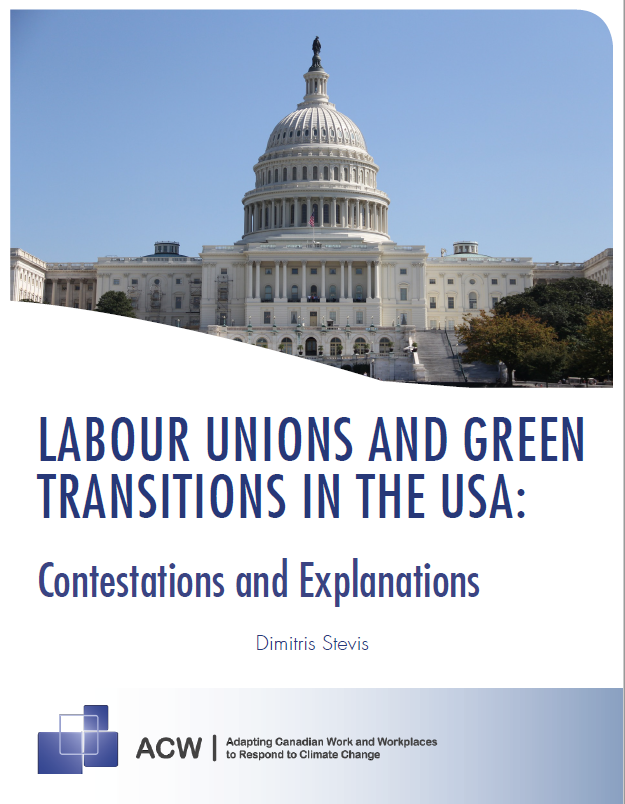
Labor Unions and Green Transitions in the USA

By Dimitris Stevis - Adapting Canadian Work and Workplaces to Respond to Climate Change, February 27, 2019

“In broad terms there are now two camps amongst US labour unions with respect to climate change and renewables (the two not always related). On one side, are those unions that believe that something needs to be done about climate change and that renewables are a good strategy. On the other side are those that are opposed to meaningful climate policy –even as they claim that climate change is a problem.”

This report outlines the deep cleavages with respect to climate policy but also argues that the views of unions are more complex and contradictory than the opposition-support dichotomy. Additionally, it seeks to understand what explains the variability in union responses to climate change and policy. What can account for the contradictions evident amongst and within unions?

Read the report (PDF).

Fighting for Green Solutions to Pittsburgh’s “Sewage in the Rivers Problem”

By Thomas Hoffman - Labor Network for Sustainability, January 4, 2018

Almost 7 years ago, six Pittsburgh based organizations realized that our region was going to spend $2-4 billion dollars of area residents’ money to stop 9+ billion gallons of untreated sewage from flowing into our iconic three rivers. The overflows occur when stormwater runs off roads roofs and parking lots into the storm sewers which are the same as the waste sewers.

Pittsburgh is not unusual – many older industrial cities have the same problem. If you combine all the money that will be spent by these cities fixing this problem it totals to roughly half a trillion dollars.

The groups formed the Clean Rivers Campaign to win a “maximum green first followed by right sized gray” solution to cleaning our rivers. They felt that in addition to cleaning our rivers such a solution would bring maximum community benefits back to area residents. These benefits include long term local family sustaining Union jobs, cleaner air and water, and revitalized communities.

The six organizations are Pittsburgh United, a PWF affiliate composed of labor, faith and community groups, Pennsylvania Interfaith Impact Network, a faith based organization, three enviro groups -Sierra Club, Clean Water Action and Nine Mile Run Watershed Association and Action United, a low income neighborhood organizing group. The Unions in Pittsburgh United (SEIU, UFCW and USWA) have been very supportive of the campaign because the neighborhoods where much of the green investments would happen are where their members live.

The alternative solution being promoted by our regional sewer authority, ALCOSAN, is the construction of miles of massive tunnels to collect all the stormwater runoff and sewage overflow. The sewage would then be pumped out of the tunnels using pumps powered by fossil fuels and then treated  before being released into the river again. While this would solve the sewage in the rivers problems it would have none of the community benefits listed above. It would also do nothing to reduce the flooding that may low income and minority communities are experiencing.

How to Achieve Zero Emissions, Even if the Federal Government Won't Help

By C.J. Polychroniou - Truthout, January 17, 2018

With Donald Trump in the White House, the prospects for fighting climate change have never been any bleaker in the US. Yet there are options available to state governments to move forward with the greening of the economy even without federal support. This point is made crystal clear in two studies produced recently by economist Robert Pollin and some of his colleagues at the Political Economy Research Institute (PERI) at the University of Massachusetts at Amherst for the states of Washington and New York. In this exclusive interview for Truthout, Pollin explains the significance of Green New Deal programs.

C.J. Polychroniou: Bob, two new studies on fighting climate change have been produced by you and two PERI researchers for the states of New York and Washington. How did these studies come about?

Robert Pollin: These were both commissioned studies. For the New York study, the commissioning group was New York Renews, which is a coalition of over 130 organizations in New York State, including labor unions, environmental groups and social justice organizations. For the Washington State study, three important groups within the US labor movement commissioned the study -- the United Steelworkers, Washington State Labor Council of the AFL-CIO and the Tony Mazzocchi Center for Health, Safety and Environmental Education (TMC). Tony Mazzocchi was a great visionary labor leader with the Oil, Chemical and Atomic Workers International Union (OCAW -- [which] has since merged into the United Steelworkers), who fought to link the aims of working people with those of environmentalists.

It is not an accident that my co-workers and I were asked to do these similar studies at basically the same time. In both cases, the groups supporting the studies are advancing ambitious green economy programs within their respective states. It is obvious that nothing good on climate change is going to be coming out of the federal government under Trump. It is equally obvious that we can't wait around on climate issues (and many other matters) until somebody less awful gets into the White House. We therefore have to take the most forceful possible actions at the level of state politics. This is what the coalitions are doing in both New York and Washington States.

It is also significant that, with both studies, our priority was to show how a viable climate change project can be completely compatible with -- indeed, supportive of -- a pro-labor agenda. Trump and others on the right have feasted on the divides between labor and environmentalists, claiming that if you are for the environment, then you have to be against working people and their communities. These studies show in great detail (some might even say excruciating detail) that these Trump claims are flat-out wrong.

Big Oil’s Bi-Partisan Helpers: a Refiner’s Fire 5 Years Later

By Steve Early - Counterpunch, August 4, 2017

Five years ago, my wife and I moved to Richmond, CA and soon learned about the local emergency response protocol known as “shelter in place.”

When large fires break out in Bay Area refineries, like the century old Chevron facility near our house, first a siren sounds. Then public officials direct everyone nearby to take cover inside. Doors must be closed, windows taped shut, if possible, and air conditioning turned off.

August 6th is the fifth anniversary of such self-help efforts in Richmond. On that day in 2012, we looked up and saw an eruption worthy of Mount Vesuvius. Due to pipe corrosion and lax maintenance practices, a Chevron processing unit sprang a leak. The escaping petroleum vapor reached an ignition source. This led to a raging fire that Contra Costa County (home to four refineries) classified as a “Level 3 incident,” posing the highest level of danger.

Nineteen oil workers narrowly escaped death at the scene of the accident. It sent a towering plume of toxic smoke over much of the East Bay and fifteen thousand refinery neighbors in search of medical attention for respiratory complaints, While local property values took a hit, Chevron stayed on track to make $25 billion in profits that year.

Four Months into Strike, Idaho Miners Stand Strong

By Brian Skiffington - Labor Notes, July 28, 2017

A beloved 53-year old miner named Larry Marek was killed on the job at the Lucky Friday mine in Mullan, Idaho just a few years back. Steelworkers Local 5114 had been warning the company about the stability of a certain area called a stope. Management had Marek mine out the last piece of earth supporting the cavern for the ore it contained and the roof collapsed.

The consensus is that company greed for profit killed Larry Marek when the ceiling caved in. Now his picture stands on the 24-hour picket line in front of the mine, as 250 miners enter their fifth month on strike.

WHAT’S THE DEAL?

Rick Norman, known as “Redman,” is one of the striking silver miners in the Silver Valley, a stretch of small but proud mining towns along I-90 in the northern Idaho panhandle. He says the terms that Hecla Mining imposed on workers in March radically changes almost every aspect of their daily lives. The company wants to:

  • Eliminate the bid system, a longstanding union procedure in which senior union members put together crews and bid on various jobs in the mine
  • Reduce call-back protections in the event of a mine closure or layoff from three years to three months
  • Pass large insurance costs on to workers
  • Eliminate workers’ ability to bank vacation time, which many use to transition into retirement early

“The bid system is everything,” Redman tells me. “It’s about control.” Workers speculate that the company wants to control job assignments so that they can make old-timers do the backbreaking labor they did 30 years prior, pressuring them to quit and leave the industry. At stake are years of experience, trust, safety, and opportunities for younger workers to learn the job from senior members.

Trust is critical six thousand feet beneath the earth's surface, in confined spaces with rock temperatures near 110 degrees and with unpredictable movements of the earth. “It’s about the right to work with guys that have the training and know the safety,” Redman says.

Idaho is a right-to-work state, so a key component of organizing new workers into the union is convincing them that they have to join if a senior member is going to pick them through the bid system. Ninety-six percent of the bargaining unit is in the union.

The hard-rock mining industry is fickle. Downturns in markets, catastrophes, environmental protections, and many other factors can open and close mines at the drop of a dime. A three-year call-back is critical for any sort of stability for a mining family.

Redman and his fellow strikers paint a picture of a company that used to care about workers and their community. Upper management knew everyone by name and would sit down with you if you were having a problem. “Their office was in Wallace [a 10-minute drive from the mine] and any miner could walk right in and shake their hand,” Redman says. “Sure, there were problems, but we knew we needed each other.”

Several strikers said Hecla used to give workers interest-free home loans. Now, miners say the company seems willing to sacrifice its workforce, the community, and anyone that gets in its way to appease shareholders and generate profit. This strike, the first since 1981, only scratches the surface of the disbelief and frustration this union feels.

Local 5114 has been without a contract since March 2016. When Hecla began implementing its “last, best, and final” offer in March 2017, the union declared an unfair labor practice strike.

Miners contend that management never intended to negotiate at all, and was just buying time while outside contractors finished a critical project. Some speculate that the company intended to force a strike all along. Under labor law, the company cannot permanently replace unfair labor practice strikers. Hecla has not attempted to bring in strikebreakers, though some maintenance and contracting work has continued in the mine and the mill. Rumors abound that management could begin blasting at a slow pace.

Pages

The Fine Print I:

Disclaimer: The views expressed on this site are not the official position of the IWW (or even the IWW’s EUC) unless otherwise indicated and do not necessarily represent the views of anyone but the author’s, nor should it be assumed that any of these authors automatically support the IWW or endorse any of its positions.

Further: the inclusion of a link on our site (other than the link to the main IWW site) does not imply endorsement by or an alliance with the IWW. These sites have been chosen by our members due to their perceived relevance to the IWW EUC and are included here for informational purposes only. If you have any suggestions or comments on any of the links included (or not included) above, please contact us.

The Fine Print II:

Fair Use Notice: The material on this site is provided for educational and informational purposes. It may contain copyrighted material the use of which has not always been specifically authorized by the copyright owner. It is being made available in an effort to advance the understanding of scientific, environmental, economic, social justice and human rights issues etc.

It is believed that this constitutes a 'fair use' of any such copyrighted material as provided for in section 107 of the US Copyright Law. In accordance with Title 17 U.S.C. Section 107, the material on this site is distributed without profit to those who have an interest in using the included information for research and educational purposes. If you wish to use copyrighted material from this site for purposes of your own that go beyond 'fair use', you must obtain permission from the copyright owner. The information on this site does not constitute legal or technical advice.