You are here

green jobs

Railroad Workers United's Jen Wallis and Greenpeace's Kim Marks on We Do The Work radio

By Jen Wallis and Kim Marks - We Do the Work Radio, July 28, 2015

Disclaimer: The views expressed here are not the official position of the IWW (or even the IWW’s EUC) and do not necessarily represent the views of anyone but the author’s.

Sid Ryan on the unstoppable alliance of labour, environment and Indigenous groups

Sid Ryan Interviewed by Steve Cornwell - Rabble.Ca, July 16, 2015

Disclaimer: The views expressed here are not the official position of the IWW (or even the IWW’s EUC) and do not necessarily represent the views of anyone but the author’s.

The recent March for Jobs, Justice, and the Climate brought together -- among others -- Indigenous, labour, and environmentalist groups. What do you expect to arise out of such a diverse movement of groups and communities?

The march is a way to announce to the world that there is a very powerful coalition coming together. I think people are beginning to believe that a lot of what we need to be doing is dealing with the climate. We know that all of our different groups, labour, First Nations, environmentalists, if we don't come together to put the pressure on, we're not going to be successful.

I was at the Battle in Seattle. You had the community activists, environmentalists, and you had a lot people from around the world and different organizations coming into Seattle. The labour movement had its own separate demonstration in a football stadium five miles out of town in a football field. There were all these wonderful speeches taking place in this football field.

But downtown Seattle was erupting with running battles between police, environmentalists, students and activists from around the world. We were completely disconnected. I thought "wow, now I can see why sometimes these other organizations say to the labour movement that we don't see you guys involved in the fight." Even though we think we're supportive of all of their issues, we seem to be doing it apart from them.

I see the July 5 march as a coming out of a new movement -- the beginnings of us saying that we're willing to work together. We know that shifting away from a carbon-based economy is a difficult decision, certainly for labour. But we're going to be there and we're going to be a part of it, and the hope is to build something much much bigger.

The aim is to say to the world that there is a new game in town, and keep your eye on it because it can build into something very powerful.

A world beyond tar sands: the fight for climate jobs

By Jesse McLaren - Socialist Worker, June 17, 2015

Disclaimer: The views expressed here are not the official position of the IWW (or even the IWW’s EUC) and do not necessarily represent the views of anyone but the author’s.

The IPCC report from last year said that climate change would produce “severe, widespread, and irreversible impacts” if not reduced, and a report in the journal Nature this year showed that 85 per cent of tar sands must remain in the ground to avoid a 2 degree rise.

As the Globe and Mail explained, “Domestic estimates of Alberta’s oil reserves come in at about 168 billion barrels, with hundreds of billions more available for extraction if future oil prices make the resource more attractive. The study uses a more conservative estimate of 48 billion barrels as the current reserve and then finds that only 7.5 billion barrels of that, or about 15 per cent, can be used by 2050 as part of the global allotment of fossil-fuel use in a two-degree scenario." The Council of Canadians have done the math: “The proposed Keystone XL, Northern Gateway, Energy East, Trans Mountain and Arctic Gateway pipelines. Together, those pipelines would move about 3.45 million barrels of oil per day or about 1.26 billion barrels a year. If all of these pipelines were to become operational, they would exceed the 7.5 billion barrel limit noted in this British study in less than six years.”

So this is an urgent question, and what happens in Canada will have a major impact on the global climate. As NASA scientist James Hansen explained: “If Canada proceeds, and we do nothing, it will be game over for the climate.” But this risk is not evenly distributed. When Hurricane Katrina hit New Orleans it disproportionately affected poor and racialized communities. Hurricane Sandy and typhoon Haiyan’s destruction in Haiti/Philippines is linked to the history of colonialism and imperialism in the region. Tar sands disproportionately affect indigenous communities, including the Athabasca Chippewyan First Nation at ground zero, Aamjiwnaang First Nation surrounded by refineries in Chemical Valley, and Chippewas of the Thames whose territory Line 9 crosses (and who are appealing its reversal).

Trade Union Climate Summit: Registration Extended

Announcement - Global Climate Jobs, June 29, 2015

Disclaimer: The views expressed here are not the official position of the IWW (or even the IWW’s EUC) and do not necessarily represent the views of anyone but the author’s.

No jobs on a dead planet!

Trade Union Climate Summit #unions4climate 14 & 15 September, 2015 Paris

You can download a flyer for the summit here: flyer_climate

• Join trade union leaders, experts & activists campaigning to mobilise for a zerocarbon future
• Showcase how the union movement is working to de-carbonise our workplaces and industries
• Campaign to secure jobs with a Just Transition as industries transform
• Let’s ensure workers have a right to know about how employers plan for a zerocarbon future and what governments can do.

Guest speakers include: Laurent Fabius (French Minister of Foreign Affairs & upcoming COP21 President); Professor Hans Joachim Schellnhuber CBE (tbc) (Potsdam Institute for Climate Impact); an interview with Naomi Klein (Canadian author This Changes Everything); Hassan Yussuff (CLC Canada President) and Jerry Dias (Unifor Canada President); Guy Ryder (tbc) (ILO Director General); Sharan Burrow (ITUC General Secretary), and Global Union Federation and National Union leaders.

PLACES LIMITED TO 250 PARTICIPANTS REGISTRATION CLOSES 15 JULY

Does this sound like you?
• Are you passionate about climate change and concerned for a just transition to a zero-carbon economy?
• Has your union committed to support climate action?
• Do you have plans or ideas for union actions on climate?

Join the Trade Union Climate Summit on 14 & 15 September in Paris

Agenda: Industrial Transformation – Opportunities for growing decent jobs out of an ambitious climate agenda – Just transition – Building alliances – Mobilisation towards COP21 and beyond, and more.
Show-cases: Experiences from unions working to secure jobs and save the planet. Panellists from unions, environmental and development NGOs, employers, experts & activists will take part in debates demonstrating how unions are ensuring a zero-carbon world.

Language: The meeting will be conducted in English, French and Spanish.

Where: French Economic, Social and Environmental Council (CESE) Paris, France

Registrations: Places are limited – the deadline for applications is 15th July

Send nomination to Anabella.rosemberg@ituc-csi.org with your name, union, country
 and an indication that your union leadership supports this nomination.

We have limited funds, but let us know if you’re from a developing country
and need some support to come.

This meeting is organised by the International Trade Union Confederation (ITUC), in cooperation with Global Union Federations, Sustainlabour, the One Million Climate Jobs campaign, and French national trade union centres CFDT, CGT and FO. It is supported by Friedrich-Ebert-Stiftung.

Contact: Anabella Rosemberg, Anabella.rosemberg@ituc

Sustainable and Safe Recycling: Protecting Workers Who Protect the Planet

By GAIA - Partnership for Working Families, MassCOSH, and the National Council for Occupational Safety and Health, June 23, 2015
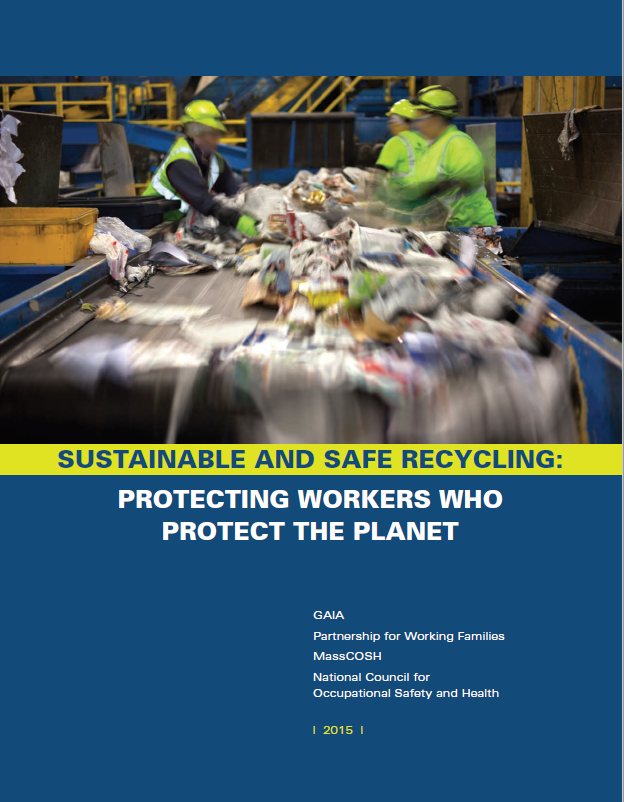
Zero waste is the future. Growth in the recycling economy has the potential to not only conserve the environment, but also create 1.5 million new jobs. But research indicates that recycling work can be dangerous, with injury rates more than double the national average. By addressing this problem, local governments have an opportunity to secure the sustainability and health of their cities while ensuring that recycling jobs are good jobs. Recyclers deserve safe working conditions, as they protect public health and the planet from waste, pollution, and resource depletion.

The environmental necessity of recycling is well-established: achieving a 75% recycling rate would yield greenhouse gas emission reductions equivalent to shutting down one-fifth of all U.S. coal power plants (Tellus 2011). A growing number of cities recognize recycling as a key component of their local climate action plans (West Coast Climate and Materials Management Forum 2012). In short, recycling provides proven benefits for clean air and waste reduction, and along with other zero waste strategies it can offer a critical pathway for municipalities to achieve sustainable growth.

Recycling can also play a key role in urban job creation strategies. At our current national recycling rate of 34.5%, the U.S. recycling industry employs nearly 1 million people and generates billions of dollars of economic activity annually (Tellus 2011, USEPA 2012).

Studies have shown that recycling creates at least 10 times as many jobs per ton of waste as disposal in either incinerators or landfills, and that investments in recycling, composting, and recycling reliant manufacturing could produce 1.5 million more jobs across the country.

But recycling workers face serious hazards on the job. In too many cities across the country, sorters work in loud and dusty facilities where they are often exposed to extreme temperatures. Working long hours, they lean over conveyor belts sorting materials – pulling out things that don’t belong, ensuring the best quality materials are bundled together for the highest value. They work with heavy equipment in dangerous situations – climbing onto and into massive conveyor belts and balers to clean them. They maneuver past huge front-end loaders and forklifts, and walk by heavy bales of material that, when unsafely managed, can fall on workers who are in the wrong place at the wrong time. Moreover, they deal with an array of inherently unsafe materials that should not be on the recycling line – used needles, chemicals, dead animals and broken glass. As a result of these unsafe conditions, recycling workers face above-average injury rates and are sometimes even killed on the job.

Many recycling sorters are employed by temp agencies, further increasing the likelihood that they won’t have the training or experience needed to do their job safely. But it doesn’t have to be this way. Occupational hazards can be mitigated, and in some cases eliminated, with a combination of engineering controls, improved safety systems, work practices, and extensive training.

There are important actions and best management practices that cities can and should take to improve recycling jobs. Cities that offer curbside recycling service generally contract with private companies to process recyclable materials collected from households. To ensure safe and dignified recycling jobs, municipal governments must require rigorous health and safety standards in recycling contracts.

This report offers a unique inside look at the working conditions faced by recycling workers across the United States, as well as a series of specific policy recommendations that municipal decision makers should follow to improve industry accountability and health and safety outcomes. It also includes practical recommendations for public education programs that can prevent dangerous materials from entering the recycling stream. Our analysis is based on occupational health studies, OSHA reports about health and safety violations, articles from news media and industry trade publications, interviews with recycling workers, and first-hand observation of recycling work.

Our findings underscore the need for urgent action to improve health and safety conditions for recycling workers. Improving the recycling sector overall is not only possible – it’s imperative for averting today’s ecological crises, and protecting the health and well-being of this important group of climate workers who protect us all.

Read the report (PDF).

Replace Hazelwood Primer

By David Spratt - Climate Action Moreland, June 2015

Hazelwood Power Station (HPS) was built between 1964 and 1971, and comprises 1542 megawatt (MW) of capacity over eight generators. It was privatised by the Victorian Liberal Party Kennett government in 1996 for $2.35 billion.If HPS had stayed in public hands, it would likely have been decommissioned in 2005, but in 2004 the Bracks Labor government extended its operations till 2031, allowing Hazelwood to move a road and a river to access 43 million tonnes of brown coal deposits in a realignment of the mining licence boundaries. The owners have a 30-year mining licence due for renewal in 2026.HPS and the land on which it operates are owned by the Hazelwood Power Partnership. Since 7 June 2013, the four partners have been subsidiaries of International Power (Australia) Holdings Pty Ltd. This company is in turn jointly owned by subsidiaries of Engie (formerly GDF Suez SA) (72 per cent ownership) and Mitsui & Co Ltd (28 per cent ownership). Engie is a global energy company with corporate headquarters in France. Mitsui & Co Ltd is a global trading company with corporate headquarters in Japan.Currently HPS produces more than 10,000 gigawatt hours (GWh) of energy annually and is supplied with up to 18 million tonnes of coal each year from the adjacent Hazelwood mine, releasing around 16 million tonnes of greenhouse gases annually. Today HPS provides approximately 21 per cent of Victoria’s baseline electricity supply.

The Victorian Government has expressed a desire (though it does not yet have a policy) for a significant expansion of renewable energy in Victoria. This has widespread community support and must be done quickly and at a large scale because climate change is already dangerous. Scientists warn that two degrees Celsius of warming could occur in just two decades, so preserving a safe climate and a healthy future requires rapid de-carbonisation.

Expanding renewable energy requires coal-generating capacity to be removed from the market because oversupply is crowding out and preventing new investment. The Australian energy market operator says there are about eight gigawatts of surplus generating capacity across the national market, equivalent to five Hazelwood power stations. This includes up to 2.2 gigawatts of brown coal generation that is no longer required in Victoria in 2015, which is greater than Hazelwood’s capacity. Power companies have been lobbying government for capacity to be reduced, and senior Victorian energy department bureaucrats are aware of the need to close coal power stations in order to roll out renewables.

The Victorian Government has committed to being a leader on climate change. Closing down excess coal generation is a key test of the government’s climate credentials. Coal-fired power stations are the world’s largest source of planet-warming carbon dioxide emissions. Victoria cannot make the necessary emissions reductions without addressing the operations of Hazelwood and/or Yallourn power stations.

Hazelwood power station is old, unsafe and dirty. Based on emissions intensity, it is the third-dirtiest coal power station in the world and the dirtiest in Australia, releasing around 16 million tonnes of greenhouse gases annually, almost three per cent of total Australian greenhouse emissions. The Hazelwood majority owner, Engie (formerly GDF Suez), owns the third-most polluting coal-power station fleet in the world. The full – health and carbon pollution – social costs of Hazelwood totalling $900 million per year are borne by the community, rather than the plant’s owners.

A steady stream of local jobs can be created in the Latrobe Valley with the rehabilitation of mines and decommissioning of plant, which will require a significant workforce stretching well over a decade. The Latrobe Valley needs a strong jobs package and an economic transition plan and new industries because the move from coal to clean wind and solar renewable energy is now both urgent and inevitable.

Hazelwood power station and mine are a health hazard to local residents, exemplified by the autumn 2014 mine fire. The owners of Hazelwood have abused their social licence and forfeited the right to profit from a power station that is now a major health hazard – both to local people and to all peoples who face the uncertainties of living in a hotter and more extreme climate.

In July 2010, the Victorian Labor government promised to start shutting Hazelwood and passed climate legislation providing the reserve power to regulate emissions from existing brown coal-fired generators. Restoring the government’s capacity to regulate emissions would be complementary to actions being taken by other governments, including in the United States and Europe.

Read the report (PDF).

Mark Serwotka: Trade Unions and the Environmental Movement are Natural Allies

By Mark Serwotka - DeSmog UK, April 9, 2015

Disclaimer: The views expressed here are not the official position of the IWW (or even the IWW’s EUC) and do not necessarily represent the views of anyone but the author’s. 

The trade union movement and the environmental movement should be “together like hand in glove, they should be allies,” argues Mark Serwotka, the General Secretary of the Public and Commercial Services Union (PCS) – the trade union for British civil servants.

We should watch out for those who try to divide us and try to get their way by getting us at each other’s throats: it makes life easier for them and worse for us.

We should be absolutely, naturally allies. And that means starting to recognise that capitalism attacks workers who are members of trade unions, and it attacks the environment.

For us, at the moment, we’re dealing with tens of thousands of people being laid off, living standards have dropped at a faster rate than any time since Queen Victoria, and, for the environmental movement, we see a lack of investment in renewables, in public transport, [and] pollution seems to be something the capitalists can get away with willy-nilly.

REGISTER NOW!: The Future of Railroads: Safety, Workers, Community & the Environment

By Railroad Workers United and Others - railroadconference.org, March 1, 2015

Disclaimer: The views expressed here are not the official position of the IWW (or even the IWW’s EUC) and do not necessarily represent the views of anyone but the author’s.

The Future of Railroads: Safety, Workers, Community & the Environment is the title of two back-to-back conferences; the first on Saturday, March 14, 2015 in Richmond, California; the second on Saturday, March 21 in Olympia, Washington.

Everyday a tragic trail derailment occurs, often transporting highly flammable Bakken Shale or Tar Sand, from North Dakota or Alberta, to refineries across North America. The 47 -- preventable-- deaths in Lac-Mégantic has wakened people to the dangers of oil trains and the movement of trains in general through their communities. Environmental activists are up-in-arms about the amounts of fossil fuels moving by rail. Farmers and other shippers are concerned about the congestion that has occurred in recent months, but in part to the oil boom. The rail networks in the U.S. and Canada and clogged with crude-by-rail, displacing the already heavy traffic of grains headed to port for export.

The public generally has no idea what goes on daily on America’s railroads. Chronic crew fatigue, single employee train crews, excessively long and heavy trains, draconian availability policies, short staffing, limited time off work create challenging safety issues of concern not just to railroaders, but to the entire population.

Please join us at this cutting edge conference that brings together railroad workers, environmentalists, community activists and concerned workers from other sectors, in order to build the movement for a safer and greener railroad, on that is more responsive to the needs of workers, trackside communities, citizens in general, and society as a whole.

Richmond is a perfect confluence for this conference as it has always been a company town, first for Santa Fe Railroad as the western terminus of its transcontinental railroad in 1900, then for Standard Oil (later becoming Chevron) in 1901 and its massive refinery complex, and again for Kaiser Industries with its four assembly line-like shipyards in the late 1930s through World War II. From 1910 until 1959 the Pullman Company located its largest West Coast rail car repair shop adjacent to the Southern Pacific and Santa Fe lines in the center of Richmond. It also fronts the San Francisco Bay with access to a channel of 40-60 feet deep, allowing the largest seagoing ships (mostly oil tankers these days) to call its ports. Despite still being the location of the Burlington Northern Sante Fe rail yard and Chevron's massive refinery, Richmond is a bottomed out deindustrialized city that puts its largely working class people of color population in the toxic shadow of oil, chemical and other polluting heavy industries.

In adjacent cities of Rodeo there is the Conoco Phillips Refinery, Benecia has Valero Refinery, and Martinez has both Shell and Tesoro Refineries (the latter currently on strike). They are served by both BNSF and Union Pacific Railroads and maritime wharfs. This area along the San Francisco and San Pablo Bays is statistically known as a "cancer cluster."

EcoUnionist News #26

Compiled by x344543 - IWW Environmental Unionism Caucus, February 1, 2015

Disclaimer: The views expressed here are not the official position of the IWW (or even the IWW’s EUC) and do not necessarily represent the views of anyone but the author’s.

The following news items feature issues, discussions, campaigns, or information potentially relevant to green unionists:

Lead Stories:

Crude by Rail:

Carbon Bubble:

Green Jobs and Just Transition:

Other News of Interest:

For more green news, please visit our news feeds section on ecology.iww.org; Twitter #IWWEUC

EcoUnionist News #25

Compiled by x344543 - IWW Environmental Unionism Caucus, January 26, 2015

Disclaimer: The views expressed here are not the official position of the IWW (or even the IWW’s EUC) and do not necessarily represent the views of anyone but the author’s.

The following news items feature issues, discussions, campaigns, or information potentially relevant to green unionists:

Lead Stories:

Crude by Rail:

Carbon Bubble:

Green Jobs and Just Transition:

Other News of Interest:

For more green news, please visit our news feeds section on ecology.iww.org; Twitter #IWWEUC

Pages

The Fine Print I:

Disclaimer: The views expressed on this site are not the official position of the IWW (or even the IWW’s EUC) unless otherwise indicated and do not necessarily represent the views of anyone but the author’s, nor should it be assumed that any of these authors automatically support the IWW or endorse any of its positions.

Further: the inclusion of a link on our site (other than the link to the main IWW site) does not imply endorsement by or an alliance with the IWW. These sites have been chosen by our members due to their perceived relevance to the IWW EUC and are included here for informational purposes only. If you have any suggestions or comments on any of the links included (or not included) above, please contact us.

The Fine Print II:

Fair Use Notice: The material on this site is provided for educational and informational purposes. It may contain copyrighted material the use of which has not always been specifically authorized by the copyright owner. It is being made available in an effort to advance the understanding of scientific, environmental, economic, social justice and human rights issues etc.

It is believed that this constitutes a 'fair use' of any such copyrighted material as provided for in section 107 of the US Copyright Law. In accordance with Title 17 U.S.C. Section 107, the material on this site is distributed without profit to those who have an interest in using the included information for research and educational purposes. If you wish to use copyrighted material from this site for purposes of your own that go beyond 'fair use', you must obtain permission from the copyright owner. The information on this site does not constitute legal or technical advice.

