

You are here

green jobs

Code Words Hint At Eliminating Jobs & Stifling Renewable Energy Employment

By Carolyn Fortuna - Clean Technica, February 6, 2023

The term “just transition” emerged from the 1970s North American labor movement to become a campaign for a planned energy transition. It includes justice and fairness for workers through united future visions about economic and climate action. These days it’s incredibly contentious.

Wouldn’t you think that renewable energy employment would be uplifting fossil fuel communities and remaking climate politics? Not so fast. Eliminating jobs in the fossil fuel sector has become highly controversial.

Language in headlines and social media posts is reinforcing the place and power of the fossil fuel industry, helping to keep it from becoming little more than stranded assets and from being held accountable for the climate crisis. The words “just transition” are a not-so-secret code that triggers mistrust and confusion among the energy workforce — the same workers who are most likely to benefit from the renewable energy employment marketplace.

Generally, a just transition is defined as programs, services, legislation, and practices that include equity opportunities for all in the move from fossil fuels to renewable energy. I’ve written several times here at CleanTechnica about a just transition and how fears about eliminating jobs are unwarranted (see here, here, here, and here, among others). But what seemed less evident to me then and now a bit naïve now is the degree to which the fossil fuel industry has turned its mighty propaganda forces against renewables while, concurrently, embellishing their professed concern for worker livelihoods.

ITUC report shows big economic returns for modest investment in infrastructure, the care economy and the green economy

By Özlem Onaran and Cem Oyvat - International Trade Union Confederation, February 6, 2023

The study simulated the impact that public spending increases in the care economy, the green economy, and infrastructure could have across eight countries.
The report shows that a repeated annual increase in public spending by 1% of GDP within these three sectors would yield major economic returns that exceed the initial level of investments made. The findings reveal that:

  • Investing an extra 1% of GDP in the care economy over five years would yield an average GDP increase of more than 11%, as well as a 6.3% increase in total employment levels.
  • An extra 1% of GDP investment in the green economy over five years would yield an average GDP increase of 10%, as well as a 7.5% increase in total employment levels.
  • An extra 1% of GDP on infrastructure investment over five years would increase both employment and GDP levels by 12% on average.

Owen Tudor, ITUC Deputy General Secretary, stressed: “The lingering employment effects of Covid-19, as well as a rapidly changing world of work, have underscored the urgency of addressing employment deficits and inequalities. Governments must step up their investments to support the creation of quality jobs – especially in strategic sectors that are good for both people and the planet including care, infrastructure and the green economy.”

At the global level, trade unions are calling for the creation of 575 million jobs and the formalisation of at least one billion informal jobs by 2030, to enable delivery of the United Nations’ 2030 Agenda commitment for full employment and decent work under Sustainable Development Goal 8.

Read the report (Link).

'Only the Beginning': Democrats' IRA Set to Create 100,000+ US Green Jobs

By Brett Wilkins - Common Dreams, February 6, 2023

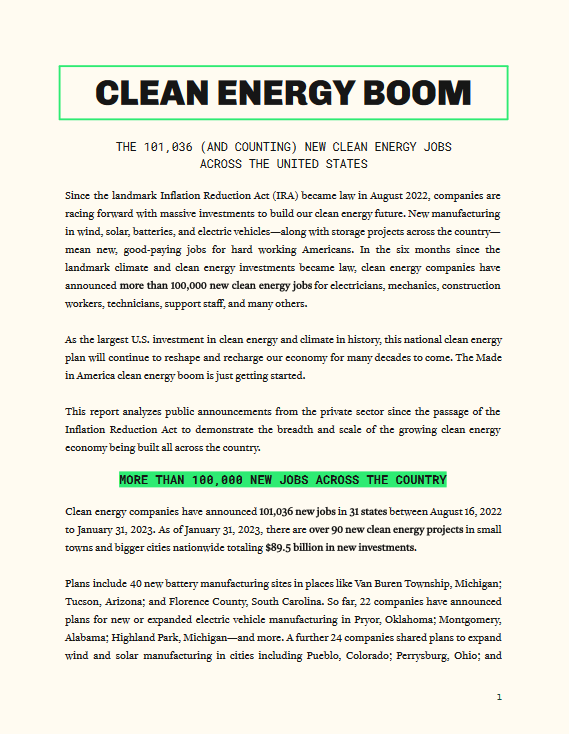
A leading climate action group on Monday published a report revealing that the 94 clean energy projects announced since U.S. President Joe Biden signed the Inflation Reduction Act into law last August are set to create more than 100,000 green jobs.

Climate Power—which published the report as part of a new six-figure national ad campaign touting the growing green economy—said that since the IRA became law without any Republican support last year, "companies are racing forward with massive investments to build our clean energy future."

"New manufacturing in wind, solar, batteries, and electric vehicles—along with storage projects across the country—mean new, good-paying jobs for hard-working Americans," the group continued. "In the six months since the landmark climate and clean energy investments became law, clean energy companies have announced more than 100,000 new clean energy jobs for electricians, mechanics, construction workers, technicians, support staff, and many others."

"As the largest U.S. investment in clean energy and climate in history, this national clean energy plan will continue to reshape and recharge our economy for many decades to come," Climate Power added.

While green groups have generally praised the IRA's historic $369 billion investment in renewable energy production and innovation, activists have condemned provisions including fossil fuel tax credits and mandatory lease sales on public lands and at sea.

The 94 new clean energy projects in the Climate Power report—which are spread across 31 states and have a combined investment value of $89.5 billion—include:

Forty new battery manufacturing sites in places like Van Buren Township, Michigan; Tucson, Arizona; and Florence County, South Carolina. So far, 22 companies have announced plans for new or expanded electric vehicle manufacturing in Pryor, Oklahoma; Montgomery, Alabama; Highland Park, Michigan—and more. A further 24 companies shared plans to expand wind and solar manufacturing in cities including Pueblo, Colorado; Perrysburg, Ohio; and Georgetown, Texas. The majority of the projects are in seven states—Arizona, Georgia, Michigan, Ohio, South Carolina, Tennessee, and Texas.

"Thanks to President Biden's affordable clean energy plan, businesses are investing in manufacturing like never before, and planning to create good-paying jobs in every corner of the country," Climate Power executive director Lori Lodes said in a statement.

"This is only the beginning—we're months after the passage of the Inflation Reduction Act and we're already at the precipice of a renewed manufacturing, made-in-America boom that will create opportunities for millions of Americans, all while reducing toxic emissions that harm the health and wellbeing of our communities," Lodes added.

Last month, the International Energy Agency said in a report that "the world is at the dawn of a new industrial age—the age of clean energy technology manufacturing," and that green manufacturing jobs will more than double by the end of the decade if countries worldwide live up to their climate and energy pledges—a huge "if" given that global emissions remain at record levels.

Read the report (Link).

Preliminary Assessment of Economic Benefits of Offshore Wind: Related to Seaport Investments and Workforce Development

By Paul Deaver and Jim Bartridge - California Energy Commission, February 2023

This report responds to the directive set forth by Assembly Bill 525 (AB 525, Chiu, Chapter 231, Statutes of 2021). The law directs that on or before December 31, 2022, the California Energy Commission (CEC) shall “complete and submit to the Natural Resources Agency and relevant fiscal and policy committees of the Legislature a preliminary assessment of the economic benefits of offshore wind as they relate to seaport investments and workforce development needs and standards.” This report addresses these requirements.

This report is the second of four products that AB 525 directs the CEC to prepare, informing a strategic plan for offshore wind energy turbines installed off the California coast in federal waters in coordination with federal, state, and local agencies and a wide variety of stakeholders. The strategic plan must be submitted to the California Natural Resources Agency and the Legislature no later than June 30, 2023. The strategic plan is to be informed by interim activities and products developed by the CEC that include this report and two additional reports. The first report, Offshore Wind Energy Development off the California Coast: Maximum Feasible Capacity and Megawatt Planning Goals for 2030 and 2045, was adopted by the CEC at the August 10, 2022, public business meeting. That report established offshore wind energy planning goals of 2,000–5,000 megawatts by 2030 and 25,000 megawatts by 2045. The other interim report, also due on or before December 31, 2022, will provide a permitting roadmap that describes the time frames and milestones for a coordinated, comprehensive, and efficient permitting process for offshore wind energy facilities and associated electricity transmission infrastructure off the California coast.

For more details, see: AB 525 Reports: Offshore Renewable Energy

Download a copy of this publication here (PDF).

In Maine, coalition works to make sure organized labor has role in offshore wind

By Sarah Shemkus - Energy News, February 1, 2023

A group of environmental and labor organizations want a state offshore wind advisory committee in its final plan to include more specific language recommending project labor and labor peace agreements.

As Maine comes close to finalizing its roadmap for the development of offshore wind, a coalition of labor and environmental groups is asking the state to strengthen its commitment to supporting union jobs in the burgeoning industry. 

A group of 12 environmental and labor organizations has sent a letter to the Maine Offshore Wind Roadmap Advisory Committee asking that the final plan, expected by early February, incorporate explicit language recommending the use of project labor agreements and labor peace agreements as the offshore wind sector develops in Maine. Many of the same advocates are supporting a bill, announced by Democratic state Sen. Mark Lawrence last month, that would require union labor agreements on offshore wind projects. 

“Organized labor needs to be a crucial part of this investment,” said Kelt Wilska, energy justice manager for Maine Conservation Voters. “And we need to make sure working families, both coastal and inland, benefit from this.”

As states from New England down to North Carolina work on their own plans for implementing offshore wind projects, Maine is expected to be a major player in the growing industry. With strong, consistent winds, the Gulf of Maine is widely considered to be one of the most promising areas for offshore wind development.

Maine convened its Offshore Wind Roadmap Advisory Committee in July 2021 with the mission of creating an economic development plan for the fast-emerging industry. The panel — which includes 25 members representing state and municipal governments, private business, community and environmental nonprofits, and organized labor — released its draft plan in early December. 

The document outlines strategies for investing in infrastructure and workforce development; reducing costs and increasing resilience through renewable power; advancing Maine-based innovation; and protecting and supporting the seafood industry, coastal communities and the ocean ecosystem. Labor and environmental groups have praised much of the plan, particularly its focus on comprehensive planning, workforce and supply chain investment, and environmental monitoring and mitigation. 

Why unions are excited about these provisions hidden deep in the Inflation Reduction Act

By Kristin Toussaint - Fast Company, January 27, 2023

The Inflation Reduction Act, which was signed into law last summer, is the U.S.’s largest-ever investment in clean and renewable energy. But it’s also a landmark policy for labor, tying $270 billion in tax incentives (of the bill’s $369 billion clean energy investment) to labor standards that will boost working conditions for those in clean energy jobs.

Those standards are set to go into effect on January 29, and labor advocates say it’s a historic opportunity to create a tremendous number of union jobs in the clean energy economy.

The IRA has tax credits that create financial incentives not only for developers to embark on more clean energy projects but also for those projects to meet high labor standards. Companies can get a 30% tax credit on their qualifying projects—from offshore wind to solar construction to energy storage—but only if they meet certain standards. That includes paying workers a prevailing wage (the federal government sets this rate for work on public projects; states can set theirs higher) and having a certain amount of work done by those in registered apprenticeship programs. (To start, 12.5% of total labor hours must be done by apprentices; that increases to 15% in 2024.)

If clean energy developers don’t meet those standards—say, paying only minimum wage and choosing not to hire any apprentices—they get a tax credit of just 6%. “The IRA provides a substantial and impactful financial benefit for developers to pay good wages, hire apprentices, and really create a pipeline to good careers in the clean energy economy,” says Dave Hancock, director of strategic campaigns at the Climate Jobs National Resource Center, which helps unions develop labor-led climate job coalitions and works toward a “worker-centered renewable economy.”

Carbon Free Healthy Schools Teach-In

Britishvolt administration ‘potentially catastrophic’ for both the North East and UK’s automotive transition

By staff - Unite the Union, January 17, 2023

Britishvolt, which was planning to build a giga-battery factory in Northumberland, has today (Tuesday) announced that it is going into administration.

Unite national officer for the automotive sector Steve Bush said: “This is a grim day for the North East and for the just transition to the electrification of the nation’s automotive sector.

“The complete lack of a competent industrial strategy by the government to protect jobs in the UK automotive sector is becoming potentially more catastrophic by the day.

“It is extraordinary that despite the UK automotive sector being required to move to the production of electric vehicles, there are still no UK stand-alone factories making the batteries that are required. The demise of Britishvolt means there are not even any in the pipeline.

“The government’s strategy seems to be to cross their fingers and hope that everything will be ok. The workers in the automotive sector are frankly enraged at this dreadful and total abdication of leadership”

We need a lot more electricians if we’re going to electrify everything

By Emily Pontecorvo - Canary Media, January 11, 2023

The U.S. has a shortage of electricians to install clean equipment like EV chargers, heat pumps and induction stoves. Those who get into the field can earn big.

Chanpory Rith, a 42-year-old product designer at the software company Airtable, bought a house in Berkeley, California with his partner at the end of 2020. The couple wasn’t planning to buy, but when Covid hit and they began working from their one-bedroom San Francisco apartment, they developed a new hobby: browsing listings on Zillow and Redfin — ​“real estate porn,” as Rith put it.

Their pandemic fantasizing soon became a pandemic fairy tale: They fell for a five-bedroom midcentury home in the Berkeley hills with views of San Francisco Bay and put down an offer. ​“And then came the joys and tribulations of homeownership,” Rith said.

One of those tribulations began with a plan to install solar panels. Rith didn’t consider himself a diehard environmentalist, but he was concerned about climate change and wanted to do his part to help. He didn’t have a car but planned on eventually getting an electric vehicle and also wanted to swap out the house’s natural-gas appliances for electric versions. Getting solar panels would be a smart first step, he figured, because it might trim his utility bills. But Rith soon found out that the house’s aging electrical panel would need to be upgraded to support rooftop solar. And he had no idea how hard it would be to find someone to do it.

Many of the electricians Rith reached out to didn’t respond. Those who did were booked out for weeks, if not months. He said they were so busy that the conversations felt like interviews — as if he were being evaluated, to suss out whether his house was worth their time. 

“It felt like trying to get your kid into a nice kindergarten, where you have to be interviewed and do a lot of things just to get on the radar of these electricians,” Rith told Grist.

Passionate, Public Service-Oriented People Seeking Healthy, Rewarding Working Environments

By Laurel Paget-Seekins - Transit Center, January 4, 2023

There are not enough people working at transit agencies to provide the service our communities need. This problem existed before the pandemic, but it has evolved into a crisis. 

A 2015 Federal Government report on future transportation workforce needs identified a looming shortage. In 2014, over 65% of transit workers were 45 or older. The report projected annual job openings in transportation to be 68% higher than the number of students completing related education programs. 

On top of this, pandemic-related job churn hit the public sector particularly hard. The public sector quit rate reached a 20-year high in October of 2021. The American Public Transportation Association surveyed transit agencies in 2022; 92% reported difficulty with hiring, and 64% reported difficulty with retention.

Much of the reporting has highlighted vacancies in critical frontline roles, like bus and rail operators, dispatchers, and mechanics and maintenance workers. In July 2022, TransitCenter released a report that outlined causes behind and solutions to the national bus operator shortfall. However, transit agencies are also struggling to maintain fully staffed administrative, planning, engineering, and capital planning departments. In a November 2022 report, the Maryland Transit Administration reported vacancy rates over 10% in support departments like accounting, HR, engineering, IT, procurement and training.

Shortages in these roles can have a direct impact on customer experience, and can slow-down improvement projects like new customer information or capital improvements. For example, New York City DOT is behind on bus lane mileage mandated by the City’s Streets Master Plan, and a primary reason is staff shortages of planners and construction crews

Pages

The Fine Print I:

Disclaimer: The views expressed on this site are not the official position of the IWW (or even the IWW’s EUC) unless otherwise indicated and do not necessarily represent the views of anyone but the author’s, nor should it be assumed that any of these authors automatically support the IWW or endorse any of its positions.

Further: the inclusion of a link on our site (other than the link to the main IWW site) does not imply endorsement by or an alliance with the IWW. These sites have been chosen by our members due to their perceived relevance to the IWW EUC and are included here for informational purposes only. If you have any suggestions or comments on any of the links included (or not included) above, please contact us.

The Fine Print II:

Fair Use Notice: The material on this site is provided for educational and informational purposes. It may contain copyrighted material the use of which has not always been specifically authorized by the copyright owner. It is being made available in an effort to advance the understanding of scientific, environmental, economic, social justice and human rights issues etc.

It is believed that this constitutes a 'fair use' of any such copyrighted material as provided for in section 107 of the US Copyright Law. In accordance with Title 17 U.S.C. Section 107, the material on this site is distributed without profit to those who have an interest in using the included information for research and educational purposes. If you wish to use copyrighted material from this site for purposes of your own that go beyond 'fair use', you must obtain permission from the copyright owner. The information on this site does not constitute legal or technical advice.
