You are here

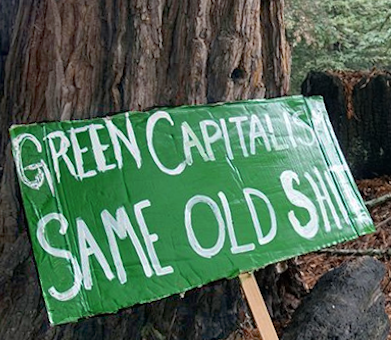
green capitalism

Green Economy, Green Capitalism? The Case Against The Case for Climate Capitalism

By Nick Grover - The Bullet, May 14, 2021

Even now, with a ten-year timeframe left for action, it’s rare for the climate crisis to be treated as the emergency it is. So, credit where due to Tom Rand. In his The Case for Climate Capitalism: Economic Solutions for a Planet in Crisis (Toronto: ECW Press, 2020), Rand calls for a rapid transition away from fossil fuels and toward renewables; he blames the political and business elite for the mess and says they will have to pay the price as markets turn against oil and assets are stranded; he even advocates for expansion of public transit. Where the book gets less refreshing is Rand’s tone toward the people who have been saying these things all along: his secondary enemy, leftists fusing demands for climate action with calls for economic justice.

Rand’s Case for Climate Capitalism aims to preserve and “co-opt” the forces of capitalism to usher in a transition toward green tech. His case is presented as simple pragmatism: the emergency we face affords us no time to discuss economic reforms; we must unite and do what works instead of holding out for a perfect system. His concern is that left ideas like the Green New Deal and Leap Manifesto – which wed strong climate action with job guarantees, labour protections, taxing the rich, and expanding social programs – alienate conservatives and the business class when we need them in our coalition to save the planet.

Green Energy, Green Mining, Green New Deal?

Biden’s Climate Pledge Is a Promise He Cannot Keep

By Howie Hawkins - Solidarity, May 4, 2021

IWW EUC web editor's disclaimer: the IWW does not advoate electralism or endorse political parties, including the Green Party. This article is included to provide a critique of the reformism of the Democratic Party (a similar critique could be offered about the Greens and all other parties).

The climate emergency demands a radical and rapid decarbonization of the U.S. economy with numerical goals and timetables to transform all productive sectors, not only power production (27% of carbon emissions), but also transportation (28%), manufacturing (22%), buildings (12%), and agriculture (10%). It also requires that the U.S. pay its “climate debt” as the world’s largest historical carbon emitter and destroyer of carbon-storing forests, wetlands, and soils. Paying that climate debt would not only be reparations to the Global South for deforestation and fossil fuel emissions by the rich capitalist countries, but also an investment in the habitability of the planet for everyone. This emergency transformation can only be met by an ecosocialist approach emphasizing democratic public enterprise and planning.

Instead, Biden’s plan features corporate welfare: subsidies and tax incentives for clean energy that will take uncertain effect at a leisurely pace in the markets. It does nothing to stop more oil and gas fracking and pipelines for more gas-fired power plants, or to shut down coal-fired power plants. Without out directly saying so, it is a plan to burn fossil fuels for decades to come.

The scale of spending falls pathetically short of what is needed to decarbonize the economy. An effective plan would not only reach zero emissions on a fast timeline. It would also move quickly toward negative emissions. We have to draw carbon out of the atmosphere because we are already well past carbon levels that are triggering dangerous climate change.

Biden’s stated goal of a 50% cut in emissions does not actually cut current emissions in half. His proposed 50% cut is from a baseline of 2005 when emissions were at their peak, not what they are today. Emissions were 6 GtC (gigatons of carbon dioxide) in 2005. Due to a leveling of electric power demand, a trend away from coal to wind, solar, and gas for electric power, and more energy-efficient vehicles, U.S. emissions were down 13% from 2005 by 2019 to 5.1 GtC and, due to the covid contraction, down 21% in 2020 to 4.6 GtC, although emissions are now soaring back up as the economy re-opens. Biden’s goal of 50% below 2005 is 3 GtC per year in emissions instead of 2.5 GtC if 2019 were the baseline, or 2.3 GtC if 2020 were the baseline.

Biden provided no explanation for how the U.S. will get to the precisely stated range of “50% to 52%.” 52% seems to be an arbitrary number pulled out of the air so he can say he is aiming for more than 50%. Greta Thunberg’s video prebuttal to the targets that were to be announced by Biden and the other 40 world leaders at his Earth Day Climate Summit saw right through the staged spectacle. “We can keep cheating in order to pretend that these targets are in line with what is needed, but while we can fool others, and even ourselves, we cannot fool nature and physics… Let’s call out their bullshit.”

In Broad Daylight: Uyghur Forced Labour and Global Solar Supply Chains

By Laura T Murphy and Nyrola Elima - Sheffield Hallam University, May 2021

The People’s Republic of China (PRC) has placed millions of indigenous Uyghur and Kazakh citizens from the Xinjiang Uyghur Autonomous Region (XUAR or Uyghur Region) into what the government calls “surplus labour” (富余劳动力) and “labour transfer” (劳动力转移)programmes. An official PRC government report published in November 2020 documents the “placement” of 2.6 million minoritised citizens in jobs in farms and factories within the Uyghur Region and across the country through these state-sponsored “surplus labour” and “labour transfer” initiatives. The government claims that these programmes are in accordance with PRC law and that workers are engaged voluntarily, in a concerted government-supported effort to alleviate poverty. However, significant evidence – largely drawn from government and corporate sources – reveals that labour transfers are deployed in the Uyghur Region within an environment of unprecedented coercion, undergirded by the constant threat of re-education and internment. Many indigenous workers are unable to refuse or walk away from these jobs, and thus the programmes are tantamount to forcible transfer of populations and enslavement.

It is critical that we examine the particular goods that are being produced as a result of this forced labour regime. This paper focuses on just one of those industries – the solar energy industry – and reveals the ways forced labour in the Uyghur Region can pervade an entire supply chain and reach deep into international markets. We concluded that the solar industry is particularly vulnerable to forced labour in the Uyghur Region because:

  • 95% of solar modules rely on one primary material – solar-grade polysilicon.
  • Polysilicon manufacturers in the Uyghur Region account for approximately 45% of the world’s solar-grade polysilicon supply.
  • All polysilicon manufacturers in the Uyghur Region have reported their participation in labour transfer programmes and/or are supplied by raw materials companies that have.
  • In 2020, China produced an additional 30% of the world’s polysilicon on top of that produced in the Uyghur Region, a significant proportion of which may be affected by forced labour in the Uyghur Region as well.

In the course of this research, we identified:

  • 11 companies engaged in labour transfers
  • 4 additional companies located within industrial parks that have accepted labour transfers
  • 90 Chinese and international companies whose supply chains are affected

This report seeks to increase the knowledge base upon which the solar industry determines its exposures to forced labour in the Uyghur Region. We investigated the entire solar module supply chain from quartz to panel to better understand the extent to which forced labour in the Uyghur region affects international value chains. The examples of engagement in these programs are meant to provide stakeholders with the evidence base upon which to judge risk of exposure to forced labour in the solar supply chain.

Read the Report (PDF).

Ireland’s Energy System: The Historical Case for Hope in Climate Action

By Sinéad Mercier - New Labor Forum, May 17, 2021

For thirty years, governments have been promising climate action. They seem incapable of undertaking the necessary major shifts in their energy systems required by the 2015 Paris Agreement. They also seem incapable of delivering on climate targets in a manner that both “leaves no one behind” and “reaches the furthest behind first,” as required by the 2030 Agenda for Sustainable Development, also agreed in 2015. In Ireland, we fall continually to the bottom of the rankings in climate action, with the current Fine Gael, Fianna Fáil, and Green Party coalition government failing to achieve a mere 16 percent target of renewable energy by 2020.[1]

There are lessons to be learned from the past. One hundred years ago, the two civil war parties—Fine Gael (then Cumann na nGaedheal) and Fianna Fáil—were united in their commitment to a state-owned energy system with an objective of universal access, public good, and public value. Irish state electricity generation started out in 1929 as being from almost 100 percent renewable sources.[2] The historical development of Ireland’s own energy system can be a model for a successful, fast paced national delivery program for a just transition and energy democracy. Ireland has previously made sweeping changes to the energy system, in a time of far greater difficulty, fewer resources, and almost intractable political fragility. The example is the establishment of the country’s—and the world’s—first state-owned national energy company, the Electricity Supply Board (ESB), and its roll-out of universal access to affordable electricity through the Rural Electrification Scheme (RES).

Administering Dreams

The Ireland of the 1920s presented unlikely circumstances for ambitious national projects of any kind. After three years of guerrilla warfare against the British Crown forces, a form of independence had been achieved by 1922. The young Irish Free State government of freedom fighters and idealists was to set out on its own with little source of economic development beyond the sale of cattle to Britain and with much of its populace in extreme poverty. In 1921, the Anglo-Irish Treaty was signed, giving independence to twenty six counties and leaving the six counties in the north east of Ireland under British rule. The signing of the Treaty caused a split in the founding Sinn Féin party between those opposing and supporting the Treaty. This sparked a bitter civil war from June 1922 to May 1923 that has marked Irish politics for a century. The pro-Treaty element formed Cumann na nGaedheal, today the centerright (Christian Democrat) party Fine Gael. A group of republicans led by Éamon de Valera broke away from Sinn Féin in 1926 and formed Fianna Fáil,[3] in protest at the Oath of Allegiance to the British Crown, which all members of Dáil Éireann (the Irish Parliament) were obliged to take. The Cumann na nGaedheal party was in office from 1922 to 1932. Laissez-faire economic and commercial orthodoxies of the 1920s, inherited from the British administration, and a reinstated civil service were largely the global order of the day.

One hundred years ago, the two civil war parties . . . were united in their commitment to a state-owned energy system with an objective of universal access, public good, and public value.

However, the young state took on a number of major interventions in the economy. Most notable were the Land Commission and the creation of Ireland’s state energy company, the ESB, and its primary power source, the Ardnacrusha Hydroelectric Power Station on the Shannon River—also known as the “Shannon Scheme.”[4] To deliver Ardnacrusha’s energy to the public, in 1927 the government established its first Irish state company, the ESB, through the Electricity (Supply) Act, 1927. This was to be the first national electricity service in the world, with full responsibility for the generation, transmission, distribution, and marketing o electricity.[5] From its beginnings, the aim of the ESB was not-for-profit, universal, and affordable access to electricity; “strong on technical expertise, with set targets and with the muscle, dynamism and freedom to achieve these targets.”[6] Attempts had been made to attract foreign investors, particularly from the United States, but “most of the big corporations objected to the government’s stipulation that unprofitable rural lines might have to be built without any guaranteed government subsidy.”[7] The Irish electricity industry had been in existence for forty years, yet the vast majority of the population had been left in darkness and drudgery. As a result of these failings, the fledgling Department of Industry and Commerce concluded that confining the ESB to mere distribution of the energy from the Shannon Scheme was likely to place the whole enterprise in “immediate jeopardy.”[8] The government therefore nationalized what was a piecemeal mess of three hundred expensive, “badly run,” inefficient private and local authority undertakings.[9]

Label Before Labor: Fair Trade USA’s Dairy Label Fails Workers

By Anna Canning - Fair World Project, May 2021

Fair Trade USA released a new “Fair Trade Dairy” label in partnership with Chobani. It’s a program that has been opposed by farmworker and human rights organizations since it was first announced. Now that there is yogurt on the shelf, but still no final standard released, this report looks at the label claims and evaluates “Fair Trade Dairy” based on the available standards.

The critique focuses on three key areas:

  • Inadequate standards development process
  • Standards that are not fit for purpose
  • Lack of enforcement mechanisms

Finally, the report also reviews the rising tide of research that shows that corporate-developed and led certifications are inadequate and points instead to existing models that are better suited to defending workers’ rights and safety. Organized workers are pushing policy changes across the country, improving wages and winning vital workplace protections. And Worker-driven Social Responsibility programs are building power and supporting workers defending their rights and addressing the fundamental power imbalances in the food system.

The report concludes that:
“Corporate consolidation, trade policy, and other macro trends are squeezing farmers and workers in the dairy industry. To address the forces at work requires addressing the imbalance of power head on. If we are to envision a world where those at the top of supply chains are held accountable, we must support programs that are transformative. Instead of reinforcing existing systems of power, we should look to the leadership of those who have been protesting, leading, and advocating for their own communities for hundreds of years.”

Read the text (PDF).

Public energy companies necessary for a fair transition

By Dries Goedertier - Trade Unions for Energy Democracy, April 19, 2021

The debacle with the reversing electricity meter [also called “net-metering” in many contexts — a billing mechanism that credits solar capacity owners for electricity they feed into the grid] shows the limits of Flemish energy policy, which places the responsibility for the much-needed energy transition in the hands of the individual as consumer, investor and entrepreneur. For a socially just and democratic energy transition, the necessary efforts of energy cooperatives will not be sufficient. Only the state can regain control of the energy sector on behalf of, and for the benefit of, society as a whole.

Flemish energy policy has recently suffered from a severe heat stroke. The Constitutional Court has put an end to the reversing electricity meter. The decision dealt a heavy blow to those families who, after the (apparently worthless) guarantees of a bunch of liberal energy ministers about the legality of this particular support scheme, decided to install solar panels on their roofs before the deadline of January 1, 2021. Many of them feel cheated and that is certainly understandable. However, a critical inquiry should not stop there. The whole debacle shows the limits of an energy policy that places the responsibility for the much-needed energy transition in the hands of the individual as a consumer, investor and entrepreneur. 

“The sun has become a neoliberal investment product,” stated Dirk Holemans (Oikos). Holemans, together with Dirk Vansintjan (Ecopower & REScoop.EU), is arguing for a shift to a collective model in which citizens pool their resources and capacities in energy cooperatives. There is indeed a lot to be said for that. After all, energy cooperatives have a lot to offer in terms of democratic, social and ecological benefits. 

If we really want to democratize the energy sector in function of social and environmental objectives, then public energy companies will have to play a major part

In my opinion, however, the admirable self-organization of thousands of citizens will not be enough to break the dominance of the current for-profit energy model. The market power of the established players is simply too great for that. Only the state has the capacities, resources and potentially democratic legitimacy to regain control of the energy sector on behalf of and for the benefit of society as a whole. 

If we really want to democratize the energy sector in the service of social and ecological objectives, then public energy companies will have to play a major part. This does not have to be at the expense of energy cooperatives, as is sometimes incorrectly claimed. I am convinced that energy cooperatives in a public-driven model of energy democracy will actually have more opportunities to unleash their potential. But in order for that to happen, we must dare to question the liberalization of the energy sector. 

Hoodwinked in the Hothouse (Third Edition)

Edited by Lucia Amorelli, Dylan Gibson, Tamra Gilbertson, the Indigenous Environmental Network, et. al. - Various Organizations (see below), April, 2021

Authored by grassroots, veteran organizers, movement strategists and thought leaders from across our climate and environmental justice movements, the third edition of Hoodwinked in the Hothouse is an easy-to-read, concise-yet-comprehensive compendium of the false corporate promises that continue to hoodwink elected officials and the public, leading us down risky pathways poised to waste billions of public dollars on a host of corporate snake-oil schemes and market-based mechanisms. These false solutions distract from the real solutions that serve our most urgent needs in an alarming climate justice moment of no-turning-back. By uncovering the pitfalls and risky investments being advanced by disaster capitalists to serve the needs of the biggest polluters on the planet, Hoodwinked also provides a robust framework for understanding the depth of real solutions and how they should be determined. As a pop-ed toolbox, Hoodwinked promises to be instructive for activists, impacted communities and organizers, while providing elected officials with critical lenses to examine a complex, technocratic field of climate change policy strategies, from local to national and international arenas.

The second version of Hoodwinked in the Hothouse was released in 2009 as a pop-ed zine collaboratively produced by Rising Tide North America and Carbon Trade Watch with the Indigenous Environmental Network and a number of allied environmental justice and climate action organizers leading up to the 2009 United Nations climate conference in Copenhagen (COP 15). During that mobilization and in years since, this zine has played a major role in raising awareness across climate movements around the world – both helping frontline organizers in their fights against destructive energy proposals and shifting policy positions of large non-governmental organizations.

With the proliferation of false solutions in the Paris Climate Agreement, national and subnational climate plans, the third edition of Hoodwinked in the Hothouse aims to provide a resource that dismantles the barriers to building a just transition and a livable future.

Includes contributions from the following organizations:

  • Biofuelwatch
  • Energy Justice Network
  • Global Alliance for Incinerator Alternatives
  • ETC Group
  • Global Justice Ecology Project
  • Indigenous Climate Action
  • Indigenous Environmental Network
  • Just Transition Alliance
  • La Via Campesina
  • Movement Generation Justice and Ecology Project
  • Mt. Diablo Rising Tide
  • Mutual Aid Disaster Relief
  • North American Megadam Resistance Alliance
  • Nuclear Information and Resource Service
  • Rising Tide North America
  • Shaping Change Collaborative

Read the text (PDF).

System Change not Climate Change: the Anarchist Argument

By collective - Aotearoa Workers Solidarity Movement, April 2021

Aotearoa Workers Solidarity Movement is encouraged by the alarm over climate change. It has mobilised many people previously uninvolved in protest. We do not want to undermine the important message being brought forward. However, we feel that there is a conversation that needs to be had about what people are demanding.

Pinning your hopes on merely making adjustments to the present system which is destroying our world isn’t enough. The only way to effectively campaign to halt climate change is to impart a true picture of capitalism. Its insatiable hunger for profit is not only undermining the working and living conditions of billions of working people but the basis of life itself.

The future of our planet depends on building a liveable environment and a movement powerful enough to displace capitalism.

We can begin by looking to build ways of living outside this economic system and start building the new world in the shell of the old.

Nucleocrats Don’t Sleep

By Achim Klüppelberg - Undisciplined Environments, March 31, 2021

In a global state of climate emergency, technocratic voices for nuclear renaissance to curb greenhouse gas emissions are becoming prominent. The current anniversaries of the disasters at Fukushima (10 years) and Chernobyl (35 years) demand a reflection.

Nuclear energy as a contributor for the mitigation of global warming is heavily discussed among environmentalists and nuclear experts. While it is clear that fossils need to be replaced by alternative energy sources, people divide around the question whether nuclear could be an option for the future.

A debate surfaced after the ecomodernist manifesto proposed a technocratic approach in 2015, supporting the benefits of technofixes in a world which would be split into culture and nature. Political ecologist Giorgos Kallis disagreed, arguing with Latour and Žižek for the inseparability of human society and nature. He also argued against large technological systems, since such systems would result in the division of society into consumers and experts – and who could then challenge the experts? For him, this could not be ideal, since “a society powered by nuclear energy [could not] be a society of equals or of mutual aid.”

In the meantime, Robbins and Moore did not see this strong divide and rather saw themselves mediating for common ground between ecomodernists and environmentalists. Five years later, their theories were put to the test, as nuclear historian Kate Brown has found herself in a very practical struggle, after publishing Manual for Survival.

She analysed Chernobyl’s negative health consequences in Belarus and Ukraine on the basis of declassified material in central and county archives, supplemented by oral history. Quickly she got attacked by nuclear experts, challenging her interpretation of source material with an alleged lack of knowledge about radioactivity. By turning towards flora and fauna, she was able to add so-to-speak living archives of radioactive contamination.

Pages

The Fine Print I:

Disclaimer: The views expressed on this site are not the official position of the IWW (or even the IWW’s EUC) unless otherwise indicated and do not necessarily represent the views of anyone but the author’s, nor should it be assumed that any of these authors automatically support the IWW or endorse any of its positions.

Further: the inclusion of a link on our site (other than the link to the main IWW site) does not imply endorsement by or an alliance with the IWW. These sites have been chosen by our members due to their perceived relevance to the IWW EUC and are included here for informational purposes only. If you have any suggestions or comments on any of the links included (or not included) above, please contact us.

The Fine Print II:

Fair Use Notice: The material on this site is provided for educational and informational purposes. It may contain copyrighted material the use of which has not always been specifically authorized by the copyright owner. It is being made available in an effort to advance the understanding of scientific, environmental, economic, social justice and human rights issues etc.

It is believed that this constitutes a 'fair use' of any such copyrighted material as provided for in section 107 of the US Copyright Law. In accordance with Title 17 U.S.C. Section 107, the material on this site is distributed without profit to those who have an interest in using the included information for research and educational purposes. If you wish to use copyrighted material from this site for purposes of your own that go beyond 'fair use', you must obtain permission from the copyright owner. The information on this site does not constitute legal or technical advice.