

You are here

green capitalism

The Challenge of Building a High-road Electric Vehicle Industry with Anti-union Employers

“COP26 Is a Failure”: Greta Thunberg Condemns U.N. Climate Summit as a “Greenwash Festival”

By Amy Goodman and Greta Thunberg - Democracy Now!, November 8, 2021

Eighteen-year-old Swedish climate activist Greta Thunberg called COP26 a “failure” when she addressed the Fridays for Future rally in Glasgow, which drew around 25,000 demonstrators. Her address comes after Thunberg dismissed climate leaders a month prior to the U.N. climate summit for political inaction. “The COP has turned into a PR event where leaders are giving beautiful speeches and announcing fancy commitments and targets, while behind the curtains the governments of the Global North countries are still refusing to take any drastic climate action,” said Thunberg on Friday. “This is not a conference. This is now a Global North greenwash festival.”

COP26: We Only Want the Earth

By IWW Ireland - IWW UK, November 7, 2021

World leaders gathering in Glasgow for COP26 are more concerned with the theatrics of playing to the media than the climate catastrophe.

The vocal pledges and emotive speeches hold little weight against the refusal to hold large corporations to account. Despite a planet which is slowly eating itself alive, world leaders repeatedly hold back when it comes to holding their profit driven capitalist projects to account. Instead, they are opting for wishful thinking as exemplified by the Trevi fountain stunt.

As members of the Industrial Workers of the World gather to protest in support of our earth, we do so knowingly that what is actually called for is the immediate end of capitalism and that of the power structures which keep it intact. Nothing short of the complete destruction of global capitalism, here and now, will prevent us from free-falling into an irreversible environmental catastrophe for the world and all its inhabitants.

Due to the unjust structures in our world, it is those at the lower ends of capitalist hierarchies that are most affected by climate distress. Those in lower-profit countries, people of colour, women, the trans community, those who are disabled and the working class have an increased chance of experiencing the negative impact of climate change.

Simultaneously, it is those least affected who cause the most damage to our planet. During the first lockdown, when everyone stopped, carbon emissions only decreased by 3%. 71% of global emissions are produced by 100 companies including Amazon and the US Military.

For ourselves, as revolutionary syndicalists, it is our belief that the working class ultimately has the power and strength to end this nightmare for all. From the outset as a revolutionary union, our principles and vision refuses to compromise.

“The working class and the employing class have nothing in common. There can be no peace so long as hunger and want are found among millions of the working people and the few, who make up the employing class, have all the good things of life.

“Between these two classes a struggle must go on until the workers of the world organise as a class, take possession of the means of production, abolish the wage system, and live in harmony with the Earth.”

COP26 is a piece of theatre. As members mobilise on the streets of Glasgow, in Ireland, Wales, Scotland, England, and across the world, we do so without hesitation at the importance of the challenges that lay ahead of our earth. There must be no ceasefire in the class war as our mission remains as important as it was back in 1905. Only organising industrially, within the workplace, within our communities, our streets and home can begin to form the structure of the new society within the shell of the old.

You can play your part by joining the IWW today where you work or live and encourage others to do likewise.

From the words of James Connolly, founding member of the Industrial Workers of the World, we echo today, “Our demands are most moderate, We only want the earth!

Refuse workers take strike action during COP26 climate talks

(TUED Working Paper #14) Beyond Disruption: How Reclaimed Utilities Can Help Cities Meet Their Climate Goals

By Sean Sweeney and John Treat - Rosa Luxemburg Stiftung, November 3, 2021

In TUED Working Paper 14, Beyond Disruption: How Reclaimed Utilities Can Help Cities Meet Their Climate Goals, Sean Sweeney and John Treat showcase how the energy transition that was promised has yet to come to fruition. They argue specifically the arguments around cities leading the transition have not been fully accurate and provide a sober analysis of where we stand.
As Sweeney and Treat argue, “the incumbent energy companies will not be dis­rupted out of existence; rather, they will remain dominant as market players and, under the current neoliberal framework, they will help perpetuate an energy for profit regime. If this is not changed, then cities will not be able to reach their energy and decarbonization targets. There is a need, therefore, to develop an alternative approach, one that goes beyond disruption (in a politi­cal sense).”

Through the piece they outline an “alternative approach that is offered shifts attention away from disruption of the incumbent companies toward the need to focus efforts on reclaiming these companies to public ownership.”

This Working Paper, released during COP 26 in Glasgow provides a clear-eyed analysis of the challenges ahead but also highlights an alternative public-goods approach to overcoming the worst of the crisis. Download the PDF here.

Read the text (PDF).

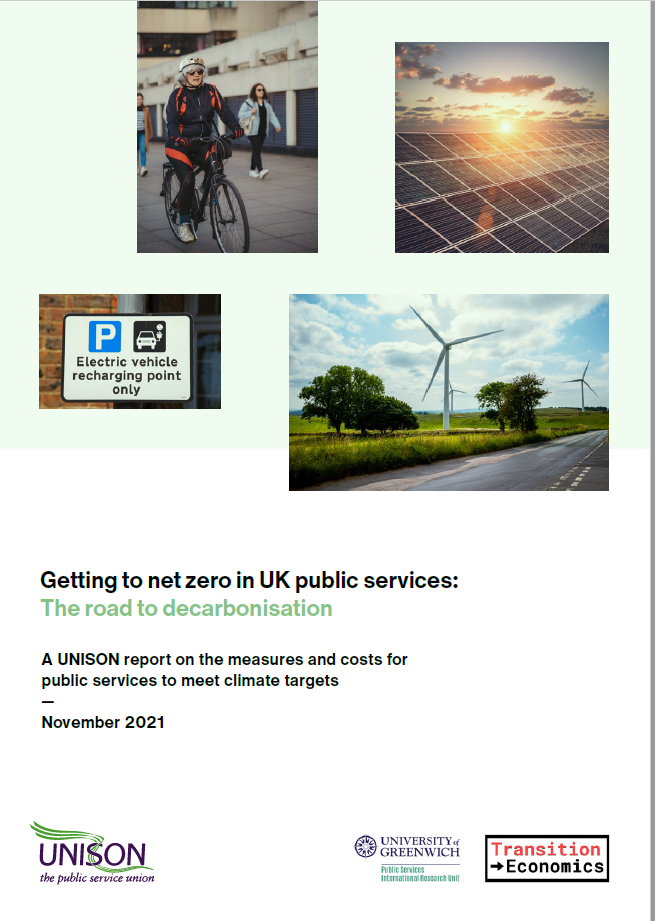
Getting to Net Zero in UK Public Services: The Road to Decarbonisation

By Dr. Vera Weghmann, et. al. - Unison, November 2021

Public services as a whole (excluding transport) represent about 8% of the UK’s direct greenhouse gas emissions. The NHS alone represents about 4% of the UK’s emissions. When procurement, construction, and social housing are taken into account, public services’ impacts are much greater.

Different sectors within the overall framework of public services have declared their decarbonisation plans. Some are ahead of the national targets. The NHS has declared that it will reach net zero by 2040, with an ambition to reach an 80% reduction by 2028 to 2032. More than one-third of local authorities (single- and upper-tier) committed themselves to decarbonise their local area by or before 2030.

The government aims to reduce direct emissions from public sector buildings by 75% against a 2017 baseline by the end of the Sixth Carbon Budget.

This report identified 21 different measures that should be taken across buildings, transport, electricity generation, waste, procurement and land use along with costed measures for each of nine different public services.

In our analysis, the UK’s public services need a capital investment injection of over £140 billion to 2035 to meet their Net Zero obligations. This will set the public sector on track to meet their climate targets and contribute to the UK’s overall carbon reduction aims. The analysis also identified measures that required annual operational expenditures of £1 billion to hit net zero targets. UNISON fully advocates that quality public services are best delivered by public ownership of public services and utilities rather than privatisation, outsourcing or PFI contracting of public services.

As well as improving the quality of life for service users, workers and the wider community, a number of the measures will also result in significant savings to public services’ budgets, through lower energy bills, cheaper to run fleets, and procurement savings. UNISON fully advocates that quality public services are best delivered by public ownership of public services and utilities rather than privatisation, outsourcing or PFI contracting of public services.

Read the text (PDF).

The Road to Ruin? - Electric vehicles and workers’ rights abuses at DR Congo’s industrial cobalt mines

By staff - Rights and Accountability in Development (RAID) and the Centre d’Aide Juridico-Judiciaire (CAJJ), November 2021

Cobalt is everywhere. It is a silvery-blue mineral used in the rechargeable batteries that power our mobile phones, laptops and tablets, and in larger quantities, the electric vehicles that will soon dominate our roads. It is a strategic mineral in the plan to decarbonise and move away from fossil fuels towards renewable energy. Accelerating this switch is one of the priorities to tackle the climate crisis and industry experts forecast that electric vehicle sales will skyrocket in the next 10 years. This will require a dramatic increase in cobalt production.

The booming demand for cobalt has a dark side, however. The Democratic Republic of Congo, one of Africa’s poorest nations, holds the lion’s share of the world’s cobalt reserves. In 2020, 70% of the world’s cobalt was extracted from within its borders with tens of thousands of workers labouring in large-scale industrial mines to dig up the ore. Multinational mining companies that own many of Congo’s mines, eager to demonstrate their “green” and “responsible” credentials, say they produce “clean” and “sustainable” cobalt, free from human rights abuses, and that their operations contribute to good jobs and economic opportunities.

This report, based on extensive research over two years, paints a very different picture. It shows dire conditions for many Congolese workers in the industrial mines, often characterised by widespread exploitation and labour rights abuses. Many workers do not earn a “living wage” – the minimum remuneration to afford a decent standard of living – have little or no health provision, and far too often are subjected to excessive working hours, unsafe working conditions, degrading treatment, discrimination and racism.

In recent years attention has mainly focused on Congo’s artisanal mining sector, partly because of the risks of child labour it creates, whereas the conditions for workers in the large-scale industrial mines have gone largely unnoticed. This report examines workers’ rights at Congo’s industrial mines where the large majority of cobalt is coming from, producing some 80% of the cobalt exported from the country (in contrast to the 20% produced in artisanal mines).

The findings presented in this report are based on detailed research over 28 months by UK-based corporate watchdog Rights and Accountability in Development (RAID) and the Centre d’Aide Juridico- Judiciaire (CAJJ), a Congolese legal aid centre specialised in labour rights. The research team carried out extensive field research in and around Kolwezi, a mining town where many of Congo’s cobalt and copper mines are located. It is informed by 130 interviews of workers and former workers at five mining companies, as well as interviews with subcontractors, union representatives, lawyers, Congolese local authorities, medical staff and industry experts.

Read the text (PDF).

COP26: Trade Unions Must Fight for a Socialist Transition to Renewables

By Chris Baugh - The Bullet, October 26, 2021

The UK government is hosting the 26th United Nations Climate Change “Conference of the Parties” (COP26) in Glasgow from 31 October to 12 November 2021.

The Intergovernmental Panel on Climate Change (IPCC) was formed in 1988. Its latest report to the UN in August of this year contains even starker warnings for the Earth’s climate than previously, unless decisive action is taken to cut greenhouse emissions. Without this, there is little prospect of keeping an average global temperature increase below the 1.5 to 2 degrees Celsius target in the 2015 COP21 Paris Agreement.

This was the first time an agreement had been reached on target reductions but it excluded major polluting industries like aviation and shipping and was devoid of any mechanism for implementing the targets. This reflects the global capitalist consensus that it is market mechanisms that will make the adjustment from fossil fuels to a zero carbon economy. This is despite the warning of Lord Stern who famously described climate change as “the biggest market failure in human history.”

Articles in the pages of The Socialist and Socialism Today have pointed out that it is capitalism’s insatiable pursuit of profit that has led us to this situation. Capitalism has shown itself unwilling and an actual impediment to the action on the timescale and scope required. An article published by Trade Unions for Energy Democracy (TUED) gives recent evidence of how renewable energy companies are “party to a race to the bottom, capitalist dynamic.”

It cites the use of forced Uyghur labour in China-based solar companies and the ‘off-shoring’ of manufacturing for the Scottish wind industry. The large wind and solar companies prop up a market architecture that is sucking in huge amounts of public money to guarantee profit margins. The report is quoted as saying “these companies have not just gone over to the political dark side, they helped design it.”

While richer governments of US and Europe talk up their climate commitments, the solutions proposed will not fix the climate crisis. UK plans to transition to renewable energy are reliant upon an unprecedented wave of resource extraction from ‘Global South’ countries. Intensifying the mining of so-called transition metals and minerals used to produce green technologies such as solar panels, wind turbines and electric vehicle batteries, is devastating communities from Chile to China.

Energy transition or energy expansion?

By Sean Sweeney, John Treat, and Daniel Chavez - Trade Unions for Energy Democracy and Trans National Institute, October 22, 2021

From politicians to corporate executives, media commentators to environmental campaigners, narratives evoking the “unstoppable” progress of a global transition from fossil fuels to renewable energy have grown increasingly commonplace.

However, in reality, the global shifts in energy production, energy usage and greenhouse gas emissions we urgently need are not happening:

  • In 2019, over 80% of global primary energy demand came from fossil fuels, with global greenhouse gas emissions at record levels.
  • In 2020, wind and solar accounted for just 10% of global electricity generated.
  • Despite stories of its decline, coal-fired power generation continues to rise globally. In 2020, global efforts to decommission coal power plants were offset by the new coal plants commissioned in China alone, resulting in an overall increase in the global coal fleet of 12.5 GW.

Recently, some have argued that the Covid-19 pandemic and subsequent contraction in economic activity signal a turning point. Indeed, global energy demand fell by nearly 4% in 2020, while global energy-related CO2 emissions fell by 5.8% — the sharpest annual decline since the second world war.

Despite these short-term shifts, the pandemic has failed to result in any significant long-term changes for the energy sector or associated emissions:

  • Global energy-related CO2 emissions are projected to grow by 4.8% in 2021, the second highest annual rise on record.
  • Demand for all fossil fuels is set to rise in 2021.6 A 4.6% increase in global energy demand is forecast for 2021, leaving demand 0.5% higher than 2019 levels.
  • By the end of 2020 electricity demand had already returned to a level higher than in December 2019, with global emissions from electricity higher than in 2015.
  • By the end of 2020, global coal demand was 3.5% higher than in the same period in 2019. A 4.5% rise in coal demand is forecast for 2021, with coal demand increasing 60% more than all renewables growth combined and undoing 80% of the 2020 decline.
  • Oil demand is forecast to rebound by 6% in 2021, the steepest rise since 1976. By 2026, global oil consumption is projected to reach 104.1 million barrels per day (mb/d), an increase of 4.4 mb/d from 2019 levels.

As such, an energy transition with the depth and speed necessary for meeting the 2015 Paris Agreement shows no sign of materializing. Indeed, most of the world’s major economies are not on track to reach their Nationally Determined Contributions (NDCs) on emissions reductions.

These facts point to a clear conclusion: the dominant, neoliberal climate policy paradigm, which deploys a “sticks and carrots” approach that attempts to disincentivize fossil fuels through carbon pricing, while promoting low-carbon investment through subsidies and preferential contractual arrangements has been completely ineffective. This policy paradigm positions governments as guardians and guarantors of the profitability of private actors, thus preventing them from addressing social or environmental challenges head-on.

Read the text (PDF).

Hoodwinked in the Hothouse: Examining False Corporate Schemes advanced through the Paris Agreement

Pages

The Fine Print I:

Disclaimer: The views expressed on this site are not the official position of the IWW (or even the IWW’s EUC) unless otherwise indicated and do not necessarily represent the views of anyone but the author’s, nor should it be assumed that any of these authors automatically support the IWW or endorse any of its positions.

Further: the inclusion of a link on our site (other than the link to the main IWW site) does not imply endorsement by or an alliance with the IWW. These sites have been chosen by our members due to their perceived relevance to the IWW EUC and are included here for informational purposes only. If you have any suggestions or comments on any of the links included (or not included) above, please contact us.

The Fine Print II:

Fair Use Notice: The material on this site is provided for educational and informational purposes. It may contain copyrighted material the use of which has not always been specifically authorized by the copyright owner. It is being made available in an effort to advance the understanding of scientific, environmental, economic, social justice and human rights issues etc.

It is believed that this constitutes a 'fair use' of any such copyrighted material as provided for in section 107 of the US Copyright Law. In accordance with Title 17 U.S.C. Section 107, the material on this site is distributed without profit to those who have an interest in using the included information for research and educational purposes. If you wish to use copyrighted material from this site for purposes of your own that go beyond 'fair use', you must obtain permission from the copyright owner. The information on this site does not constitute legal or technical advice.
