You are here

publications

A New Circular Vision for Electronics - Time for a Global Reboot

By staff - Platform for Accelerating the Circular Economy (PACE) and E-waste Coalition, January 2019

The global consumption of smart phones and other electronic devices is increasing, and bringing benefits to many people in areas as wide- ranging as health, education, finance and commerce. But there is a downside: the world is now seeing a growing tsunami of e-waste.

A new report launched by the United Nations E-waste Coalition indicates that the global economy generates approximately 50 million tonnes of e-waste every year. This is a huge amount, representing the mass of all the commercial aircraft ever produced.

Unfortunately, less than 20% of this is waste formally recycled. This results in global health and environmental risks, as well as the unnecessary loss of scarce and valuable natural materials.

But businesses, policy makers, and the public can turn this global challenge around. And the rewards will be significant. Indeed, the proper management of e-waste yields not just one, but multiple gains for development.

The new report calls for a systematic collaboration with major brands, small and medium-sized enterprises (SMEs), academia, trade unions, civil society and associations in a deliberative process to reorient the system and reduce the waste of resources each year with a value greater than the GDP of most countries.

Read the report (PDF).

Responsible Minerals Sourcing for Renewable Energy

By Elsa Dominish, Sven Teske, and Nick Florin - Institute for Sustainable Futures, 2019

The transition to a 100% renewable energy system is urgently needed to meet the goals of the Paris Climate Agreement and increase the chance of keeping global temperature rise below 1.5 degrees. Renewable energy technologies are now the most cost competitive technologies for new installations – and recent investment in new renewable energy infrastructure globally has been double that of new energy investment in fossil fuels and nuclear.

Renewable energy technologies, electric vehicles and battery storage require high volumes of environmentally sensitive materials. The supply chains for these materials and technologies need to be appropriately managed, to avoid creating new adverse social and environmental impacts along the supply chain.

This report presents the findings of an assessment of the projected mineral demand for fourteen metals used in renewable energy and storage technologies, the potential to reduce demand through efficiency and recycling, and the associated supply risks and impacts. Solar photovoltaic (PV) and wind power have been chosen for this assessment because these two technologies make up the majority of new global renewable electricity installations. Batteries have been assessed because of their importance for use in electric vehicles (EVs) and energy storage systems.

This research aims to identify the main ‘hotspots’ or areas of concern in the supply chain, including technologies, metals and locations, where opportunities to reduce demand and influence responsible sourcing initiatives will be most needed.

Read the report (PDF).

Realizing a Just and Equitable Transition Away From Fossil Fuels

By Georgia Piggot, Michael Boyland, Adrian Down, and Andreea Raluca Torre - Stockholm Environment Institute, January 2019

Meeting agreed climate goals requires a rapid decarbonization of the global energy system, which in turn necessitates a reduction in fossil fuel production. While limiting fossil fuel use will likely bring a multitude of societal benefits — related to reduced climate risks, sustainable economic growth, air quality and human health — it is important to recognize that not everyone will benefit equally from a transition to a low-carbon economy. In particular, those who rely on fossil fuel production for their livelihood, or who were anticipating using fossil-fuelled energy to meet development needs, may carry a disproportionate share of the burdens of an energy transition.

The need for a “just transition” to a low-carbon economy — namely, a transition that minimizes disruption for workers and communities reliant on unsustainable industries and energy sources — is gaining traction in climate policy and political discourse. A call for “a just transition of the workforce” was included in the preamble to the Paris Agreement, and the United Nations Framework Convention on Climate Change (UNFCCC) secretariat has prepared a technical paper on transition planning.10 In addition, several national and regional governments have recently announced new transition planning processes, including Canada, Germany, Spain, Scotland, New Zealand, and the European Union.

A central concern of just transition efforts is to ensure that low-carbon transitions address social and economic inequality. The UNFCCC calls for a transition that “contribute(s) to the goals of decent work for all, social inclusion and the eradication of poverty.” Likewise, the European Commission aims to “boost the clean energy transition by bringing more focus on social fairness.” And the Scottish Government is seeking a transition that “promotes inclusive growth, cohesion and equality.”

Key messages:

  • Governments are introducing new “just transitions” policies to help workers and communities move away from fossil fuels.
  • Most policies assume that justice goals will be achieved by helping those dependent on coal, oil and gas move into new roles; however, there is little critical reflection on what justice means in the context of an energy transition away from fossil fuels.
  • There are a number of gaps in current just transition policies when viewed through a justice lens. For example, no policies contain measures to improve the lives of people currently marginalized in the energy system.
  • Creating just and equitable transition policies requires collecting data on the current distribution of the harms and benefits of the energy system, and mapping out how this will change as fossil fuels become a less-prominent part of the energy mix.
  • By taking justice considerations into account, transition policies are more likely to limit social and political resistance, win a broad consensus, and achieve effective implementation.

Read the text (PDF).

The Ruhr or Appalachia: Deciding the Future of Australia’s Coal Power Workers and Communities

By Peter Sheldon, Raja Junankar, and Anthony De Rosa Pontello - CFMMEU Mining and Energy, December 3, 2018
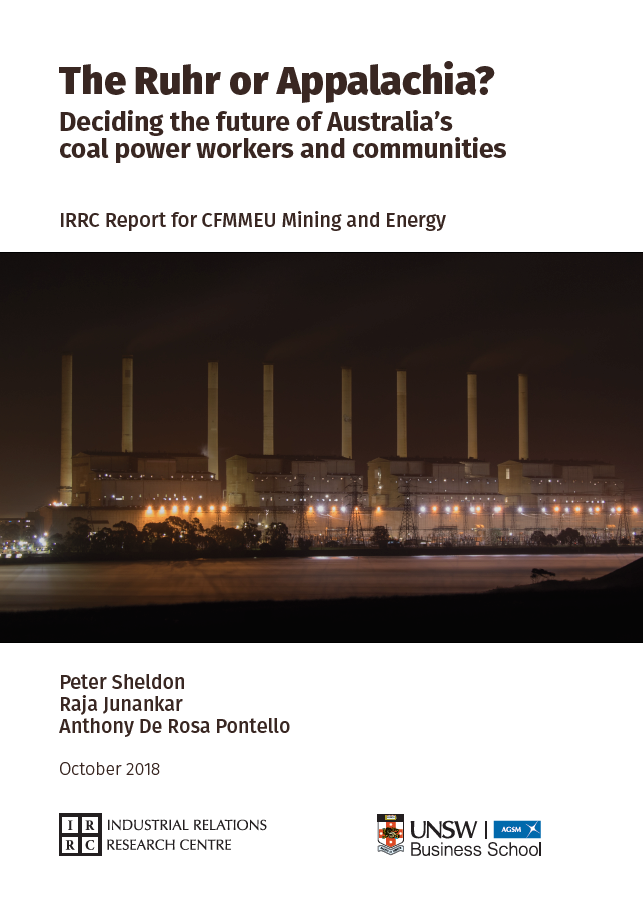
Australia’s coal-fired power stations will all close in the next two or three decades. We know this because the companies that operate the 23 power stations currently operating nation-wide have told us so.

Despite the empty rhetoric of some, it is unlikely that the economic case for investing in new coal-fired power stations in Australia will stack up. Those who currently own and operate coal power stations have no plans to build new ones.

The bad news is that the transition in how we produce power will bring great change to the workers and communities we have relied on to provide Australian homes and industry with reliable energy over many decades.

The good news is that we have the lead time to make smart decisions about what that change looks like—or at least, we now have the lead time after being caught unprepared by earlier closures, including Hazelwood in 2017.We have the choice to manage this structural economic change so that individuals, families and regions aren’t abandoned to unemployment, low-value jobs, poverty and associated health and social decline. Even better, we have the evidence about what works to deliver just transitions for coal power workers and communities, with skills, jobs, opportunities and hope for the future.

Communities grow around power stations and the mines that supply them. They are unique communities bonded in many cases by history, geography, difficult and dangerous working conditions and good unionised jobs. They are also uniquely vulnerable in their heavy dependence on the coal power industry.

This analysis of transitions in resource economies internationally and here in Australia provides valuable insights into the ingredients of success and the wide scope of outcomes.The Appalachian region in the United States is a heart-breaking story of industry transition characterised by short-term, reactive and fragmented responses to closures of coal mines, resulting in entrenched, intergenerational poverty and social dysfunction.

Compare this with the transition away from a heavy reliance on coal mining in Germany’s Ruhr region, where forward planning, investment in industry diversification, staggering of mine closures and a comprehensive package of just transition measures delivered a major reshaping of the regional economy with no forced job losses.

Central to these vastly different outcomes is the presence of a national, coordinated response. To this end, a major recommendation of this report is the establishment of a national, independent statutory authority to plan, coordinate and manage the transition.

In the energy debate to date, the impact of the transition on workers and communities has been almost completely ignored. This is an omission we can’t afford. After all, the costs of investing in a Just Transition need to be balanced against the costs of doing nothing and abandoning whole communities to a bleak future.

While global trends suggest that Australian export coal for steelmaking and energy production will be in demand for decades to come, coal-fired power generation in Australia is winding down. On the information available, there are no excuses for not taking action to protect the best interests of those affected.</p.

I thank Peter Sheldon and the team at UNSW Sydney’s Industrial Relations Research Centre for this important piece of work. I call on all power industry stakeholders to engage with its findings and consider how we can work together to deliver a Just Transition for coal power workers and communities.

Read the report (PDF).

Climate Stability, Worker Stability: are they compatible?

By Dr. Louise Comeau, JD, PhD and Devin Luke - Adapting Canadian Work and Workplaces to Respond to Climate Change, December 3, 2018

It appears we face a low- carbon transition dilemma. On the one hand, climate change solutions, like greenhouse gas regulation and carbon pricing, raise concerns about potential job displacement for workers in traditional energy sectors like oil and gas production and fossil-fuel generated electricity. Hence the calls for just transition. Our research, however, suggests that this blame may be at least partially misplaced. Energy workforce changes are currently affected by broader societal changes relating to fuel-cost differentials (i.e., natural gas cheaper than coal), automation, and the societal transition to non-unionized, unstable and lower-paying work. Greenhouse gas regulations and carbon pricing are certainly not the only driver of workforce change, and likely not, at least currently, not the primary driver.
Should proponents of renewable energy, energy efficiency and the low-carbon transition address these broader societal trends? If so, how? Is the solution to focus on collective responses such as energy cooperatives, public sector ownership of renewable energy supply, utility-scale and managed energy efficiency programs, rather than market- based, privatized solutions? These questions are worth answering. Our goal with this study was to better understand the training needs associated with renewable energy and energy efficiency job projections. There appears, however, to be a greater need to better integrate climate change and low-carbon economy discussions into a broader discourse on the nature of work.

Read the report (PDF).

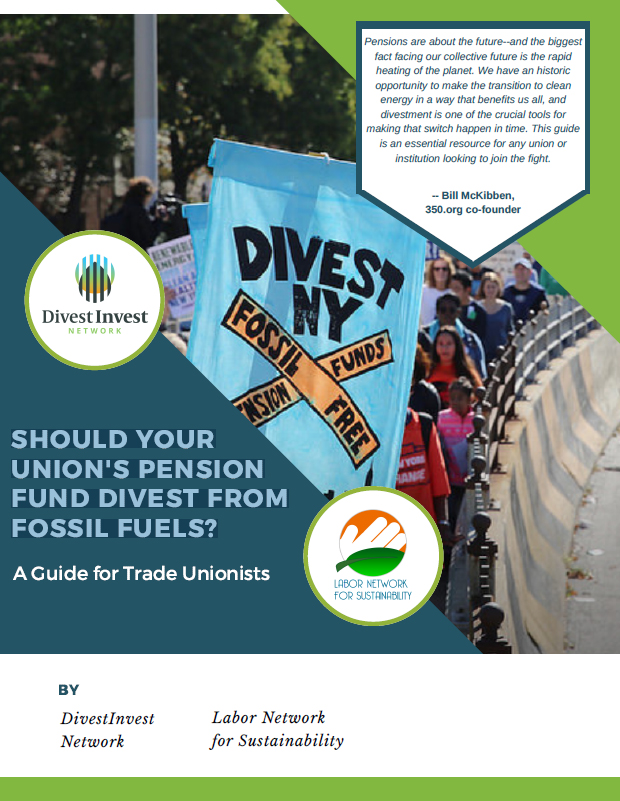
Should Your Union’s Pension Fund Divest from Fossil Fuels?

By staff - Labor Network for Sustainability, November 2018

This guide is designed to help you and your union consider whether you should divest from fossil fuels.
Working people collectively own an enormous amount of capital in our pensions. As a sector, pensions are the largest source of investment in financial holdings, even larger than standard investment houses and banks! Pensions constitute over $40 trillion! Our pension funds are invested in stocks and bonds that may not be serving our interests as working people and may be harming our families’ futures. Imagine what we might be able to support and build, imagine the great jobs we could create, if we use more of our pension funds to directly benefit our members and our families.

The Guide Contains:

  • An introduction to pension fund divestment and links to further information about it
  • Whether failure to divest can constitute a failure in fiduciary responsibility
  • How you can respond to divestment proposals and what questions need to be answered to reach a decision
  • How to start a divestment campaign yourself and answers to questions you may encounter from union members and divestment opponents

Download and Read the PDF Here.

Working Together for a Just Transition

By David Powell, Alfie Stirling and Sara Mahmoud - New Economics Foundation, November 2018

This short pamphlet has been produced to launch the New Economics Foundation’s new programme of work on the 'just transition'. Our interest is in the practicality of change: the policies, processes, narrative and investment needed to accelerate the UK’s progress on 'just transition', here and now. Over the coming months and years we will be working at local and national levels to explore what is needed to build common cause and provide the right mixture of incentives and critical challenge to all parties to help unlock a new momentum for a 'just transition' for the UK.

It has been produced in association with the Friedrich-Ebert-Stiftung’s London Office, part of the international network of FES. The London office was established in 1988 to promote better understanding of British- German relations. FES's work in the United Kingdom focuses in particular on the exchange of ideas and discussion on the following topics: common challenges facing Germany, the United Kingdom and the European Union; economic and social policy; experiences gained from differing regional and local policies and practices; and a continuing dialogue between politicians as well as between the trade unions in both countries.

Read the report (PDF).

Metals in the Circular Economy

By Davide Patteri and Frédéric Simon - Euractiv, November 2018

Vanadium, borate, bismuth, gallium – they may sound like planets from a science fiction movie, but in fact they are some of the most critical elements of the European Union’s economy.They are all on the European Commission’s ‘critical raw materials list’.

The 27 materials on the list are considered both very important to the EU economy and of worrying scarcity. They therefore benefit from specific measures to guarantee their sourcing and encourage their reuse.

These metals are essential components in the manufacturing of smart phones, electric car batteries and other green technologies. In this special report, EURACTIV looks at how the EU’s circular economy strategy can help secure Europe’s supply of critical raw materials in a sustainable way.

Read the report (PDF).

Just cuts for fossil fuels? Supply-side carbon constraints and energy transition

By Philippe Le Billon and Berit Kristoffersen - Economy and Space, November 2018

Reducing greenhouse gas emissions has generally been approached through demand-side initiatives, yet there are increasing calls for supply-side interventions to curtail fossil fuel production. Pursuing energy transition through supply-side constraints would have major geopolitical and economic consequences. Depending on the criteria and instruments applied, supply cuts for fossil fuels could drastically reduce and reorient major financial flows and reshape the spatiality of energy production and consumption. Building on debates about just transitions and supply constraints, we provide a survey of emerging interventions targeting the supply of, rather than the demand for, fossil fuels. We articulate four theories of justice and selection criteria to prioritize cuts among fossil fuel producers, including with regard to carbon-intensity, production costs, affordability, developmental efficiency, and support for climate change action. We then examine seven major supply-constraint instruments, their effectiveness, and possible pathways to supply cuts in the coal, oil and gas sectors. We suggest that supply cuts both reflects and offers purposeful political spaces of interventions towards a 'just' transition away from fossil fuel production.

Read the text (PDF).

A Just and Fair Transition: For Canadian Coal Power Workers and Communities

By staff - Task Force on Just Transition for Canadian Coal Power Workers and Communities, October 2018

The devastating impacts of climate change are becoming clearer each year. More frequent and intense floods, storms, fires, heat waves, and droughts are destroying communities and homes, and putting the lives and futures of Canadians at risk. The Intergovernmental Panel on Climate Change’s 2018 report on global warming of 1.5°C shows that our window to prevent the worst-case scenario is quickly closing.

We do know what is causing climate change and we can do something about it. We need to reduce the amount of greenhouse gas (GHG) emissions released into our environment. There are several ways in which we can accomplish this, including wasting less energy and investing in cleaner energy sources. Businesses, scientists, governments, communities, and individuals in Canada and around the world are beginning to prove that you can reduce GHG emissions, invest in reliable and affordable clean energy, create decent jobs, and have stable economies.

Although coal-fired electricity has contributed significantly to Canada’s economic past and present—and provided Canadians with affordable and reliable electricity and heat for many generations—it produces significant amounts of air pollutants and GHG emissions. It has well documented costs to human health and is a major contributor to climate change: approximately 20% of all GHG emissions in the world came from coal-fired electricity in 2013.

Recognizing these facts, and supported by commitments in the 2015 Paris Agreement, Canada and other countries are intent on replacing coal-fired electricity with cleaner sources of fuel over the coming years and decades. In 2016, Canada committed to the phase-out of traditional coal-fired electricity across the country by 2030.

Phasing out coal-fired electricity, however, will have direct and indirect impacts on thousands of workers, dozens of communities, and four provinces, including:

  • Alberta, Saskatchewan, New Brunswick, and Nova Scotia;
  • Nearly 50 communities with nearby coal mines or generating stations;
  • 3,000 to 3,900 workers at coal-fired generating stations and domestic thermal coal mines;
  • Over a dozen generating stations, owned by six employers;
  • Nine mines, owned by three employers.

In reality, the phase-out of coal fired electricity generation is already underway, especially in Alberta.

The extensive personal and societal impacts of the phase-out of coal-fired electricity are reasons why the labour movement has been advocating for a just transition alongside Canada’s efforts to reduce GHG emissions. We cannot leave affected workers and communities behind during the transition to a low-carbon economy. They too must have hope for the future.

Read the report (Link).

Pages

The Fine Print I:

Disclaimer: The views expressed on this site are not the official position of the IWW (or even the IWW’s EUC) unless otherwise indicated and do not necessarily represent the views of anyone but the author’s, nor should it be assumed that any of these authors automatically support the IWW or endorse any of its positions.

Further: the inclusion of a link on our site (other than the link to the main IWW site) does not imply endorsement by or an alliance with the IWW. These sites have been chosen by our members due to their perceived relevance to the IWW EUC and are included here for informational purposes only. If you have any suggestions or comments on any of the links included (or not included) above, please contact us.

The Fine Print II:

Fair Use Notice: The material on this site is provided for educational and informational purposes. It may contain copyrighted material the use of which has not always been specifically authorized by the copyright owner. It is being made available in an effort to advance the understanding of scientific, environmental, economic, social justice and human rights issues etc.

It is believed that this constitutes a 'fair use' of any such copyrighted material as provided for in section 107 of the US Copyright Law. In accordance with Title 17 U.S.C. Section 107, the material on this site is distributed without profit to those who have an interest in using the included information for research and educational purposes. If you wish to use copyrighted material from this site for purposes of your own that go beyond 'fair use', you must obtain permission from the copyright owner. The information on this site does not constitute legal or technical advice.

