

You are here

imperialism

Wind energy on the Northeast Brazilian coast and the contradictions between ‘clean energy’, injustices and environmental racism

By Cris Faustino and Beatriz Fernandes - World Rainforest Movement, July 9, 2021

In dominant models of energy production and consumption, the centralization of the energy matrix and the concentration of decision-making power remain, and with all the marks of inequalities, patriarchy and environmental racism, even if the source of energy has changed.

Energy production in the face of demand to sustain, develop and expand predominant urban-industrial-capitalist ways of life in so-called global society, does not take place without high levels of interference on a daily basis in nature and the environment, as well as in multiple societies and peoples, their territories and experiences. Regardless of the source of energy and of the technology used to generate it, in these dominant models, energy ventures produce countless socio-environmental conflicts, risks and damage in contexts of deep-seated inequalities.

It just so happens that in Brazil and Latin America, the dynamics of demand for, access to and use of land, water and territory, as well as the ecological and socio-environmental harm that results from them, carry the inheritance of historical facts. An example of this is the expropriation of others’ territories and the setting up of a political, economic, legal, military and religious power based on the supremacy of the colonizer, white men and women, over indigenous and black people. In these processes, violence, subjugation and violation of bodies, of history and of dignity, were instituted as methods. To this day, despite all the achievements in terms of winning rights, these inheritances are encrusted in the dominant political, economic and socio-cultural powers. In the current socio-environmental conflicts, such inheritances manifest themselves in the naturalization of white privileges over state policies and in the relations of the state and the private sector with each other and with black populations, indigenous peoples, riverine peoples, fisherfolk, quilombola communities and others. These do not necessarily have as a reference the consumerist and energy-intensive models of living and organizing life.

In these circumstances, even if the source for producing energy via the wind industry in Brazil, and particularly in the Northeast Region, is considered technologically and ecologically cleaner, the concrete way in which wind farms are implemented is marked by the productivist/consumerist logic. According to the values of this logic, the provision of human needs is only viable in the form of hyper-exploitation and profits at the expense of the environment, of territories and their peoples. And this does not take place without being cut across by structural racism and its expressions in the environmental reality and in the democratic fragilities involved in ensuring the rights of peoples.

Anti-imperialist Manifesto in Defense of the Environment

Biden-Kerry International Climate Politricks

By Patrick Bond - CounterPunch, February 1, 2021

Is U.S. President Joe Biden’s January 27 Executive Order to address ‘climate crisis’ as good as many activists claim, enough to reverse earlier scepticism?

To be sure, it’s great that the word crisis is consistently deployed, not just ‘climate change.’ Applause is due Biden’s commands to halt fossil fuel subsidies and new oil and gas drilling leases on national government lands, and phase out hydrofluorocarbons. There is a welcome promise to instead subsidize new solar, wind, and power transmission projects. Cancelling the nearly-finished Keystone Pipeline extension (from Canada to Nebraska) is praiseworthy, although surely the Dakota Access Pipe Line should be shut, too.

Moreover, a weakened and often climate-unconscious U.S. labor movement did extremely well, with quite a few paragraphs of the Executive Order – e.g. in the box way below – promising well-paying union jobs in a Just Transition. There is an unusual race consciousness, too, as ‘environmental justice’ is invoked to address the discrimination that so often characterizes pollution in the U.S. Much of the Order resonates with Green New Deal demands, so the Sanders-AOC team pulling Biden leftwards can claim some excellent language.

However, caveats and hard-hitting criticisms of the Order were immediately offered by long-standing Climate Justice organizations, e.g.:

Indigenous Environmental Network: “we stand by our principles that such justice on these stolen lands cannot be achieved through market-based solutions, unproven technologies and approaches that do not cut emissions at source. Climate justice is going beyond the status quo and truly confronting systemic inequities and colonialism within our society.”

Food & Water Watch: “Biden’s orders fall well short of what’s needed and must be paired with serious plans to stop our deadly addiction to fossil fuels. We need a White House that is committed to stopping all drilling and fracking, and shutting down any schemes to export fossil fuels.”

These are absolutely valid misgivings, and apply locally and globally. My additional concerns are about how during the 2010s, United Nations Framework Convention on Climate Change (UNFCCC) policy was manipulated by Biden’s climate envoy John Kerry (Secretary of State from 2013-17) and other staff from the Obama-era State Department and U.S. Environmental Protection Agency (including former pro-fracking EPA head Gina McCarthy, now Biden’s senior climate advisor). From Copenhagen’s 2009 United Nations Conference of the Parties COP15 to the 2016 Marrakesh COP22 – and especially at Durban COP17 in 2011 and Paris COP21 in 2015 – their corporate neoliberal agenda held sway. This group’s climate-policy imperialism did enormous harm and it’s vital to recall why.

Ukraine: neither NATO nor Moscow!

By staff - Anarchist Communist Group, January 29, 2022

The Western media is pounding the drum for a conflict between Putin’s Russia and the Western powers over Ukraine.

Let us be clear. Vladimir Putin leads a gangster regime in Russia, sometimes referred to as a kleptocracy (rule by thieves). He runs an oppressive regime and as an ex-high up in the Russian secret police, the KGB, he has extremely close relations with its latest incarnation, the FSB (Federal Service Bureau of the Russian Federation). He has come down heavily on any form of opposition, and the anarchist movement in Russia has suffered, with anarchist militants, arrested tortured and given heavy prison sentences. The Putin regime is massing large numbers of troops on Ukraine’s borders for a number of reasons. The domestic situation is far from healthy and the Covid pandemic has aggravated this. Putin is wary of growing discontent and hopes that his belligerent attitude will unite the Russian masses behind him and make them forget their economic woes. This is a gamble, as the Russian masses are in general not keen to engage in warfare with their fellow Slavs in Ukraine, and remember the disastrous consequences of the war in Afghanistan, when Russian troops sent in to save the pro-Russian regime there were bogged down for years with massive casualties.

With the collapse of the Soviet Union in 1991, a number of republics emerged that had separated from the Russian Federation. Among these was Ukraine, the largest in terms of landmass and the most important in terms of industrial development, an industrial development that had reached its climax under Stalin and his successors.

The fall of the Soviet Union seriously weakened Russia but thanks to rising oil prices coupled with the rise to power of Putin, it began to re-assert itself. It was determined to control and influence the surrounding countries on its borders, both for defence reasons and to re-affirm its control over those regions which it had established after World War Two.

The political-military alliance it had established with its satellites, the Warsaw Pact, was dissolved. However, the corresponding political-military alliance developed by the United States and the Western European powers, NATO, was not wound up and remains an instrument of both the USA and various component Western countries. In fact, NATO sought to increase its influence and has intervened in Kosovo, Afghanistan and Libya. Despite promising the Russian regime that it would not expand its influence east of what was East Germany, it has invested its forces in the countries surrounding Russia, including the Baltic States.

NATO is an aggressive military machine, not a body there to passively defend the West. It has intervened in Libya, in Afghanistan and Iraq. It actively seeks to recruit not just former Soviet republics like Ukraine and Georgia into its alliance, but also so called neutral countries like Finland and Sweden, both very close to Russia. It demands that each component country of NATO spends at least 2% of its Gross Domestic Product on military expenditure.

Fighting the wrong battles: how obsession with military power diverts resources from the climate crisis

By Sam Perlo-Freeman - Campaign Against Arms Trade, February 15, 2020

The first duty of government, it is often said, is to provide for the security of its people. But what is security? For whom, and from what? UK governments typically view security through a military lens; but the real threats affecting the security of people in the UK and worldwide, most urgently the climate crisis, are not susceptible to military force, and indeed military interventions by the UK and its allies this century have had an overwhelmingly disastrous impact on peace and security.
The central role of the military in the government’s understanding of security is reflected in budgetary allocations. There is thus a widespread consensus on maintaining military spending at a minimum of 2% of GDP, the NATO target, with many politicians calling for far higher levels. Meanwhile, the climate crisis, the most urgent threat to human security worldwide, receives far less funding.

Military security or sustainable security

This report argues for a shift of focus both in understanding of security and in resources away from military security and towards a concept of sustainable security that prioritises the security of people over that of states and addresses the underlying causes of conflict and insecurity. In particular, the climate crisis needs to be treated as the urgent, devastating and present threat to human security that it is, with resources allocated accordingly.

Arguments for higher military spending typically start from the premise that the world is an ever more dangerous place. While this contains an element of truth, such arguments are based on a narrow and fundamentally flawed understanding of security centred on military power. The conclusion that what is needed is greater military force from the west is fallacious. Indeed, it has often been the actions of the UK and its allies that have made the world more dangerous, as in Iraq.

Non-military security challenges are minimised or ignored. Climate change, for example, is barely mentioned in the Government’s most recent Strategic Defence and Security Review. When mentioned, they are often framed in terms of the impact on national security, and approached with ‘hard’ security responses, such as militarised borders to deal with mass migration. Meanwhile, ambitions for the UK to retain or regain status as a ‘great military power’, able to project military force around the world, are presented as essential requirements for security, on a par with ensuring the survival and sovereignty of the nation.

Read the text (PDF).

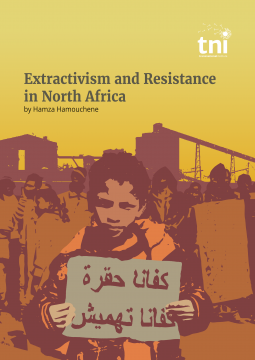
Extractivism and Resistance in North Africa

By Hamza Hamouchene - Transnational Institute, October 2019

Extractivism as a mode of accumulation and appropriation in North Africa was structured through colonialism in the 19th century to respond to the demands of the metropolitan centres. This accumulation and appropriation pattern is based on commodification of nature and privatisation of natural resources, which resulted in serious environmental depredation. Accumulation by dispossession has reaffirmed the role of Northern African countries as exporters of nature and suppliers of natural resources – such as oil and gas- and primary commodities heavily dependent on water and land, such as agricultural commodities. This role entrenches North Africa’s subordinate insertion into the global capitalist economy, maintaining relations of imperialist domination and neo-colonial hierarchies.

The neo-colonial character of North African extractivism reflects the international division of labour and the international division of nature. It is revealed in largescale oil and gas extraction in Algeria and Tunisia; phosphate mining in Tunisia and Morocco; precious ore mining - silver, gold, and manganese - in Morocco; and water-intensive agribusiness farming paired with tourism in Morocco and Tunisia. This plays an important role in the ecological crisis in North Africa, which finds its clear expression in acute environmental degradation, land exhaustion and loss of soil fertility, water poverty, overexploitation of natural resources, pollution and disease, as well as effects of global warming such as desertification, recurrent heat waves, droughts and rising sea levels.

Concurrent with this dynamic of dispossession of land and resources, new forms of dependency and domination are created. The (re)-primarisation of the economy (the deepened reliance on the export of primary commodities) is often accompanied by a loss of food sovereignty as a rentier system reinforces food dependency by relying on food imports, as in the case of Algeria; and/or as land, water and other resources are increasingly mobilised in the service of export-led cash crop agribusiness, as in Tunisia and Morocco. Extractivism finds itself mired in serious tensions, which generates protests and resistance. This paper documents some of these tensions and struggles by analysing activist grassroots work, including the participation in alternative regional conferences and ‘International Solidarity Caravans’ where representative of grassroots organisations, social movements and peasant communities met and travelled together to sites of socio-environmental injustices, providing a space to strategise together and offer effective solidarity to their respective struggles.

The rural working poor and the unemployed in Northern Africa are the most impacted by the multidimensional crisis. Comprising small-scale farmers, near-landless rural workers, fisherfolks and the unemployed, the movements emerging in the five case studies presented here are resisting the looting of their subsoil resources, the despoliation of their lands, pervasive environmental destruction and the loss of livelihoods. The paper asks the following questions: should we see these protests, uprisings and movements as mainly environmental, or are these fundamentally anti-systemic – anti-capitalist, antiimperialist, decolonial and counter-hegemonic protests? Are these circumstantial episodes of resistance, or do they rather represent the latest development in the historical trajectory of class struggle against the latest capitalist offensive in North Africa? The paper presents an assessment of the nature of these movements which grapple with tensions and contradictions that face them.

Read the report (PDF).

A Real Extinction Rebellion Means the End of Colonialism, Imperialism, and Capitalism

By Jessica Garraway - Common Dreams, September 22, 2019

Land and Water Defender Beginnings

In 2011, as a 20 year old activist new to the environmental movement I joined up with other like-minded people for a retreat in rural Wisconsin to plan and strategize our next steps. As a Black woman, it was painfully obvious that amongst the scores of people in attendance that there were very few people of color present. However, what was even more jarring than the racial disproportionality of the retreat was the attitudes of the white activists.

We were hanging out late at night in the living room of a retreat after a long day of workshops and trainings.

The overwhelming number of white activists and their views on race and the environment came to a head for me when I was asked,

“Damn, how do we get black people to care about the environment?”

This is what a white environmentalist (with dreads no less) asked me years ago. Being new to environmental spaces, I was dumbfounded by this comment. I took a long deep sigh, and thought, aren't I Black? Didn't I spend countless hours turning people out for direct actions? It was at this moment I began to realize that I was scoring points for the organization with frontline folks while within the organization I was in a sea of white people who saw me as a token.

Yet I knew that Black people care about the environment - about lead paint in housing, parks in the neighborhood, clean water and clean air. We have to care because we are disproportionately affected by the processes of capitalist environmental degradation.

Historically “environmentalism” was not the modality through which Black people explicitly addressed these issues. It was only later that I realized the lack of orientation that white-dominated environmental groups had toward people of color, and Black people in particular, helped to reinforce the alienation of marginalized communities from the wider environmental movement.

It is no wonder that so many of our people see environmental issues as largely the concern of privileged white people. Far too often we hear more about the protection of wild places we have little access to and not about the incinerators, refineries and mines that pollute our air and water. Anti police brutality movements such as Black Lives Matter struggles have focused attention on deaths of Black people through police terror, however, it is only recently that cases like Flint, Michigan and Newark, New Jersey, majority Black cities with no access to clean water, have gotten notice.

Because of racist housing practices like redlining, Black people have been forced to live near refineries and incinerators at higher rates compared to white people. According to a recent study from the Proceedings of the National Academy of Sciences, white people bear the burden of 17 percent less air pollution than is generated by their own consumption. Meanwhile, Blacks and Latinos experience 56 percent and 63 percent more exposure, respectively, than is caused by their consumption. Even still, it is not the consumption habits of workers that is causing this crisis. It is a political and economic system based on the accumulation of profits and ever expanding markets that is pushing the earth over the edge. Individual actions such as taking shorter showers or passing on plastic straws is not going to change that.

An Investigation into Red-Brown Alliances: Third Positionism, Russia, Ukraine, Syria, and the Western Left

By the blogger - A Roaming Vagabond, January 15, 2018

This long post started as an investigation about the Left and Syria which I started after I read the Sol Process blog’s publication of three posts concerning shady pro-Assad sources used in leftist circles (which can be read here: part I, part II, part III), and which later expanded into a more extensive investigation. I also thank the acknowledgement of my blog post by Russia Without BS, whose blog was helpful in the initial stages of my research.

Note for safety purposes: this post will contain links to far-right pages for documentation and sourcing purposes, and any link to such a page will be in bold and italic, such as this.

Western blind spot: the Kurds' war against Islamic State in Syria

By Derek Wall  - Open Democracy, September 29, 2014

Disclaimer: The views expressed here are not the official position of the IWW (or even the IWW’s EUC) and do not necessarily represent the views of anyone but the author’s.

A victory for the Kurds and their allies in Syria would be a victory for all who seek a future dictated by neither fundamentalists nor imperialists, writes Derek Wall. Is that why NATO members' have taken no effective action to help Syria's Kurds resist Islamic State - even as Kobane is set to fall, and with 160,000 Kurdish refugees trapped at the Turkish border?

The current narrative from Cameron and Obama is simple: the head-chopping Islamic State is a threat to all of humanity, so western forces need to return to the Middle East.

Yet this narrative is far from supported by the empirical evidence. Non-existent weapons of mass destruction and non-existent Islamic fundamentalist jihadists were used to justify the invasion of Iraq in 2003 by George Bush and Tony Blair.

Iraq was transformed from secular totalitarianism to chaos: in turn, chaos and opposition to occupation seeded a jihadist movement.

Western support for opponents of Assad in Syria gave the so-called 'Islamic State' an opportunity to take territory. ISIS was able to seize huge quantities of heavy weaponry supplied by the USA and its allies.

Thus, if US intervention has created or at least massively accelerated the growth of a monster, critics argue that more intervention will no doubt provide the Islamic State with more weapons, more support and more chaos on which to thrive.

Noam Chomsky: Our Govt. Is Capable of Creating Total Catastrophe for Humankind

By Noam Chomsky - Alternet, July 1, 2014

Disclaimer: The views expressed here are not the official position of the IWW (or even the IWW’s EUC) and do not necessarily represent the views of anyone but the author’s.

The question of how foreign policy is determined is a crucial one in world affairs.  In these comments, I can only provide a few hints as to how I think the subject can be productively explored, keeping to the United States for several reasons.  First, the U.S. is unmatched in its global significance and impact.  Second, it is an unusually open society, possibly uniquely so, which means we know more about it.  Finally, it is plainly the most important case for Americans, who are able to influence policy choices in the U.S. -- and indeed for others, insofar as their actions can influence such choices.  The general principles, however, extend to the other major powers, and well beyond.

There is a “received standard version,” common to academic scholarship, government pronouncements, and public discourse.  It holds that the prime commitment of governments is to ensure security, and that the primary concern of the U.S. and its allies since 1945 was the Russian threat.

There are a number of ways to evaluate the doctrine.  One obvious question to ask is: What happened when the Russian threat disappeared in 1989?  Answer: everything continued much as before.

The U.S. immediately invaded Panama, killing probably thousands of people and installing a client regime. This was routine practice in U.S.-dominated domains -- but in this case not quite as routine. For first time, a major foreign policy act was not justified by an alleged Russian threat. 

Instead, a series of fraudulent pretexts for the invasion were concocted that collapse instantly on examination. The media chimed in enthusiastically, lauding the magnificent achievement of defeating Panama, unconcerned that the pretexts were ludicrous, that the act itself was a radical violation of international law, and that it was bitterly condemned elsewhere, most harshly in Latin America.  Also ignored was the U.S. veto of a unanimous Security Council resolution condemning crimes by U.S. troops during the invasion, with Britain alone abstaining. 

All routine.  And all forgotten (which is also routine).

Pages

The Fine Print I:

Disclaimer: The views expressed on this site are not the official position of the IWW (or even the IWW’s EUC) unless otherwise indicated and do not necessarily represent the views of anyone but the author’s, nor should it be assumed that any of these authors automatically support the IWW or endorse any of its positions.

Further: the inclusion of a link on our site (other than the link to the main IWW site) does not imply endorsement by or an alliance with the IWW. These sites have been chosen by our members due to their perceived relevance to the IWW EUC and are included here for informational purposes only. If you have any suggestions or comments on any of the links included (or not included) above, please contact us.

The Fine Print II:

Fair Use Notice: The material on this site is provided for educational and informational purposes. It may contain copyrighted material the use of which has not always been specifically authorized by the copyright owner. It is being made available in an effort to advance the understanding of scientific, environmental, economic, social justice and human rights issues etc.

It is believed that this constitutes a 'fair use' of any such copyrighted material as provided for in section 107 of the US Copyright Law. In accordance with Title 17 U.S.C. Section 107, the material on this site is distributed without profit to those who have an interest in using the included information for research and educational purposes. If you wish to use copyrighted material from this site for purposes of your own that go beyond 'fair use', you must obtain permission from the copyright owner. The information on this site does not constitute legal or technical advice.
