






You are here
climate change
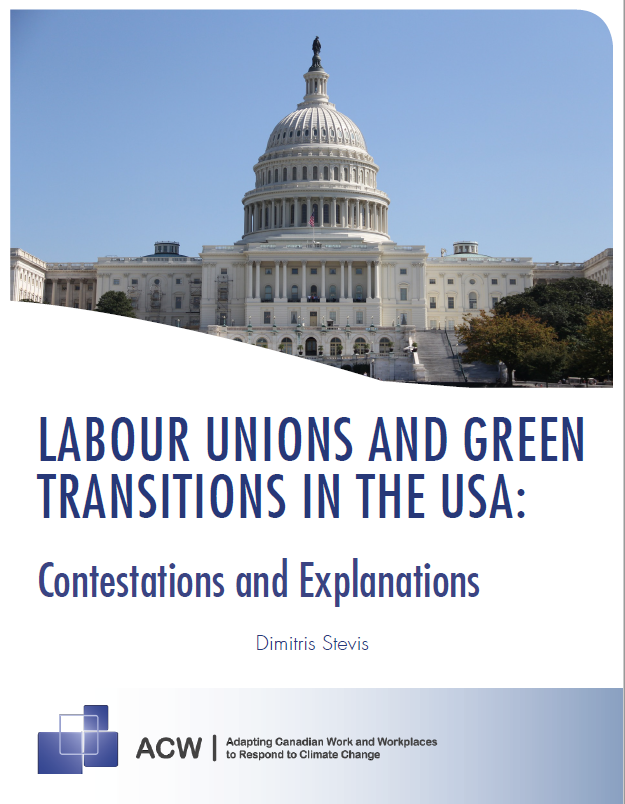 “In broad terms there are now two camps amongst US labour unions with respect to climate change and renewables (the two not always related). On one side, are those unions that believe that something needs to be done about climate change and that renewables are a good strategy. On the other side are those that are opposed to meaningful climate policy –even as they claim that climate change is a problem.”
 Sadly, we are becoming used to seeing headlines about the costs of fighting climate change-related wildfires, hurricanes, and floods – most recently, the record wildfire season of 2017. These news reports usually discuss loss in terms of the value of insurance claims – for example, “
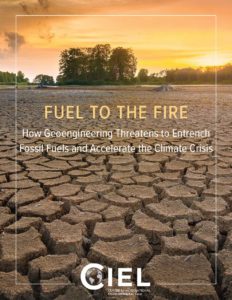 The present report investigates the early, ongoing, and often surprising role of the fossil fuel industry in developing, patenting, and promoting key geoengineering technologies. It examines how the most heavily promoted strategies for carbon dioxide removal and solar radiation modification depend on the continued production and combustion of carbon-intensive fuels for their viability.
 The Food for Health Manifesto aims to give voice, hope and future to all those who wish to commit themselves to act and consume in keeping with a new sustainable food for health paradigm. Additionally, this Manifesto is intended to be used as a tool to help mobilize the urgent transition to local, ecological and diversified food systems. The Manifesto asserts that health, starting with the soil, to plants, animals and humans must be the organizing principle and the aim of agriculture, commerce, science, of our lives and of international trade and aims to create convergence between consumers, producers and stakeholders for a common vision of sustainable development in line with the Millenium Development Goals.
 The role of trade unions and social dialogue is key in demonstrating the major differences between coal-based energy generation and the automobile industry. This book presents two faces of a just transition towards a net-zero carbon economy by drawing lessons from these two carbon-intensive sectors. The authors regard just transition not as an abstract concept, but as a real practice in real workplaces. While decarbonisation itself is a common objective, particular transitions take place in work environments that are themselves determined by the state of the capital-labour relationship, with inherent conflicts of interest, during the transition process.
 Over the past thirty years, Denmark has positioned itself as a global climate leader through its policies to support wind power, district heating, and energy efficiency, amongst other actions.5Building on this, in June 2019, the newly elected Danish government committed to a new climate target of reducing emissions 70 percent below 1990 levels by 2030, surpassing its previous goal of 40 percent by 2020.
The Fine Print I:
Disclaimer: The views expressed on this site are not the official position of the IWW (or even the IWW’s EUC) unless otherwise indicated and do not necessarily represent the views of anyone but the author’s, nor should it be assumed that any of these authors automatically support the IWW or endorse any of its positions.
Further: the inclusion of a link on our site (other than the link to the main IWW site) does not imply endorsement by or an alliance with the IWW. These sites have been chosen by our members due to their perceived relevance to the IWW EUC and are included here for informational purposes only. If you have any suggestions or comments on any of the links included (or not included) above, please contact us.
The Fine Print II:
Fair Use Notice: The material on this site is provided for educational and informational purposes. It may contain copyrighted material the use of which has not always been specifically authorized by the copyright owner. It is being made available in an effort to advance the understanding of scientific, environmental, economic, social justice and human rights issues etc.
It is believed that this constitutes a 'fair use' of any such copyrighted material as provided for in section 107 of the US Copyright Law. In accordance with Title 17 U.S.C. Section 107, the material on this site is distributed without profit to those who have an interest in using the included information for research and educational purposes. If you wish to use copyrighted material from this site for purposes of your own that go beyond 'fair use', you must obtain permission from the copyright owner. The information on this site does not constitute legal or technical advice.
 This site is not the official webpage of the Industrial Workers of the World.