

You are here

climate change

Blue Collar Workers and a Sustainable Economy

By Steve Morse - Labor Rise for Climate, Jobs, Justice, and Peace, November 2022

We who work and have worked with our hands, bodies and minds to build, manufacture and repair are committed to our own well-being and that of our families. Our unions have often fought successfully toward this goal, delivering on wages and pensions.
It’s time to face another commitment we owe our families and the next generation: to work for a healthy planet and for justice.

The Climate Crisis is now. We know about the melting glaciers, rising sea levels, droughts, floods, heat waves, fires and hurricanes. Youth, including our own children and grandchildren, are ready to fight for a livable planet, and many are already doing so. Our unions must stand with them.

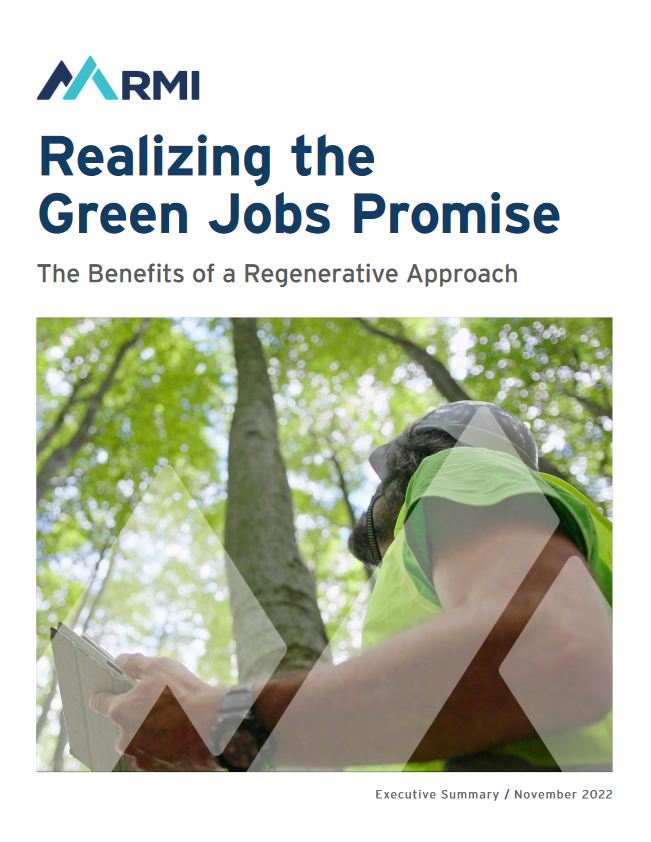
Realizing the Green Jobs Promise

By Raul Alfaro-Pelico, Charlie Bloch, Nick Pesta, and Madeline Tyson - Rocky Mountain Institute, November 2022

The switch to a carbon-free economy is the biggest economic opportunity of our era. The International Energy Agency and other analysts have predicted that this wave of market-driven innovation will create two to six “green jobs” for each fossil fuel job lost. The promised jobs are already arriving — the 2022 Annual Review by the International Labour Organization and the International Renewable Energy Agency reported that renewables alone had created more than 12 million jobs as of 2021.

But as well-researched and credible as such studies are, unfulfilled promises of prosperity have left many people skeptical about clean energy job claims, a skepticism that is commonly accompanied by the belief that the future holds less opportunity than the past. Even before COVID-19, two out of three people felt pessimistic that the gap between the rich and poor in their own country would ever improve. In fact, the U.N.’s World Social Report 2020 identifies four megatrends that are contributing to growing inequality for more than 70 percent of the global population: climate change, technological innovation, urbanization, and international migration. As a result, narrowly framing job numbers as a direct tradeoff between fossil fuel jobs lost and clean energy jobs gained risks undermining political and popular support for the clean energy transition.

A clean energy focus also misses the bigger picture of our rapidly changing global economy, obscuring the “hidden” costs and risks within our current economic system as well as the nascent opportunities embedded in a shift to a more sustainable economy. Compounding forces — pandemics and supply chain fragilities, new technologies and networked intelligence, and climate change and environmental degradation — are creating unprecedented rates of change in the global economy. Workers, communities, and companies cannot afford to ignore the big picture of what the future holds.

Read the report (Link).

Enough is Enough: British and French Workers Fight Climate and Inequality Crises

By staff - Labor Network for Sustainability, October 30, 2022

Hundreds of thousands people marched and rallied October 1 in over 50 towns and cities across the UK on a National Day of Action protesting the soaring cost of living and inaction on the climate crisis. The actions were called by Enough is Enough, a 700,000 member campaign supported by the trade union movement and community groups including tenant unions and foodbanks. Its five demands are:

  1. A real pay raise
  2. Slash energy bills
  3. End food poverty
  4. Decent homes for all
  5. Tax the rich

Climate campaigners brought London’s famed Westminster Bridge to a standstill. Don’t Pay UK encouraged householders to stop paying their bills if the government does not offer further support to families. 50,000 workers from four postal and railroad unions struck for wage increases to make up for inflation.

On October 16, 140,000 people marched through Paris protesting the rising cost of living and government inaction against climate change. They demanded massive investment in climate action, higher wages, an emergency freeze on the prices of groceries, rent, and energy, and greater taxation of windfall profits of corporations. A leader of the action called on protesters to “not allow themselves to be divided by their skin color, their religion, political affiliation or indifference.” Some of the demonstrators wore yellow vests, the symbol of disruptive actions that started in 2018 by protesting against government climate protection policies. The recent demonstration dovetailed with a strike by refinery workers, an impending strike by transportation workers, and a call for a general strike by France’s largest trade unions.

Victory against Manchin’s “Dirty Deal”!

By Larry Williams, Jr. - Labor Network for Sustainability, October 30, 2022

Dear friends,

We’re celebrating the recent defeat of US Senator Joe Manchin’s “Dirty Deal.” This was a proposal to undermine environmental reviews and fast-track fossil fuel projects like the Mountain Valley Pipeline.

Today, we’d like to lift up the board members of the Labor Network for Sustainability who fought tooth and nail to oppose this Dirty Deal. LNS Board Members Jennifer Krill and Edgar Franks recently joined an action in the Hart Senate Building in Washington DC, in which Jennifer was arrested in an act of civil disobedience to oppose the deal.

Jennifer Krill stated: “Prioritizing the climate crisis means prioritizing environmental justice. Legislation that leads to more drilling and mining is precisely the kind of political side-dealing that has set us back from meeting our urgent climate goals. We’re grateful that members of Congress have taken action to stop the exploitation of frontline communities and stand up to the fossil fuel and mining industries. Congress has sacrificed people for corporate profits for far too long.”

Edgar Franks stated: “We as a farmworker union want to stand on the side of environmental justice. We are one of the communities that are bearing the brunt of climate change and also some of the most disenfranchised politically. The Dirty Deal was filled with mechanisms that further widen the divide where we will continue to be sacrificed for profits to the fossil fuel industry. We look for the time where we will not have to pit environment over jobs. As unions we need to be present and demand real solutions that are led by affected communities.”

But of course, this victory does not belong to us. It belongs to the many environmental justice leaders from across the country who’ve taken a stand against the Dirty Deal. It belongs to the communities in the Gulf of Mexico and coastal Alaska and everywhere in between. And it belongs to you.

To every member of the Labor Network for Sustainability—thank you. Whether you signed a petition, emailed or called your Senator, marched in a rally, risked arrest, or donated to support the cause, this is your victory.

We know the fight’s not over. Manchin will stop at nothing to cater to the fossil fuel industry, and we expect him to try to force through a similar deal later this year. But in the meantime, we can celebrate this moment and take stock of all we hold dear.

Thanks for being part of this movement.

Safe and Sustainable Rail

A Renewable Rural America

TUC Congress votes to endorse a ‘just transition’ to a UK free from carbon emissions

By Chris Jarvis - Left Foot Forward, October 18, 2022

The TUC (held) its annual Congress is meeting in Brighton from 18-20 October. On the first day of the Congress, delegates voted for a motion that called for a ‘just transition’ to a UK free from carbon emissions.

In backing the motion, the TUC has agreed to support “a move to net zero that offers a fair deal for workers”, “where green jobs are secure, sustainable, good jobs delivered through collective bargaining and where those workers and communities whose industries are threatened by the changes to develop a low-carbon world have jobs protected, through decarbonisation of existing industries in consultation with workers in those industries and their skills fully utilised in the sustainable industries of the future.”

According to the motion passed by the TUC, there is a need for “state intervention, investment and support to protect jobs, incomes, skills and communities.”

The motion went on to argue for decarbonisation – with protections for jobs – in a number of key industries, including steel and the transport sector. The motion argued, “A just transition in transportation requires ambitious objectives from government to support the upskilling and reskilling of workers, as well as sustainable employment opportunities that supports the transport sector transitioning to a zero-carbon future.”

Alongside this, the motion acknowledged concerns concerns about what a different path towards net zero could mean for trade unions and workers’ jobs. The motion read, “The UK government is promising up to 480,000 skilled green jobs by 2030 and Congress welcomes the TUC’s involvement in the green jobs delivery group. However, there is not nearly enough detail about what those jobs are.

“Congress is also concerned that some companies are using the transition into green industries to discard national agreements and remove collective bargaining.”

In light of this, the motion called for the TUC General Council to ensure that any just transition strategy endorsed by the trade union movement must set out: “realistic estimates” for numbers of green jobs; “the skills, education and training” required for new green jobs, and guarantees for health and safety practices.

In proposing the motion, Gail Cartmail, from Unite, said the it would see the trade union movement working to “ensure a future built on secure, well paid green jobs”, adding, “we must demand a comprehensive climate strategy – from retrofitting of homes to take energy back into public hands, properly funding services and building a green manufacturing sector”.

WANTED: a debate on climate policy in the Trade Union movement

By Tahir Latif - Greener Jobs Alliance, October 16, 2022

On 8th October, our colleagues in Campaign Against Climate Change held a day’s conference titled ‘Urgent action, long term solutions: cost of living, climate and industrial action’. One of the sessions, for which I was Chair, had the title ‘Winning climate arguments in trade unions’ and included excellent contributions from Sam Mason (PCS and Trade Unions for Energy Democracy), Mel Mullings (RMT) and Suzanne Jeffery (Chair, CACCTU).

There was also a great contribution from Pablo John, a GMB worker and a member of GMB for a Green New Deal, and Pablo has written a follow-up piece that appears alongside this article as part of the debate thread we hope to initiate around trade union policy and climate.

At such a critical moment for the country we desperately need a sensible, well-thought-out debate about how trade unions deal with the climate crisis and serve the long-term interest of their members. That means recognising first that what many GJA supporters will see as a worrying trend towards regressive policies (support for fracking, oil and gas drilling, more nuclear) is a response to the fact that we have a government that is promoting those very industries and therefore that’s where the jobs would be.

My own counter to that would be that, as climate catastrophe approaches, those industries become increasingly untenable and our energy strategy will have to change and change more abruptly and dramatically the longer we leave it. But it is difficult to sustain that argument when union leaders only have to look around to see that their members’ current jobs are ‘real’ while the point I’ve just made is ‘notional’. The ask of those trade unions would be, even while supporting ‘regressive’ policies, at least come to the table to talk about the future, and what the workforce will look like, or else when the catastrophe strikes, as everyone knows it will, the change will be done to you not by you.

Machinists Union Making Plans for Workers Impacted by Climate Change

By staff - Labor Network for Sustainability, October 7, 2022

The International Association of Machinists, a venerable union representing half-a-million workers in more than 200 manufacturing and transportation industries, passed a powerful resolution on climate change at its October national convention. The resolution notes that: “Our Union is especially vulnerable to the consequences of climate change,” with “large percentages of IAM members working in at-risk occupations and industries.” Further, “the threat to IAM members, and the entire human race, from unchecked climate change is undeniable.” The threat includes “massive disruptions to the global economy, national security, displacement of people in coastal communities, extreme heat, wildfires, drought, flooding, and other extreme weather-related events.”

The resolution called for concrete steps to address the impact of climate change on the IAM and more broadly. It establishes a union commission to conduct a year-long examination of the potential impact of climate change on the jobs and industries of IAM members. The commission will produce a report that includes “both broad plans and specific approaches for addressing jobs impacted by climate change” and “the steps needed for workers and communities to transition to new jobs and industries in the new green economy.”

The resolution also declares that the IAM will engage in “pro-active leadership” to address this crisis by “joining with other unions and organizations in the international climate change movement” to “actively defend workers’ jobs, rights, and lives,” as well as secure “a livable future for our children and future generations.”

Outdoor Workers and Organizers in Miami are Fighting for a Countywide Heat Standard

By Alexandra Martinez - Prism, October 6, 2022

Marta Gabriel has been picking tomatoes in Homestead, Florida, since she arrived from Guatemala five years ago. She didn’t know how hot and grueling conditions would be, but the job guaranteed her money that she could use to support her growing family as a mother of young children. However, after she nearly fainted from heat exhaustion and then suffered heatstroke while bending down to cut tomatoes, Gabriel realized her working conditions were not sustainable. She was already a member of WeCount!, a coalition of immigrant workers in southern Florida, and shared her concerns with organizers. 

Hundreds of thousands of other outdoor workers across South Florida share Gabriel’s experience. Starting in 2017, they began telling organizers at WeCount! that heat had become an issue. Now, construction workers, farmworkers, and other outdoor workers across Miami-Dade County are fighting for a countywide heat standard to ensure workers are protected from the deadly rising temperatures on the frontlines of climate change and extreme heat.

As it stands, workers in southern Florida are forced to work outside in the extreme heat without any local, state, or federal heat standards. WeCount!’s “¡Que Calor!” campaign (Spanish for “it’s so hot!”) is hoping to enact a heat standard similar to the one states like California, Washington, or Oregon, have already implemented—one that highlights the need for water, shade, and rest for workers. Led by those most impacted by the problem—farmworkers, plant nursery workers, day laborers, and construction workers—¡Qué Calor! is building a grassroots movement for climate, health, and labor justice. 

Pages

The Fine Print I:

Disclaimer: The views expressed on this site are not the official position of the IWW (or even the IWW’s EUC) unless otherwise indicated and do not necessarily represent the views of anyone but the author’s, nor should it be assumed that any of these authors automatically support the IWW or endorse any of its positions.

Further: the inclusion of a link on our site (other than the link to the main IWW site) does not imply endorsement by or an alliance with the IWW. These sites have been chosen by our members due to their perceived relevance to the IWW EUC and are included here for informational purposes only. If you have any suggestions or comments on any of the links included (or not included) above, please contact us.

The Fine Print II:

Fair Use Notice: The material on this site is provided for educational and informational purposes. It may contain copyrighted material the use of which has not always been specifically authorized by the copyright owner. It is being made available in an effort to advance the understanding of scientific, environmental, economic, social justice and human rights issues etc.

It is believed that this constitutes a 'fair use' of any such copyrighted material as provided for in section 107 of the US Copyright Law. In accordance with Title 17 U.S.C. Section 107, the material on this site is distributed without profit to those who have an interest in using the included information for research and educational purposes. If you wish to use copyrighted material from this site for purposes of your own that go beyond 'fair use', you must obtain permission from the copyright owner. The information on this site does not constitute legal or technical advice.
