






You are here
climate justice
 Climate change and human rights are not separate concepts, but rather go hand-in-hand. In line with the increased recognition in human rights bodies, countries around the world, and public discourse, Rights in a Changing Climate demonstrates the fundamental links between human rights and climate change and documents the growing momentum within the UN climate regime to articulate the legally binding duties of States to protect, respect, and promote human rights in the context of the climate crisis.
 Europe today confronts three overlapping crises.
 Organized Labor has been the most powerful force for change in the History of the United States of America. From the 8 hour day/40 hour work week, the establishment of the weekend, livable wages (in Union shops), to workplace safety standards; Labor has won these foundational victories through collective action and solidarity. However, for some decades Labor, nationally, has been on the decline. After endorsing Bill Clinton for President (1992), Clinton and the Democrats in Congress sent our manufacturing jobs to low wage (super exploited) nations through NAFTA and other free trade agreements (agreements which we opposed, and which we still oppose). And with these good manufacturing jobs, so went thousands of Union jobs.
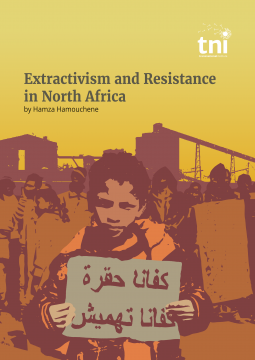 Extractivism as a mode of accumulation and appropriation in North Africa was structured through colonialism in the 19th century to respond to the demands of the metropolitan centres. This accumulation and appropriation pattern is based on commodification of nature and privatisation of natural resources, which resulted in serious environmental depredation. Accumulation by dispossession has reaffirmed the role of Northern African countries as exporters of nature and suppliers of natural resources – such as oil and gas- and primary commodities heavily dependent on water and land, such as agricultural commodities. This role entrenches North Africa’s subordinate insertion into the global capitalist economy, maintaining relations of imperialist domination and neo-colonial hierarchies.
 In ways unimaginable just a few years ago, public banking and its potential for catalyzing a transition to a green and just future have been catapulted to the center of political and economic debate. The reason: The greed-driven excesses of Wall Street and global finance that gave rise to the 2008-09 global financial crisis are now continuing to drive today’s global crisis of climate finance.
 As Greenland experiences a record melt, Europe recovers from record-breaking heat, California braces for another fire season, and Puerto Rico still struggles to rebuild nearly two years after Hurricane Maria, it is becoming ever clearer how profoundly the climate crisis is changing everything, and how imperative it is that we act now if we hope to avert an existential disaster.
 The idea of just transition first emerged in the 1970s, when US union leader Tony Mazzocchi1 proposed that people whose jobs were threatened by nuclear disarmament should be compensated for the loss. In the 1990s Mazzocchi broadened the argument to refer to workers in environmentally damaging jobs, whose employment is affected by new policies aiming to reduce pollution.
The Fine Print I:
Disclaimer: The views expressed on this site are not the official position of the IWW (or even the IWW’s EUC) unless otherwise indicated and do not necessarily represent the views of anyone but the author’s, nor should it be assumed that any of these authors automatically support the IWW or endorse any of its positions.
Further: the inclusion of a link on our site (other than the link to the main IWW site) does not imply endorsement by or an alliance with the IWW. These sites have been chosen by our members due to their perceived relevance to the IWW EUC and are included here for informational purposes only. If you have any suggestions or comments on any of the links included (or not included) above, please contact us.
The Fine Print II:
Fair Use Notice: The material on this site is provided for educational and informational purposes. It may contain copyrighted material the use of which has not always been specifically authorized by the copyright owner. It is being made available in an effort to advance the understanding of scientific, environmental, economic, social justice and human rights issues etc.
It is believed that this constitutes a 'fair use' of any such copyrighted material as provided for in section 107 of the US Copyright Law. In accordance with Title 17 U.S.C. Section 107, the material on this site is distributed without profit to those who have an interest in using the included information for research and educational purposes. If you wish to use copyrighted material from this site for purposes of your own that go beyond 'fair use', you must obtain permission from the copyright owner. The information on this site does not constitute legal or technical advice.
 This site is not the official webpage of the Industrial Workers of the World.