You are here

green unionism

Amazon workers demand company quit polluting near communities of color

By Justine Calma and Zoe Schiffer - The Verge, May 25, 2021

Hundreds of Amazon tech workers are pressuring Amazon to quit polluting — especially in communities near its warehouses. More than 600 workers signed a petition asking Amazon to bring its pollution down to zero by 2030. They also called on the company to prioritize deploying zero-emissions technologies near the communities hit hardest by Amazon’s pollution.

The petition was started after Amazon rejected a shareholder resolution asking the company to report how much pollution it emits in communities of color. Amazon says the proposal was similar to a resolution that was voted down by shareholders last year. Amazon’s annual shareholder meeting is scheduled for May 26th.

Amazon’s warehouses have mushroomed around working-class communities predominately made up of households of color, activists say. Those warehouses are magnets for pollution from diesel trucks, trains, and planes that are constantly moving goods to and from the warehouses for the e-commerce giant.

“Amazon shows up without informing the community about their encroachment. They show up with warehouses and delivery trucks that worsen our roads, our air.” Paola Dela Cruz-Perez, a youth organizer for the nonprofit East Yard Communities for Environmental Justice said during a shareholder briefing held today. “Amazon has been expanding their operations in Southeast L.A. neighborhoods like my own by exactly understanding how environmental racism works, and choosing to profit from this oppression.”

The workers organizing the petition are part of Amazon Employees for Climate Justice. “As employees, we are alarmed that Amazon’s pollution is disproportionately concentrated in communities of color,” they said in a statement. “We want to be proud of where we work. A company that lives up to its statements about racial equity and closes the racial equity gaps in its operations is a critical part of that.”

American Jobs Plan Can Accelerate Solar Power in West Virginia

By Autumn Long and Ted Boettner - Ohio River Valley Institute, May 25, 2021

As a recent article in Forbes noted, the ‘dam has broken’ in West Virginia for solar power. While solar energy comprises less than 0.2 percent of electricity production in the state today, the market for solar energy is marching forward. Despite not having a renewable energy portfolio standard – which would require that utilities get a certain percentage of the electricity they sell in the state from renewable resources – like 30 other states, West Virginia lawmakers have started opening more doors for solar power. For example, state lawmakers this year legalized purchase power agreements (PPAs) to allow third parties to own and operate solar installations for customers while charging them a fixed rate that is typically lower that what the customer pays for electricity. In 2020, the West Virginia Legislature created a utility solar program that allows the state’s investor-owned utilities (FirstEnergy and American Electric Power) to produce as much as 200 megawatts of solar electricity each.

A flurry of new solar projects is now under development in the state. Toyota announced plans to spend $4.9 million to construct a 2.6-Megawatt solar array at its manufacturing plant in Buffalo, West Virginia. In October 2020, the WV Public Service Commission approved plans for a $90 million investment to build a 90-Megawatt solar farm in Raleigh County. Earlier this year, a 100-Megawatt utility-scale solar project was announced at the former Dupont Potomac River Works manufacturing facility in Berkeley County. And earlier this month, Nitro Construction Services acquired local solar installation company Revolt Energy, with plans to expand operation throughout the state on former coal mine sites. Revolt had recently installed a 487-kilowatt rooftop solar array (1,200 solar panels) at Nitro Construction Services’ headquarters in Putnam County.

According to the Solar Energy Industries Association (SEIA), West Virginia ranks last (50th) in solar production in the nation with just 11.2 megawatts of installed solar power and less than $35 million in total solar investment in the state. Total solar jobs in the state were just 311 in the 4th quarter of 2020, with 18 solar companies operating in the state. Between 2012 and 2020, the number of solar jobs in West Virginia has grown by 241.

An October 2020 report by E2 found that jobs in solar pay close to what jobs in the coal, oil, and gas industries pay, $24.48 an hour (median) compared to $24.37 an hour (median), respectively. Approximately 10 percent of solar industry jobs are unionized, according to the Solar Foundation, which is above the national average and similar to levels found throughout the construction industry. Wage data for solar employment is not available for West Virginia, but it is likely below the national average.

There are a number of policy proposals at the federal level that could lead to significant acceleration in West Virginia’s solar industry. President Biden’s American Jobs Plan includes two key provisions, including a 10-year extension of the federal solar Investment Tax Credit (ITC), which currently offers a 26% tax credit for solar installations, and an expanded direct cash payment in lieu of the ITC that allows solar owners to receive money even if they don’t have taxable income, much like a refundable tax credit. A cash grant option would ensure equitable benefits of the ITC are accessible to low- and moderate-income households, people with low tax liability, and nonprofit institutions such as schools, churches, local governments, and rural electric cooperatives.

Once again on sabotage and climate change

By Lars Henriksson - Climate and Capitalism, May 22, 2021

What should we do when airy political promises amount to little more than excuses for business as usual, and when the friendly climate protests have not prevented the world from heading towards a burning inferno? Submissively accept doom or take the climate struggle to a new level?

That Andreas Malm does not preach resignation will come as no surprise to those who know the author — activist and socialist since childhood and today well-known in the radical section of international academia. For those unfamiliar with him, the book’s title should dispel all doubt.

To stoically wait for doom is not an option for most of us, even if some claim to have drawn that conclusion. The book’s final section is a reckoning with intellectuals such as Roy Scranton and Jonathan Franzen who flirt with that standpoint.

For the rest of us, who either try to do something, or wish we knew how to do something, the question is: what do we do now? It is this question to which Malm devotes most of his book.

The attention given to the book ahead of publication has mostly concerned the question of sabotage as a method in the climate struggle. Despite the book’s provocative title, this is far from an anarchist cookbook but a thought-through — albeit impatient — contribution to the debate about strategy and tactics in the climate movement.

Malm raises a question posed by the British author John Lanchester: Why has the climate movement not resorted to violence? Given what is at stake is humanity’s survival, it is strange that nobody has started blowing up petrol stations or at least started scratching the paint on city jeeps, Lanchester states, in what Malm refers to as Lanchester’s paradox.

In the latter case, the effort is very small and would make these gas guzzling monster cars almost impossible to own in a city like London. Malm himself has a past as an SUV-saboteur of the milder kind, when the group The Indians of the Concrete Jungle in the early 2000s let the air out of gas guzzling luxury cars’ tyres in upper class neighborhoods. He takes this paradox — that the climate movement, despite knowing what is at stake, continues to be peaceful and well behaved — as the starting point for his argument.

The Workers' Committees of Porto Marghera and 'Workerist Environmentalism'

Canada’s banks continue to finance oil and gas

By Elizabeth Perry - Work and Climate Change Report, May 19, 2021

A report released at the end of April examines the performance and the links between Canada’s oil companies and the big banks which form Canada’s “comfortable oligopoly”: Royal Bank (RBC), Toronto-Dominion Bank, Bank of Nova Scotia, Bank of Montreal, Canadian Imperial Bank of Commerce, and the National Bank of Canada. Fossilized Finance: How Canada’s banks enable oil and gas production is written by Donald Gutstein and published by by the B.C. Office of the Canadian Centre for Policy Alternatives as part of its Corporate Mapping Project. The report outlines the bank presence in the Canadian energy sector since the collapse of oil prices in 2014 – lending, underwriting, advising and investing. It also examines interlocking directorates, executive transfer, industry conference sponsorships and industry association memberships.This reveals different details than the international report, Banking on Climate Chaos, published by BankTrack in late March.

While acknowledging that the banks have begun to invest in some renewable energy projects, Fossilized Finance shows that this leopard has not changed its spots:

“In contrast to the need to reduce financing of fossil fuels, banks actually increased their lending and commitments to the industry by more than 50 per cent—to $137 billion—between 2014 and 2020. Toronto-Dominion, in particular, upped its lending by 160 per cent over the seven-year period, to nearly $33 billion in 2020. As well, banks have invested tens of billions of dollars in fossil fuel and pipeline company shares. Here, Royal Bank leads the pack with nearly $21 billion invested in the top 15 fossil fuel and pipeline companies as of November 2019. Banks continue to underwrite fossil fuel company stock and bond issues, and they continue to provide key advice on mergers, acquisitions and other corporate moves.”

Many of the researchers involved in the CCPA/Corporate Mapping Project have written chapters in Regime of Obstruction: How Corporate Power blocks Energy Democracy, a book edited by William Carroll and published by Athabasca University Press. Readers of the WCR may be particularly interested in Chapter 15, “From Clean Growth to Climate Justice” by Marc Lee, but all the excellent chapters are available for free download here. The publisher’s summary states: “Anchored in sociological and political theory, this comprehensive volume provides hard data and empirical research that traces the power and influence of the fossil fuel industry through economics, politics, media, and higher education. Contributors demonstrate how corporations secure popular consent, and coopt, disorganize, or marginalize dissenting perspectives to position the fossil fuel industry as a national public good. They also investigate the difficult position of Indigenous communities who, while suffering the worst environmental and health impacts from carbon extraction, must fight for their land or participate in fossil capitalism to secure income and jobs. The volume concludes with a look at emergent forms of activism and resistance, spurred by the fact that a just energy transition is still feasible. This book provides essential context to the climate crisis and will transform discussions of energy democracy.”

If you are outraged by what these researchers reveal, a personal option to switch banks is now made easier through the Bank Green website, launched in April in association with BankTrack. So far, Bank Green covers more than 300 banks globally, including only two “ethical banks” in Canada: Vancity, and Duca Credit Union. The website provides information for customers and encourages them to switch banks and divest from fossil fuels.

Growth of ZEV’s impacts trucks, buses – and their drivers too

By Elizbeth Perry - Work and Climate Change Report, May 17, 2021

The International Energy Agency released its annual Global Electric Vehicle Outlook report for 2021 in April, providing data, historical trends and future projections. Despite the pandemic, there was a 41% increase in electric vehicle registrations in 2020 – compared to a 16% contraction of the overall global automobile market. There are now more than 10 million electric cars on the world’s roads, and for the first time, Europe overtook China as the centre of the global electric car market. In addition, there are roughly 1 million electric vans, heavy trucks and buses globally. A separate forecast by Bloomberg New Energy Finance, as summarized by The Guardian, projects that electric vehicles will reach price parity with internal combustion engine (ICE) vehicles by 2027. Another April report from Boston Consulting Group forecasts that zero-emission vehicles will replace ICE vehicles as the dominant powertrain for new light-vehicle sales globally just after 2035.

Most policy discussions of the electrification of transportation focus on the potential for GHG emissions reductions, consumer preferences, and the economic impacts for the automotive industry. There has been a lack of attention on operational workers – with a few exceptions. A 2020 report from the International Labour Organization and the United Nations Economic Commission for Europe, Jobs in green and healthy transport: Making the green shift , offers modelling of employment impacts in a broad definition of transportation, including personal vehicles, trucks and public transport. It focuses on Europe, and discusses the employment impacts in both manufacturing and operation.

Future skills for the energy efficient building workforce

By Elizbeth Perry - Work and Climate Change Report, May 19, 2021

A recent report from ECO Canada,  Assessment of Occupational and Skills Needs and Gaps for the Energy Efficient Buildings Workforce, focuses on the occupations and skills needed for designing, constructing, managing, and retrofitting energy efficient commercial and institutional buildings and multi-unit residential buildings.  The report states that much of the technology, materials, and processes are in place, but workforce skills still need to be developed – for example, under a “building-as-a-system” approach,  workers are increasingly called upon to function within multi-disciplinary teams, requiring soft skills such as collaboration and facilitation. Such a system also requires a workforce culture shift. A section called “ Future-Proofing the Energy Efficient Building Sector”  provides a summary of core and growing occupations and skills related to design, construction, operation, and retrofitting of energy efficient buildings. The report assesses specific occupation skills and gaps, and recommends ways to connect with workers– and includes unions amongst the stakeholder groups which can support skills acquisition. The 73-page report is available for free download from this link (registration required).

IEA calls for a future without fossil fuel investment

By Elizbeth Perry - Work and Climate Change Report, May 18, 2021

Net Zero in 2050: A roadmap for the global energy system was released by the International Energy Agency on May 18, and has been described as a “bombshell”, and a “landmark”. Why? The normally conservative IEA describes the global energy future bluntly and urgently, calling for “…. from today, no investment in new fossil fuel supply projects, and no further final investment decisions for new unabated coal plants. By 2035, there are no sales of new internal combustion engine passenger cars, and by 2040, the global electricity sector has already reached net-zero emissions.”

This special report claims to be “ the world’s first comprehensive study of how to transition to a net zero energy system by 2050 while ensuring stable and affordable energy supplies, providing universal energy access, and enabling robust economic growth.” It sets out 400 indicators for “an economically productive pathway to 2050”, where energy production will be dominated by renewables instead of fossil fuels. The report also flags and discusses bioenergy, carbon capture, and behavioural changes as “key uncertainties” for the future.

Highlights from the discussion of employment in Chapter 4:

  • In 2021, approx. roughly 40 million people work directly in the oil, gas, coal, renewables, bioenergy and energy network industries . 
  • By 2030 in the Net Zero scenario, 30 million more people will be working in clean energy, efficiency and low‐emissions technologies. 
  • By 2030, employment in oil, gas and coal fuel supply and power plants will decline by around 5 million jobs.
  • Nearly two‐thirds of workers in the emerging clean energy sectors will be highly skilled by 2030, and the majority will require substantial training. 
  • The new jobs created in the net zero economy will have more geographic flexibility. Around 40% are jobs located close to where the work is being done, e.g. building efficiency improvements or wind turbine installation, and the remaining are jobs tied to manufacturing sites. 

Canada’s Climate Emergency Unit seeks to light a spark across Canada

By Elizabeth Perry - Work and Climate Change Report, May 17, 2021

A report released at the end of April examines the performance and the links between Canada’s oil companies

The Climate Emergency Unit is a newly-launched initiative of the David Suzuki Institute, with the Sierra Club B.C. and the Rapid Decarbonization Group of Quebec as Strategic Partners. The Unit is led by Seth Klein and inspired by his 2020 book, A Good War: Mobilizing Canada for the Climate Emergency, which argues that climate mobilization requires an effort similar to what previous generations expended against the existential threat of fascism during the Second World War. (This is an approach shared with the U.S. group The Climate Mobilization, and others). The stated goal of the CEU is “to work with all levels of government and civil society organizations – federal, provincial, local and Indigenous governments, businesses, trade unions, public institutions and agencies, and industrial/sectoral associations” – to network, educate and advocate for the mobilization ideas in A Good War, to decarbonize and electrify Canadian society and the economy, while enhancing social justice and equity. 

In an article in Policy Options in November 2020, Klein summarizes the four hallmarks of a government committed to an urgent, emergency response:

  • It spends what it takes to win;
  • It creates new economic institutions to get the job done;
  • It shifts from voluntary and incentive-based policies to mandatory measures;
  • It tells the truth about the severity of the crisis and communicates a sense of urgency about the measures necessary to combat it.

Seth Klein was the founding Director of the Canadian Centre for Policy Alternatives in British Columbia, and continues to publish in the CCPA Policy Note , as well as in the Climate Emergency Unit blog, and as a columnist for The National Observer – for example, with “Feds need to treat climate crisis like a national emergency” on April 30.

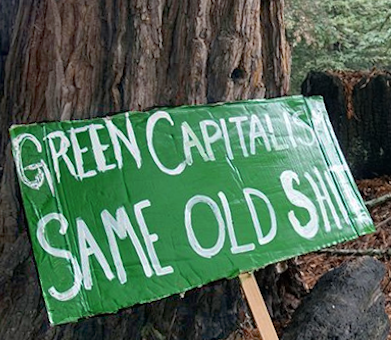
Green Economy, Green Capitalism? The Case Against The Case for Climate Capitalism

By Nick Grover - The Bullet, May 14, 2021

Even now, with a ten-year timeframe left for action, it’s rare for the climate crisis to be treated as the emergency it is. So, credit where due to Tom Rand. In his The Case for Climate Capitalism: Economic Solutions for a Planet in Crisis (Toronto: ECW Press, 2020), Rand calls for a rapid transition away from fossil fuels and toward renewables; he blames the political and business elite for the mess and says they will have to pay the price as markets turn against oil and assets are stranded; he even advocates for expansion of public transit. Where the book gets less refreshing is Rand’s tone toward the people who have been saying these things all along: his secondary enemy, leftists fusing demands for climate action with calls for economic justice.

Rand’s Case for Climate Capitalism aims to preserve and “co-opt” the forces of capitalism to usher in a transition toward green tech. His case is presented as simple pragmatism: the emergency we face affords us no time to discuss economic reforms; we must unite and do what works instead of holding out for a perfect system. His concern is that left ideas like the Green New Deal and Leap Manifesto – which wed strong climate action with job guarantees, labour protections, taxing the rich, and expanding social programs – alienate conservatives and the business class when we need them in our coalition to save the planet.

Pages

The Fine Print I:

Disclaimer: The views expressed on this site are not the official position of the IWW (or even the IWW’s EUC) unless otherwise indicated and do not necessarily represent the views of anyone but the author’s, nor should it be assumed that any of these authors automatically support the IWW or endorse any of its positions.

Further: the inclusion of a link on our site (other than the link to the main IWW site) does not imply endorsement by or an alliance with the IWW. These sites have been chosen by our members due to their perceived relevance to the IWW EUC and are included here for informational purposes only. If you have any suggestions or comments on any of the links included (or not included) above, please contact us.

The Fine Print II:

Fair Use Notice: The material on this site is provided for educational and informational purposes. It may contain copyrighted material the use of which has not always been specifically authorized by the copyright owner. It is being made available in an effort to advance the understanding of scientific, environmental, economic, social justice and human rights issues etc.

It is believed that this constitutes a 'fair use' of any such copyrighted material as provided for in section 107 of the US Copyright Law. In accordance with Title 17 U.S.C. Section 107, the material on this site is distributed without profit to those who have an interest in using the included information for research and educational purposes. If you wish to use copyrighted material from this site for purposes of your own that go beyond 'fair use', you must obtain permission from the copyright owner. The information on this site does not constitute legal or technical advice.