You are here

green unionism

Job Creation for a Clean Jumpstart

By Amanda Novello - Data for Progress, July 2021

Government stimulus is sorely needed: more than a year into the pandemic recession, nearly 10 percent of Black workers are unemployed, and over 6 percent of all workers are unemployed. There are still more than 7 million fewer jobs than there were last June, and nearly 40% of all unemployed workers are long-term unemployed. A majority of those out of work have no college degree. In addition, there are 5 million fewer people in the labor force than pre-pandemic, including 3 million women who left the labor force since last February, and 2 million men.

Decarbonizing the economy in tandem with a full, job centered green recovery, will require many different plans to be executed at all levels of government and society. That’s why, this March, Data for Progress and Evergreen Action released the Clean Jumpstart 2021 report that offers 39 policy priorities for how to carry out our existing commitments, while increasing ambition and creating good jobs that Americans desperately need, in communities that need them most. All components of this plan are popular with likely voters. The Clean Jumpstart 2021 plan represents how a bold climate investment package, like the American Jobs Plan, could tackle the climate crisis and build a clean energy economy.

The Clean Jumpstart 2021 plan would invest a total of $2.3 trillion over four years. Some investments would create jobs more or less immediately, while others will take longer to realize full job-creation effects. Therefore, in this memo, we estimate that the plan would create an average of 2.7 million jobs annually for the first five years. But the job benefits of the plan don’t end there. The policies in Clean Jumpstart would also create up to 960,000 jobs annually for five years following (year 6-10 after investments begin). Approximately 40 percent of all jobs created would be “direct” jobs, or employment working directly toward these policy goals, and the rest would be due to additional work generated along supply chains and in communities due to the multiplied impacts of increased demand.

Read the text (PDF).

Ramona Strategies: Executive Summary of Recommendations (for addressing Sierra Club internal organizational dynamics)

By Elizabeth Brown Riordan, Katherine Kimpel, and Kathryn Pogin - Ramona Strategies, August 2021

This Executive Summary was prepared by Ramona Strategies to relay the substance of the Recommendations to the broader set of stakeholders that make up the Sierra Club community. Ramona Strategies exercised control over the scope and substance of this Executive Summary at all times.

About the Restorative Accountability Process:

In the summer of 2020, public allegations surfaced that a celebrated former employee and thencurrent Volunteer Leader had raped a Sierra Club employee when he was her boss; others came forward to share similar experiences of inappropriate and degrading experiences with that same man. Those reports prompted not only a targeted investigation of his tenure at the organization, but also this broader Restorative Accountability Process. This Restorative Accountability Process was commissioned to help the organization rise to the challenges that confront it in this definitional moment.

The opportunity to participate in the Restorative Accountability Process was extended by the Club through a series of emails from Leadership directed at both staff and volunteers. No one who expressed an interest in participating was turned away. Most interviews were conducted between September 2020 and January 2021, although a few interviews happened outside of that time frame. Individuals were under no obligation to contribute to the process; however, between unsolicited participants and those organizational representatives to whom we reached out to directly, members of the Office of General Counsel, the Human Resources Department, the Chapter Services Department (also known as “Office of Chapter Support”), the Volunteer Accountability Working Group (also known as the “Volunteer Accountability Process Reform Team”), and some individuals in union leadership spoke with us to explain more about the details of the processes used for complaints, investigations, and resolutions and to explain recordkeeping systems and materials related to prior issues.

Participants in the interviews were not guided to any particular perspectives, conclusions, themes, or narratives; in general, we encouraged participants to share what they thought was important to be known and then we listened. We did not ask participants to comment on information or perspectives shared by others, and we did not engage in cross-examination. However, we did probe for details, and we did listen for corroborating factors across interviews. To the extent that the Process identified individual matters that require investigation and/or further intervention, those individual matters were relayed to the teams that handle Employee and Volunteer Relations (‘EVR”)' in a manner that protects the anonymity of the participants and the confidentiality of the Process but also ensures the organization is attending to those situations.

Read the text (PDF).

UFAW-Unifor proposals to save the Pacific salmon fishery not included in government announcement of closures

By Lee Wengraf - Tempest, June 29, 2021

On June 29, Fisheries and Oceans Canada (DFO) announced the closure of 79 salmon fisheries on the Pacific coast. Along with the closures, the press release also announced a new Pacific Salmon Commercial Transition Program – described so far only as a voluntary program which offers harvesters the option to retire their licenses for fair market value, with the goal of permanently reducing the number of fishers and reducing the size of the industry. The government press release states: “Over the coming months DFO will be engaging with commercial salmon licence holders to work collaboratively on developing the program, assess the fair market value or their licences and confirm the design of the program. All commercial salmon licence holders will have an opportunity to participate in this initiative.” This is part of the Pacific Salmon Strategy Initiative (PSSI) announced on June 8, and falls under the “Harvest transformation pillar” of the strategy.

UFAWU-Unifor is the union representing commercial fishers. Their response to the closures is here (June 29), and reflects surprise and concern for the future. Further, it states: “While it’s widely agreed that a license retirement program is needed, it is only one part of what should be a multi-pronged approach to solving the issues in salmon fisheries… Pinniped reduction has to be part of the equation. We need habitat restoration and investments in hatcheries.”

The union, along with other commercial salmon harvesters, had proposed their own specific recommendations, addressing all of these aspects as well as the relationship with First Nations fishers in May 2021 in: The Report on the Future of B.C. Commercial Salmon Fishing . As with the growing consensus amongst coal and fossil fuel workers, the UFAWU-Unifor report acknowledges the crisis and the need for change, stating: “The regular commercial salmon fishery is clearly in a state of crisis. This is a result of DFO policies and recent low salmon productivity, in part driven by higher predation and climate change, that have reduced harvests in regular commercial fisheries to the point where no one can survive.” (The report has strong criticism for the federal Department of Fisheries and Oceans on many fronts). Regarding the kind of licence retirement program that the government has announced, the report states: “This program must offer commercial salmon harvesters the ability to exit the industry with dignity and grace. For the future, it recommends all commercial salmon licences be held by harvesters or First Nations for active participation. A commercial salmon licence bank where licences from a buyout can be held will also allow for future re-entry into the industry. Licences must not be allowed to become investment paper or security for production for processors.” Unlike the federal DFO, the union is not seeking to shrink the industry, and argues that their proposals will allow for a viable and profitable future. The subtitle of their report reflects this optimism:  An Active Fishermen’s Guide to a Viable, Vibrant, and Sustainable Commercial Fishery. To date, the government has not responded to the union’s proposals.

Volvo truck workers on strike

By Lee Wengraf - Tempest, June 29, 2021

At Volvo Trucks North America in Dublin, Virginia, picket lines stretch along Cougar Trail Road at the entrances to the 300-acre New River Valley assembly plant. Around 2,900 members of United Auto Workers (UAW) Local 2069 have been on strike since June 7 in this small town in the southwestern corner of the state near the West Virginia border. It’s their second strike this year. Just two months ago in April, workers walked out for two weeks after voting down a tentative agreement by a whopping 91 percent. The union went back to the table and again the membership turned down the deal, this time by a 90 percent margin, a resounding rejection.

At stake in the agreement are critical issues around the two-tier wage structure, work schedule and overtime, health and safety, and employee and retiree healthcare benefits, among others. The company claims they’ve offered “significant economic improvements for all UAW-represented workers,” but in reality the proposed 12 percent raise over six years falls well below the current rate of inflation. The latest agreement also calls for higher copays and out-of-pocket expenses from employees, including a doubling of the out-of-pocket maximum over the life of the contract. The last contract amounted to hundreds of dollars of added costs for retirees per month, according to a striker family member. The company hasn’t tried to sugarcoat these givebacks, stating bluntly on their website, “The hard truth is that there’s likely not a company left in the United States that can guarantee its people – hourly or salaried – that they won’t have to worry about retiree health care costs, even after 30 or more years of work.”

The union is fighting to abolish a two-tier wage system introduced in previous contracts. Although Volvo claims it will get rid of the tiers “over a reasonable time frame,” members 
with two years or fewer seniority still wouldn’t reach top pay over the life of the contract. The company is also pushing to change the work schedule to four 10-hour shifts, a move that would cut into overtime pay. Finally, the rejected agreement removed the union’s right to strike at the end of the proposed six-year deal in 2027.

What Might an Ecosocialist Society Look Like?

By David Klein - System Change not Climate Change, June 27, 2021
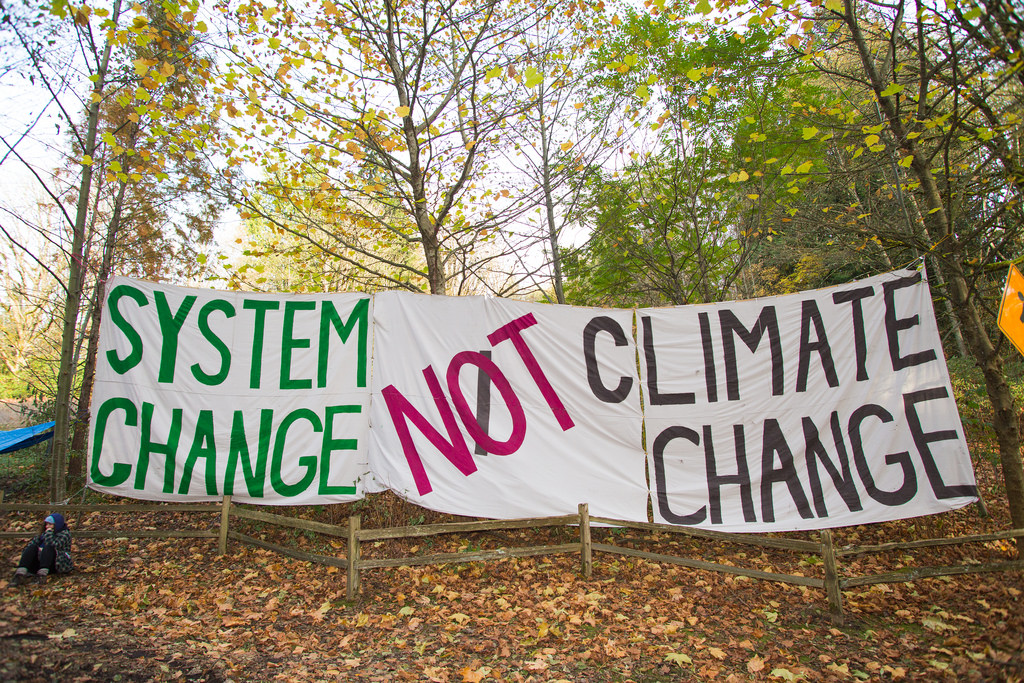
Why can’t the problems that ecosocialism would solve also be remedied within the current global capitalist system?

Before describing possible features of a future ecosocialism, it is worthwhile to consider why such a system is even needed. Why can’t the problems that ecosocialism would solve also be remedied within the current global capitalist system? Part I of this essay addresses that question by summarizing recent scientific reports on the state of the climate and extent of the ecological crisis; reviewing available methods and technologies that could be used to address the climate and ecological crises; and briefly describing capitalism’s structural inability to provide solutions at the scale of the crises. Part II then takes up the subject of the title, ecosocialism, along with strategies to move in that direction. 

Part I: Context and Background

The threat to life on Earth posed by the climate and ecological crises can hardly be overstated. A 2019 Nature article warned that up to a million species of plants and animals are on the verge of extinction, and a United Nations study the same year identified global warming as a major driver of wildlife decline. Much of the devastation to date was catalogued in the 2020 WWF Living Planet report, which recorded a 68 percent decline in the population of vertebrates around the world, in just the past five decades. More succinctly, scientists report that Earth is experiencing a sixth mass extinction. (The previous mass extinction, 66 million years ago, ended the dinosaurs).

The scale of the environmental crisis is unprecedented in human history. At stake are human civilization and billions of lives. An article last year in Proceedings of the National Academy of Sciences predicted that for every additional 1̊C rise beyond the 2019 global average, a billion people will be forced to abandon their locations or endure insufferable heat. The paper warns that under a scenario of increasing emissions, areas now home to a third of the world’s population could experience the same temperatures as the hottest parts of the Sahara within 50 years. 

Summing up the findings of some 150 scientific studies, a 2021 paper authored by 17 scientists warned that the “scale of the threats to the biosphere and all its life forms –- including humanity –- is in fact so great that it is difficult to grasp even for well-informed experts.” Adding further urgency, 101 Nobel laureates released an open letter in April 2021 in which they wrote, “We are seized by the great moral issue of our time: the climate crisis and commensurate destruction of nature.” The laureates called for a worldwide fossil fuel non-proliferation treaty

Global heating is driven by greenhouse gases in the atmosphere, and yet emissions continue at high levels despite the chorus of promises by “climate leaders” in governments. In 2020 global emissions decreased by a meager 5.8 percent due to Covid-19 lockdowns, but they were already on the rebound by the end of the year. For the current year, 2021, the International Energy Agency (IEA) forecasts the second largest annual increase in history of greenhouse gas emissions, as global economies recover from the Covid-19 recession. In May 2021 a record-breaking monthly average concentration of 419 parts per million (ppm) of CO2 was measured in Mauna Loa, Hawaii, breaking the previous May 2020 record of 417 ppm. 

The drivers of ecocide, more generally, include not only climate change, but also habitat destruction, toxic dumping, plastic pollution in the oceans, radiation poisoning, and other customary byproducts of the global capitalist economy. All of this destruction continues unabated despite the flood of warnings from scientists, lobbying by environmental activists, and even warnings from institutions deeply rooted in the capitalist economy. 

Consider, for example, that in May 2021 the IEA released an unprecedented call to the world to rapidly reach zero emissions in its report, Net Zero by 2050: A Roadmap for the Global Energy Sector. Widespread news coverage and expressions of optimism followed. Yet from February to the end of April 2021, the Biden administration approved nearly 1200 drilling permits on federal lands, along with more than 200 offshore permits, and defended in court the ConocoPhillips Willow project in Alaska, which is expected to emit 260 million metric tons of CO2 during the next 30 years, the equivalent of 66 coal-fired plants. And Biden is far from alone among world leaders in his support of fossil fuel expansions.

It’s the hottest week in Portland history and the boss still won’t fix the AC

By CF Ivanovic - (In)Action (Substack), June 24, 2021

The following account, by an IWW member, illustrates just how much climate and the environment are significant workplace issues, and how they will become increasingly relevant to point-of-production, workplace organizing:

An extreme heat wave is sweeping the Northwest right now. Some weather forecasts predict we will see the hottest day in Portland history this weekend with temperatures hitting 110 degrees Fahrenheit. And the climate doomer in all of us is collectively sharing, “hottest day in Portland history, so far.” Yea it fucking sucks. With even more neighbors out on the street, even with a small safety net of the city setting up a few “cooling shelters” for the unhoused, people in all likelihood are going to die.

For those in houses and apartments, most of which without AC, we will deem it too hot to cook, which for restaurant workers it means expect an all day dinner rush baby. Hunched over that pipping hot flat top, AC busted, but thank god the boss was kind enough to plug in a box fan pointed at your feet—or if you’re lucky he’ll let you prop it up on a chair so it’s aimed at your back. Same legal minimum break times being squeezed as short as possible. Hell, maybe your boss is woke and reminded you to drink water. Don’t worry if you’re getting woozy there’s a 33.3% chance you pass out on the sandwich wrapping line instead of the grill or fryer. 

Again, I’m filled with righteous anger. A little voice in the back of my head that wants to shout to my co-workers, “we don’t have to fucking do this.” And how can we? Then I remember it’s the 23rd and rent is due in a week, and I remember there’s an infinite number of excuses and legitimate fears we place in front of us. And that my righteous anger has worked to dissuade those fears in my co-workers about as well as firing a squirt gun at the sun. 

“I want to share the nuts-and-bolts of how we came together and fought back against the Hooters corporation. But right now I’m hot, agitated, and in no way feeling sentimental. Here I want to share a story about some of the stuff that we tried that didn’t work when things first started heating up.”

When I started working at Little Big Burger in 2017 it was a super hot summer[1]. A friend of mine got me the job when they were hiring at the start of the summer and I figured getting minimum wage+tips was better than 10 cents above minimum wage operating rides at an amusement park. It was my first restaurant job. Somehow it felt more dangerous working on that narrow line with a clogged grease trap and no slip mats than operating a 40+ year old spinning metal puke machine. It was barely a month in when my friend told me, “hey there’s a union at this other burger joint in town, we flip burgers, why can’t we have that here?” Perhaps not the most “by the books” organizing conversation, as he showed me the Burgerville Workers Union facebook page, but he was my friend. Nuff said for me. Shit needed to change, and we couldn’t do it alone. We reached out to the union and started trying to talk to our co-workers. 

Our union would go on to win a number of amazing changes. Safety concerns, like a non-slip map, a replacement AC system, managers required to go up on the roof to unclog the vent, getting managers to stop calling the cops on homeless people. And, bread and butter policy changes, like schedules that come out two weeks in advance (instead of 1-2 Days in advance) and getting paid sick leave instead of being forced to work sick or fear getting fired. All of this we won by sticking up for each other, building trust over time, co-writing petitions, and regular ass restaurant workers standing together and marching on our corporate bosses. I want to share the nuts-and-bolts of how we came together and fought back against the Hooters corporation[2]. But right now I’m hot, agitated, and in no way feeling sentimental. Here I want to share a story about some of the stuff that we tried that didn’t work when things first started heating up.

Just Transition Strategies: Workers and the Green Revolution

Why we need a UK Food Sovereignty Movement

By Staff - Land Workers Alliance, June 16, 2021

“Food sovereignty” as a term and a movement has become more prominent in the last few decades, but its reception by governments and institutions in wealthier countries, including the UK, has been unenthusiastic, to say the least.

What is food sovereignty?

“Food sovereignty” is a relatively new way of describing and unifying longstanding aims and methods of the work of peasants, indigenous people, and communities as well as that of various food justice campaigns and organisations. Its six unifying principles are providing food for people; valuing food providers; localising food systems; centring local control; building knowledge and skills; and working with nature. By centring these 6 key principles, the food sovereignty movement seeks to guarantee and protect people’s space, ability and right to define their own models of food production, distribution and consumption.

Where has it grown from?

In 2007, more than 500 people gathered at the Nyéléni forum in Mali, so-called after a Malian peasant farmer who developed crops to feed her people. This forum brought together many diverse groups and individuals working on food issues, and united them under the Declaration of Nyeleni. The food sovereignty movement transformed from being disparate and lacking in visibility into being an interconnected movement, with strong underlying principles, coordination and solidarity between countries, communities and activists working together towards a common goal.

At TUED Global Forum, Scottish TUC Calls for Public Energy in preparation for COP26 in Glasgow: STUC General Secretary Roz Foyer delivers call for “A People’s Transition to Net Zero”

By Staff - Trade Unions for Energy Democracy, August 16, 2021

On August 11, TUED convened its latest Global Forum, to take up the question: "COP26: What Do Unions Want?"

The Forum saw contributions from COP26 host national center, the Scottish Trades Union Congress (STUC), the UK Trades Union Congress (TUC), the International Transport Workers Federation (ITF), Trade Union Confederation of the Americas (TUCA), the UK’s Public and Commercial Services Union (PCS), and Public Services International (PSI).

Nearly 150 participants joined the call, from 69 unions in 40 countries around the world.

The forum opened with remarks from Roz Foyer, General Secretary of the STUC. As the national trade union center for Scotland, with 40 affiliated unions as of 2020, the STUC represents over 540,000 trade unionists. Based in Glasgow, STUC will play host to trade unionists from around the world at COP26, in partnership with the UK’s TUC. (The recording of Foyer’s full contribution is available here.)

Foyer began by highlighting the STUC’s domestic campaigning priorities in Scotland in preparation for COP26, noting that these “chime in very closely with the TUED approach”:

We are first and foremost striving at the moment to build a genuine people’s recovery from the pandemic, and that people’s recovery that we are calling for is about calling for systematic changes to how our economy is organized, and really shifting the narrative around “private = good, public = bad.” And we’re also wanting to see our economy being rebuilt on a just transition. Everyone talks about a ‘just transition’ for workers, but we don’t believe that that just transition is being carried out by governments at this time. So we want to see a people’s recovery from the pandemic and a people’s transition to net zero.

The Covid crisis and the climate crisis have both brought into sharp focus the fact that the private sector and big business have proven themselves as being totally unable to meet the economic and social challenges that economies across the world now face. I think the writing was already on the wall when ordinary people through their governments were forced to bail out the banks during the financial crisis of 2010. And the latest incarnation of this are the various government rescue plans that we’ve seen across the world during covid, which, however necessary to save jobs in the short term, have really been largely focused on bailing out the bosses and the private sector.

So as we look forward to the vital need to decarbonize and achieve net zero through a Just Transition, it’s quite unthinkable that this could be achieved without massive government intervention, and without the efficiency and accountability that can only be delivered by direct, public sector delivery.

Turning to preparations for COP26, Foyer emphasized that the STUC’s approach is to use COP26 as a campaigning and leveraging opportunity, and as a means to build awareness and working class power, and make demands to government which are rooted in the real material needs of working people in Scotland. Towards that end, STUC has identified three campaign priorities which they will focus on in the months leading up to COP26.

I Was Illegally Fired By Elon Musk For Trying to Unionize Tesla

By staff - More Perfect Union, June 16, 2021

Autoworker Richard Ortiz tried to organize a union at Tesla. Elon Musk's company responded by "coercively interrogating" him 3 times, then illegally firing him, federal investigators found. Ortiz is sharing his full story on camera for the first time.

More Perfect Union is a new nonprofit media org with a mission to empower working people.

Pages

The Fine Print I:

Disclaimer: The views expressed on this site are not the official position of the IWW (or even the IWW’s EUC) unless otherwise indicated and do not necessarily represent the views of anyone but the author’s, nor should it be assumed that any of these authors automatically support the IWW or endorse any of its positions.

Further: the inclusion of a link on our site (other than the link to the main IWW site) does not imply endorsement by or an alliance with the IWW. These sites have been chosen by our members due to their perceived relevance to the IWW EUC and are included here for informational purposes only. If you have any suggestions or comments on any of the links included (or not included) above, please contact us.

The Fine Print II:

Fair Use Notice: The material on this site is provided for educational and informational purposes. It may contain copyrighted material the use of which has not always been specifically authorized by the copyright owner. It is being made available in an effort to advance the understanding of scientific, environmental, economic, social justice and human rights issues etc.

It is believed that this constitutes a 'fair use' of any such copyrighted material as provided for in section 107 of the US Copyright Law. In accordance with Title 17 U.S.C. Section 107, the material on this site is distributed without profit to those who have an interest in using the included information for research and educational purposes. If you wish to use copyrighted material from this site for purposes of your own that go beyond 'fair use', you must obtain permission from the copyright owner. The information on this site does not constitute legal or technical advice.

