

You are here

green unionism

Cannabis Agricultural Workers at Tikun Olam CA Vote to Join Teamsters

By Mario Vasquez - International Brotherhood of Teamsters, June 15, 2021

First Successful Cannabis Agricultural Union Election in Southern California Conducted in Adelanto:

On Monday, cannabis agricultural workers at Tikun Olam California’s Adelanto facility voted overwhelmingly to join Teamsters Local 1932. The results mark the first Agricultural Labor Relations Board election victory for cannabis workers in Southern California. There are 39 workers in the bargaining unit.

“Today is a historic day for workers across the cannabis industry in Southern California,” said Randy Korgan, Secretary-Treasurer of Teamsters Local 1932. “By exercising their rights to unionize, Tikun Olam workers are joining a proud legacy of Teamsters who have come together for more than 100 years to secure stability, dignity and respect at work.”

Tikun Olam California opened its 80,000 square foot cultivation facility in 2019. The workers, organizing with San Bernardino-based Teamsters Local 1932, are the heartbeat of Tikun Olam’s operations, ensuring that the product successfully makes it from seed to trimmed product.

Doug Herring and Kurt Newman of Cultivation are two of the new Teamsters at Tikun Olam California.

“We are anticipating a strong future after joining Local 1932,” says Herring and Newman. “Together, cannabis workers will carve the future for this industry that we are all so proud to be a part of.”

Teamsters Local 1932 was founded in 2015 and is made up of over 14,000 working people in the public and private sectors across the counties of Riverside and San Bernardino.

Fishing communities in Costa Rica oppose the 30×30 conservation target

By Chris Lang - REDD Monitor, June 15, 2021

Costa Rica is currently the co-chair of the High Ambition Coalition for Nature and People, together with France and the UK. A central goal of the Coalition is to protect at least 30% of the world’s land and seas by 2030. This 30×30 target is included in the draft of the post-2020 Global Biodiversity Framework, that will be negotiated at the next Conference of Parties of the Convention on Biodiversity, planned to be held in China in October 2021.

The High Ambition Coalition hopes to push the 30×30 target at the UNFCCC COP26 meeting in Glasgow in November 2021, as well as the CBD COP15 meeting in China.

The Coalition promotes the 30×30 target as aiming “to halt the accelerating loss of species, and protect vital ecosystems that are the source of our economic security”. But there is a serious danger that the 30×30 target will result in the biggest land grab the world has ever seen.

A recent Declaration from the Grupo de las Gentes del Mar in Costa Rica highlights this danger. The Declaration puts the 30×30 target in the context of the livelihoods of fishing communities in Costa Rica, and in the context of the history of dispossession, displacements, violations of human rights and violence associated with the creation of protected areas.

The declaration is available here with a full list of signatories.

Clean energy jobs as a transition destination

By Elizabeth Perry - Work and Climate Change Report, June 15, 2021

Released on June 3, Responding to Automation: Building a Cleaner Future is a new analysis by the Conference Board of Canada, in partnership with the Future Skills Centre. It investigates the potential for clean energy jobs as a career transition destination for workers at high risk of losing their jobs because of automation. The clean energy occupations were identified from three areas: clean energy production, energy efficiency , and environmental management and the “rapid growth” jobs identified range from wind turbine technicians and power-line installers to industrial engineers, sheet metal workers, and geospatial information scientists. Based on interviews with clean economy experts, as well as the interview responses from over five hundred workers across Canada, the analysis identifies the structural barriers holding employers and workers back from transition:

  • Lack of consistent financial support for workers to reskill
  • Employer hesitancy to hire inexperienced workers
  • Current demand for relevant occupations which makes change less attractive
  • Lack of awareness around potential transition opportunities
  • Personal relocation barriers, such as high living costs in new cities, and family commitments.

None of the recommended actions to overcome the barriers include a role for unions, with the burden for action falling largely on the individual employee. Only summary information is presented as a web document, but this research is part of a larger focus on automation, so it can be hoped that a fuller report will be published – if so, the partner group, Future Skills, maintains a Research website where it will likely be available.

Other news about renewable energy jobs:

“Renewable Energy Boom Unleashes a War Over Talent for Green Jobs” appeared in Bloomberg Green News (June 8), describing shortages of skilled workers in renewable energy, mainly in the U.S.. It also summarizes a U.K. report which forecasts a large need for workers in the U.K. offshore industry, which is expected to be met by people transferring from the oil and gas sector.

A report by the Global Wind Energy Council forecasts a growth of 3.3 million wind jobs worldwide by 2025, and suggests that offshore wind energy jobs could offer a natural transition for workers dislocated from offshore oil and gas and marine engineering workers. According to the analysis, in 2020, there were approximately 550,000 wind energy workers in China, 260,00 in Brazil, 115,000 in the US and 63,000 in India. A related report, The Global Wind Workforce Outlook 2021-2025 forecasts a large training gap: the global wind industry will need to train over 480,000 people in the next five years to construct, install, operate and maintain the world’s growing onshore and offshore wind fleet. That report is available for download here (registration required), and is summarized in this press release.

And forthcoming: Clean Energy Canada will release its research on the clean energy labour market in Canada on June 17. Their last jobs report, The Fast Lane: Tracking the Energy Revolution, was released in 2019.

Ohio Valley Environmental Coalition Workers Stand Firm Despite Management Offensive

By staff - IWW, June 14, 2021

HUNTINGTON, WV — While public concern for urgent action on the environment remains high, one of West Virginia’s most prestigious environmental organizations, the Ohio Valley Environmental Coalition (OVEC), is poised to miss crucial organizing opportunities this summer as it enters into the fourth month of a brutal dispute over their employee’s right to unionize.
In March 2021, workers of the Ohio Valley Environmental Coalition organized with majority support as the OVEC Union (OVECU) under the IWW, requesting voluntary recognition.

Despite majority support among the members of OVEC’s Board of Directors for a positive and good faith engagement with staff, the organization has chosen to fight tooth and nail. With Mike Sullivan at the helm of the Board, and Tonya Adkins & Vivian Stockman in Co-Direction, OVEC has chosen to effectively whittle down its capacity to organize as it suspends, fires, and threatens its staff into submission.

Upon learning of the union drive, OVEC management immediately launched an internal hunt for instigators, placing their Director of Organizing, Brendan Muckian-Bates, on suspension. While the organization claimed that Brendan was a supervisor and consequently not entitled to participate in union activity, OVEC was unable to convince the National Labor Relations Board (NLRB) which ruled that Brendan was to be included in the bargaining unit at a formal hearing earlier this month.

Upon learning of their loss at the NLRB, OVEC management opted to double down by terminating their Director of Organizing as well as their Project Coordinator, Dustin White. While Brendan’s suspension and termination is bad enough — arriving as it does mere days following the birth of a new child — Dustin’s termination is especially egregious given his unimpeachable credentials in the environmental movement.

Heralding from 11 generations of working class ancestry in the so called “coal fields” of Southern West Virginia, and family ties to the UMWA including a great grandfather who fought at Blair Mountain, Dustin became involved in the environmental movement as a volunteer with OVEC around 2007 before joining the staff in 2012. Dustin has lobbied on both the state and federal levels on numerous issues leading to important legal changes. Recognized with an award by OVEC, Dustin has testified before Congress, conducted ground tours with Congressional representatives, held numerous meetings with state and federal agencies, and worked with the United Nations and Human Rights Watch for reports on the conditions in Appalachia. Having been featured in media locally, nationally, and internationally, including a recent feature in a National Geographic series, just prior to his termination Dustin conducted two tours with German Public Broadcasting and independent filmmakers.

In a move that demonstrates tremendous integrity and honor, non profit organizations working on environmental issues, such as the Mid-Ohio Valley Climate Action have moved to suspend their partnerships with OVEC, sending a comradely but firm signal that the organization will be welcome back into the fold when it returns to good standing with their employees.

An NLRB election is presently taking place and votes will be counted on July 9.

The IWW stands ready to reduce tensions, and negotiate a lasting agreement with OVEC that will enable them to return to their important work.

Labor-Backed Report on Path to Equitable Green California

By Staff - Sunflower Alliance, June 10, 2021

Nineteen labor organizations—including unions representing refinery workers in Northern and Southern California and the Alameda Labor Council— have endorsed a detailed plan for an equitable transition to a clean-energy economy in California.

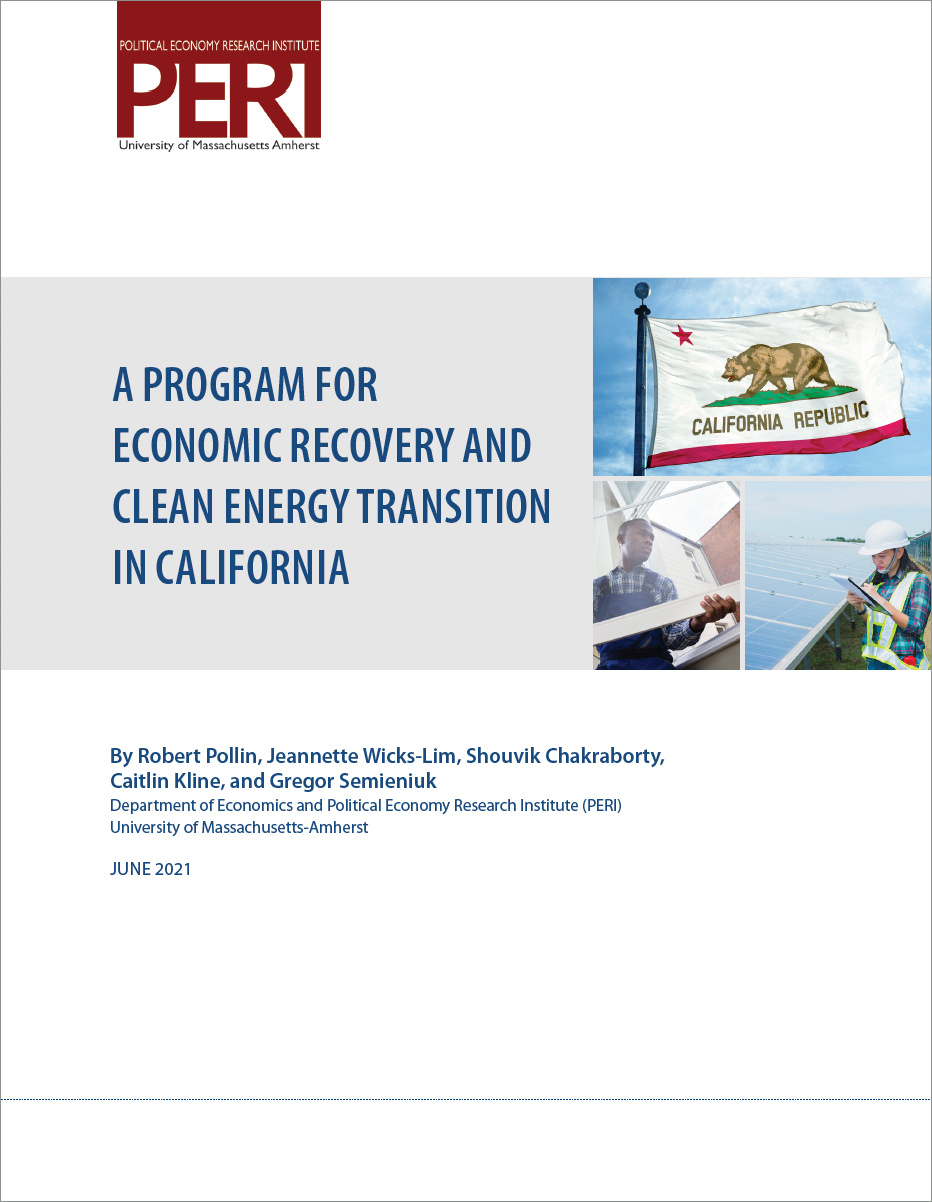
This major new report, A Program for Economic Recovery and Clean Energy Transition in California, details programs for meeting California’s 2030 climate goal (40 percent economy-wide reduction in greenhouse gas emissions from the state’s 1990 level) by creating roughly 418,000 jobs. It argues that state policy should ensure that the jobs created are good-paying jobs with full labor rights and access by historically excluded people.

The same strategies, the report says, could be continued to meet California’s longer-term goal of being carbon-neutral by 2045.

The report was commissioned by the American Federation of State, County and Municipal Employees Local 3299, the California Federation of Teachers, and the United Steelworkers Local 675. Its authors are faculty members of the University of Massachusetts at Amherst, including Robert Pollin, a leading expert on just transition.

The report provides detailed calculations for strategies outlined in an earlier report, Putting California on the High Road, from the UC Labor Center. Both reports emphasize the need for measures to protect fossil fuel industry workers including:

  • Pension guarantee for all workers.
  • Re-employment and income-level guarantees for all displaced workers.
  • Retraining and relocation support as needed.
  • “Glide-path income support” for workers 60 – 64.

The report comes as the Newsom administration is developing a report on Just Transition in California.

Just Transition in California: Robert Pollin in Conversation with Robert Kuttner

Labor Unions Rally Behind California’s Zero-Emissions Climate Plan

Robert Pollin interviewed by C.J. Polychroniou - Truthout, June 10, 2021

Robert Pollin, distinguished professor of economics and co-director of the Political Economy Research Institute (PERI) at the University of Massachusetts at Amherst, has been spearheading national and international efforts to tackle the climate crisis for more than a decade. Over the past few years, he and a group of his colleagues at PERI have produced green economy transition programs for numerous states. The latest such program is for California, and it is being released today.

The massive study — nearly 200 pages long — shows how California can become a zero emissions economy by 2045 while expanding good job opportunities throughout the state. Nineteen unions have already endorsed the green transition plan, making clear that they reject frameworks that falsely pit labor priorities and the environment against each other, and more are expected to do so in the days and weeks ahead.

In this interview for Truthout, Pollin, co-author with Noam Chomsky of Climate Crisis and the Global Green New Deal: The Political Economy of Saving the Planet (Verso 2020), talks about the climate stabilization project for California and the national implications of union support for a green economy transition.

C.J. Polychroniou: California has been at the forefront of the climate fight for years now, but the truth of the matter is that its efforts have fallen short. Now, you and some colleagues of yours at PERI have just completed a commissioned climate stabilization project for California. How does the project envision the clean energy transition to take place in a manner consistent with the emission targets set out by the UN Intergovernmental Panel on Climate Change (IPCC) in 2018, and how will it be financed?

Robert Pollin: This study presents a recovery program for California that will also build a durable foundation for an economically robust and ecologically sustainable longer-term growth trajectory. California has long been a national and global leader in implementing robust climate stabilization policies. This includes the 2018 Executive Order B-55-18 by then Gov. Jerry Brown. This measure committed the state to cut CO2 emissions by 50 percent as of 2030, to become carbon neutral no later than 2045, and to produce net negative emissions thereafter. These goals are somewhat more ambitious than those set out by the IPCC in 2018. Our study outlines a program through which the state can achieve its own established goals.

Our study shows how these 2030 and 2045 emissions reduction targets can be accomplished in California through phasing out the consumption of oil, coal and natural gas to generate energy in the state, since burning fossil fuels to produce energy is, by far, the primary source of CO2 emissions, and thereby, the single greatest factor causing climate change. The project we propose is to build a clean energy infrastructure to replace the existing fossil fuel-dominant infrastructure. The clean energy infrastructure will require large-scale investments to, first, dramatically raise energy efficiency standards in the state and, second, to equally dramatically expand the supply of clean renewable energy supplies, including solar and wind primarily, with supplemental supplies from low-emissions bioenergy, geothermal and small-scale hydro power. We show how this climate stabilization program for California can also serve as a major new engine of job creation and economic well-being throughout the state, both in the short- and longer run.

A Program for Economic Recovery and Clean Energy Transition in California

By Robert Pollin, Jeannette Wicks-Lim, Shouvik Chakraborty,Caitlin Kline, and Gregor Semieniuk - Department of Economics and Political Economy Research Institute (PERI); University of Massachusetts-Amherst, June 10, 2021

This study presents a robust climate stabilization project for California. It demonstrates that achieving the state’s official CO2 emissions reduction targets—a 50 percent emissions cut by 2030 and reaching zero emissions by 2045—is a realistic prospect. This climate stabilization project can also serve as a major engine of economic recovery and expanding economic opportunities throughout the state. This includes an increase of over 1 million jobs in the state through investment programs in energy efficiency, clean renewable energy, public infrastructure, land restoration and agriculture. The study also develops a detailed just transition program for workers and communities in California that are currently dependent on the state’s fossil fuel industries for their livelihoods. In particular, we focus here on condi­tions in Kern, Contra Costa, and Los Angeles counties.

The study is divided into nine sections:

  1. Pandemic, Economic Collapse, and Conditions for Recovery
  2. California’s Clean Energy Transition Project
  3. Clean Energy Investments and Job Creation
  4. Investment Programs for Manufacturing, Infrastructure, Land Restoration and Agri­culture
  5. Total Job Creation in California through Combined Investment Programs
  6. Contraction of California’s Fossil Fuel Industries and Just Transition for Fossil Fuel Workers
  7. County-level Job Creation, Job Displacement, and Just Transition
  8. Achieving a Zero Emissions California Economy by 2045
  9. Financing California’s Recovery and Sustainable Transition Programs

Nineteen labor unions throughout California have endorsed this study and its findings.

Read the text (PDF).

Deep-Sea Mining for Metals: Treading Carefully on the Path Toward Renewables

By Katherine Wilkin - Public Employees for Environmental Responsibility, June 8, 2021

As the push for renewable energy sources continues as a means to combat climate change, the demand for metals and minerals that make up critical components of clean energy technology will be on the rise. While some of these minerals can be obtained via deep-sea mining, the environmental impacts of such efforts are not well understood. In moving to a clean energy economy, governments and international non-governmental organizations need to research, understand, and mitigate the negative impacts to the environment and communities that can and will result from activities like deep-sea mining before allowing projects to go forward.

The United States Geological Survey has identified 11 metals and minerals as critical commodities in renewable energy technologies: arsenic, gallium, germanium, indium, tellurium, aluminum, cobalt, graphite, lithium, manganese, and rare earth elements. Silver, copper, selenium, silica, nickel, and cadmium are also used in solar panels, wind turbines, and batteries. Several of these critical metals and elements can be obtained via deep-sea mining from three different types of deposits: (i) cobalt-rich crust that contains manganese, iron, cobalt, copper, nickel and platinum; (ii) polymetallic nodules which are rich in manganese, nickel, copper, cobalt, molybdenum and rare earth elements; and (iii) sea-floor massive sulphides which contain copper, gold, zinc, lead, barium and silver.

Whether deep-sea mining is necessary to acquire enough minerals to fuel the renewable energy shift remains an unanswered question. In a May 2021 report on the need for minerals to power energy transition technologies, the International Energy Agency predicted that by 2040, total mineral demand for clean energy will be four times current demand. Electric vehicles and battery storage technology account for about half of this predicted growth in mineral demand. The Institute for Sustainable Futures at the University of Technology Sydney indicated in 2016 that this increased demand for materials can be satisfied without utilizing deep-sea mining even under a target of 100% renewable energy use by 2050. Further, Carbon Brief reported in 2018 that reserves of lithium and cobalt are likely to be sufficient to meet demand, but there are outstanding concerns of supply chain bottleneck causing delays. This is supported by the IEA report, which indicated that problems in supply of minerals is more likely to be a matter of quality rather than quantity. However, a 2018 study supported by the Dutch Ministry of Infrastructure found that the current supply of critical metals is not enough to transition to a fully-renewable energy system in the Netherlands. Additionally, a 2019 projection of demand for cobalt, lithium, and silver looking as far as 2050 found that “reserves” of these materials—a portion of total available resources that can be extracted economically—will not be sufficient to meet demand for cobalt, and demand for lithium can only be met in a “potential recycling scenario” with improved recycling rates over what is being conducted at present.

With the growing demand for metals and materials for use in renewable energy technologies, concerns arise about the environmental impacts and environmental justice implications of mining on land. For example, cobalt mines in the Democratic Republic of Congo have been the site of human rights violations, child labor, and severe environmental pollution. For that reason, deep-sea mining of these materials may present an option with fewer direct human impacts and environmental justice concerns.

Working less is both necessary and desirable from an environmental perspective.

By Kyle Lewis and Will Stronge - The Ecologist, June 8, 2021

With climate breakdown already at our doorstep, the pressing need to change course from capitalist models of growth has spawned new disciplines and approaches within the field of economics. 

One such approach is referred to as degrowth - a genre of research and activism that has been active for many decades, originally inspired by the political ecology of the French-Austrian  philosopher André Gorz. 

Conviviality

Those who advocate for degrowth define its approach as being- first and foremost- a critique of growth. Economic growth is unsustainable per se, because it is inseparable and cannot be ‘absolutely decoupled’ from greenhouse gas emissions and other negative environmental impacts.

In contrast to accounts that stress the need for ‘green growth’ or ‘socialist growth’, degrowth advocates demand the dethroning of growth as a goal in general and in its place want a political economy focused on using fewer natural resources in order to organise life and work. 

Rather than advancing an economic model destined for austerity, scarcity and recession - which are the socio-economic consequences usually associated with ‘flat’ or ‘non-growing economies’, degrowth and postgrowth advocates argue in favour of economic metrics and objectives that advance alternative modes of living, based on principles of sharing, conviviality, care and the common good. 

Pages

The Fine Print I:

Disclaimer: The views expressed on this site are not the official position of the IWW (or even the IWW’s EUC) unless otherwise indicated and do not necessarily represent the views of anyone but the author’s, nor should it be assumed that any of these authors automatically support the IWW or endorse any of its positions.

Further: the inclusion of a link on our site (other than the link to the main IWW site) does not imply endorsement by or an alliance with the IWW. These sites have been chosen by our members due to their perceived relevance to the IWW EUC and are included here for informational purposes only. If you have any suggestions or comments on any of the links included (or not included) above, please contact us.

The Fine Print II:

Fair Use Notice: The material on this site is provided for educational and informational purposes. It may contain copyrighted material the use of which has not always been specifically authorized by the copyright owner. It is being made available in an effort to advance the understanding of scientific, environmental, economic, social justice and human rights issues etc.

It is believed that this constitutes a 'fair use' of any such copyrighted material as provided for in section 107 of the US Copyright Law. In accordance with Title 17 U.S.C. Section 107, the material on this site is distributed without profit to those who have an interest in using the included information for research and educational purposes. If you wish to use copyrighted material from this site for purposes of your own that go beyond 'fair use', you must obtain permission from the copyright owner. The information on this site does not constitute legal or technical advice.
