You are here

electric vehicles

Britishvolt administration ‘potentially catastrophic’ for both the North East and UK’s automotive transition

By staff - Unite the Union, January 17, 2023

Britishvolt, which was planning to build a giga-battery factory in Northumberland, has today (Tuesday) announced that it is going into administration.

Unite national officer for the automotive sector Steve Bush said: “This is a grim day for the North East and for the just transition to the electrification of the nation’s automotive sector.

“The complete lack of a competent industrial strategy by the government to protect jobs in the UK automotive sector is becoming potentially more catastrophic by the day.

“It is extraordinary that despite the UK automotive sector being required to move to the production of electric vehicles, there are still no UK stand-alone factories making the batteries that are required. The demise of Britishvolt means there are not even any in the pipeline.

“The government’s strategy seems to be to cross their fingers and hope that everything will be ok. The workers in the automotive sector are frankly enraged at this dreadful and total abdication of leadership”

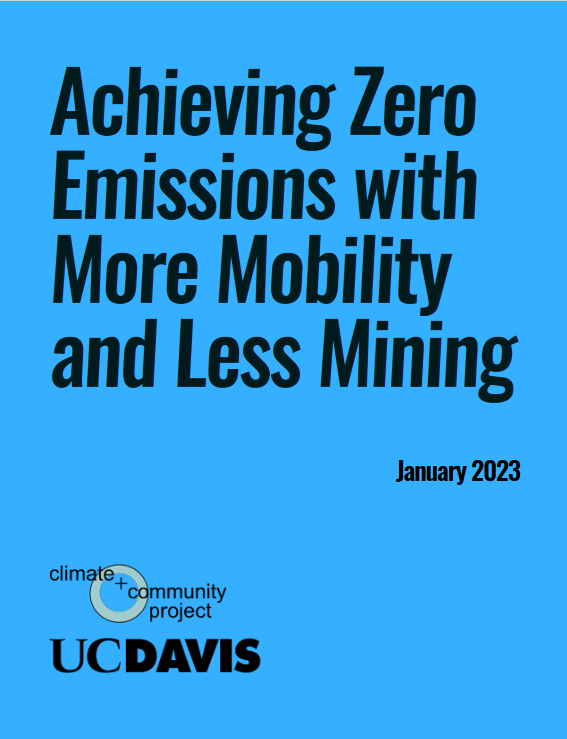
Achieving Zero Emissions with More Mobility and Less Mining

By Thea Riofrancos, Alissa Kendall, Kristi K. Dayemo, Matthew Haugen, Kira McDonald, Batul Hassan, and Margaret Slattery in partnership with the University of California, Davis - Climate and Community Project, January 2023

Transportation is the number one source of carbon emissions in the United States– making the sector crucial to decarbonize quickly to limit the climate crisis. States like New York and California banned the sale of gas cars by 2035 and the 2022 Inflation Reduction Act made major federal investments in electrifying transportation. As a result, US consumers are embracing electric vehicles (EVs), with over half of the nation’s car sales predicted to be electric by 2030. This is a critical juncture. Decisions made now will affect the speed of decarbonization and the mobility of millions. Zero emissions transportation will also see the transformation of global supply chains, with implications for climate, environmental, and Indigenous justice beyond US borders.

A crucial aspect of electrified transportation is new demand for metals, and specifically the most non-replaceable metal for EV batteries– lithium. If today's demand for EVs is projected to 2050, the lithium requirements of the US EV market alone in 2050 would require triple the amount of lithium currently produced for the entire global market. This boom in demand would be met by the expansion of mining. 

Large-scale mining entails social and environmental harm, in many cases irreversibly damaging landscapes without the consent of affected communities. As societies undertake the urgent and transformative task of building new, zero-emissions energy systems, some level of mining is necessary. But the volume of extraction is not a given. Neither is where mining takes place, who bears the social and environmental burdens, or how mining is governed. 

This report finds that the United States can achieve zero emissions transportation while limiting the amount of lithium mining necessary by reducing the car dependence of the transportation system, decreasing the size of electric vehicle batteries, and maximizing lithium recycling. Reordering the US transportation system through policy and spending shifts to prioritize public and active transit while reducing car dependency can also ensure transit equity, protect ecosystems, respect Indigenous rights, and meet the demands of global justice. 

Read the rest of the summary here.

Read the report (Link).

We Need a Pro-Worker Transition to Electric Vehicles

By Paul Prescod - ZNet, December 21, 2022

The transition to electric vehicles is mandatory to address climate change. But if done haphazardly, it could result in massive job losses. Bold industrial policy and a rejuvenated United Auto Workers union can make electric vehicles a win for workers.

As the climate crisis grinds on, policymakers and economic elites are finally reading the writing on the wall for fossil fuels. The major automobile manufacturing companies have been devastatingly slow on the uptake, but they’re now starting to signal a greater commitment to the transition to electric vehicles.

Over the summer, Ford announced plans to invest $3.7 billion in electric vehicle production facilities across the Midwest. General Motors has increased its electric vehicle production target from one million by 2025 to two million. Newer companies like Tesla, Rivian, and Lucid have made their mark by manufacturing electric vehicles and are set to continue to grow.

While electric vehicle production is not free from environmental problems, the use of these cars over gas-powered ones would certainly be better for the climate.

But without broader changes to our industrial policy, the transition to electric vehicle production will not necessarily be good news for workers in the automobile industry.

As a recent study by the Economic Policy Institute outlines, without increased domestic production of electric vehicle batteries and other power train components, the large-scale introduction of electric vehicles could result in the loss of over two hundred fifty thousand jobs in automobile assembly and parts production. Currently, 75 percent of power train components for gas-powered vehicles are manufactured in the United States, as compared to just under 45 percent for electric vehicles.

The assembly of battery-powered electric vehicles is less complex and requires fewer workers than vehicles with an internal combustion engine. These job losses can only be offset if two conditions are met: a significant strengthening of domestic industries in the electric vehicle supply chain and electric vehicles rising to 50 percent of domestic automobile sales by 2030.

The Economic Policy Institute modeled various scenarios for the large-scale introduction of electric vehicles in the US market. In a scenario where electric vehicles reach 30 percent of the market share with current domestic production levels of electric vehicle power train components, around twenty thousand assembly jobs and twenty-five thousand parts jobs would be lost.

However, if an increase in electric vehicle market share can be matched with corresponding levels of power train production, over a hundred fifty thousand jobs would be gained.

While these scenarios may seem like abstract and technocratic formulations, they have deep implications for the future of important segments of the working class. For those still employed in the production of automobiles, the industry represents a critical gateway to a higher standard of living.

The Road to Equity: Concerns and Analysis of RUC Pricing Mechanisms

New modelling finds Canada’s battery supply chain could be a boon for jobs and the economy, assuming Canada takes action

By staff - Clean Energy Canada, September 14, 2022

With the U.S.’s new electric vehicle tax credit requiring that EVs and their batteries be made in North America, Canada’s EV battery supply chain is in the spotlight. 

That spotlight is well warranted. If Canada plays its cards right, a domestic EV battery supply chain could support up to 250,000 jobs by 2030 and add $48 billion to the Canadian economy annually.

That’s according to modelling from Clean Energy Canada and the Trillium Network for Advanced Manufacturing, whose new report, Canada’s New Economic Engine, explores how Canada can successfully build an EV battery supply chain in order to become a North American battery powerhouse.

Recent months have seen a stream of new battery investments, from the $5 billion Stellantis and LG Energy Solution are investing in a Windsor battery factory to the $500 million General Motors and Posco are investing to bring battery material production to Bécancour, Quebec. 

But despite these encouraging investments, the success of Canada’s EV battery supply chain—and the hundreds of thousands of future jobs it could support—is still largely dependent on swift government action.

In a scenario where no additional government action is taken, Canada’s battery supply chain would create just 60,000 jobs and contribute only $12 billion in GDP—fulfilling only about a quarter of both its jobs and GDP potential.

Accordingly, the report identifies six ways in which Canada should focus its efforts to fulfill its battery-building potential. While Canada could do it all, a more effective strategy would double down on a few key stages, such as EV assembly, battery cell manufacturing, clean battery materials production.

In short, we have a once-in-a-generation opportunity to build a battery supply chain that will be the economic engine of tomorrow’s economy. 

Working Class Ecosocialism; stopping climate change and building another world

By Jonathan Neale - Fight the Fire, September 2022

This article is about stopping climate change and about fighting for a world based on love and sharing. My argument is that both these projects have to go together. But for either project to work, both climate activists and socialists have to change, fundamentally and fast. And there has to be a deeper change, a change in all humanity.

We may well fail. But with these ideas we have a chance.

Let me explain. I start with climate, and I start with failure.

For thirty years everyone who cares to know has known about the threat of climate change. Over those thirty years more and more world leaders have said louder and louder that the crisis will be upon us, that something must be done, that they promise to do something. And the more the leaders of the world tell us that they will do something, the worse things get.

It is not just that the temperatures continue to rise. It is not just that the temperatures rise faster and faster. The amount of carbon dioxide – CO2 – in the air grows every year, and each year it grows faster and faster. It is not just that the leaders of the world have failed to stop climate change. It is that they have collectively presided over making things worse.

At the United Nations climate talks in Scotland last year Greta Thunberg sent out two tweets. To the leaders of the world, she said: “Blah, blah, blah. Fuck You.”

To us, she said: “Uproot the system.”

That’s the politics of ecosocialism in eight words.

The transition to electrified vehicles: Evaluating the labor demand of manufacturing conventional versus battery electric vehicle powertrains

By Turner Cotterman, Erica R.H. Fuchs, and Kate Whitefoot - Carnegie Mellon University, July 22, 2022

The ongoing shift from traditional internal combustion engine vehicles (ICEVs) to electric vehicles (EVs) has raised questions about whether this transition will be economically as well as environmentally sustainable. In particular, one concern is the impact on manufacturing labor. Prior studies of the anticipated impacts of vehicle electrification on manufacturing labor requirements are mixed, with some suggesting that producing EVs may require fewer labor hours and jobs than conventional gasoline vehicles and some suggesting that there will be limited impacts on labor outcomes. Moreover, analysis of labor implications has been hindered by a lack of shop floor-level data on the labor hours required for ICEV and EV manufacturing. We collect detailed data on the production process steps required to build key ICEV and battery electric vehicle (BEV) powertrain components and the labor required for each process step.

The data include information for 252 process steps, which we collected from the shop floors of leading automotive manufacturers and combine with information on a further 78 process steps found in the existing literature. We then use this data to build a production process model that determines the labor hours required to produce ICEV and BEV powertrain components in a variety of scenarios of different production volumes and labor efficiency levels. We find that, in all scenarios we explore, the labor intensity required for the manufacturing of BEV powertrain components is larger than for ICEV powertrain components. Our results imply that vehicle electrification may lead to more jobs in powertrain manufacturing, at least in the short- to medium-term. These results emphasize the importance of using information about manufacturing process tasks and labor requirements to estimate the labor impacts of EVs, rather than recent approaches concentrating on part counts.

'Public Pressure Works': Postal Service to Boost Electric Vehicle Purchases After Backlash

By Kenny Stancil - Common Dreams, July 20, 2022

Pressure from progressive advocacy groups and lawmakers bore fruit on Wednesday when the U.S. Postal Service announced that it would be making 40% of its new delivery vehicles electric, up from Postmaster General Louis DeJoy's initial plan to electrify just 10% of the mail agency's aging fleet.

The news comes in the wake of a lawsuit filed in late April by a coalition of environmental organizations that accused the USPS of conducting an unlawfully shoddy analysis of the widely condemned plan's climate impacts. More than a dozen state attorney generals and the United Auto Workers (UAW) also sued to halt DeJoy's anti-green and anti-labor procurement scheme pending a comprehensive review of its ecological and public health consequences.

"Public pressure works, and today's announcement from the Postal Service is proof of that," Katherine García, director of the Sierra Club's Clean Transportation for All campaign, said in a statement. "The agency's original plan for a fleet of 90% fossil fuel trucks should have never been a consideration."

"Still, making only half of its delivery fleet electric does not go far enough to address climate change or improve air quality in neighborhoods across the nation," said García. "There is also no guarantee in today's announcement that union workers will be building these pollution-free vehicles."

"This is an opportunity to transform the postal fleet to be 100% union-built electric vehicles," she added. "We won't settle for anything less."

Transforming Transportation–from Below

By Jeremy Brecher - Labor Network for Sustainability, July 2022

People are acting at the local and state level to create jobs, reduce greenhouse gas pollution, and equalize transportation by expanding and electrifying public transit, electrifying cars and trucks, and making it safe to walk and bike. It’s a crucial part of building the Green New Deal from Below.

More than a quarter of greenhouse gases [GHGs) emitted in the US come from transportation – more than from electricity or any other source.[1] Pollution from vehicles causes a significant excess in disease and death in poor communities. Lack of transportation helps keep people in poor communities poor.

Proposals for a Green New Deal include many ways to reduce the climate, health, and inequality effects of a GHG-intensive transportation system. “Transit Oriented Development” (TOD), “smart growth,” and other forms of metropolitan planning reduce climate-and-health threatening emissions while providing more equal access to transportation. Switching from private vehicles to public transit reduces GHG emissions by more than half and substantially reduces the pollution that causes asthma and other devastating health effects in poor communities. Changing from fossil fuel to electric vehicles also greatly reduces emissions. Expanded public transit fights poverty and inequality by providing improved access to good jobs. And expansion of transit itself almost always creates a substantial number of good, often union jobs. Every $1 billion invested in public transit creates more than 50,000 jobs.[2]

Plans for a Green New Deal generally include substantial federal resources to help transform our transportation system.[3] The 2021 “bipartisan” Infrastructure Investment and Jobs Act provided $20 billion over the next five years for transit projects. But meanwhile, efforts at the community, local, and state level have already started creating jobs reducing transportation pollution – models of what we have called a Green New Deal from Below.[4]

These Green New Deal from Below programs are often characterized by multiple objectives – for example, protecting the global climate, improving local health, providing jobs, and countering inequality. And they often pursue concrete ways to realize multiple goals, such as “transit-oriented development” that builds housing near transit to simultaneously shift travel from cars to public transit and to expand access to jobs and urban amenities for people in low-income communities.

Union Alliance Calls for Electric School Buses

By staff - Labor Network for Sustainability, July 2022

On May 31, autoworkers and teachers rallied in Washington, DC to call on states, local governments, and school districts around the country to electrify the nation’s school bus fleet with union-built, climate-safe, pollution-free electric school buses.

AFT President Randi Weingarten called the rollout a “win-win-win” for children’s health, for the climate and for the economy. “We need to make sure these electric buses are made in America at unionized factories. We need to ensure that students and drivers are protected from environmental hazards. We need to address the climate crisis.”

UAW President Ray Curry said he wants to see electric buses not only in a handful of cities but in every school district in the country—for “a future that all of us can thrive in.” The workers who build these vehicles need a voice on the job, he said, so that each bus will be built to union standards.

The UAW represents workers at two of the largest bus manufacturers in the nation, Thomas Built in North Carolina and IC Bus in Oklahoma. As a result of the federal infrastructure bill, Thomas Built and IC Bus plan on significantly increasing their hiring to meet the demand for electric school buses. Thomas Built Buses, for example, will supply hundreds of electric school buses to Montgomery County, MD, which will provide the largest single deployment of electric school buses in North America.

You can rewatch the AFT-UAW press conference and rally here.

Pages

The Fine Print I:

Disclaimer: The views expressed on this site are not the official position of the IWW (or even the IWW’s EUC) unless otherwise indicated and do not necessarily represent the views of anyone but the author’s, nor should it be assumed that any of these authors automatically support the IWW or endorse any of its positions.

Further: the inclusion of a link on our site (other than the link to the main IWW site) does not imply endorsement by or an alliance with the IWW. These sites have been chosen by our members due to their perceived relevance to the IWW EUC and are included here for informational purposes only. If you have any suggestions or comments on any of the links included (or not included) above, please contact us.

The Fine Print II:

Fair Use Notice: The material on this site is provided for educational and informational purposes. It may contain copyrighted material the use of which has not always been specifically authorized by the copyright owner. It is being made available in an effort to advance the understanding of scientific, environmental, economic, social justice and human rights issues etc.

It is believed that this constitutes a 'fair use' of any such copyrighted material as provided for in section 107 of the US Copyright Law. In accordance with Title 17 U.S.C. Section 107, the material on this site is distributed without profit to those who have an interest in using the included information for research and educational purposes. If you wish to use copyrighted material from this site for purposes of your own that go beyond 'fair use', you must obtain permission from the copyright owner. The information on this site does not constitute legal or technical advice.