You are here

electric vehicles

Why Elon Musk Won't Save Us

Job Creation for a Clean Jumpstart

By Amanda Novello - Data for Progress, July 2021

Government stimulus is sorely needed: more than a year into the pandemic recession, nearly 10 percent of Black workers are unemployed, and over 6 percent of all workers are unemployed. There are still more than 7 million fewer jobs than there were last June, and nearly 40% of all unemployed workers are long-term unemployed. A majority of those out of work have no college degree. In addition, there are 5 million fewer people in the labor force than pre-pandemic, including 3 million women who left the labor force since last February, and 2 million men.

Decarbonizing the economy in tandem with a full, job centered green recovery, will require many different plans to be executed at all levels of government and society. That’s why, this March, Data for Progress and Evergreen Action released the Clean Jumpstart 2021 report that offers 39 policy priorities for how to carry out our existing commitments, while increasing ambition and creating good jobs that Americans desperately need, in communities that need them most. All components of this plan are popular with likely voters. The Clean Jumpstart 2021 plan represents how a bold climate investment package, like the American Jobs Plan, could tackle the climate crisis and build a clean energy economy.

The Clean Jumpstart 2021 plan would invest a total of $2.3 trillion over four years. Some investments would create jobs more or less immediately, while others will take longer to realize full job-creation effects. Therefore, in this memo, we estimate that the plan would create an average of 2.7 million jobs annually for the first five years. But the job benefits of the plan don’t end there. The policies in Clean Jumpstart would also create up to 960,000 jobs annually for five years following (year 6-10 after investments begin). Approximately 40 percent of all jobs created would be “direct” jobs, or employment working directly toward these policy goals, and the rest would be due to additional work generated along supply chains and in communities due to the multiplied impacts of increased demand.

Read the text (PDF).

Volvo truck workers on strike

By Lee Wengraf - Tempest, June 29, 2021

At Volvo Trucks North America in Dublin, Virginia, picket lines stretch along Cougar Trail Road at the entrances to the 300-acre New River Valley assembly plant. Around 2,900 members of United Auto Workers (UAW) Local 2069 have been on strike since June 7 in this small town in the southwestern corner of the state near the West Virginia border. It’s their second strike this year. Just two months ago in April, workers walked out for two weeks after voting down a tentative agreement by a whopping 91 percent. The union went back to the table and again the membership turned down the deal, this time by a 90 percent margin, a resounding rejection.

At stake in the agreement are critical issues around the two-tier wage structure, work schedule and overtime, health and safety, and employee and retiree healthcare benefits, among others. The company claims they’ve offered “significant economic improvements for all UAW-represented workers,” but in reality the proposed 12 percent raise over six years falls well below the current rate of inflation. The latest agreement also calls for higher copays and out-of-pocket expenses from employees, including a doubling of the out-of-pocket maximum over the life of the contract. The last contract amounted to hundreds of dollars of added costs for retirees per month, according to a striker family member. The company hasn’t tried to sugarcoat these givebacks, stating bluntly on their website, “The hard truth is that there’s likely not a company left in the United States that can guarantee its people – hourly or salaried – that they won’t have to worry about retiree health care costs, even after 30 or more years of work.”

The union is fighting to abolish a two-tier wage system introduced in previous contracts. Although Volvo claims it will get rid of the tiers “over a reasonable time frame,” members 
with two years or fewer seniority still wouldn’t reach top pay over the life of the contract. The company is also pushing to change the work schedule to four 10-hour shifts, a move that would cut into overtime pay. Finally, the rejected agreement removed the union’s right to strike at the end of the proposed six-year deal in 2027.

Driving Destructive Mining: EU Civil Society Denounces EU Raw Materials Plans in European Green Deal

By various - Yes to Life No to Mining, June 2021

A global coalition of 180+ community platforms, human rights and environmental organisations, and academics from 36 nations is calling on the EU to abandon its plans to massively expand dirty mining as part of EU Green Deal and Green Recovery plans.

In a statement released in the middle of EU green week, the coalition explains why, if left unchanged, EU policies and plans will drastically increase destructive mining in Europe and in the Global South, which is bad news for the climate, ecosystems, and human rights around the world.

“The EU is embarking on a desperate plunder for raw materials. Instead of delivering a greener economy, the European Commission’s plans will lead to more extraction beyond ecological limits, more exploitation of communities and their land, and new toxic trade deals. Europe is consuming as if we had three planets available”, says Meadhbh Bolger, Resource Justice Campaigner for Friends of the Earth Europe.

Coordinated by the Yes to Life, No to Mining Network’s European Working Group, the statement’s signatories are united in support of an urgent and rapid transition to renewable energy.

However, they argue that relying on expanding mining to meet the material needs of this transition will replicate the injustices, destruction and dangerous assumptions that have caused climate breakdown in the first place:

“The EU growth and Green Deal plans must consider a deep respect of the rights of affected communities in the Global South, that are opposing the destruction of their lands, defending water and even their lives. A strong collective voice is arising from affected communities around the Planet, denouncing hundreds of new mining projects for European consumption. Their urgent message needs to be heard in the North: Yes to Life No to Mining”, says Guadalupe Rodriguez, Latin American Contact Person for the global Yes to Life, No to Mining solidarity network.

“Research shows that a mining-intensive green transition will pose significant new threats to biodiversity that is critical to regulating our shared climate. It is absolutely clear we cannot mine our way out of the climate crisis. Moreover, there is no such thing as ‘green mining’. We need an EU Green Deal that addresses the root causes of climate change, including the role that mining and extractivism play in biodiversity loss ”, adds Yvonne Orengo of Andrew Lees Trust, which is supporting mining affected communities in Madagascar.

The statement sets out a number of actions the EU can take to change course towards climate and environmental justice, including recognising in law communities’ Right to Say No to unwanted extractive projects and respect for Indigenous Peoples’ right to Free, Prior and Informed Consent.

Read the text (PDF).

We can't mine our way out of climate crisis

By Hannibal Rhoades and Andy Whitmore - The Ecologist, May 25, 2021

A new and thorny environmental debate is breaking into mainstream conversations about climate breakdown.

We are going to need a vast supply of ‘transition minerals' like lithium and nickel - used in everything from wind turbines to solar panels to electric vehicles - if we are to papidly accelerate our switch to renewable energy.

Obtaining enough of these minerals while scaling up supply to meet rapidly growing demand represents a serious potential bottleneck in achieving global climate targets. How will we get these minerals and metals - and can we get them quickly enough?

Colonialism

This discussion has moved from activist and academic meeting rooms to the Washington DC, Beijing and Brussels. And mining corporations, ever-alert for a profit-making opportunity, have begun presenting themselves as our climate saviours.

Clean, green, sustainable, responsible mining, they say, will deliver the materials we need to meet our climate commitments. Policymakers have largely accepted the mining industry’s presentation of itself in these glowing terms.

Critical minerals task forces and industrial alliances are proliferating among wealthy nations. The aim is finding ways to secure supply. Governments around the world - both in the Global South and the North - are competing to attract foreign mining investment, often linked to the economic recovery from the COVID-19 pandemic. 

For anyone who cares about climate justice, this is not good news.

Industrial-scale mining is synonymous with a long history of colonialism, oppression and ecological devastation. The industry has an appalling human rights record to this day where frontline communities and workers are concerned.

Growth of ZEV’s impacts trucks, buses – and their drivers too

By Elizbeth Perry - Work and Climate Change Report, May 17, 2021

The International Energy Agency released its annual Global Electric Vehicle Outlook report for 2021 in April, providing data, historical trends and future projections. Despite the pandemic, there was a 41% increase in electric vehicle registrations in 2020 – compared to a 16% contraction of the overall global automobile market. There are now more than 10 million electric cars on the world’s roads, and for the first time, Europe overtook China as the centre of the global electric car market. In addition, there are roughly 1 million electric vans, heavy trucks and buses globally. A separate forecast by Bloomberg New Energy Finance, as summarized by The Guardian, projects that electric vehicles will reach price parity with internal combustion engine (ICE) vehicles by 2027. Another April report from Boston Consulting Group forecasts that zero-emission vehicles will replace ICE vehicles as the dominant powertrain for new light-vehicle sales globally just after 2035.

Most policy discussions of the electrification of transportation focus on the potential for GHG emissions reductions, consumer preferences, and the economic impacts for the automotive industry. There has been a lack of attention on operational workers – with a few exceptions. A 2020 report from the International Labour Organization and the United Nations Economic Commission for Europe, Jobs in green and healthy transport: Making the green shift , offers modelling of employment impacts in a broad definition of transportation, including personal vehicles, trucks and public transport. It focuses on Europe, and discusses the employment impacts in both manufacturing and operation.

Green Energy, Green Mining, Green New Deal?

Luddism for the age of robotics

By Simon Pirani - The Ecologist, May 7, 2021

Climate breakdown is driven by industrial production, production by machines controlled by people. But can those very people demand a new, low carbon production?

Are the technologies developed by giant capitalist corporations – Walmart’s logistics or Elon Musk’s driverless cars – the foundation on which a post-capitalist society can be built? No way, argues Gavin Mueller in his latest book, Breaking Things At Work: the Luddites were right about why you hate your job (Verso, 2021).

He challenges “Marxist theoreticians” who see “the capitalist development of technology as the means for creating both abundance and leisure”, to be “realised once the masses finally [take] the reins of government and industry”.

Against these technocratic illusions, Mueller proposes “a decelerationist politics: of slowing down change, undermining technological progress, and limiting capital’s rapacity, while developing organisation and cultivating militancy”.

Calls for sustainable and responsible mining for the clean energy transition

By Elizabeth Perry - Work and Climate Change Report, May 6, 2021

An important Special Report by the International Energy Association was released in May: The Role of Critical Minerals in Clean Energy Transitions. Reflecting a mainstream view of the importance of the raw materials for clean technologies such as electric vehicles and energy storage, the IEA provides “ a wealth of detail on mineral demand prospects under different technology and policy assumptions” , and discusses the various countries which offer supply – including Canada. The main discussion is of policies regarding supply chains, especially concerning responsible and sustainable mining, concluding with six key recommendations, including co-ordination of the many international frameworks and initiatives in the area. The report briefly recognizes the Mining Association of Canada’s Towards Sustainable Mining (TSM) protocols as internationally significant, and as one of the first to require on-site verification of its standards. The Towards Sustainable Mining (TSM) initiative was established in 2004, requiring member companies to “demonstrate leadership by reporting and independently verifying their performance in key environmental and social areas such as aboriginal and community engagement, biodiversity conservation, climate change, tailings management.”

On May 5, the Mining Association of Canada updated one of its TSM protocols with the release a new Climate Change Protocol, a major update to its 2013 Energy Use and GHG Emissions Management Protocol. It is designed “to minimize the mining sector’s carbon footprint, while enhancing climate change disclosure and strengthening the sector’s ability to adapt to climate change.” The Protocol is accompanied by a new Guide on Climate Change Adaptation for the Mining Sector, intended for mine owners in Canada, but with global application. The Guide includes case studies of such mines as the Glencore Nickel mine in Sudbury, the notorious Giant Mine in the Northwest Territories, and the Suncor Millennium tailings pond remediation at its oil sands mine in Alberta. The membership of MAC is a who’s who of Canadian mining and oil sands companies / – including well-known companies such as ArcelorMittal, Barrick Gold, Glencore, Kinross, Rio Tinto, Suncor, and Syncrude. Other documentation, including other Frameworks and progress reports, are compiled at a dedicated Climate Change Initiatives and Innovations in the Mining Industry website.

The demand for lithium, cobalt, nickel, and the other rare earth minerals needed for technological innovation has been embraced, not only by the mining industry, but in policy discussions – recently, by Clean Energy Canada in its March 2021 report, The Next Frontier. The federal ministry of Natural Resources Canada is also supportive, maintaining a Green Mining Innovation Initiative through CanmetMINING , and the government joined the U.S.-led Energy Resource Governance Initiative (ERGI) in 2019 to promote “secure and resilient supply chains for critical energy minerals.”

Alternative points of view have been pointing out the dangers inherent in the new “gold rush” mentality, since at least 2016 when Amnesty International released its 2016 expose of the use of child labour in the cobalt mines of the Democratic Republic of Congo. Most recently, in February 2021, Amnesty released Powering Change: Principles for Businesses and Governments in the Battery Value Chain, which sets out specific principles that governments and businesses should follow to avoid human rights abuses and environmental harm. Other examples: MiningWatch Canada has posted their April 2021 webinar Green Energy, Green Mining, Green New Deal?, which states: “The mining sector is working hard to take advantage of the climate crisis, painting mining as “green” because it supplies materials needed to support the “green” energy transition. But unless demand for both energy and materials are curtailed, environmental destruction and social conflicts will also continue to grow.” MiningWatch Canada published Turning Down the Heat: Can We Mine Our Way Out of the Climate Crisis? in 2020, reporting on a 2019 international conference which focused on the experience of frontline communities. Internationally, the Business & Human Rights Resource Centre maintains a Transition Minerals tracker, with ongoing data and reports concerning human and labour rights in the mining of “transition minerals”, and also compiles links to recent reports and articles. Two recent reports in 2021: Recharge Responsibly: The Environmental and Social Footprint of Mining Cobalt, Lithium, and Nickel for Electric Vehicle Batteries (March 2021, Earthworks) and A Material Transition: Exploring supply and demand solutions for renewable energy minerals from the U.K. organization War on Want.

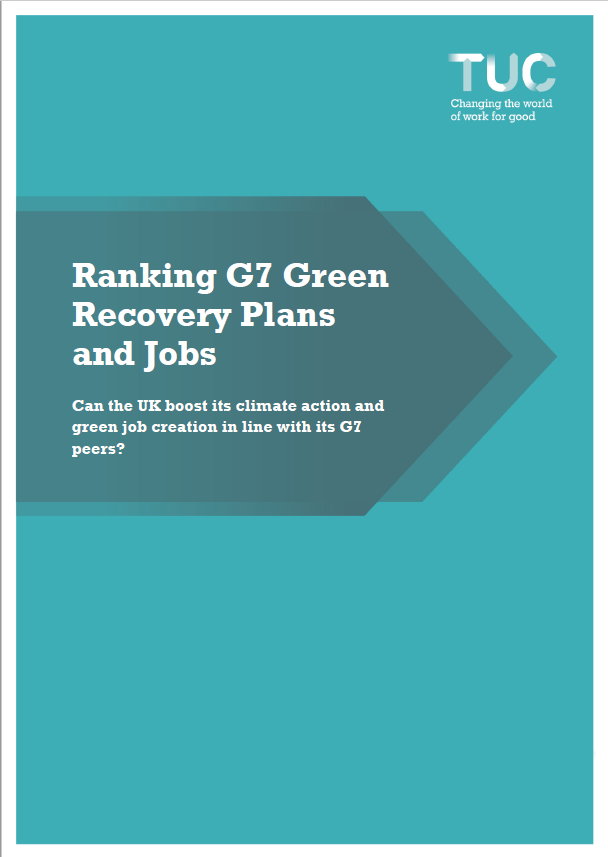
Ranking G7 Green Recovery Plans and Jobs: Can the UK boost its climate action and green job creation in line with its G7 peers?

By staff - Trades Union Caucus (TUC)May 2021

This report ranks G7 countries’ green recovery and job creation plans. It shows how the UK is lagging behind its G7 peers, and the potential to do much more to expand green jobs and accelerate climate action.

The TUC’s ranking of all G7 countries’ green recovery and jobs investments shows that the UK comes sixth. Only Japan scores worse per person.

The UK’s green recovery plans remain only a tiny fraction of that in other G7 countries, despite the government’s flagship Ten Point Plan for a Green Industrial Revolution which purports to support the UK’s climate targets and establish UK world leadership in some areas of green technology. Scaled by population, the UK green investment plans are only 26% of France’s, 21% of Canada, 13% of Italy’s and 6% of the USA’s.

This means that the UK Prime Minister would need five Ten Point Plans to match Prime Minister Trudeau in Canada, eight Ten Point Plans to match Prime Minister Draghi in Italy, and sixteen Ten Point Plans to match President Biden’s in the US.

Read the text (PDF).

Pages

The Fine Print I:

Disclaimer: The views expressed on this site are not the official position of the IWW (or even the IWW’s EUC) unless otherwise indicated and do not necessarily represent the views of anyone but the author’s, nor should it be assumed that any of these authors automatically support the IWW or endorse any of its positions.

Further: the inclusion of a link on our site (other than the link to the main IWW site) does not imply endorsement by or an alliance with the IWW. These sites have been chosen by our members due to their perceived relevance to the IWW EUC and are included here for informational purposes only. If you have any suggestions or comments on any of the links included (or not included) above, please contact us.

The Fine Print II:

Fair Use Notice: The material on this site is provided for educational and informational purposes. It may contain copyrighted material the use of which has not always been specifically authorized by the copyright owner. It is being made available in an effort to advance the understanding of scientific, environmental, economic, social justice and human rights issues etc.

It is believed that this constitutes a 'fair use' of any such copyrighted material as provided for in section 107 of the US Copyright Law. In accordance with Title 17 U.S.C. Section 107, the material on this site is distributed without profit to those who have an interest in using the included information for research and educational purposes. If you wish to use copyrighted material from this site for purposes of your own that go beyond 'fair use', you must obtain permission from the copyright owner. The information on this site does not constitute legal or technical advice.