

You are here

offshore wind

Why Maine’s climate-conscious governor vetoed an offshore wind bill

By Naveena Sadasivam - Grist, June 29, 2023

Ever since Democrat Janet Mills was elected governor of Maine in 2018, she has been a strong advocate for renewable energy in general and wind energy in particular. The state has tremendous potential for wind production, given the high wind velocities off its coast, and it has committed to procuring 100 percent of its energy from clean sources by 2050. Earlier this year, in an attempt to supercharge wind energy production in the state, Mills proposed legislation to speed up permitting for wind ports, sites where wind turbines could be built before being deployed offshore.

That bill got the votes needed to pass in the state legislature — only to be vetoed by Mills herself earlier this week. At issue are amendments to the bill made in the state senate, which require the undertaking to incorporate Project Labor Agreements, or PLAs, a type of collective bargaining agreement in the construction industry that streamlines work on projects and establishes standards for wages and working conditions — standards that are typically more robust than those that would prevail in their absence. 

In a letter vetoing the bill, the governor said the provision would have a “chilling effect” on companies that are non-unionized, raise construction costs for the wind port which would eventually be borne by Maine taxpayers, and lead to out-of-state workers being bussed to Maine. The idea is that the PLAs will lead to fewer firms pursuing contracts for work on the wind project — or firms will increase costs to meet the PLA requirements — leading to a higher overall price tag and less employment for local residents. (Only 10 percent of construction workers in Maine are in a union.)

Unions Furious After Democratic Maine Gov. Vetoes Offshore Wind Bill Over Fair Labor Rules

By Kenny Stancil - Common Dreams, June 28, 2023

Democratic Maine Gov. Janet Mills on Monday vetoed an offshore wind development bill because she opposed an amendment requiring collective bargaining agreements for future projects, drawing condemnation from the state's largest federation of unions.

"Maine's climate motto has been 'Maine Won't Wait.' With this veto, Gov. Mills is saying, 'Maine Will Wait'—for thousands of good jobs, for clean energy, and for the build-out of a new industry," Maine AFL-CIO executive director Matt Schlobohm said in a statement. "We will wait because the governor is opposed to fair labor standards which are the industry norm."

"The governor's ideological opposition to strong labor standards," said Schlobohm, "jeopardizes the build-out of this industry and all the climate, economic, and community benefits that come with it."

Mills supported an earlier version of Legislative Document (L.D.) 1847 that originated from her office. Last week, however, the governor made clear that she opposed the addition of an amendment requiring project labor agreements (PLAs)—pre-hire deals negotiated between unions and employers that establish wage floors and other conditions—for the construction of offshore wind ports as well as the manufacturing of turbines and other components needed for wind energy projects.

In a letter to state lawmakers, "Mills argued that mandating a PLA would create a 'chilling effect' for non-union companies, discouraging them from bidding on construction," The American Prospect's Lee Harris reported. "Supporters of the PLA provision say that is a far-fetched objection, since the agreements do not ban non-union contractors from vying for jobs. (In fact, that's one reason some more radical unionists say PLAs do too little to advance labor's cause.)"

The governor vowed to veto the bill unless the Legislature recalled it from her desk and revised it to the initial version or adopted "language that would ensure that union workers, employee-owned businesses, and small businesses could all benefit."

Wind turbine ports run by union labor could help Maine be leader in climate, industry

By Dan Neumann - Maine Beacon, June 19, 2023

A bill introduced by Gov. Janet Mills that would create visual impact standards for future offshore wind projects has passed the Maine Legislature and is on its way to her desk. 

Advocates are describing the amended version of the bill as “groundbreaking,” as it now includes requirements that any port facilities that are built to support offshore wind energy in Maine include strong labor, community benefit and environmental standards.

Proponents say the changes would put Maine in a strong position to attract federal funding for future ports as President Joe Biden signed an executive order last year prioritizing federal funding for large-scale builds that include project labor agreements (PLAs). PLAs ensure construction is done by union workers making a prevailing wage determined to be livable. 

However, it remains to be seen if Mills will support the final legislation. A conservative Democrat who has sided with business interests over workers on several proposals since taking office in 2019, Mills has so far been non-committal about her position on the proposed labor standards.

“A broad coalition of working people and environmental advocates have come together to support the creation of a new industry in Maine that can help us combat climate change, create good jobs and support coastal communities,” Francis Eanes, director of the Maine Labor Climate Council, said in a statement last week. “We are grateful for the strong support we’ve seen in the Legislature, and we are hopeful that Gov. Mills will support this groundbreaking step forward on one of her most high-profile priorities.”

AB 525 Workforce Development Readiness Plan

By Brooklyn Fox and Sarah Lehman - California State Lands Commission, June 16, 2023

The purpose of this Assembly Bill (AB) 525 Workforce Development Readiness Plan is to provide recommendations for workforce development efforts ahead of the necessary seaport investments and activities identified in the AB 525 Port Readiness Plan.
The workforce development readiness plan was developed considering the workforce required in California to deliver 25 GW of offshore wind power generation capacity by year 2045.This assessment includes the potential direct workforce required for the delivery of offshore wind projects, the workforce required for related port infrastructure upgrades as outlined in the AB 525 Port Readiness Plan, and the workforce requirement related to transmission network upgrades.

The workforce development assessment consists of three discrete pieces: (1) a needs assessment that analyzed the scale, timing and necessary skills of the required workforce; (2) an assessment of the currently available workforce and training infrastructure in California to support the growth of the offshore wind industry; and (3) a gap and opportunity analysis between the needs and availability assessments.

For more details, see: AB 525 Reports: Offshore Renewable Energy

Download a copy of this publication here (PDF).

Responsible Offshore Wind Development Starts with a Green Port

By Luis Neuner, Jennifer Kalt, Caroline Griffith, and Colin Fiske - Lost Coast Outpost (reposted at Wild California), May 10, 2023

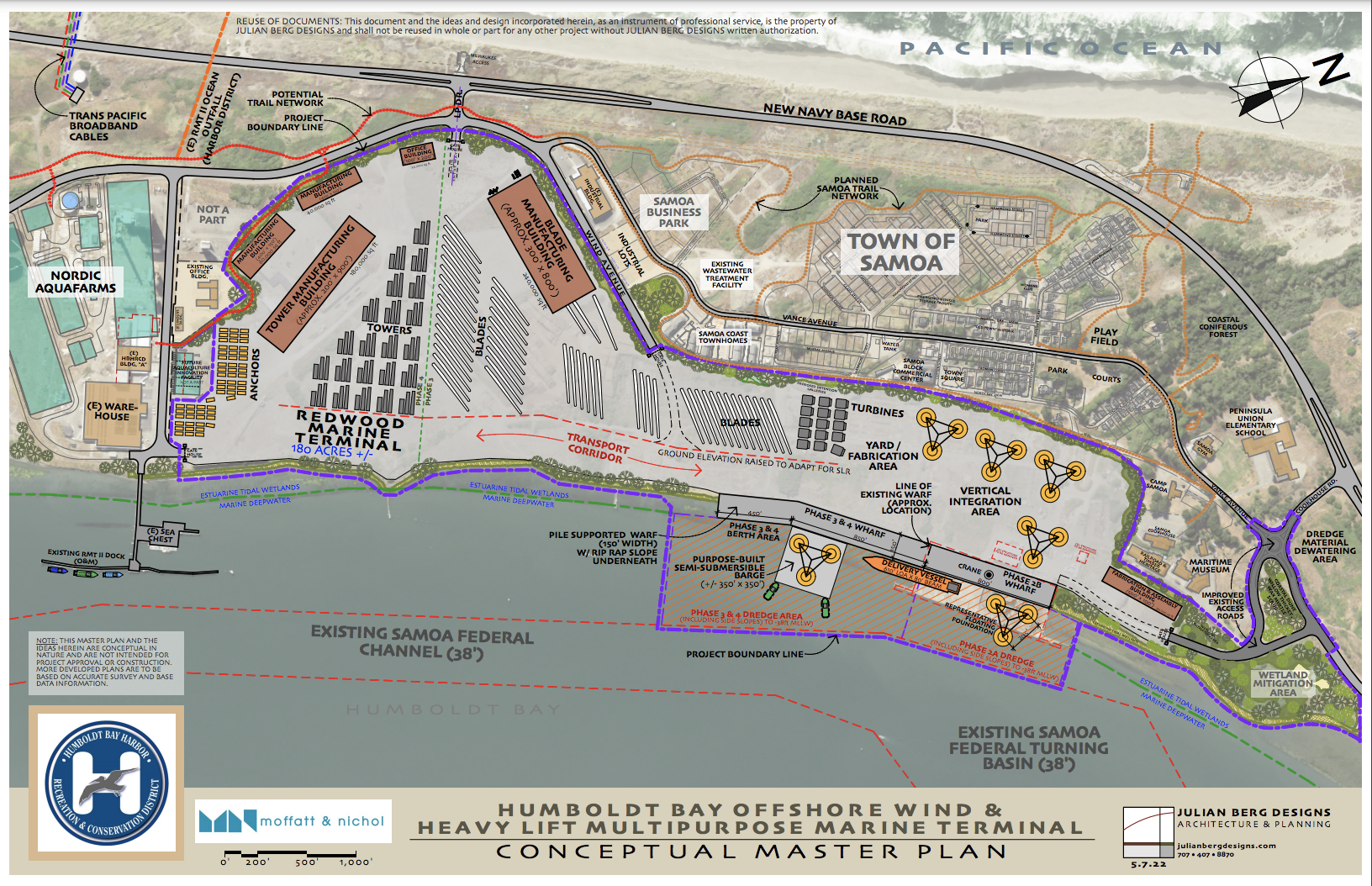
Humboldt Bay Offshore Wind & Heavy Lift Multipurpose Marine Terminal Conceptual Master Plan. Image from Humboldt Bay Harbor Resource & Conservation District.

Humboldt County’s proposed offshore wind project would significantly reduce carbon emissions throughout California by providing upwards of 1.6 gigawatts of clean, renewable-sourced energy. But to ensure the success of offshore wind and to meet the promise of climate action, decision-makers must commit to a green port facility capable of building and servicing the turbines while not further contributing to greenhouse gas emissions or polluting Humboldt Bay.

A key component of a thriving offshore wind industry is a port capable of constructing, assembling, and maintaining wind turbines. The Humboldt Bay Harbor District has partnered with Crowley Wind Services, a multinational port development company, to build this heavy lift terminal on the Samoa Peninsula. There are various potential benefits: port development could create many family-wage jobs and substantially contribute to a growing local economy—all while making important strides towards a clean-energy future to address the climate crisis.

Unfortunately, these types of heavy-lift terminals have a mixed track record for communities. On land, port equipment such as terminal tractors, forklifts, yard trucks, cranes, and handlers commonly run on diesel. In the water, most heavy-duty cargo ships and tugboats also run on diesel or heavy fuel oil, polluting the air. Ships and tugs even burn fuel while docked at the terminal to maintain a base load of electricity. As a result, communities surrounding these ports often suffer from the effects of air pollution. In Los Angeles, for example, air quality studies revealed that these diesel fumes significantly raised cancer risk for people within fifteen miles of the terminals.

Our port doesn’t have to be this way. Recent technological developments have made major progress towards enabling the possibility of a ‘green port.’ Green ports seek to make all aspects of operation sustainable, from the heavy machinery on land to the ships docked at the harbor. This work requires moving away from fossil fuels and shifting towards electrification and other zero-carbon energy sources, such as green hydrogen.

Daniel Randall RMT at the XRTU Hub, The Big One

Union welcomes end to labour exploitations made through Offshore Wind Workers Concession

By staff - Nautilus International, April 28, 2023

Nautilus has warned offshore wind employers against seeking to continue to exploit migrant labour following the expected end of the Offshore Wind Workers Concession (OWWC) on 30 April.

Nautilus has consistently campaigned against the OWWC for disincentivising employers from hiring and training UK maritime professionals to work in the rapidly growing industrial sector of offshore wind in UK territorial waters.

Nautilus International general secretary Mark Dickinson said: ‘The end of the OWWC is a welcome move from government. Employers have had almost six years to develop UK maritime professionals in the skills needed for the growth of offshore wind. Instead, they have used this concession to utilise workers from abroad, often on much less pay and weaker conditions, undermining job opportunities and secure employment for UK resident seafarers.

‘Government must commit to a fair visa system ensuring that any seafarer recruited from abroad to work in the UK offshore wind sector is needed and that they receive wages and conditions reflective of UK standards.

‘If government are serious about their commitment to investing in the UK maritime workforce as highlighted in Maritime 2050, they must ensure a level playing field for seafarers across the offshore wind sector.’

The Home Office have said: ‘The OWWC is time limited and leave to enter under the terms of the concession will not be granted beyond 30 April 2023. The concession will not be renewed beyond this date.’

The concession was introduced as a temporary measure in 2017 and has been extended six times.
Nautilus has raised concerns that while this concession may end, employers may seek to find alternative ways to import and exploit workers from abroad, such as using the Migration Advisory Committee shortage occupation list.

Laid off twice: a Nautilus member speaks on the consequences of the OWWC

By Barry Edwards - Nautilus International, April 28, 2023

Nautilus member Barry Edwards is speaking out after he and his fellow seafarers lost their jobs due to the Offshore Wind Workers Concession (OWWC). The visa concession is due to end on 30 April.

‘I got laid off twice last year because of this waiver. When you ask the company why, the answer you get is that they can get two people from abroad for the price of one of you,’ he said.

‘The first time it happened I was cheesed off, the second time I just thought “this is crazy, how can the British government allow this to happen?”’

On the second occasion, Mr Edwards was one month into a six-month contract when the waiver was renewed at the last minute, which caused the company to let its existing contractors go.

Mr Edwards describes the pay, terms and conditions offered to international crew as ‘horrendous’. ‘These guys are doing 12-hour shifts for £900 per month, which is just over UK National Minimum Wage rates for highly trained maritime professionals. The seafarers spend four to five months onboard at a time, without any shore leave, which saves employers money on travel costs. I don’t think that’s fair, especially if they’re working within the 12-mile limit.

‘The transport secretary and minister for shipping are saying there’s a shortfall in British seafarers – but this cheap employment is the real reason.’

Recently, Mr Edwards was offered another job in offshore wind by the same company that laid him off – though this time via an agency. He decided not to accept and has taken a different job outside the offshore wind industry.

‘When I got laid off for the second time, I thought about leaving the whole game – I thought, I can’t keep doing this, being offered a contract for six months and then being told to leave after a month,’ he said.

‘I don’t trust what’s going on. The government hasn’t said it will renew [the OWWC], but at the minute I’m not confident enough to accept a job in offshore wind and then be told the rules have been changed and I’m back to square one.

‘I’d like the government to put an end to all this completely and stop messing seafarers around.’

Whose Green Transition? Ours!

By Keith Brower Brown - Labor Notes, April 25, 2023

Huge changes are coming for our workplaces, quick as a heat wave. This month Joe Biden inked new rules to make all-electrics the majority of new cars sold in America within a decade.

o charge all those batteries, many of the largest states are pushing to power their grids with two-thirds clean energy by the same deadline.

These green shifts have put billion-dollar signs in the eyes of bosses. Public cash is pouring out to subsidize cleaner manufacturing and energy. Corporations aim to cash in double by cutting unions out.

Automakers like General Motors are setting up huge parts of the electric car supply chain in anti-union “joint venture” plants. Solar energy jobs, as of 2022, were 90 percent non-union across the country. Union-busting is even more disgusting in a green disguise.

But as the song goes, “Without our brains and muscle, not a single wheel can turn.” That goes for electric wheels, too.

The enormous sweat and smarts needed for any climate transition worth the name give workers huge potential leverage, from electricians in Arizona to auto workers in Tennessee.

And around these green boom-towns, childcare, education, health, and logistics workers could see their leverage grow, too.

Lobstering Union (IAM 207), Maine Building Trades unions, Maine AFL-CIO Back Proposal to Protect Fishing Jobs & Create Union Jobs in Offshore Wind

By Andy O’Brien - Maine AFL-CIO, April 20, 2023

The Maine Lobstering Union (IAM 207) and the Maine AFL-CIO Executive Board have voted to support a proposal that would protect fishing grounds while also allowing offshore wind development in a way that creates good union jobs. The Maine Lobstering Union, IAM Local 207, the building trades, the Maine Labor Climate Council and others have worked tirelessly on the legislation, LR 741, -- with the support of bill sponsor Sen. Mark Lawrence and Senate President Troy Jackson -- to protect core fishing grounds and set high fisheries, environmental, equity, and labor standards on offshore wind development.

"We applaud the Maine Lobstering Union, Building Trades locals and others for doing the spade work to develop a solid plan for workers that protects Maine fisheries and guarantees good union jobs in the development of this new industry," said Matt Schlobohm, Maine AFL-CIO Executive Director. "When we work together to develop a worker led vision for climate action, we can create new union jobs, protect existing industries and tackle climate change head on."

Pages

The Fine Print I:

Disclaimer: The views expressed on this site are not the official position of the IWW (or even the IWW’s EUC) unless otherwise indicated and do not necessarily represent the views of anyone but the author’s, nor should it be assumed that any of these authors automatically support the IWW or endorse any of its positions.

Further: the inclusion of a link on our site (other than the link to the main IWW site) does not imply endorsement by or an alliance with the IWW. These sites have been chosen by our members due to their perceived relevance to the IWW EUC and are included here for informational purposes only. If you have any suggestions or comments on any of the links included (or not included) above, please contact us.

The Fine Print II:

Fair Use Notice: The material on this site is provided for educational and informational purposes. It may contain copyrighted material the use of which has not always been specifically authorized by the copyright owner. It is being made available in an effort to advance the understanding of scientific, environmental, economic, social justice and human rights issues etc.

It is believed that this constitutes a 'fair use' of any such copyrighted material as provided for in section 107 of the US Copyright Law. In accordance with Title 17 U.S.C. Section 107, the material on this site is distributed without profit to those who have an interest in using the included information for research and educational purposes. If you wish to use copyrighted material from this site for purposes of your own that go beyond 'fair use', you must obtain permission from the copyright owner. The information on this site does not constitute legal or technical advice.
