






You are here
reports
 African agriculture and food systems are evolving in an increasingly volatile context, impacted by climate change, conflicts, fragile and iniquitous globalised food systems, successive food crises, and unaddressed structural causes. Africa is one of the first victims of existing global inequalities, with a generally subordinate economic position, a limited voice in political decisions affecting the continent and its nations, and an extremely unequal distribution of the costs and benefits stemming from the exploitation of natural resources. In this context, the 2021 UN Food Systems Summit (UNFSS), widely denounced by people’s movements around the world as undemocratic and illegitimate, sought to kickstart a global process towards “food system transformation” and urged countries to develop their own “national pathways” for achieving this goal. The Dakar 2 – ‘Feed Africa Summit’ in January 2023, sponsored by the African Development Bank, also enjoined countries to present “national compacts” emphasising private sector investment.
 The effects of climate change are becoming increasingly clear, and countries are beginning to react. To mitigate further climate change while maintaining economic stability, the demand for lower-carbon energy is growing — and workers in high-emitting sectors must be supported through this transition to a clean energy economy. Governments need to help the regions most impacted by the transition prepare for what is already underway and take proactive steps to avoid stranded assets and stranded workers. Other countries including Germany, Spain, Scotland, New Zealand, the United States and Denmark have already modelled components of successful governance to support the transition to sustainable jobs.
 California continues to lead the nation in charting a path to economy-wide decarbonization. On this path, the state has committed to pursuing a high road transition that prioritizes the development of a sustainable economy grounded in equity for workers and communities.
 Blue hydrogen hype has spread across the U.S., spurred by the billions of dollars of government funding and incentives included in the 2021 Bipartisan Infrastructure Law (BIL) and the 2022 Inflation Reduction Act (IRA). The fossil fuel industry promises that blue hydrogen, produced from methane or coal, can be manufactured cleanly and contribute to climate change mitigation measures. As we demonstrate in this report, the reality is that blue hydrogen is neither clean nor low-carbon. In addition, pursuing it will waste substantial time that is in short supply and money that could be more wisely spent on other, more effective investments for reducing greenhouse gas emissions in the immediate future.
 A Rural New Deal is urgently needed to build and rebuild local economies across rural America, reverse forty years of wealth and corporate concentration, restore degraded lands, reclaim land and ownership opportunities for those whose land was taken by force or deceit, and ensure that communities and the nation can and do meet the basic needs of its people. This document proposes ten pillars essential to a Rural New Deal, each with a modest amount of detail about specific policies in order to understand what implementation of the pillar might look like.
 Following the onset of the COVID-19 pandemic in early 2020, calls for a GGND and a commitment to GPGs intensified. In July 2020, UN Secretary-General Antonio Guterres declared, “The global political and economic system is not delivering on critical global public goods: public health, climate action, sustainable development, peace…we need a New Global Deal to ensure that power, wealth and opportunities are shared more broadly and fairly at the international level.”
 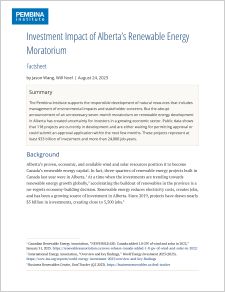 Alberta’s proven, economic, and available wind and solar resources position it to become Canada’s renewable energy capital. In fact, three-quarters of renewable energy projects built in Canada last year were in Alberta. At a time when the investments are trending towards renewable energy growth globally, accelerating the buildout of renewables in the province is a no-regrets economy-building decision. Renewable energy reduces electricity costs, creates jobs, and has been a growing source of investment in Alberta. Since 2019, projects have drawn nearly $5 billion in investments, creating close to 5,500 jobs.
 By the first quarter of 2020, EQT Corporation, the nation’s largest domestic producer of natural gas, was supplying more than 4 billion cubic feet of natural gas per day. Just a decade earlier, EQT’s output wasn’t even one-tenth as much and the company ranked an undistinguished 25th for output among US producers. But EQT had the good fortune and foresight to base all of its operations in Appalachia, which made it the greatest beneficiary of what turned out to be the world’s richest natural gas field.
 The Fine Print I:
Disclaimer: The views expressed on this site are not the official position of the IWW (or even the IWW’s EUC) unless otherwise indicated and do not necessarily represent the views of anyone but the author’s, nor should it be assumed that any of these authors automatically support the IWW or endorse any of its positions.
Further: the inclusion of a link on our site (other than the link to the main IWW site) does not imply endorsement by or an alliance with the IWW. These sites have been chosen by our members due to their perceived relevance to the IWW EUC and are included here for informational purposes only. If you have any suggestions or comments on any of the links included (or not included) above, please contact us.
The Fine Print II:
Fair Use Notice: The material on this site is provided for educational and informational purposes. It may contain copyrighted material the use of which has not always been specifically authorized by the copyright owner. It is being made available in an effort to advance the understanding of scientific, environmental, economic, social justice and human rights issues etc.
It is believed that this constitutes a 'fair use' of any such copyrighted material as provided for in section 107 of the US Copyright Law. In accordance with Title 17 U.S.C. Section 107, the material on this site is distributed without profit to those who have an interest in using the included information for research and educational purposes. If you wish to use copyrighted material from this site for purposes of your own that go beyond 'fair use', you must obtain permission from the copyright owner. The information on this site does not constitute legal or technical advice.
 This site is not the official webpage of the Industrial Workers of the World.