You are here

movements, unions, and organizations

Chapter 2 : Pollution, Love it or Leave it!

By Steve Ongerth - From the book, Redwood Uprising: Book 1

Download a free PDF version of this chapter.

"Since when are humans solely a biological product of wilderness? (What is ‘wilderness’?) If you accept an evolutionary development of Homo sapiens, as I do, it does not mean that you profess a disbelief in God. Quite the contrary. It was God, the Creator, who created humans, who imbued them with a will, with a soul, with a conscience, with the ability to determine right from wrong. It is inconceivable that the Creator would create such vast resources on earth without expecting them to be utilized."

—Glenn Simmons, editor of the Humboldt Beacon and Fortuna Advance, February 1, 1990.

"Growth for the sake of growth is the ideology of the cancer cell.

—Edward Abbey

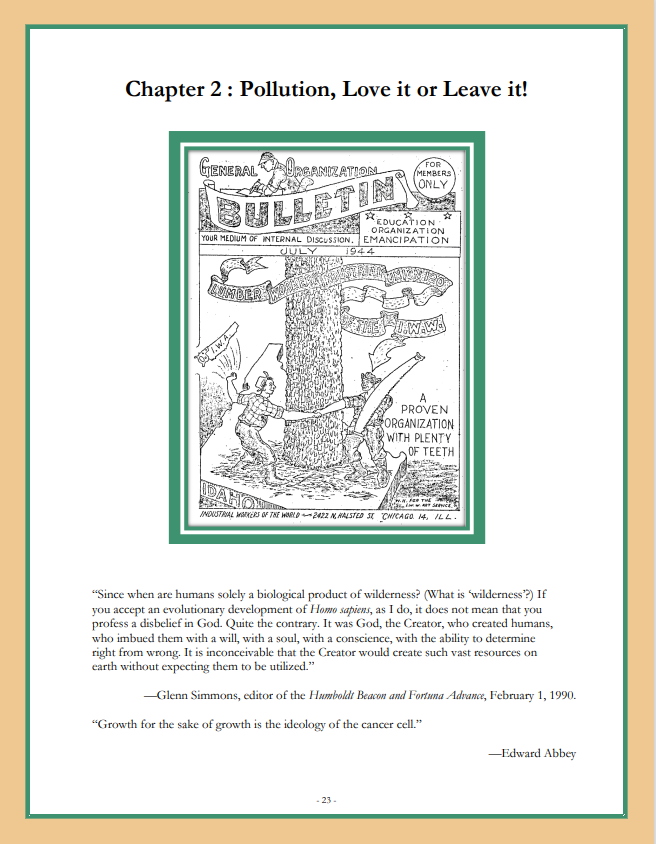
Earth shattering though it may have seemed, the IWW’s victory was both transitory and incomplete, and historical currents would never again mesh as perfectly. To begin with, the strike on the job had taken place only in the Pacific Northwest, and had excluded California at that. The Wobblies recognized one strategic weakness in this situation in noting that the employers could have eventually organized a lockout of that region and relied instead on wood production from the southern or eastern United States. They knew—in the abstract at least—that their victory would never be complete until they organized all lumber workers nationally and internationally.[1] The Wobblies inability to make inroads among the highly skilled redwood loggers of California’s North Coast was especially troublesome, and it portended their undoing. Two companies, Pacific Lumber (P-L) and Hammond Lumber Company (HLC) had each adopted separate techniques that had kept the IWW out and would soon be duplicated by the Lumber Trust elsewhere. That combined with the much larger shockwaves brought on by the Russian Revolution in 1917 conspired against the One Big Union and led to the eventual decline of the American working class as an adversarial force and the liquidation of the forests of the Pacific Northwest.

Although most corporations comprising the Lumber Trust had refused to budge, lest they embolden the Wobblies, there were those that adopted “welfare capitalism” on their own initiative, in which they would provide amenities and benefits to their workers—union or not—in an attempt to win over their loyalty. It was in the crucible of timber worker unionism, Humboldt County, where this was first attempted with any lasting success, by the Pacific Lumber Company (P-L), based in Scotia, beginning in 1909. P-L had discovered that by creating a wide variety of social programs, employee benefits, and community based events, it was able to secure the loyalty and stability of its workforce. P-L general manager A. E. Blockinger described these efforts in great detail in an article featured in the Pioneer Western Lumberman:

"A reading room with facilities for letter writing and any games, except gambling, is easily and cheaply put into any camp. Arrange subscription clubs for papers and periodicals or let the company do it for the men. If you can have a circulating library among your camps and at the mill plant, it will be much appreciated. Let the daily or weekly papers be of all nationalities as represented in your camp. Lumber trade journals are especially interesting to the men and they can and will readily follow the markets for lumber and appreciate that you have some troubles of your own.

“Organize fire departments among your men. The insurance companies will give you reductions in rates for such additional protection while it offers another opportunity for your men to relax and enjoy themselves.

“Shower baths at the camps or mill are easily and cheaply installed. They will be used and appreciated after a hot, dusty day’s work.

“Get your men loyal and keep them so. Let this replace loyalty to a union. The spirit is what you want in your men. Ten good men will accomplish as much as fifteen ordinary laborers if the spirit and good will is there. Treat them right and they will treat you right.”[2]

The employers’ introduction of paternalism achieved its intended goal. The Secretary of the Pacific Logging Congress, an employers’ association had declared in his 1912 report, “The best cure for the IWW plague—a people without a country and without a God—is the cultivation of the homing instinct in men.”[3] When the IWW campaign for the eight hour day ensued in 1917, P-L simply added more programs. Carleton H. Parker, a onetime U.C. Berkeley economics professor working for the War Department as a mediator during the lumber workers’ strike, had previously conducted sociological studies on workers, including agricultural and timber laborers. Parker was familiar with P-L, and had some fairly extensive knowledge of the Wobblies.[4] Some of the latter had been gained through first-hand studies by two of his assistants, Paul Brissenden[5] and F. C. Mills[6] who had posed as IWW members and later produced extensive studies on the organization. Using this knowledge, Parker offered many suggestions to Disque which the latter somewhat reluctantly adopted. The LLLL created social halls for its members and replaced the employment sharks with free employment agencies. The IWW quite rightly recognized these amenities as a means to buy the workers’ loyalty and likely to be liquidated when the employers drive for profits once again accelerated, but this process would take a long time, and convincing the workers of a threat that could take one or more generations to manifest proved futile.[7]

How Unions Are Fighting for Public Pension Fossil Fuel Divestment

Victory Against Polluter Points Way to Clean, Green, and Fully Funded Schools

By Lauren Bianchi - Labor Notes, January 31, 2023

For two years, teachers and staff in my workplace, George Washington High School, helped lead a community campaign to stop a hazardous industrial metal shredder, General Iron, from moving a few blocks from our school.

Repeating a historic pattern, city officials facilitated General Iron’s planned move from the wealthy and white Lincoln Park neighborhood where it had operated for decades to the working-class, majority Latino Southeast Side.

Our campaign won a major victory when we pressured Mayor Lori Lightfoot and the Chicago Department of Public Health into denying the final operating permit for General Iron. It took years of mobilizing, street protest, and a month-long hunger strike to force the mayor to do the right thing.

The experience of Chicago Teachers Union members in the #StopGeneralIron campaign highlights the power of union members when we stand shoulder to shoulder with environmental justice activists to demand safe living and working conditions.

'Our Future Is Public': Santiago Declaration Envisions End of Neoliberalism Death Spiral

By Kenny Stancil - Common Dreams, January 27, 2023

A new manifesto calls for building "a sustainable social pact for the 21st century" in which "our rights are guaranteed, not based on our ability to pay, or on whether a system produces profit, but on whether it enables all of us to live well together in peace and equality."

An international coalition made up of more than 200 trade unions and progressive advocacy groups on Thursday published the Santiago Declaration, a manifesto for "a complete overhaul of our global economic system."

The undeniably anti-neoliberal document proclaiming that "our future is public" is the product of a meeting held in Chile—the "laboratory of neoliberalism" where Milton Friedman and his University of Chicago acolytes' upwardly redistributive economic model was first imposed at gunpoint by Gen. Augusto Pinochet's military junta.

From November 29 to December 2, more than 1,000 organizers from over 100 countries gathered in Santiago and virtually to germinate a left-wing movement against "the dominant paradigm of growth, privatization, and commodification."

"We are at a critical juncture," the manifesto begins. "At a time when the world faces a series of crises, from the environmental emergency to hunger and deepening inequalities, increasing armed conflicts, pandemics, rising extremism, and escalating inflation, a collective response is growing."

"Hundreds of organizations across socioeconomic justice and public services sectors—from education and health services, to care, energy, food, housing, water, transportation, and social protection—are coming together to address the harmful effects of commercializing public services, to reclaim democratic public control, and to reimagine a truly equal and human rights-oriented economy that works for people and the planet," reads the document. "We demand universal access to quality, gender-transformative, and equitable public services as the foundation of a fair and just society."

Chapter 1 : An Injury to One is an Injury to All!

By Steve Ongerth - From the book, Redwood Uprising: Book 1

Download a free PDF version of this chapter.

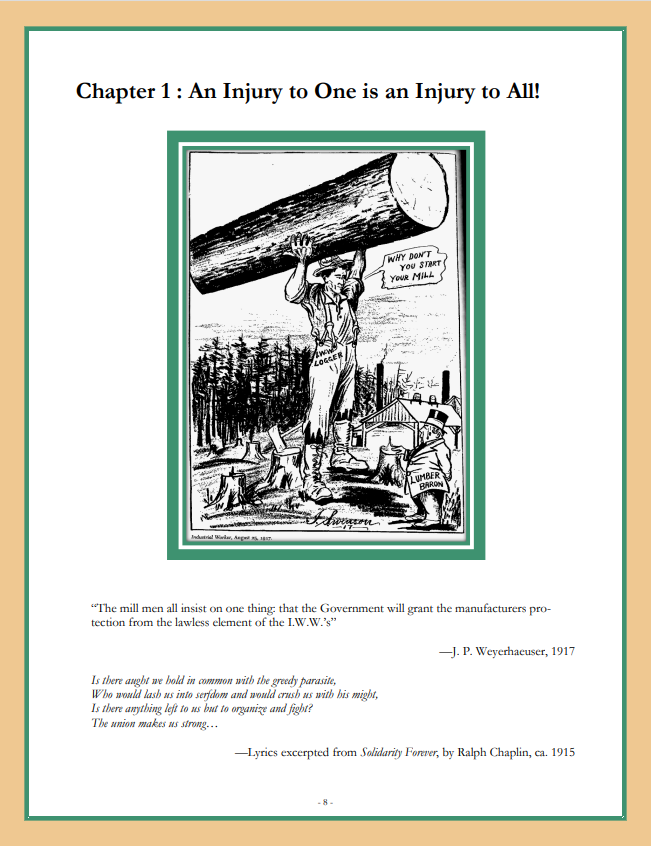
The mill men all insist on one thing: that the Government will grant the manufacturers protection from the lawless element of the I.W.W.’s”

—J. P. Weyerhaeuser, 1917

Is there aught we hold in common with the greedy parasite,
Who would lash us into serfdom and would crush us with his might,
Is there anything left to us but to organize and fight?
The union makes us strong…

—Lyrics excerpted from Solidarity Forever, by Ralph Chaplin, ca. 1915

The timber industry has, throughout nearly its entire history, been in the control of an elite minority of the very rich and powerful, and they have been especially avaricious, violent, and repressive towards all who would challenge their power. They have also—in spite of a barrage of slick propaganda trumpeting their careful management of the resource—depleted most of the virgin forests of the Pacific Northwest. Many environmental organizations can trace their origins to opposition to such practices, and in the struggles by environmentalists to preserve forestlands, timber workers have had a reputation for being their fiercest adversaries, and in many cases, this is true. Timber workers have a well deserved reputation for being outspoken about the pride of purpose in their job, as well as a deeply ingrained cultural machismo. Yet lumber harvesting and production is historically one of the ten most dangerous jobs in the industrialized world, and timber workers are among those most exploited by their employers. One would logically expect the timber workers to be highly resistant to such treatment, but in recent years they haven’t been. This wasn’t always so. To understand why, one must examine the industry’s origins.

Before the arrival of European-American settlers to the Pacific Northwest, the entire region stretching from northern California to Canada and Alaska from the Pacific Coast to the Rocky Mountains was dominated by coniferous old growth forests. At least 20 million acres of this land was forested, dominated by various species of trees, some of them hundreds of feet in height, over a dozen feet in diameter, and centuries or even millennia old.[1] In the southwestern part of this region, stretching from Big Sur to roughly what is now the Oregon state line, in a belt that was at least twenty miles wide for most of its expanse a very unique species of tree dominated, Sequoia sempervirens, commonly known as the California redwoods, some of them standing over 350 feet tall. Their close (and similarly large) cousins, Sequoiadendron giganteum, better known as the Giant Sequoia, only grew in a few isolated spots in the southern end of the Sierra Nevada foothills. These vast forests were far more then the trees, however. Hundreds, if not thousands of plant and animal species lived and flourished within these wooded habitats, and as far as is known, the indigenous population of the Americas had no significant lasting impact on California’s ancient redwood forests, nor did they have any lasting effect on the timberlands of the Pacific Northwest in general.[2] Like the Native Americans, the old growth forests of the Pacific Northwest had remained left more or less untouched for thousands, if not hundreds of thousands of years.

The coming of the white man changed all of that. The Russians first began exploiting the redwoods for the construction of Fort Ross in 1812, during their very brief settlement there.[3] As more Europeans arrived, the forests south of San Francisco were the first to be logged, usually through clearcutting, until these ancient stands were completely liquidated by 1860. In those days, loggers used hand saws, and felling an ancient redwood could take anywhere from two-to-five days to complete. The redwoods to the north of the Golden Gate in what is now Marin County were logged next, especially along rivers that allowed easy transportation by the available modes of the day. By this time, around 1881, the steam engine had replaced pack animals. Though this first wave of automation did not have a significant impact on the number of workers involved in the logging process, it greatly increased the impact logging had on the redwoods. Entire forests were liquidated, no matter how small the tree, because even the baby trees were used to build the skid roads used for hauling the larger ones. These forests were never replanted, and very few of them grew back, and in some cases, farmlands replaced them. By the beginning of the 20th Century, all but a few of these ancient trees were gone and logging operations migrated north to Sonoma County. One quarter century later, most of these old growth forests were likewise gone.[4]

Redwood Uprising: Introduction

By Steve Ongerth

Download a free PDF version of this chapter.

The arc of history is long, but it bends towards justice.

—Martin Luther King Jr.

I know, I know. I need to write a book about all this. Fighting to save the redwoods, building alliances with the loggers, getting car bombed and finding out what we’re up against not just the timber industry but also the FBI. Then coming back home and ending up back on the front lines again. I fully intend to write about it eventually, but it’s hard to write about something when you’re still in the middle of it.”

—Judi Bari, introduction to Timber Wars, 1994

“All this,” is a very complex and intriguing story (not to mention a call to action), and while most people have never heard it, a great many are at least partially aware of its defining moment.

On the morning of May 24, 1990, two activists, Judi Bari and her friend and comrade Darryl Cherney, set out from Oakland, California, while on a tour to organize support for a campaign they had organized called Redwood Summer. They were part of the radical environmental movement known as Earth First!, which had a reputation for militant tactics, including the sabotaging of logging and earth moving machinery as well as spiking trees—the act of driving large nails into standing trees in order to deter logging operations. The previous year in Arizona, five environmentalists, including Peg Millett and Earth First! cofounder Dave Foreman, had been arrested and charged by the FBI for a conspiracy to sabotage power lines in protest against nuclear power. Some welcomed Earth First!’s uncompromising reputation. Others denounced them as reckless, or even as terrorists.

According to the mainstream media, Earth First!’s radical agenda earned them the animosity of the timber workers whose jobs the environmentalists supposedly threatened. They were described as “outside agitators” (among many other things) who had “polarized” the timber dependent communities of northwestern California’s redwood region—historically known as the “Redwood Empire”, but more recently as the “North Coast”—with their militant and uncompromising “environmental extremism.” Their alleged hard-line anti-logging stances were seen as too extreme even by most environmentalists, and they supposedly stood upon the radical fringes of the ecology movement. Redwood Summer was reportedly planned as a summer-long campaign of direct actions by these “fringe” environmentalists to thwart the harvesting of old growth redwood timber in northwestern California, specifically Humboldt, Mendocino, and Sonoma Counties.

On May 24, however, Bari’s and Cherney’s planned destination was Santa Cruz County, where—just one month previously—power lines had supposedly been sabotaged by unknown perpetrators calling themselves the “Earth Night Action Group”. Just before 11:55 AM a bomb in Bari’s car exploded, nearly killing her and injuring Cherney. Within minutes the FBI and Oakland Police arrived on the scene and arrested both of them as they were being transported to Highland Hospital. The authorities called them dangerous terrorists and accused the pair of knowingly transporting the bomb for use in some undetermined act of environmental sabotage when it had accidentally detonated. The media spun the event as the arrest of two potentially violent environmental extremists.

TUED South Platform: a “Public Pathway” Approach to a Just Energy Transition in the Global South

Revolutionary unionism and the Industrial Workers of the World

By CC Gwalia - Red Pepper, January 14, 2023

Founded in 1905, the Industrial Workers of the World (IWW, Or ‘Wobblies’) was once considered the protagonist of the American class struggle. The union emerged out of a conflict with one of the largest worker’s institutions at the time, the American Federation of Labor. Radical thinkers affiliated with the Socialist and Socialist Labor Parties, along with leading trade unionists, felt that the union had taken a reformist stance toward capitalism and pursued an exclusionary policy toward “unskilled” labourers and migrant workers. What was needed was a fighting union, that wouldn’t make needless concessions to the ruling class. A union that would try to bring all workers into the struggle, regardless of profession or race. This historical necessity is also a present one. We still direly need a radical and cohesive instrument of class struggle.

The union’s first ten years proved considerably successful, so much so that it took massive state repression to quell the movement. Though its numbers are now diminished, the IWW retains strongholds around the world, its theory and practice retaining relevance for contemporary struggles. In 2016, IWW activists organised the largest prison strike in American history, and as strikes hit nearly all major industries of the UK, the possibility of building one cohesive movement for justice again raises its head. The task of creating a coordinated workers’ movement will demand unity, solidarity and a mutual recognition of the structural and cultural modes of oppression confronting each worker personally and collectively. To effect this, we need a basis for understanding the shared injuries inflicted on the working class by capitalism, a democratic body to coordinate our efforts, and a method for the critique of half-measures and compromise. Ultimately, we need one large union to link up the smaller struggles.

Stopping Cop City and Reconnecting with Abundance: Interview with Abundia Alvarado of Mariposas Rebeldes

By Abundia Alvarado and Dan Fischer - New Politics, January 14, 2023

Abundia Alvarado is a community organizer and a co-founder of Mariposas Rebeldes, a member of the movement to protect Weelaunee Forest and Stop Cop City, and a founder of FaunAcción, and El Molcajete. A Nahuatl and Apache trans femme migrant, she is currently based between Atlanta and Tennessee. In Atlanta, she helped launch an annual money-free gift-economy festival called the Dandelion Fest and is working on projects around the idea of the universe as a “Sacred Web of Abundance.” We spoke about Abundia’s life’s philosophy, its roots, and how it has shaped the trajectory of her organizing.

Since the interview was conducted last month, there have been some developments in Atlanta’s grassroots campaign to stop construction of a highly militarized police training facility, nicknamed “Cop City,” on 85 acres of the Weelaunee forest. On December 13 and 14, SWAT teams and police arrested twelve land defenders and six of them were given bogus “domestic terrorism” charges. All six have been bonded out of jail, but readers can contribute to their legal expenses through the Atlanta Solidarity Fund, follow the movement at Scenes from the Atlanta Forest, and organize solidarity events.

You’ve described your childhood surroundings near Monterrey, Mexico, as a “web of abundance”. Could you elaborate on some of the values you picked up in this environment – including from your Nahuatl and Apache family and from the local community as well as the broader ecosystem – which continue to inform your organizing?

I grew up in a neighborhood called Canteras in the outskirts of Monterrey, Nuevo León, Mexico, the third largest city and center of the Mexican business and economy, located in the desert land, surrounded by a beautiful web of abundance that saved me from the daily horrible reality of extreme poverty. Canteras was full of different cacti—many of them edible like the nopales which have tunas (prickly pears)—that I collected almost all year round. There were different varieties of chiles, my favorites being the tiny yet potent piquin. For my sweet tooth, there were blackberries, mulberries, and many other desert foods and flowers. So even though we were food insecure at my household, I still ate so well and plentifully. Canteras’s web of abundance (or WoA, for short) was everything to me. I played in it all day, befriended animals and plants, and imagined other worlds outside the neighborhood and its physical and mental constraints. I relentlessly explored every inch of that land and learned something new every day from all the plants, animals, insects, fungi, etc, that were part of that particular WoA. There were a lot of waterways, little waterfalls, and pools to bathe in. It was heaven for a curious and very active little girl (although I didn’t yet identify as a girl outwardly).

This particular land where I was born and grew up was owned by a very rich landowner, but my mother helped organize 120 families to occupy it and settle there. The occupation was successful and the Canteras neighborhood was born.These 120 families were mostly Indigenous people from different parts of Mexico but mainly Nahuatl people like my father’s family. I learned about their cultures and traditions by paying attention to the staples they grew (such as corn, tomatoes, chilis (especially chile piquin), blackberries, mangoes, oranges, peanuts, bananas, and avocados), the way they cooked them and the dishes they made. My neighbors helped each other to grow food and shared the harvests. One value that was instilled in me during these early years was respect for all the plants, ecosystems, and animals, and always being aware of other species’ jurisdictions or territories. Canteras was also the home of many kinds of snakes like the rattlesnakes, copperhead, coralillo and the mysterious (mythical) Alicante snakes. My family was so lucky we never got bitten by a snake even though I encountered them every day in the mountains. I knew where they lived and hung out and was careful not to intrude then. That respect and awareness is something that I carry on with me and that informs my activism around animal rights. Regarding human jurisdictions, I was never good and always transgressed their boundaries.

Commentary: The Green New Deal in the States, Part 1

By Jeremy Brecher - Labor Network for Sustainability, January 4, 2023

Just since the start of 2021 there has been a wave of state legislation and executive action that sets and implements new standards for greenhouse gas emissions. States have greatly expanded their plans for wind and solar energy and energy efficiency. In most cases these are combined with policies specifically designed to create good quality jobs and to counter inequality. This Commentary describes job-creating, justice-promoting climate protection in Hawaii and Illinois. The following Commentary will describe such initiatives in California and evaluate the origins and effects of state-level Green New Deal-style initiatives overall.

States have the power to implement much of the Green New Deal – and some states are using that power. States regulate power generation, local distribution of electricity, and siting decisions. They set the parameters for urban planning and public transit. Most states have adopted renewable portfolio standards that require utilities to use a certain percentage of electricity from renewable sources. Many have adopted policies for energy storage, electric vehicles, energy efficiency standards for appliance and buildings, low carbon fuel standards, and emissions trading. And some are combining such climate protection policies with strategies to create good jobs and overcome longstanding economic and social injustices.

There are organizing efforts for programs that embody the principles of the Green New Deal in every one of the fifty states. In many states some of these policies have already been established and are starting to be implemented. This is largely a result of popular pressure and organization. It also results from politicians trying to appeal to concerned electorates. These victories have typically been produced by coalitions whose objectives combine climate, jobs, and justice.[1]

Pages

The Fine Print I:

Disclaimer: The views expressed on this site are not the official position of the IWW (or even the IWW’s EUC) unless otherwise indicated and do not necessarily represent the views of anyone but the author’s, nor should it be assumed that any of these authors automatically support the IWW or endorse any of its positions.

Further: the inclusion of a link on our site (other than the link to the main IWW site) does not imply endorsement by or an alliance with the IWW. These sites have been chosen by our members due to their perceived relevance to the IWW EUC and are included here for informational purposes only. If you have any suggestions or comments on any of the links included (or not included) above, please contact us.

The Fine Print II:

Fair Use Notice: The material on this site is provided for educational and informational purposes. It may contain copyrighted material the use of which has not always been specifically authorized by the copyright owner. It is being made available in an effort to advance the understanding of scientific, environmental, economic, social justice and human rights issues etc.

It is believed that this constitutes a 'fair use' of any such copyrighted material as provided for in section 107 of the US Copyright Law. In accordance with Title 17 U.S.C. Section 107, the material on this site is distributed without profit to those who have an interest in using the included information for research and educational purposes. If you wish to use copyrighted material from this site for purposes of your own that go beyond 'fair use', you must obtain permission from the copyright owner. The information on this site does not constitute legal or technical advice.