You are here

movements, unions, and organizations

Overcoming Capitalism: Strategy for the Working Class in the 21st Century: Reviewed

By That Green Union Guy - IWW Environmental Union Caucus, February 8, 2023

While the IWW is not an explicitely anarcho-syndicalist organization, much of its praxis fits comfortably within the anarcho-syndicalist tradition. It's not the only revolutionary organization or union that does, either, and it's evident that anarcho-syndicalism as a living, breathing revolutionary practice is alive and well in the first couple of decades of the 21st Century. It's therefore somewhat puzzling that nobody has bothered to write a book that provides an updated overview of anarcho-syndicalism for a modern audience in well over seven or eight decades.

While there have been no shortage of books that have updated the history of anarcho-syndicalism, including the much covered (but contentiously debated) Spanish Revolution of 1936, as well as numerous revolutionary union organizing efforts throughout the last century; and there have been many books detailing the history, workplace and industrial organizing campaigns, methods, and praxis of syndicalist and/or syndicalist-adjacent unions, such as (but not limited to) the IWW, the IWA-AIT, and many others, there hasn't been an English Language book laying out the basic ideas of anarcho-syndicalism since Sam Dolgoff's and Rudolph Rocker's works of the mid-20th Century.

Fortunately, Overcoming Capitalism: Strategy for the Working Class in the 21st Century, by Tom Wetzel, AK Press, 2022 finally attempts to fill that void.

California Aims To Boot Dirty Investment With California Fossil Fuel Divestment Act (SB 252)

By Zachary Shahan - Clean Technica, February 9, 2023

California continues to be a climate and cleantech leader. One of its big recent announcements in this regard is that state policymakers have introduced the California Fossil Fuel Divestment Act (SB 252).

Naturally, this divestment move was stimulated by young adults, students. It was then introduced by Senator Scott Wiener (D-San Francisco), Senator Lena Gonzalez (D-Long Beach), and Senator Henry Stern (D-Los Angeles) in the California Senate. The package actually covers a range of topics. It is “a suite of bills that work together to improve transparency, standardize disclosures, align public investments with climate goals, and raise the bar on corporate action to address the climate crisis.”

One of the shocking stats that the parties use to emphasize the importance of this matter and the stunning reality of human-induced global heating is that 71% of greenhouse gas emissions to date have come from just 100 companies. “Without corporate action to reduce these emissions, California would be unable to meet its climate goals,” the state senators surmise. “At a time when rising anti-science sentiment is driving strong pushback against responsible business practices like risk disclosure and ESG investing, these bills leverage the power of California’s market to continue the state’s long tradition of setting the gold standard on environmental protection for the nation and the world.”

Chapter 3 : He Could Clearcut Forests Like No Other

By Steve Ongerth - From the book, Redwood Uprising: Book 1

Download a free PDF version of this chapter.
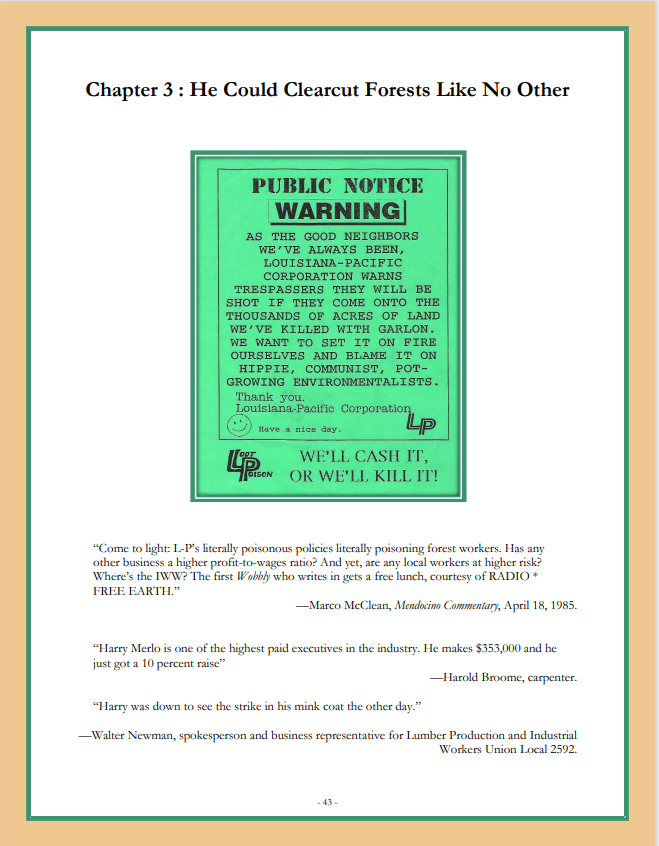
“Come to light: L-P’s literally poisonous policies literally poisoning forest workers. Has any other business a higher profit-to-wages ratio? And yet, are any local workers at higher risk? Where’s the IWW? The first Wobbly who writes in gets a free lunch, courtesy of RADIO * FREE EARTH.”

—Marco McClean, Mendocino Commentary, April 18, 1985.

Harry Merlo is one of the highest paid executives in the industry. He makes $353,000 and he just got a 10 percent raise”

—Harold Broome, carpenter.

“Harry was down to see the strike in his mink coat the other day.”

—Walter Newman, spokesperson and business representative for Lumber Production and Industrial Workers Union Local 2592.

Americans are raised on the mythology of the “self-made man”, the “enterprising go-getter” archetype who creates his own fortune and charts his own destiny. Very often he faces incredible odds, and, armed only with his wits and will to succeed, he alone overcomes disadvantages to become a leader among his fellow Americans. The gender specific pronoun is intentional, because in these stories, women more often than not play a subordinate role. There is an element of “pioneer” spirit within this narrative, and this is not entirely coincidental, because much of the narrative stems from the European-American subjugation of indigenous peoples and the wild. This archetype certainly matches the description of most “captains of industry”, particularly railroad bosses, oil magnates, and timber barons. There is more than folktale about such individuals. Indeed there is a strong ideological component to them, a personification of capitalism, perhaps expressed most unapologetically, albeit crudely, in the narratives of Ayn Rand, particularly Atlas Shrugged or The Fountainhead.

Whether fact or fiction, in these narratives, the entrepreneur is always the hero—virtuous to the core—and he is held up as an example to the rest of us to follow. Very often they not only rely on their own means, they often struggle against a cool and callous society, usually personified by a bureaucratic government, who appropriates some or all of the hero’s self-made fortune to serve its own political ends. What these stories consistently omit, is that most often these “conquering heroes” are neither self-made nor are they virtuous. They often lie, cheat, bend or break the rules, stab those close to them in the back, and rely on the benefits provided by the very same “government” they decry when it doesn’t serve their every need. They appropriate the fruits of others’ labor and call it their own. If there are consequences to their actions, they are shifted to the general public, usually upon the backs of those most unable to resist. And, it is the richest and the most powerful among them who commission the narratives that celebrate their triumphs, sanitizing their own histories so that it is difficult to tell what constitutes fact or fiction.

Harry A. Merlo Jr. was such a man. He began his career as a shipping foreman at a small, independently owned mill, advanced to partner, and then, after the mill was bought out by Georgia Pacific (G-P) he quickly moved up ranks of the G-P corporate structure.[1] Georgia Pacific spun off Louisiana Pacific (L-P) as a result of an antitrust suit brought by Boise Cascade (B-C) against the former for monopolistic practices in 1973. The Federal Trade Commission had threatened to break up the former for monopolizing the timberlands of northwestern California after acquiring holdings formerly held by Boise-Cascade, including the Fort Bragg California mill.[2] Merlo took over as head of the newly created L-P, and, under his management, the latter quickly expanded to become the second largest lumber company in the United States with 110 plants and at least 13,000 employees nationwide, with annual sales in excess of $1 billion.[3] Despite Merlo’s reputation as a self-made man, he received achieved many of his “successes” on the backs of others.

Learning From Rosa Parks on Transit Equity Day

By staff - People's Transit Alliance, February 6, 2023

This past Saturday, Feb. 4th, 2023, was Transit Equity Day, “a collaborative effort of several organizations and unions to promote public transit as a civil right and a strategy to combat climate change…” organized by Labor 4 Sustainability.

For Transit Equity Day 2023, the People’s Transit Alliance held a canvass of transit riders in Downtown Berkeley to discuss what improvements could be made to the bus system, the planned service redesign, and the importance of transit workers and riders building power together.

Labor 4 Sustainability chose Feb. 4th, Rosa Parks’ birthday, in order to honor her legacy as a civil rights icon, and her courageous action taken on a segregated bus on December 1, 1955. Those of us raised in the United States know the story of Rosa Parks, and her refusal to give up her seat to a white passenger.

What is less well known is her long history as an organizer for the NAACP, her radical politics, and her lifelong commitment to fighting white supremacy in the United States. 

The People’s Transit Alliance wishes to share this neglected side of Rosa Parks’ story. As we organize in her name, we must disrupt the whitewashed version of her life that is taught in schools, and used by politicians and corporations to maintain the very systems of oppression that she spent her life fighting against.

How worker ownership builds community wealth and a more just society

By Pamela Haines - Waging Nonviolence, February 3, 2023

Community wealth building initiatives are taking hold in cities across the world, strengthening worker pay, local economies and democracy.

A recent help-wanted ad for a laundry worker in Cleveland contained some unusual language, asking prospective candidates: “Have you ever wanted to work for a company that is 90 percent employee-owned? What about a company that offers a program to help you become a homeowner?” The ad went on to identify Evergreen Cooperative Laundry as the only employee-owned commercial laundry firm in the country, citing a commitment to building the wealth and careers of its employees.

Founded in Cleveland in 2009, Evergreen laundry lies at the heart of a movement that has now spread around the world. This attention to community wealth building is providing a 21st century model for Gandhi’s “constructive program,” which — along with nonviolent direct action — powered his overall campaign to overcome the political and economic oppression of colonialism.

The cooperative movement in the Rust Belt city of Cleveland has deep roots in community struggle for shared wealth. Its earliest origins are in the Mondragon co-op movement of the Basque Country in northern Spain, where tens of thousands of workers are organized into a vast co-op network that has flourished since the 1950s. Here in the U.S., when steel companies were closing down throughout the Ohio Valley in the 1970s — and moving to non-union, lower-wage regions in the south, and then overseas — a small band of activists promoted the idea of worker ownership.

Commentary: The Green New Deal in the States, Part 2

By Jeremy Brecher - Labor Network for Sustainability, February 2023

As the Green New Deal program has met headwinds in Washington, many states have plowed ahead with efforts to correct injustices and create good jobs as part of programs to fight climate change by reducing greenhouse gas emissions. “The Green New Deal in the States –Part 1” reviewed the climate, jobs, and justice programs in Hawaii and Illinois. This commentary examines the extensive Green New Deal-style programs that California has instituted this year and draws conclusions from the experience of many states.

As the Green New Deal program has met headwinds in Washington, many states have plowed ahead with efforts to correct injustices and create good jobs as part of programs to fight climate change by reducing greenhouse gas emissions. “The Green New Deal in the States –Part 1” reviewed the climate, jobs, and justice programs in Hawaii and Illinois. This commentary examines the extensive Green New Deal-style programs that California has instituted this year and draws conclusions from the experience of many states.

California: The Summer of Climate Catastrophe – and of Climate Protection

California is the world’s fifth largest economy. Climate change has led to unprecedented heat, drought, wildfires, and other extreme weather conditions that have devasted many parts of the state. Partially as a result, 80% of Californians consider climate change “a serious concern” and 60 percent want to see state-led climate action.

In 1988, just as scientists were confirming the threat of climate change, California mandated an inventory of greenhouse gas emissions. In 2002 it passed vehicle emission standards far exceeding those set by the federal government. In 2006 it passed AB 32, the Global Warming Solutions Act, which required that greenhouse gas emissions be reduced back to 1990 levels by 2020 and established a cap-and-trade program. Subsequent legislation required emissions be cut to 40% below 1990 levels and mandated 60% of all electricity from renewable sources by 2030 and 100% by 2045.[1]

New Foundations for the House of Labor?

By Jeremy Brecher - Labor Network for Sustainability, February 2023

Workers’ problems are not limited to their relationships with their immediate employers. How can they gain the power to affect the hidden decisionmakers who affect them both at work and in the rest of their lives? Two new books shed light on that question..

Books discussed:

  •  Fight Like Hell: The Untold History of American Labor by Kim Kelly, Simon and Schuster, 2022.
  •  The Future We Need: Organizing For a Better Democracy in the Twenty-First Century by Erica Smiley and Sarita Gupta, Cornell University Press, 2022.

Kim Kelly’s Fight Like Hell: The Untold History of American Labor describes the heroic battles of workers to gain their rights and create a better life for all working people. It illuminates those who have often been left out of historical accounts, like “poor and working-class women, Black people, Latino people, Indigenous people, Asian and Pacific Islander people, immigrants of all backgrounds, religious minorities, queer and trans people, disabled people, the sex workers and undocumented people whose work is criminalized, and people who are incarcerated.” Many of them have been excluded not only from the history books, but from the self-declared “House of Labor” itself. This is labor history for the era of diversity.

Fight Like Hell not only recounts worker action in the past, it describes how these struggles are continuing today. Contemporary accounts range from the effort to win a union election at the Amazon warehouse in Bessemer, Alabama to recent struggles for equal rights for Black, LGBTQIA, and sex workers. Like workers in the past, such workers today have to put their jobs, their well-being, and sometimes even their lives on the line to win the most elementary rights on the job.

Young Workers’ Trajectory of Climate Consciousness

By staff - Labor Network for Sustainability, February 2023

The Young Worker Listening Project interviewed 70 young workers in all parts of the country about the ways climate change impacts how they do and think about work, and how their work informs their understanding of the climate crisis and potential solutions. They ranged from 16-year-olds who were just starting to think about what kind of work they might do to 35-year-olds with 20 years experience as construction workers, government employees, teachers, and nonprofit workers.

Many young workers shared common trajectories in developing their consciousness around climate change. While most interviewees never received formal education about workers and unions, almost everyone shared memories of learning about climate change as children. Folks talked about recycling and measuring their carbon footprints; watching An Inconvenient Truth; and seeing the news about Hurricanes Katrina and Sandy. Many of them perceived that the scale of the solutions they were being offered didn’t match the scale of the crises they were witnessing. Learning about climate change through the lens of individual responsibility often led to an understanding that urgent action must be taken – combined with feelings of anxiety and depression and a general sense of paralysis.

Generational consciousness-shaping events came up over and over again: 9/11 and the invasions of Iraq and Afghanistan; the Great Recession and the Occupy movement; direct action at Standing Rock in 2016, at the Trump Inauguration on J20, in the Youth Climate Strikes, and during the George Floyd uprisings.

Economic and environmental uncertainty have been the backdrop of young workers’ entire lives, and they have an intuitive understanding of how deeply linked these issues are to each other, as well as to issues of racial inequality, militarism and imperialism, and gender equity.

This has led many young workers to seek out education about and participation in collective action. They are seeking economic stability, a sense of community, and the opportunity to effect political change, and have realized worker activism and union participation can provide avenues for achieving all of these at once. This is the foundation of a shared and unrelentingly intersectional analysis that has brought many young workers to the Young Worker Project and on which we hope to build deeper coordination for a powerful labor-climate movement.

Discussions on the New Anti-Union Laws

By staff - Earth Strike UK, February 1, 2023

The labour movement is facing a grave threat in the form of a raft of new and incredibly restrictive anti-union laws. These laws will make all-out strike action in several industries outright illegal and are designed to immobilise our movement.

Current anti union laws limit legal strike action to disputes between a specific group of workers and their employer over workplace issues, ruling out strikes over “political issues” or in support of other workers. The law also imposes a slow and bureaucratic balloting process and sets strict ballot thresholds. The new laws will also require unions in some sectors to break their own strikes and continue providing a minimum service level, set by the government.

In response to this threat Earth Strike UK and Free Our Unions organised a demonstration outside the Department for Business, Energy and Industrial Strategy, the government department responsible for both environmental and trade union policy. There was drumming, chanting, banners, and we heard from workers from across numerous industries who explained how current anti-union laws affected them and the threat posed by these new ones. Following the demo, we held a small assembly to discuss in more detail the challenges posed by all anti-union legislation and begin to develop a strategy of resistance. During the meeting we discussed 3 questions. Here are some of the outcomes of that discussion.

Question 1. What are the most important ways in which existing anti-union laws hinder workers’ struggles and the Labour movement? How will the proposed new laws do so?

The Green New Deal: The Current State of Play

By Jeremy Brecher - Labor Network for Sustainability, February 2023

For the past year I have been researching and writing about initiatives around the country to implement the core ideas of the Green New Deal at a community, state, and local level – what I call the “Green New Deal from Below.” I have discovered hundreds of projects, policies, programs, and new laws that embody the principles of the Green New Deal at a sub-national level. But as I begin to tell people about what I am finding, I often get a response that I could paraphrase as “The Green New Deal – isn’t that just last-decade’s fad?” That is often followed with the question, “What’s left of the Green New Deal?” That’s the question I address in this Commentary.

Green New Deal – the Backstory

The Green New Deal is a visionary program to protect the earth’s climate while creating good jobs, reducing injustice, and eliminating poverty. Its core principle is to use the necessity for climate protection as a basis for realizing full employment and social justice. It became an overnight sensation with a 2018 occupation of Nancy Pelosi’s office by the youth climate movement Sunrise supporting a congressional resolution by newly elected Rep. Alexandria Ocasio-Cortez calling for a Green New Deal. A poll released December 14, 2018 by the Yale Program on Climate Change Communication found that 40% of registered voters “strongly support” and 41% “somewhat support” the general concepts behind a Green New Deal.[1]

Soon after the occupation of Pelosi’s office, a wide swath of public interest organizations endorsed the Green New Deal, which also instantly became a prime whipping boy for the Right. Its core ideas were embodied in legislation by Alexandria Ocasio-Cortez and Sen. Edwin Markey, which divided the Democratic Party into pro- and anti-Green New Deal factions. Democratic presidential candidate Joe Biden convened a Unity Task Force that included Bernie Sanders, AOC, and the head of Sunrise, which came up with a plan incorporating many elements of the Green New Deal but eschewing the name. Biden called his program Build Back Better, and after the 2020 elections this became the nomenclature of Democratic Party and allied climate, jobs, and justice programs. A broad coalition of organizations called the Green New Deal Network, for example, developed and promoted an extensive legislative program, described on its website as “in line with the Green New Deal vision,” which it dubbed the THRIVE Agenda.[2] Supported by more than 100 members of Congress and 280 organizations, the THRIVE Act was introduced in Congress in the fall of 2020.

Pages

The Fine Print I:

Disclaimer: The views expressed on this site are not the official position of the IWW (or even the IWW’s EUC) unless otherwise indicated and do not necessarily represent the views of anyone but the author’s, nor should it be assumed that any of these authors automatically support the IWW or endorse any of its positions.

Further: the inclusion of a link on our site (other than the link to the main IWW site) does not imply endorsement by or an alliance with the IWW. These sites have been chosen by our members due to their perceived relevance to the IWW EUC and are included here for informational purposes only. If you have any suggestions or comments on any of the links included (or not included) above, please contact us.

The Fine Print II:

Fair Use Notice: The material on this site is provided for educational and informational purposes. It may contain copyrighted material the use of which has not always been specifically authorized by the copyright owner. It is being made available in an effort to advance the understanding of scientific, environmental, economic, social justice and human rights issues etc.

It is believed that this constitutes a 'fair use' of any such copyrighted material as provided for in section 107 of the US Copyright Law. In accordance with Title 17 U.S.C. Section 107, the material on this site is distributed without profit to those who have an interest in using the included information for research and educational purposes. If you wish to use copyrighted material from this site for purposes of your own that go beyond 'fair use', you must obtain permission from the copyright owner. The information on this site does not constitute legal or technical advice.


