You are here

green jobs

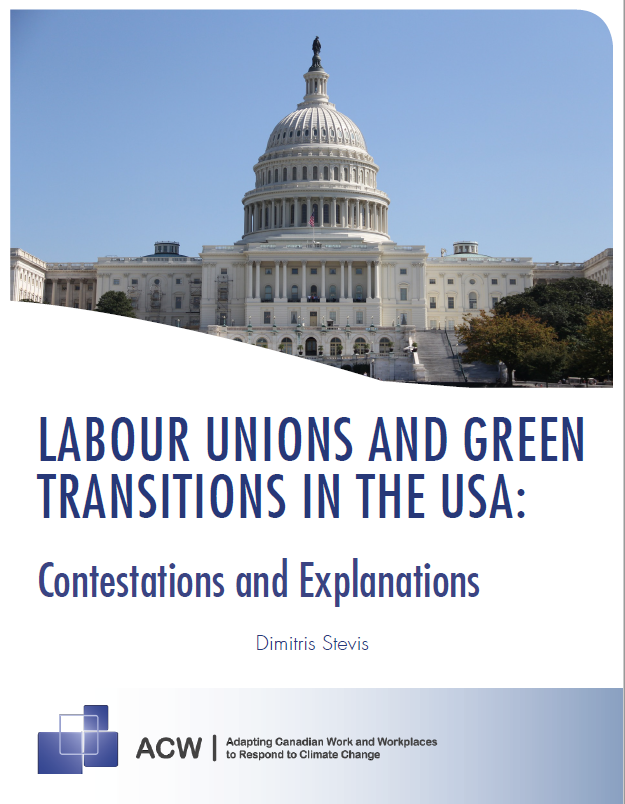
Labor Unions and Green Transitions in the USA

By Dimitris Stevis - Adapting Canadian Work and Workplaces to Respond to Climate Change, February 27, 2019

“In broad terms there are now two camps amongst US labour unions with respect to climate change and renewables (the two not always related). On one side, are those unions that believe that something needs to be done about climate change and that renewables are a good strategy. On the other side are those that are opposed to meaningful climate policy –even as they claim that climate change is a problem.”

This report outlines the deep cleavages with respect to climate policy but also argues that the views of unions are more complex and contradictory than the opposition-support dichotomy. Additionally, it seeks to understand what explains the variability in union responses to climate change and policy. What can account for the contradictions evident amongst and within unions?

Read the report (PDF).

Trump’s solar tariffs may impact solar jobs worldwide

By Elizabeth Perry - Work and Climate Change Report, February 4, 2018

Donald Trump’s decision to impose tariffs on solar panels and washing machines on January 23  was roundly criticized on many grounds – most frequently, the impact on jobs in the solar industry, as stated in the  New York Times Editorial on January 23 ,“Mr. Trump’s Tariffs will not bring back manufacturing jobs”.   The Times supported their opinion with several articles, including  “Trump’s Solar Tariffs are clouding the industry’s future” (Jan. 23) , which states: “Far more workers are employed in areas that underpin the use of solar technology, such as making steel racks that angle the panels toward the sun. And the bulk of workers in the solar industry install and maintain the projects, a process that is labor-intensive and hard to automate.” The Solar Energy Industries Association in the U.S. response is here, and their Fact Sheet (Feb. 2)  explains the terms and impact of the decision.  CleanTechnica summarized a  study by GTM Research, which forecasts that the utility-scale segment of the solar industry will be hardest hit, beginning in 2019.  For a thorough overview, see the Fact Checker article by the Washington Post,  “Trump says solar tariff will create ‘a lot of jobs.’ But it could wipe out many more” (Jan. 29).

For a deeper look at the possible implications for other countries, including Canada, consider the complexity of global trade:  From an excellent overview in  The Energy Mix: “Trump Solar Tariff may be opening salvo in trade war”: “Although China appeared to be Trump’s intended target, the tariff on solar cells and panels will mostly hit workers in other countries. Thanks to dispersed supply chains—and partly in response to previous U.S. tariffs—solar photovoltaic manufacturing is a global industry. Malaysia, South Korea, and Vietnam all hold a larger share of the U.S. market than China does directly. And all are entitled to seek remedies under various trade agreements.”   The Energy Mix item refers to “U.S. tariffs aimed at China and South Korea hit targets worldwide”    in the New York Times (Jan. 23), which adds:  “Suniva, one of the American solar companies that had sought the tariffs, filed for bankruptcy protection last year, citing the effects of Chinese imports. But the majority owner of Suniva is itself Chinese, and the company’s American bankruptcy trustee supported the trade litigation over the objections of the Chinese owners.” From Reuters,  “Why the US decision on solar panels could hit Europe and Asia hard”  states that Goldman Sachs estimated that the tariffs implied “a 3-7 percent cost increase for utility-scale and residential solar costs, respectively …. Two key exclusions with respect to technology and certain countries (Canada/Singapore, among others) were included as part of the (initial) recommendation.” Canadian Solar , founded in Canada but a multinational traded on NASDAQ,  is one the world’s biggest panel manufacturers.

For an overview of the current state of the U.S. renewable energy markets and labour force, including solar, see  In Demand: Clean Energy, Sustainability and the new American Workforce  (Jan. 2018) , co-authored by Environmental Defense Fund (EDF) and Meister Consultants Group.  Highlights:  there are  4 million clean energy jobs in the U.S., with wind and solar energy jobs outnumbering  coal and gas jobs in 30 states.  Quoting the IRENA Renewable Energy and Jobs Annual Review for 2017 ,  the In Demand report states that: “The solar industry grew 24.5 percent to employ 260,000 workers, adding jobs at nearly 17 times the rate of the overall economy in 2016.”  The coal industry employs 160,000 workers in the U.S.  In Demand  compiles statistics from the U.S. Department of Energy, International Energy Agency, International Renewable Energy Agency (IRENA) and many others, about current and projected clean energy markets and employment in the U.S.: renewable energy, energy efficiency, alternative vehicles, and energy storage and advanced grid sectors.

California’s progressive policies yield better job growth and wage growth than Republican comparators

By Elizabeth Perry - Work and Climate Change Report, January 15, 2018

A November 2017 report from the Labor Center at University of California Berkeley  examined the “California Policy Model” –  defined as a collection of 51 pieces of legislation and policy implementations enacted in California between 2011 and 2016 – and found that with progressive policies such as minimum wage increases, increased access to health insurance, reduction of carbon emissions and higher taxes on the wealthy, the state showed  superior economic  performance  in comparison to Republican-controlled states and to a simulated version of California without such policies.  According to  “California is Working: The Effects of California’s Public Policy on Jobs and the Economy since 2011,  the suite of progressive policies resulted in superior total employment growth , superior private sector employment growth, and higher wage growth for low-wage workers from 2014 to 2016. All the while, keeping the state on track to meet its 2020 GHG emissions targets.  The  environmental policies included in the analysis were: starting in 2006, AB 32, which committed the state to lowering its greenhouse gas emissions to 1990 levels by 2020;  regulations under AB 32 in 2012 and 2013, which introduced the state cap and trade program;  SB 350 in 2015 and 2016,  committing the state to greater use of renewable energy and further improvements in energy efficiency ; and SB 32, which raised the emissions reduction goal to 40 percent below 1990 levels by 2030.  The report warns that  enforcement of labour standards and a lack of affordable housing remain as challenges facing the state, and also admits to possible weakness  regarding the second of its two methods of analysis, the synthetic control statistical method.

Methane regulations: a path to lower emissions and more jobs for Alberta

By Elizabeth Perry - Work and Climate Change Report, August 23, 2017

A July 2017  report by Blue Green Canada,   argues that the Alberta government should implement methane regulations immediately, rather than wait for the proposed federal regulations to take effect in 2023.    Speeding up regulations “could reduce air pollution, achieve our climate targets more cost-effectively, and create thousands of high-paying jobs in a single step”, according to Don’t Delay: Methane Emission Restrictions mean Immediate jobs in Alberta .  Blue Green estimates that Alberta’s oil and gas operations release $67.6 million worth of methane annually, and recovering it for energy use could create more than 1,500 new jobs in the province – well paid jobs,  including work in engineering, manufacturing, surveying, and administration.

The findings of the BlueGreen report are in line with a broader report released by  Environmental Defence in April, which demonstrated that methane emissions are higher than reported by industry: 60% higher in Alberta.  See  Canada’s Methane Gas Problem: Why strong regulations can reduce pollution, protect health and save money   at the Environmental Defence website. Research funded by the David Suzuki Foundation, and released in April,  found that methane emissions in B.C. are 250% higher than reported.   The Cost of Managing Methane Emissions,  a June blog from the Pembina Institute, also sheds light on the GHG savings to be had by instituting regulations. The political slant is covered in “ Trudeau must hold the line on Canada’s new methane rules”   by Ed Whittingham and   Diane Regas, in the Globe and Mail (June 11) .   A July article in Energy Mix summarizes the battle in the U.S., as the courts push back on the  Trump administration efforts to weaken the Obama-era methane regulations.

Do electric vehicles create good green jobs? An Amnesty International report on Supply Chains says No

By Elizabeth Perry - Work and Climate Change Report, November 27, 2017

November brought  exciting news about electric vehicles:  BYD,  one of China’s leading electric carmakers, announced that it will open an assembly plant in a yet-to-be-announced location in Ontario in 2018, (though according to the Globe and Mail article,   the new plant will only create about 40 jobs to start ).  Also in mid-November, Tesla revealed a concept design for  an  electric truck in an glitzy release by Elon Musk , and the Toronto Transit Commission announced its plan to buy its first electric buses, aiming for an  emissions-free fleet by 2040.    Unnoticed in the enthusiasm for these announcements was a report released by Amnesty International on November 15:    Time to Recharge: Corporate action and inaction to tackle abuses in the cobalt supply chain  which concludes : “ Major electronics and electric vehicle companies are still not doing enough to stop human rights abuses entering their cobalt supply chains, almost two years after an Amnesty International investigation exposed how batteries used in their products could be linked to child labour in the Democratic Republic of Congo (DRC).” (That earlier report was This is what we die for   released in January 2016) .

Under the heading “The Darker side of Green Technology”, Time to Recharge states: “Renault and Daimler performed particularly badly, failing to meet even minimal international standards for disclosure and due diligence, leaving major blind spots in their supply chains. BMW did the best among the electric vehicle manufacturers surveyed.”   Tesla was also surveyed and ranked for its human rights and supply chain management; Tesla’s policies are described in its response to Amnesty International here.  And further, Tesla has come in for suggestions of  anti-union attitudes  in “Critics Suggest Link to Union Drive After Tesla Fires 700+ Workers” , in  The Energy Mix (Oct. 23), and in an article in Cleantechnica  .

The Amnesty International report is a result of a survey of 29 companies, including consumer electronics giants Apple, Samsung Electronics, Dell, Lenovo, and Microsoft, as well as electric vehicle manufacturers BMW, Renault and Tesla.  Questions in the survey were based on the five-step due diligence framework set out by the Organization for Economic Co-operation and Development (OECD) in its Due Diligence Guidance for Responsible Supply Chains of Minerals from Conflict-Affected and High-Risk Areas.  Detailed responses from many of the surveyed companies are here. 

Just Transition for the coal industry is expensive – but cheaper than failure to address the needs

By Elizabeth Perry - Work and Climate Change Report, September 5, 2017

July 2017 saw the release of  Lessons from Previous Coal Transitions:  High-level Summary for Decision-makers , a synthesis report of case studies of past coal mining transitions in Spain, U.K., the Netherlands, Poland, U.S., and the Czech Republic – some as far back as the 1970’s.  Some key take-aways from the report:  “Because of the large scale and complexity of the challenges to be addressed, the earlier that actors (i.e. workers, companies and regions) anticipated, accepted and began to implement steps to prepare and cushion the shock of the transition, the better the results”; “the aggregate social costs to the state of a failure to invest in the transition of workers and regions are often much higher that the costs of not investing from an overall societal perspective.” While the level of cost details varies in the case studies, it is clear that costs are significant.  For example, the case study of Limburg, Netherlands states that the national government spent approximately 11.6 billion Euros (in today’s prices) on national subsidies to support coal prices and regional reconversion, in addition to  several 100 million per year in EU funds. “One estimate also suggested that in the Dutch case, all told, regional reinvestment in new economic activities also cost about 300 to 400 000€/per long-term job created.”  Limburg is also cited as “remarkable for the relatively consensual nature of the transition between unions, company and government.”  (see page 10).

The Synthesis report and individual case study reports of the six countries are available here . These are the work of the Research and Dialogue on Coal Transitions project, a large-scale research project led by Climate Strategies and the Institute for Sustainable Development and International Relations (IDDRI) , which also sponsors the Deep Decarbonization Pathways Project.  Future reports scheduled for 2018: a Global report, and a Round Table on the Future of Coal.

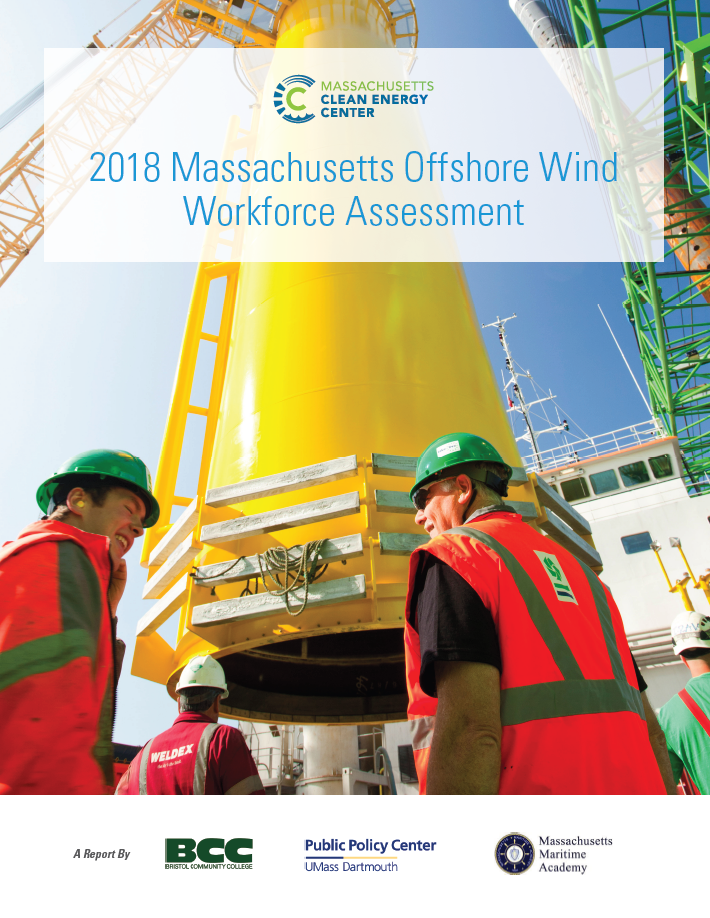
2018 Massachusetts Offshore Wind Workforce Assessment

By Paul Vigeant, et. al. - Massachusetts Clean Energy Center, January 2019

The 2018 Massachusetts Offshore Wind Workforce Assessment provides a comprehensive analysis of the workforce needs and economic development impacts associated with the deployment of 1600 megawatts of offshore wind in Massachusetts. The report describes the jobs associated with planning, constructing and servicing offshore wind projects and provides information on the education, skills and health and safety credentials required for each job. Importantly, the report highlights the opportunities for Massachusetts residents to work in this emerging industry, and identifies recommendations and key strategies to better position the Commonwealth, offshore wind industry, educational institutions, non-profits, and labor to develop and serve a burgeoning offshore wind workforce.

Read the Report (PDF).

Work for a Brighter Future

By staff - International Labour Organization, 2019

New forces are transforming the world of work. The transitions involved call for decisive action.

Countless opportunities lie ahead to improve the quality of working lives, expand choice, close the gender gap, reverse the damages wreaked by global inequality, and much more. Yet none of this will happen by itself. Without decisive action we will be heading into a world that widens existing inequalities and uncertainties.

Technological advances – artificial intelligence, automation and robotics – will create new jobs, but those who lose their jobs in this transition may be the least equipped to seize the new opportunities. Today’s skills will not match the jobs of tomorrow and newly acquired skills may quickly become obsolete. The greening of our economies will create millions of jobs as we adopt sustainable practices and clean technologies but other jobs will disappear as countries scale back their carbon- and resource-intensive industries. Changes in demographics are no less significant. Expanding youth populations in some parts of the world and ageing populations in others may place pressure on labour markets and social security systems, yet in these shifts lie new possibilities to afford care and inclusive, active societies.

We need to seize the opportunities presented by these transforma-tive changes to create a brighter future and deliver economic security, equal opportunity and social justice – and ultimately reinforce the fabric of our societies.

Read the report (Link).

A Vision for a Sustainable Battery Value Chain in 2030: Unlocking the Full Potential to Power Sustainable Development and Climate Change Mitigation

By staff - World Economic Forum, 2019

The need for urgent and more intensive actions against climate change is broadly recognized. In support of this agenda, this report presents a simple yet profound vision: a circular, responsible and just battery value chain is one of the major near- term drivers to realize the 2°C Paris Agreement goal in the transport and power sectors, setting course towards achieving the 1.5°C goal if complemented with other technologies and collaborative efforts.

With the right conditions in place, batteries are a systemic enabler of a major shift to bring transportation and power to greenhouse gas neutrality by coupling both sectors for the first time in history and transforming renewable energy from an alternative source to a reliable base. According to this report, batteries could enable 30% of the required reductions in carbon emissions in the transport and power sectors, provide access to electricity to 600 million people who currently have no access, and create 10 million safe and sustainable jobs around the world.

This report provides a quantified foundation for a vision about how batteries can contribute to sustainable development and climate change mitigation over the coming decade. The analysis underscores that this opportunity can only be achieved sustainably through a systemic approach across social, environmental and economic dimensions. It outlines key conditions and presents recommendations to realize this potential.

Read the report (Link).

Realizing a Just and Equitable Transition Away From Fossil Fuels

By Georgia Piggot, Michael Boyland, Adrian Down, and Andreea Raluca Torre - Stockholm Environment Institute, January 2019

Meeting agreed climate goals requires a rapid decarbonization of the global energy system, which in turn necessitates a reduction in fossil fuel production. While limiting fossil fuel use will likely bring a multitude of societal benefits — related to reduced climate risks, sustainable economic growth, air quality and human health — it is important to recognize that not everyone will benefit equally from a transition to a low-carbon economy. In particular, those who rely on fossil fuel production for their livelihood, or who were anticipating using fossil-fuelled energy to meet development needs, may carry a disproportionate share of the burdens of an energy transition.

The need for a “just transition” to a low-carbon economy — namely, a transition that minimizes disruption for workers and communities reliant on unsustainable industries and energy sources — is gaining traction in climate policy and political discourse. A call for “a just transition of the workforce” was included in the preamble to the Paris Agreement, and the United Nations Framework Convention on Climate Change (UNFCCC) secretariat has prepared a technical paper on transition planning.10 In addition, several national and regional governments have recently announced new transition planning processes, including Canada, Germany, Spain, Scotland, New Zealand, and the European Union.

A central concern of just transition efforts is to ensure that low-carbon transitions address social and economic inequality. The UNFCCC calls for a transition that “contribute(s) to the goals of decent work for all, social inclusion and the eradication of poverty.” Likewise, the European Commission aims to “boost the clean energy transition by bringing more focus on social fairness.” And the Scottish Government is seeking a transition that “promotes inclusive growth, cohesion and equality.”

Key messages:

  • Governments are introducing new “just transitions” policies to help workers and communities move away from fossil fuels.
  • Most policies assume that justice goals will be achieved by helping those dependent on coal, oil and gas move into new roles; however, there is little critical reflection on what justice means in the context of an energy transition away from fossil fuels.
  • There are a number of gaps in current just transition policies when viewed through a justice lens. For example, no policies contain measures to improve the lives of people currently marginalized in the energy system.
  • Creating just and equitable transition policies requires collecting data on the current distribution of the harms and benefits of the energy system, and mapping out how this will change as fossil fuels become a less-prominent part of the energy mix.
  • By taking justice considerations into account, transition policies are more likely to limit social and political resistance, win a broad consensus, and achieve effective implementation.

Read the text (PDF).

Pages

The Fine Print I:

Disclaimer: The views expressed on this site are not the official position of the IWW (or even the IWW’s EUC) unless otherwise indicated and do not necessarily represent the views of anyone but the author’s, nor should it be assumed that any of these authors automatically support the IWW or endorse any of its positions.

Further: the inclusion of a link on our site (other than the link to the main IWW site) does not imply endorsement by or an alliance with the IWW. These sites have been chosen by our members due to their perceived relevance to the IWW EUC and are included here for informational purposes only. If you have any suggestions or comments on any of the links included (or not included) above, please contact us.

The Fine Print II:

Fair Use Notice: The material on this site is provided for educational and informational purposes. It may contain copyrighted material the use of which has not always been specifically authorized by the copyright owner. It is being made available in an effort to advance the understanding of scientific, environmental, economic, social justice and human rights issues etc.

It is believed that this constitutes a 'fair use' of any such copyrighted material as provided for in section 107 of the US Copyright Law. In accordance with Title 17 U.S.C. Section 107, the material on this site is distributed without profit to those who have an interest in using the included information for research and educational purposes. If you wish to use copyrighted material from this site for purposes of your own that go beyond 'fair use', you must obtain permission from the copyright owner. The information on this site does not constitute legal or technical advice.