






You are here
neoliberalism
 The farm crisis is real, as is the climate crisis. Left unchecked, the climate crisis will dramatically deepen the income crisis on Canada’s farms as farmers struggle to deal with continued warming, more intense storms, and increasingly unpredictable weather. It is clear that climate change represents a major challenge to agriculture, but it also represents an opportunity.
 In ways unimaginable just a few years ago, public banking and its potential for catalyzing a transition to a green and just future have been catapulted to the center of political and economic debate. The reason: The greed-driven excesses of Wall Street and global finance that gave rise to the 2008-09 global financial crisis are now continuing to drive today’s global crisis of climate finance.
 The next great challenge for California climate policy lies in the transportation sector. Vehicles account for fully 40% of all greenhouse gas emissions in California, the most of any economic sector in our state, and consistent and significant reductions in vehicle emissions remain elusive.
 Climate politics are today bursting to life like never before. For four decades, market fundamentalists in the United States and United Kingdom have blocked ambitious efforts to deal with the climate crisis. But now, the neoliberal hegemony is crumbling, while popular climate mobilisations grow stronger every month. There has never been a better moment to transform politics and attack the climate emergency.
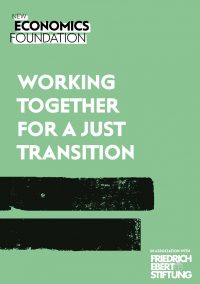 This short pamphlet has been produced to launch the New Economics Foundation’s new programme of work on the 'just transition'. Our interest is in the practicality of change: the policies, processes, narrative and investment needed to accelerate the UK’s progress on 'just transition', here and now. Over the coming months and years we will be working at local and national levels to explore what is needed to build common cause and provide the right mixture of incentives and critical challenge to all parties to help unlock a new momentum for a 'just transition' for the UK.
 Much of the argument advanced in support of expanding Canada’s fossil fuel production centres on job creation and economic benefits. Politicians, pundits and corporate spokespeople who support fossil fuel infrastructure projects—such as new oil and gas pipelines—often evoke this rhetoric when they appear in the media.
The Fine Print I:
Disclaimer: The views expressed on this site are not the official position of the IWW (or even the IWW’s EUC) unless otherwise indicated and do not necessarily represent the views of anyone but the author’s, nor should it be assumed that any of these authors automatically support the IWW or endorse any of its positions.
Further: the inclusion of a link on our site (other than the link to the main IWW site) does not imply endorsement by or an alliance with the IWW. These sites have been chosen by our members due to their perceived relevance to the IWW EUC and are included here for informational purposes only. If you have any suggestions or comments on any of the links included (or not included) above, please contact us.
The Fine Print II:
Fair Use Notice: The material on this site is provided for educational and informational purposes. It may contain copyrighted material the use of which has not always been specifically authorized by the copyright owner. It is being made available in an effort to advance the understanding of scientific, environmental, economic, social justice and human rights issues etc.
It is believed that this constitutes a 'fair use' of any such copyrighted material as provided for in section 107 of the US Copyright Law. In accordance with Title 17 U.S.C. Section 107, the material on this site is distributed without profit to those who have an interest in using the included information for research and educational purposes. If you wish to use copyrighted material from this site for purposes of your own that go beyond 'fair use', you must obtain permission from the copyright owner. The information on this site does not constitute legal or technical advice.
 This site is not the official webpage of the Industrial Workers of the World.