






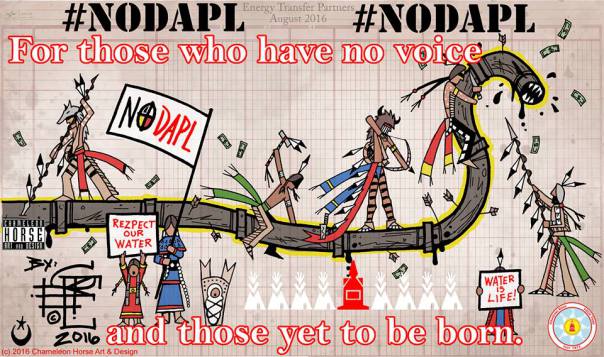
 As the eve of the 2016 US presidential election draws nearer, and the world inches ever-closer to the edge of their seats, wondering who the winner will be to lay claim to the world’s most powerful seat for committing acts of good or evil, there is yet another David & Goliath story unfolding. It’s yet one more spin on the same old story that has been told in America for eons; a story that pits ‘The People’, who seek to do good for the planet, against ‘The Powerful’ who desire to pursue the same pathways of evil that continues to destroy the people and earth alike. This time the ‘David’ in this epic clash is the Standing Rock Sioux & The Great Sioux Nation, and the ‘Goliath’ is America’s Military forces in the guise of North Dakota’s Department of Homeland Security, its National Guard troops and a host of law enforcement agencies. The other ‘Goliath’ is Energy Transfer Partners and a host of Wall Street speculators, investors and worldwide banking interests who, collectively, could be likened to General Custer and his 7th Cavalry regiment of another time and place in Sioux Territory.
To fully understand what the conflict between the Standing Rock Sioux and Dakota Access Pipeline represents in the bigger scheme of things one has to know something about the history of the Sioux people and their relationship to America’s military-corporate powers. This latest epic invasion in the 21st century of the Great Sioux Nation’s territory in North Dakota isn’t anything new under the sun. It’s but the latest episode in a centuries-old saga of American military and corporate might operating in tandem, hand-in-glove, to constantly dispossess the Sioux and other Native American Nations of their homelands and all its natural, cultural and sacred resources.
Starting in the early 19th century there were the incursions into Sioux territory by American fur companies that sought to strip from the land, as much as they could, all its precious fur-bearing animals for Wall Street’s profiteers in the East; ever since, the homelands of the Sioux has been a non-stop scene of one epic clash after another between those who want to preserve the land and its natural resources and those who want to rape and pillage it.
This epic clash started in earnest in the mid-19th century with the westward movement of immigrants and refugees from the East. What started as a trickle quickly turned into a horde-like swarm of locusts. This epic struggle continued on with the building of wagon roads and railroads by one corporate enterprise after another across Sioux lands.
It really kicked into high gear when General George Armstrong Custer and his 7th Cavalry regiment undertook their Black Hills Expedition in 1874 in search of gold, in defiance of the terms of the Treaty of Laramie of 1868 between the U.S. Government and Sioux Nation that legally granted to the Sioux the lands and natural resources of the Black Hills, and specifically forbade trespass by non-Indians. Custer and his troop’s illegal incursions ultimately led to the gold rush that decimated the Sioux’s sacred Paha Sapa (Black Hills) and stripped it of all its precious minerals, timber and water resources under the protection of General Custer and his troops. This led, as a result, to General Custer engaging the Sioux Nation in a series of battles until he and his 7th Cavalry regiment were finally annihilated by the Sioux at the Battle of the Little Big Horn.
General George Crook picked up where Custer left off and continued America’s relentless military-corporate war against the Sioux’s Chief Crazy Horse at the Battle of the Rosebud and Battle of Slim Butte. Following the murder of Chief Sitting Bull on the Standing Rock Agency where he lived, Chief Spotted Elk (also known as Chief Big Foot) fled with his band of Minniconjou and Hunkpapa allies before they were eventually caught by a remnant detachment of the 7th Cavalry who massacred them at Wounded Knee, in reprisal for Custer’s defeat, for which many received the Congressional Medal of Honor.
Like the modern-day treatment of the Palestinians in Gaza by the Israelis, the survivors of the Great Sioux Nation were all forced onto open-air prisons by America’s military-corporate powers who later more politely rebranded these prisons as Reservations. Canadian military-corporate powers did the same thing to their First Nation people with the only difference being that they used a copycat derivative to brand their open-air prisons as Reserves.
This thumbnail sketch of the horrific history of the relationship between the Sioux Nation and U.S. military and corporate forces is a sordid one that must be understood in order to properly comprehend and gauge the significance of today’s clash between the Standing Rock Sioux and the Dakota Access Pipeline and how it fits into the bigger historical picture.


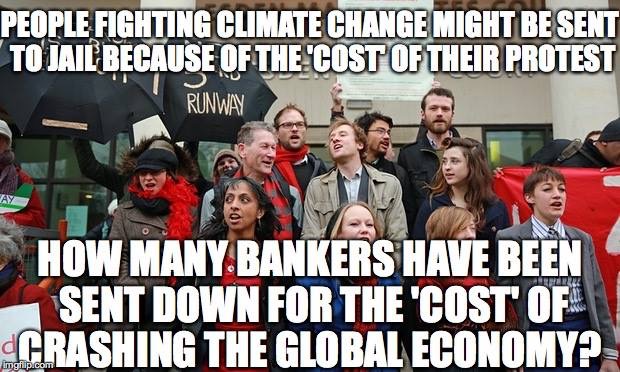 Hundreds of activists stage ‘die-in’ and disruptive ‘critical mass’ bike ride at Heathrow to protest aviation expansion and highlight injustice of climate change impacts.
 A growing number of eco-social certifications are available on food products at a variety of retail locations. These certifications cover a range of environmental and social values and include claims like fair trade, humane, and environmentally friendly. As the historically invisible contribution of farmworkers in the agriculture system gains more attention, so too do the dangerous, often unsanitary conditions and low pay of farm labor. In recent years, eco- social certifications claiming to benefit farmworkers have emerged in response to this growing recognition. This has coincided with the decreasing prominence of and membership in labor unions, the traditional tool for addressing labor issues. The emergence of farmworker labels has also coincided, especially in the U.S., with the surge of wage victoriesat the state and local level, led by the Fight for $15 labor activists. Political advocacy, collective bargaining through worker associations, and social certifications can serve to reinforce each other to achieve the broad goals of fair pay and decent working conditions. This report looks at the role that certification can play and compares seven certification schemes.
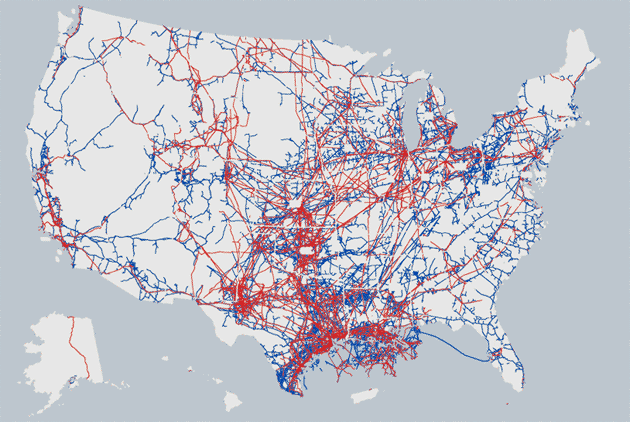
 Repairing the US nation’s aging natural gas pipelines has the potential to create and support quality, family-sustaining jobs and drive billions in investment. The BlueGreen Alliance’s RECAP campaign was developed to accelerate the repair and replacement of this network to create hundreds of thousands additional jobs while addressing the urgent threat of climate change.
 Just months after becoming president of the United States, Barack Obama met with some of the world's most powerful executives.
 The American Federation of Labor and Congress of Industrial Organizations (AFL-CIO) came out this week in support of the Dakota Access Pipeline, the construction of which was
  This site is not the official webpage of the Industrial Workers of the World.