You are here

green unionism

The Chevron Way: Polluting California and Degrading California

By various - International Transport Federation, et. al., November 2016

In the recent election, Chevron-backed campaigns lost bigtime, despite the $61 million the company has spent to influence California elections since 2009. That’s far more than any other oil company spend in state elections. The report, by the International Transport Workers Federation, was released Nov. 17 at the Chevron gates by a coalition including the Richmond Progressive Alliance (RPA), Alliance of Californians for Community Empowerment (ACCE), Communities for a Better Environment (CBE), and more.

Members of the coalition said the report, The Chevron Way: Polluting California and Degrading Democracy, will educate the public about the corrupting influence of corporate money and alert politicians that they will be judged on whether they act in the public interest or in Chevron’s interest.

In this election, in State Assembly and State Senate races, candidates heavily backed by Chevron lost. In Monterey County, Chevron spent $1.5 to oppose a ballot measure to ban fracking and expanded oil drilling. Despite being outspent 33 to 1, the measure passed.

In Richmond, Chevron sat out this election, having spent $3 million in the last election, when its candidates lost anyway. This year, two additional progressive candidates won seats on the city council and a longstanding Chevron candidate was voted out.

Chevron makes billions in profits from its huge retail and refining business in California, but has aggressively cut tax payments to federal, state and local governments. In 2015, the company paid no net income tax in the US, but instead banked nearly $1.7 billion in tax credits.

In 2015, Chevron had over $45 billion stashed in offshore accounts, including the company’s 211 active Bermuda subsidiaries, and the company’s global effective tax rate fell to below 3%.

Read the report (PDF).

Sharing the challenges and opportunities of a clean energy economy: Policy discussion paper A Just Transition for coal-fired electricity sector workers and communities

By staff - Australian Council of Trade Unions - November 2016

The ACTU is primarily concerned with workers, their rights, their welfare and their future. A just and civil society is one where everyone shares in the wealth of the nation but it is also one where economic costs are equally shared.

Transitioning an industry is a massive economic and social disruption. History shows that this has often been done poorly in Australia, with workers and communities bearing the brunt of such transitions - suffering hardship, unemployment and generations of economic and social depression.

Research in the textiles, clothing and footwear (TCF) and car manufacturing industries shows, for example, that only one third of workers find equivalent full time work following their retrenchment, while one third move into lower quality jobs (lower wage, lower job status or into part-time and casual work) and one third are locked out of the labour force altogether.

International experience however shows that a transition can be done equitably, achieve positive outcomes for workers, save communities and forge new areas of industrial growth and prosperity.

Australia is currently facing one such transition in the coal-fired electricity sector. If Australia manages this transition well, the nation would have a structured and equitable approach that could apply to any industry undergoing similar change in the future.

At last year’s Paris climate conference, Australia alongside 194 countries, committed to limit global warming to less than 2°C above pre-industrial levels. As part of this historic agreement, unions successfully achieved recognition of the need for a ‘Just Transition’ that supports the most affected workers obtain new decent and secure jobs in a clean energy economy.

While Australia’s international obligations will require a range of complementary policies that focus on emission reduction across a number of sectors of the economy, as the largest contributor to Australia’s emissions, effective reform of the electricity sector has been identified as a key step in tackling climate change.

Download (PDF).

Rank-and-File Union Members Speak Out at Standing Rock Camp

By staff - Indian Country Today, October 30, 2016

Image by Karen Pomer

Despite escalating police violenceand AFL-CIO leadershipof pipeline, a delegation of union members from around the U.S. are spending the weekend of October 29 at Standing Rock camp to join Sioux water protectors against Dakota Access Pipeline (DAPL.)

The delegation from Labor For Standing Rock(LSR), comprised of rank-and-file union members and working people.

Liam Cain,Union Laborer at LIUNA Local 1271 Cheyenne, WYand a LSR spokesperson, over years worked on numerous heavy construction sites and pipeline construction spreads. "To the union laborers working on these projects I would just implore you to listen to what regular folks are saying," Cain said. "Don't just listen to the bosses, and not to just the echo-chambers on the spread.

"Listen to the water protectors, listen to folks talking about just transition, a view of the future, involving good paying union jobs, involving many of your skill-sets. Just generating energy in a much more environmentally sustainable manner, rather than just gross over reliance on fossil fuels, that we currently engage in. As the saying goes, 'there's no jobs on a dead planet'."

Cliff Willmengis a registered nurse with UFCW Local 7, and former member of United Brotherhood of Carpenters Local 1 in Chicago. He is a leader in Colorado fight against fracking, a rank-and-file labor activist and organizer for the Colorado Community Rights Amendment. Cliff’s work against the oil and gas industry made national headlines when Lafayette, Colorado banned frackingin 2013. He and his daughter Sasha delivered water tanks to Standing Rock Camp after authorities removed the water supply in August.

“As a healthcare provider, as a father of two, and as a union member I will be heading up to Standing Rock,” said Willmeng, union member and a co-founder of LSR. "We will be supporting the First Nations fight against the Dakota Access Pipeline, to protect the environment for my kids, and as a rejection of the decision of the AFL-CIO support the pipeline."

Michael Letwinis former President of the Association of Legal Aid Attorneys/UAW Local 2325in New York City, and Co-Convener of Labor for Palestine, whose online petitionin opposition to DAPL has garnered more than 12,000 signers and helped lay the basis for Labor for Standing Rock. In 1973, at age 16, he and others were arrested by the Nixon-era FBI under the Rap Brown Actfor participating in a relief caravanto the American Indian Movement occupation at Wounded Knee.

"Escalating police attacks against unarmed water protectors at Standing Rock on behalf of the oil and gas industry evokes images of Wounded Knee in 1890 and 1973, brutality against the civil rights movement, and state violence today from Ferguson and Baltimore to Palestine," Letwin said. "The labor movement has faced similar violence throughout its history, and from the same forces of greed and injustice."

Labor For Standing Rockwas created by rank-and-file workers and union members to mobilize growing labor support for the First Nation's fight against the Dakota Access Pipeline.

The response from working people around the country has been nothing short of staggering. It is clear that the labor movement is no longer content to sit aside while Native American sovereignty is violated, and while land and water are risked. No oil company profits are more important than our rights and environment.

"We at Oceti Sakowin Campwelcome any and all support from our Union brothers and sisters," said Standing Rock Council in an October 13 message to Labor for Standing Rock. "This camp stands to protect our sacred water and support a new energy paradigm, jobs and work in green energy fields. We welcome your support in any ways you feel appropriate, join us in paving a new road to a sustainable future for many future generations."

VIDEO from this weekend here. Photos here.

Standing Rock Water-Protectors Waterboarded While the Cleveland Indians Romped

By Paul Street - CounterPunch, October 28, 2016

Three nights ago, 19.37 million television viewers watched the opening game of North American professional baseball’s so-called World Series pitting the Chicago Cubs against the Cleveland Indians (the latter team won 6-0). I made it through the second inning before I had to switch to radio out of disgust at the Indians’ jersey and ball-cap team logo – a wild grinning Native American caricature best understood as a modern-day Red Sambo. It’s bad enough that the Cleveland team retains (well into the 21st century) the name “the Indians.” First Nations people (the Canadian term) in the United States are more properly called Native or Indigenous Americans – not a name imposed on them by white conquerors who mistakenly thought they’d “discovered” “the Indes.

But the logo is really beyond the pale. Imagine a team called “The Baltimore Blacks” or “The New Jersey Negroes,” with a ball-cap showing a racist caricature of a “Black Sambo.”   Or imagine a German football (soccer) team named the “Buchenwald Semites” – or an Austrian team named the “Vienna Hebrews” – with a jersey bearing the crudely exaggerated caricature image of an old stereotypically hook-nosed Jewish man. That would be unthinkable in Holocaust-haunted Germany, of course.

Native Americans suffered their own Holocaust on the lands that were swallowed up as the United States. By some estimates more than 15 million First Nations people inhabited North America (most of them on land later seized as U.S. territory) before Columbus. Thanks to white-imposed disease, displacement, eco-cide, and murder, the number of “Indians” alive in the United States fell to less than 250,000 by 1890. But team names bearing images and/or names of Indigenous people who experienced genocide – the Washington Redskins (yes, “redskins,” which the Black comic Chris Rock once analogized to naming a team “The New York Niggers”), the Cleveland Indians, the Atlanta Braves, the Chicago Blackhawks (named after a famous Sauk Nation warrior whose tribe members were butchered en masse by Andrew Jackson’s U.S. Army), the Kansas City Chiefs, the Fighting Illini, the Florida State Seminoles, etc. – live on with impunity in the U.S.

Meanwhile, up in the northern Great Plains, predominantly white and heavily militarized local and state police are attacking the civil rights and bodies of Indigenous people fighting heroically to help humanity (including the mostly white folks watching the World Series) avert environmental catastrophe. The remarkable prayer, protest, and resistance camp set up by North Dakota’s Standing Rock Sioux tribe is dedicated to blocking Energy Transfer Partner’s eco-cidal Dakota Access Pipeline (DAPL). The pipeline is a “giant black snake” being laid to carry 470,000 barrels of hydraulically fractured (fracked) crude oil daily from the North Dakota Bakken oil field under and near the Missouri River (under twice), the Mississippi (under once), and numerous other streams, lakes, rivers, and aquifers.

Nurses Condemn Attacks on Water Protectors Opposing the Dakota Access Pipeline Project

By staff - National Nurses United, October 27, 2016

National Nurses United today sharply condemned police and armed guard attacks on members of the Standing Rock Sioux Tribe, other First Nations, environmental activists, and other protectors who have bravely participated in protests against the Dakota Access pipeline project.

Reports of police using pepper spray, military grade equipment, and other military style tactics follow physical attacks on protesters by armed security guards who have who have used dogs in ways reminiscent of assaults on peaceful protesters during the Civil Rights movement, as well as arrests of media covering the protests.

“This has become a seminal battle over the First Amendment protection of public protest. It is also a challenge for everyone who is concerned about the rights of First Nation people and their sacred sites and water sources, as well as the threat the pipeline poses to environmental degradation, public health, and to accelerating the climate crisis,” said NNU Co-President Jean Ross, RN.

NNU, through its Registered Nurse Response Network, a national network of volunteer RNs, has deployed nurse volunteers to assist with first aid needs for the land and water protectors. NNU remains committed to continuing that program in support of the DAPL protests as needed, said Ross.

“We are proud of those who are raising their voices for all of us. We are gratified to see the many public figures, including Sen. Bernie Sanders, who have stood with the Standing Rock Sioux and other protectors, as well as our union brothers and sisters in the Communications Workers of America, Amalgamated Transit Union, American Postal Workers Union, and Service Employees International Union who have also expressed solidarity for this historic fight,” Ross added.

NNU voiced its support for the protectors in early September, and also challenged claims that pipelines are a way to ensure safety of the transport of dirty, polluting crude oil.

“Contrary to claims of supporters, pipeline transportation of this volatile oil is far from safe. We have already witnessed many examples of pipeline spills from ruptured pipelines that have contaminated water supplies and led to numerous problems of respiratory ailments and other health symptoms associated with the spills,” Ross said.

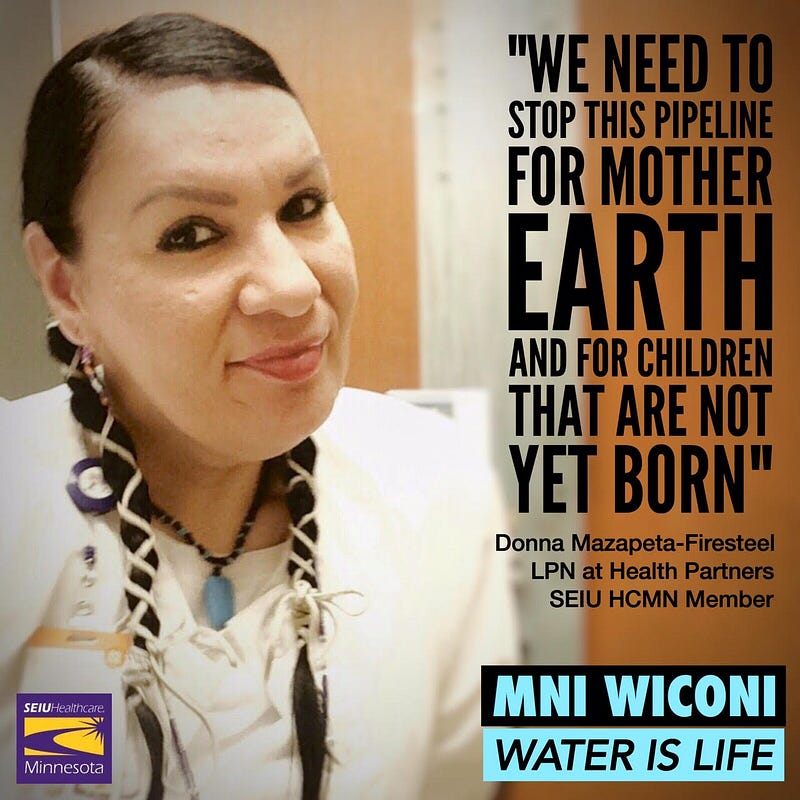
We can have good jobs and healthy communities

By SEIU Healthcare Minnesota’s Indian Healthcare Board* - Medium, October 28, 2016

In too many communities across our country, children and families suffer from exorbitant asthma rates and other respiratory ailments from air pollution caused by corporate activities that burn fossil fuels and contaminate our air. Toxins leeched into our drinking and bathing water from this same fossil fuel industry causes serious skin, digestive, and even cancerous impacts on young and old alike. As healthcare workers, we stand on the front lines of trying to help families deal with these life-altering impacts.

Our families and children deserve clean air and water and we must do all that we can to stop allowing corporations to corrupt our livelihood unchecked. Where possible, we must choose clean alternative options so that our economy and our families can thrive. It is not a one or the other choice. We can have good jobs and healthy communities by shifting away from an economy dependent on fossil fuels to one that creates jobs for workers through a just transition to a clean energy economy.

We can and must be the change we want to see in the world and we have the chance to do it right now. In North and South Dakota, construction of a crude-oil pipeline, known as the Dakota Access Pipeline, threatens the lives and livelihoods of the people of the Standing Rock Sioux Tribe. The pipeline would pass under the Missouri River (at Lake Oahe) which is just half a mile upstream from the boundary of the Standing Rock Sioux’s reservation and provides their drinking water.

Over the last three years there have been over 200 known pipeline leaks in the United States. A spill at this site would be a health, economic and cultural catastrophe for Standing Rock Sioux families. Further, the pipeline would pass through incredibly precious culturally significant sacred lands, like burial grounds, for the tribe and infringe on their freedom to practice and protect their culture and beliefs.

We are so proud that our union, the Service Employees International Union, along with other labor unions, didn’t stand idly by and let this injustice prevail. Instead SEIU along with like-minded good jobs and justice-focused partners have stood strong with the Standing Rock Sioux tribe.

Not only do the Standing Rock Sioux deserve the respect and protection of their sacred grounds, but they deserve to know the water they are drinking is uncontaminated and safe. This is yet another instance where a low income, community of color is subjected to contamination at the hands of powerful corporations and an unresponsive government. It’s a scenario that’s all too familiar to SEIU members, having struggled through the water crisis in Flint, MI and the recent flooding in Baton Rouge.

We stand with our union and the people of the Standing Rock Sioux tribe, as well as the thousands of others who could be harmed by the construction of the pipeline. As energy technology and transportation infrastructures change to reduce harmful emissions, so should the focus of the unions that fight for a better future for all families. We can let go of environmentally and racially unjust practices and look to create the good jobs and safe communities of the future.

From asthma to cancer, America’s workers suffer at the hands of big polluters. We have a choice. We can find a solution that protects people’s health and good jobs and wages. The time is now. Our government must stop the construction of the Dakota Access Pipeline, protect the interests of the Standing Rock Sioux Tribe and transition the jobs of those whose lives and livelihoods could be impacted by ending this pipeline to good family-sustaining jobs of the future.

Berkeley Protest of Arrests at Standing Rock

Rank-and-File Union Members Join Standing Rock Camp, As Crackdown on Opponents of Pipeline Escalates

By Micheal Letwin and Cliff Willmeng - Labor for Standing Rock, October 27, 2016

Editor's note: IWW Environmental Unionism Caucus cofounder, Steve Ongerth, is also a cofounder of Labor for Standing Rock.

On Saturday, October 29 at 10 AM, union members and supporters are assembling at Standing Rock Union Camp, north of Cannonball, North Dakota. Despite escalating police violence and AFL-CIO leadership support of the Dakota Access Pipeline, pipeline, a delegation of union members from around the U.S. are, at this moment, assembling with signs and banners for a labor procession at Standing Rock camp to join Sioux Water Protectors against Dakota Access Pipeline (DAPL.) The procession will be followed by a lunchtime organizing meeting, and by afternoon outreach to pipeline workers, by a delegation from Labor For Standing Rock, comprised of rank-and-file union members and working people.

This effort is being spearheaded by Labor for Standing Rock co-founders Michael Letwin and Cliff Willmeng. Letwin, a former President of the Association of Legal Aid Attorneys/UAW Local 2325 in New York City, and Co-Convener of Labor for Palestine, whose online petition in opposition to DAPL has garnered more than 12,000 signers and helped lay the basis for Labor for Standing Rock. In 1973, at age sixteen, he and others were by the Nixon-era FBI under the Rap Brown Act for participating in a relief caravan to the American Indian Movement occupation at Wounded Knee. Willmeng is a registered nurse with UFCW Local 7, and former member of United Brotherhood of Carpenters Local 1 in Chicago. He is a leader in Colorado fight against fracking, a rank-and-file labor activist and organizer for the Colorado Community Rights Amendment. Cliff’s work against the oil and gas industry made national headlines when Lafayette, Colorado banned fracking in 2013. He and his daughter Sasha delivered water tanks to Standing Rock Camp after authorities removed the water supply in August.

Labor For Standing Rock was created by rank-and-file workers and union members to mobilize growing labor support for the First Nation's fight against the Dakota Access Pipeline.

The response from working people around the country has been nothing short of staggering. It is clear that the labor movement is no longer content to sit aside while Native American sovereignty is violated, and while land and water are risked. No oil company profits are more important than our rights and environment.

"As a healthcare provider, as a father of two, and as a union member I will be heading up to Standing Rock, said Cliff Willmeng, union member and a co-founder of Labor for Standing Rock. "We will be supporting the First Nations fight against the Dakota access pipeline, to protect the environment for my kids, and as a rejection of the decision of the AFL-CIO support the pipeline."

"Workers' rights are inseparable from indigenous rights, said Michael Letwin, union member and a co-founder of Labor for Standing Rock. "We need decent union jobs that protect, rather than destroy, the Earth -- there are no jobs on a dead planet."

"We at Oceti Sakowin Camp welcome any and all support from our Union brothers and sisters," said Standing Rock Council in an October 13 message to Labor for Standing Rock. "This camp stands to protect our sacred water and support a new energy paradigm, jobs and work in green energy fields. We welcome your support in any ways you feel appropriate, join us in paving a new road to a sustainable future for many future generations."

Labor for Standing Rock and Union Camp are being hosted by Red Warrior Camp, which is made up of Dakota and Lakota people residing within the original Sacred Stone spirit camp on the Standing Rock Sioux Reservation.

Labor For Standing Rock Announces Union Camp

By Cliff Willmeng, Michael Letwin, and Steve Ongerth - Labor for Standing Rock, October 28, 2016

October 29-30, 2016: Labor Mobilization in Support of Standing Rock, First Nations, in Opposition to the Dakota Access Pipeline

“We at Oceti Sakowin Camp welcome any and all support from our Union brothers and sisters. This camp stands to protect our sacred water and support a new energy paradigm, jobs and work in green energy fields. We welcome your support in any ways you feel appropriate, join us in paving a new road to a sustainable future for many future generations.”

--Message from Standing Rock Council to Labor for Standing Rock, 10/13/26.

In response to calls from Standing Rock, please join a coordinated labor mobilization on the weekend of October 29-30!

For more details, download this pamphlet (PDF).

Also, please donate to this campaign.

New gas drilling sparks fracking showdown in the UK

By Martin Watters - Equal Times, October 26, 2016

A showdown looms over fracking in the UK after a landmark ruling opened the door to the first drilling in five years.

Controversial shale gas projects at several sites in the north of England have received government support, sparking protests from communities, activists and workers.

Earlier this month, the UK government overruled a local council’s decision to block oil and gas company Cuadrilla Resources from test drilling in Lancashire.

Opponents of the controversial practice – whereby shale gas is extracted by pumping chemical-filled liquids deep underground using hydraulic fracturing, or “fracking” – said it could result in water contamination and a higher risk of workplace injuries and deaths from accidents and explosions.

Fracking across England was suspended in 2011 after Cuadrilla admitted its drilling activities at a site near Blackpool caused minor earthquakes. The moratorium was lifted in 2012, but since then many drilling applications have been rejected by local councillors or delayed by legal appeals. Moratoria remain in Scotland and Wales, while fracking is banned in Northern Ireland.

The decision by Communities Secretary Sajid Javid to overrule Lancashire council will allow Cuadrilla to drill the first horizontal wells in Britain, despite more than 18,000 objections from local people.

Echoing the former prime minister David Cameron, who said that the government was “going all out for shale”, Javid pledged: “We will take the big decisions that matter to the future of our country as we build an economy that works for everyone, not just the privileged few.”

Cuadrilla’s chief executive Francis Egan sent a strong message to other shale gas companies struggling to convince communities and local councils.

“No doubt other people will be putting forward planning applications and this does demonstrate that they can and should be approved,” Egan said.

A week after the UK’s Labour Party vowed to ban all fracking if it came to power, the Shadow Minister for Energy Barry Gardiner said the decision “bulldozed” community wishes and risked locking Britain into old-fashioned fossil fuel energy.

“Cuadrilla’s own figures on jobs show they would be very temporary, and their claims that fracking will lower British energy bills have been discredited,” Gardiner said in a press statement.

Thousands of community objections were also swept aside earlier this year in May when North Yorkshire council approved fracking near Ryedale by the UK firm Third Energy.

Ninety-seven per cent of the fracking company is owned by multinational banking giant Barclays and this week activists are organising a series of protests targeting the bank for its involvement in fracking.

Meanwhile, the multinational petrochemical giant Ineos is planning 30 new drilling projects in the next 12 months with five mooted before Christmas. Ineos has faced criticism for planning to dump fracking wastewater in the sea and banning morning tea breaks for workers at its Scottish plant.

With more fracking on the horizon – and further petitions, marches and legal appeals almost exhausted – environmental protestors across the UK are calling for an “escalation in direct action tactics”.

Pages

The Fine Print I:

Disclaimer: The views expressed on this site are not the official position of the IWW (or even the IWW’s EUC) unless otherwise indicated and do not necessarily represent the views of anyone but the author’s, nor should it be assumed that any of these authors automatically support the IWW or endorse any of its positions.

Further: the inclusion of a link on our site (other than the link to the main IWW site) does not imply endorsement by or an alliance with the IWW. These sites have been chosen by our members due to their perceived relevance to the IWW EUC and are included here for informational purposes only. If you have any suggestions or comments on any of the links included (or not included) above, please contact us.

The Fine Print II:

Fair Use Notice: The material on this site is provided for educational and informational purposes. It may contain copyrighted material the use of which has not always been specifically authorized by the copyright owner. It is being made available in an effort to advance the understanding of scientific, environmental, economic, social justice and human rights issues etc.

It is believed that this constitutes a 'fair use' of any such copyrighted material as provided for in section 107 of the US Copyright Law. In accordance with Title 17 U.S.C. Section 107, the material on this site is distributed without profit to those who have an interest in using the included information for research and educational purposes. If you wish to use copyrighted material from this site for purposes of your own that go beyond 'fair use', you must obtain permission from the copyright owner. The information on this site does not constitute legal or technical advice.