

You are here

renewable energy

Climate-Safe Energy Production–From Below

By Jeremy Brecher - Labor Network for Sustainability, February 2022

Climate-safe energy is being produced locally all over the country in ways that also produce jobs and increase racial, social, and economic justice – fulfilling the basic principles of the Green New Deal.
Protecting the climate requires meeting the original Green New Deal proposal’s goal of 100% of national power generation from renewable sources within ten years.[1] That requires greatly expanding climate-safe sources of energy. It involves an unprecedented transformation of the energy system, and that requires national investment and planning. But much of the transformation will actually be composed of local building blocks – and those can begin right now. Indeed, hundreds of local initiatives around the country, ranging from community solar to municipal ownership to local microgrids, are already expanding renewable energy production.

Sunlight, Jobs, and Justice

Solar gardens are sprouting up all over Denver.

On November 3, 2020, Denver voters overwhelmingly approved Ballot Measure 2A, the Climate Protection Fund, to raise approximately $40 million per year dedicated to climate action. As stated in the ballot measure, the intent of this fund is to “fund programs to eliminate greenhouse gas emissions and air pollution and adapt to climate change. Funding should maximize investments in communities of color, under-resourced communities and communities most vulnerable to climate change.”[2]

Community solar gardens use photovoltaic (PV) panels to produce electricity from sunlight for an entire neighborhood. Now such solar gardens are dotting sites owned and financed by the City of Denver, including rooftops, parking lots, and vacant lands. The power generated from the solar gardens will be shared between city facilities, income-qualified residents, and publicly accessible electric vehicle charging stations.

In accord with the principles of the Green New Deal, Denver’s solar garden program has a strong justice dimension. Since Denver owns the project, it can set its own standards. Ten percent of the energy generated by the solar gardens is allocated to low-income housing through the Denver Housing Authority. An additional 10 percent will be allocated to low-income households through Energy Outreach Colorado, and will be exempt from subscription fees. A paid workforce training program available to Denver residents will provide 10 percent of the city and county’s solar workforce.

The solar gardens are designed to contribute to the goal of Denver’s “80 x 50 Climate Action Plan” to transition Denver to 100 percent renewable electricity for municipal buildings by 2025; achieve 100 percent community-wide renewable electricity by 2030; and reduce Denver’s greenhouse gas emissions 80 percent, as compared to a 2005 baseline, by 2050.[3]

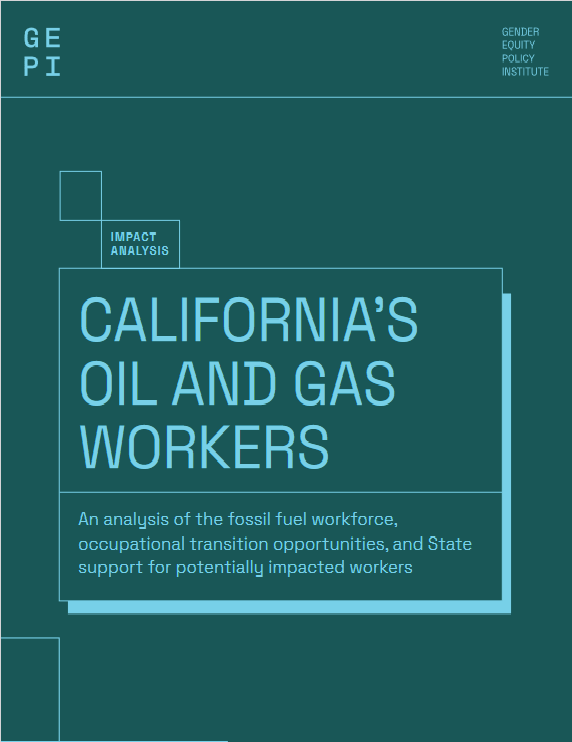
Impact Analysis: California’s Oil and Gas Workers

By Staff - Gender Equity Policy Institute, January 23, 2023

California’s ambitious climate goals, supported by state and federal investment, will create enormous economic opportunity over the coming decades. To meet the 2045 target of carbon neutrality, a 100% clean electric grid, and a 90% reduction in oil consumption and refinery production, the state will need to modernize its electrical grid and build storage capacity to meet increased demand for electricity. Carbon management techniques, plugging orphan wells, and the development of new energy sources such as geothermal will all come into play, providing economic opportunities to workers and businesses alike. Reducing use of polluting fossil fuels will likewise result in significant health benefits to Californians, especially to communities disproportionately burdened by polluting enterprises and proximity to freeways.

Supported by state investment and federal funding through the Infrastructure Investment and Jobs Act and the Inflation Reduction Act, the actions necessary to tackle the challenges of climate change are projected to create 4 million new jobs in the state. California is investing in developing the clean energy workforce, with an equity commitment to recruit and train historically disadvantaged and under- represented communities.

Decarbonizing the economy and accelerating the adoption of clean energy is necessary if we are to preserve a habitable planet. Progress to a carbon neutral future is already well underway in the state. Wind and solar power are less expensive than natural gas or coal powered electricity. A large majority of Californians are concerned about climate change and support action to address its impacts.

However, as with all sectoral economic change, some industries will grow and thrive, while others will shrink, leaving some of their workers behind. Labor unions and trades groups are rightly concerned that workers are not forced to abandon skills developed over their careers and thrown into an inhospitable labor market with no support.

Thus, a key challenge in meeting California’s climate action goals is to devise a fair, equitable, and empirically-based policy to provide support for workers at risk of unemployment and income loss as many factors combine to reduce demand in state for oil and gas products.

Ecosocialism and Degrowth: a Reply

By Simon Butler - Climate and Capitalism, January 6, 2022

David Schwartzman makes some very good points about the ecological benefits of ending militarism. I was also pleased to read his arguments about the strong potential for 100% renewable energy to meet global energy needs, although I cannot judge if his specific calculations about global per-capita energy are correct.

I’m not a degrowther per se. I think the fundamental problem is capital accumulation, of which capitalist growth is a product, but there are some questionable aspects to Schwartzman’s critique.

First, there is a claim about political strategy: that degrowth will appeal only to “the professional class” (I suppose this means middle class/petty bourgeois/intellectuals etc) in the North and would alienate the “global working class.”

That’s a strange formulation because it seems obvious that it’s not the “global” working class that Schwartzman and similar critics are worried about convincing, but the working class in the North who, they fear, will be repelled by a message that emphasises sharing resources with people elsewhere. The degrowth answer to this is that living standards for working people in the North can still improve even if economic growth is halted, as long as there is significant wealth redistribution.

I suspect that hostility to degrowth ideas among some ecosocialists in the North is linked to glossing over the sharp inequalities that divide “the global working class.” Any worthwhile ecosocialist strategy must address the North’s unequal access to the South’s mineral resources & soil nutrients. We in the North cannot hope to form international alliances with mass movements in the South if we neglect to do this. It’s imperialism that so destructively distorts the economies (and political cultures) of the South and the North, producing glaring inequalities and reproducing the ecological rift on a global level.

As the Biden Administration Eyes Wind Leases Off California’s Coast, the Port of Humboldt Sees Opportunity

By Emma Foehringer Merchant - Inside Climate News, January 5, 2022

The administration wants to sell its first lease in 2022, and a new bill in California requires a plan. Some in Humboldt have been waiting years for this moment to arrive.

In the early 20th century, the U.S. Census Bureau declared Humboldt County, California—now famous for its redwoods—the “principal center” of the state’s lumber industry. In 1900, the product accounted for nearly 60 percent of the region’s exports. 

But now, though lumber yards and wood suppliers still line Humboldt Bay, the industry is a shadow of its former self. 

“You look at old photographs of Humboldt Bay from back then and there’s mills everywhere, pulp mills and ships and docks,” said Matthew Marshall, executive director of the Redwood Coast Energy Authority. “As that retracted there’s a lot of available land and waterfront …. So, there’s a big opportunity.”

The Redwood Coast Energy Authority (RCEA)—a power organization formed by the County of Humboldt and Northern Californian cities such as Trinidad and Eureka—has been working for years to prepare for that opportunity. In 2018, RCEA submitted an unsolicited application to the U.S. Department of the Interior in hopes of building wind energy in waters just west of Humboldt Bay. 

A Critique of Degrowth: An ecosocialist perspective in the context of a global Green New Deal

By David Schwartzman - Climate and Capitalism, January 5, 2022

Ecosocialist responses to “degrowth” analysis and proposals have ranged from full support to total rejection. The author of the following critical commentary is an emeritus professor of biology at Howard University, and co-author of The Earth is Not for Sale (World Scientific, 2019). We encourage respectful responses in the comments, and hope to publish other views in future.

The positive contributions of the degrowth proponents should be recognized, in particular, their rethinking of economic growth under capitalism, critiquing its measure, the GNP/GDP, as well as pointing to capitalism’s unsustainable use of natural resources, in particular fossil fuels in its production of commodities for profit generation regardless of their impact on the health of people and the environment. Further, they wisely critique eco-modernists who claim that simply substituting the right technology into the present political economy of capitalism will be sufficient to meet human and nature’s needs.

But the degrowth solutions offered are highly flawed and their brand is not likely to be welcomed by the global working class, even as it attracts sections of the professional class.[1] Degrowth proponents commonly fail to unpack the qualitative aspects of economic growth, lumping all in one basket; i.e., sustainable/addressing essential needs of humans and nature versus unsustainable, leaving the majority of humanity in poverty or worse. Degrowthers point to the relatively privileged status of workers in the global North compared to those in the global South as a big part of the problem, instead of recognizing that the transnational working class will not only benefit from growth of sectors that meet its needs in both the global North and South but must be the leading force to defeat fossil capital.[1, 2, 3]

A common claim in the degrowth discourse is that “perpetual growth on a finite planet leads inexorably to environmental calamity.”[4] This assertion fails to deconstruct the qualitative aspects of growth, what is growing, what should degrow, under what energy regime? While of course there are obvious limits to the growth of the global physical infrastructure, why can’t knowledge and culture continue to grow for a long time into the future in a globally sustainable and just physical and political economy?

Building a Just Transition for a Resilient Future: A Climate Jobs Program for Rhode Island

By Lara Skinner, J. Mijin Cha, Avalon Hoek Spaans, Hunter Moskowitz, and Anita Raman - The Worker Institute and The ILR School, January 2022

A new report released today by climate and labor experts at Cornell University in collaboration with the Climate Jobs Rhode Island Coalition outlines a comprehensive climate jobs action plan to put Rhode Island on the path to building an equitable and resilient clean-energy economy.

The report lays out a series of wide-ranging policy recommendations to transition the Ocean State’s building, school, energy, transportation, and adaptation sectors to renewable energy with the strongest labor and equity standards. Core provisions of the plan include decarbonizing the state’s K-12 public school buildings, installing 900 MW of solar energy statewide, 1,300 MW of offshore wind energy, and modernizing the state’s electrical grid by 2030. 

“Rhode Island is in a unique position as a state, in 2019 it had the lowest energy consumption per capita across all the United States. Rhode Island can use climate change as an opportunity to eliminate carbon emissions, increase equity, and create high-quality jobs that support working families and frontline communities,” says Avalon Hoek Spaans, Research and Policy Development Extension Associate for the Labor Leading on Climate Initiative at the Worker Institute, Cornell ILR School and one of the authors of the report.

The Worker Institute’s Labor Leading on Climate Initiative in partnership with the Climate Jobs National Resource Center, and Climate Jobs Rhode Island, began a comprehensive research, educational, and policy process in early 2021 to develop an implementation framework to drastically reduce emissions in the state while creating high-quality union family sustaining jobs.

Over the past year, the Labor Leading on Climate team has conducted outreach to numerous leaders of the labor and environmental movements as well as policymakers and experts in the climate, energy, and labor fields to better understand the challenges and opportunities that climate change and climate mitigation and adaptation presents to Rhode Island workers and unions.

“With Rhode Island on the frontlines of the climate crisis, it will take bold, ambitious action to combat climate change and reduce greenhouse gas emissions and pollution to the levels that science demands. Fortunately, tackling climate change is also an opportunity to address the other crises Rhode Island is facing: inequality and pandemic recovery,” says Lara Skinner, Director, Labor Leading on Climate Initiative, at the Worker Institute, Cornell ILR School and one of the authors of the report.

“As a small state with one of the lowest emissions in the country, Rhode Island can be innovative and efficient, employing cutting-edge approaches to reverse climate change and inequality. Rhode Island has the potential to be the first state in the country to fully decarbonize and build out a net zero economy with high-quality union jobs. This would make Rhode Island's economy stronger, fairer, and more inclusive,” says Lara Skinner, Director, Labor Leading on Climate Initiative, at the Worker Institute, Cornell ILR School and one of the authors of the report.

Read the text (PDF).

A Clean Energy Pathway for Southwestern Pennsylvania

Surveys of oil and gas workers show their willingness to retrain and move to clean energy jobs

By Elizabeth Perry - Work and Climate Change Report, December 9, 2021

International recruitment firm Brunel International and Oilandgasjobsearch.com released the latest version of their annual survey on November 30, showing key employment trends such as recruitment challenges, compensation, energy transition, job engagement, and retention in the global energy sector. Energy Outlook Report 2021-2022 is summarized with key highlights here , including that more than half of the oil and gas workers surveyed want to work in the renewable energy sector – a sentiment stronger amongst workers ages 25 – 29 years old. The survey also highlights a high degree of “job volatility” in the wider energy and extraction sector, with 44% of workers in oil and gas, 42% each in mining, power, and renewables, and 39% in nuclear saying they were looking for a career change in the next five years. The full survey is available for download here.

Although not as widely reported, a Canadian survey in the summer of 2021 showed a similar appetite for career change. Iron and Earth, the Canadian organization of fossil fuel workers whose mission is “to empower fossil fuel industry and Indigenous workers to build and implement climate solutions” , commissioned Abacus Data to conduct a survey of 300 Canadians working in the oil, gas or coal industry. The survey report probed general attitudes to a net zero economy, but more particularly asked about attitudes and motivations to skills training and retraining, with breakdowns by age, gender, Indigenous/minority status, and region. The top level finding: 69% of all the workers surveyed were very interested or somewhat interested in “making a career switch to, or expanding your work involvement in, a job in the net-zero economy”. These findings are consistent with an anecdotal report “Workers Pick Job Stability Over Higher Wages as Oil Rig Operator Scrambles for Crews” (The Energy Mix, Sept. 14), which reports on the recruitment difficulties of the oil and gas industry. The article quotes the head of the Canadian Association of Energy Contractors, who speaks of shift in the industry, “citing the premium many younger workers place on work-life balance, along with the federal government’s talk about just transition legislation.”

That same Canadian Association of Energy Contractors released their industry forecast for 2022 in November. It reports that drilling activity for oil and gas wells has “bounced back” from an all-time low in June 2020, and “total jobs in 2021 were up 54 per cent year-over-year from 2020, with an increase of 9,734 jobs. In 2022, CAOEC expects another increase of approximately 7,280 total jobs to 34,925, a 26 per cent increase year-over-year.” However, clearly oil and gas workers are right to be concerned about job stability, as the CAOEC continues: “In comparison to 2014, we anticipate total jobs will still be a loss of 56 per cent from the peak of 78,793 total jobs in 2014.”

Climate Ventures Conversations: Bruce Wilson from Iron & Earth

Resisting Green Extractivism: The Unjust Cost of the Energy Transition: Mineral Extraction

Pages

The Fine Print I:

Disclaimer: The views expressed on this site are not the official position of the IWW (or even the IWW’s EUC) unless otherwise indicated and do not necessarily represent the views of anyone but the author’s, nor should it be assumed that any of these authors automatically support the IWW or endorse any of its positions.

Further: the inclusion of a link on our site (other than the link to the main IWW site) does not imply endorsement by or an alliance with the IWW. These sites have been chosen by our members due to their perceived relevance to the IWW EUC and are included here for informational purposes only. If you have any suggestions or comments on any of the links included (or not included) above, please contact us.

The Fine Print II:

Fair Use Notice: The material on this site is provided for educational and informational purposes. It may contain copyrighted material the use of which has not always been specifically authorized by the copyright owner. It is being made available in an effort to advance the understanding of scientific, environmental, economic, social justice and human rights issues etc.

It is believed that this constitutes a 'fair use' of any such copyrighted material as provided for in section 107 of the US Copyright Law. In accordance with Title 17 U.S.C. Section 107, the material on this site is distributed without profit to those who have an interest in using the included information for research and educational purposes. If you wish to use copyrighted material from this site for purposes of your own that go beyond 'fair use', you must obtain permission from the copyright owner. The information on this site does not constitute legal or technical advice.
