You are here

renewable energy

Opinion: Labor taking lead on green economy

By staff - Connecticut Post, April 28, 2022

The American economy is driven by American workers. In Connecticut, many areas of employment have organized labor and fill our unions with bright, hardworking individuals dedicated to moving the state forward and securing a better future for all residents.

However, we still aren’t moving fast enough when it comes to our economic transition toward a green-collar workforce. It is important for labor to lead on climate now. This process begins with individual workers, mainly union members, taking action and organizing around environmental issues.

Labor unions are a powerful political force that can advance environmental protection for the benefit of workers and society as a whole. An initiative of the ILR Worker Institute at Cornell, in partnership with Climate Jobs National Resource Center, “Labor Leading on Climate,” proves that when organized labor leads on an issue like climate change, the outcome is a thriving economy. According to the International Labour Organization the creation of 24 million new jobs is also something that cannot be ignored. The challenge for individual workers, however, is that it isn’t always clear what they can do to advance a clean energy transition in ways that are meaningful and sustainable.

Labor unions and their members can be a driving force of a transition to a clean-energy economy. Sometimes, unions and their members already do this when they advocate for improved workplace conditions. For example, bus drivers can advocate for electric buses to reduce both their exposure to harmful diesel exhaust and air pollution in the communities they serve. Health care professionals can advocate for air pollution reduction measures that can limit asthma prevalence. Educators can present concepts of sustainability to their students and can introduce older students to “green-collar” careers to prepare them for work in the low-carbon economy of the future.

The building trades can rally around clean infrastructure investments. For example, electricians benefit from increased electric vehicle charging installations that are beneficial for the electrification of buildings and industry whereas pipefitters can benefit from geothermal energy projects. State and municipal employees can advocate internally for Lead by Example programs and publicize what their agencies or departments have learned to help businesses and residents transition away from fossil fuels. Manufacturers can seek new opportunities in renewable energy such as manufacturing parts for the Northeast’s emerging offshore wind industry.

The opportunities for unions and their members to engage in environmental advocacy in ways that benefit both workers and the environment are abundant. Workers should not fear a transition to a clean energy economy. While fighting climate change seems like an insurmountable feat, it is also one that shouldn’t be delayed any further. The time to act is now and organized labor can and should take the lead on this issue.

Renewable Energy Materials: Supply Chain Justice

By staff - The Climate and Community Project, April 6, 2022

Sourcing materials for renewable energy, such as lithium for lithium-ion batteries, can create its own environmental justice problems. Check out this brief report from the Climate and Community Project.

The report addresses President Biden’s recent order invoking the Defense Production Act to ramp up domestic mining for “clean energy technologies,” particularly for lithium-ion batteries used to power electric vehicles and other renewable technologies.

The report points out that “mining is one of the most environmentally harmful industries, with multinational mining companies and their governmental allies subjecting communities to rights violations and outright violence.”

It outlines four policies needed to make sure the new push for renewable energy materials is just and sustainable:

  1. Reform the 1872 General Mining Law to recognize Free,
    Prior, and Informed Consent of Indigenous peoples. . . and amend to include environmental protections,
  2. Rapidly build out critical mineral recycling infrastructure.
  3. Invest in Independent and Publicly Funded Research and Development (R&D).
  4. Fund a Green New Deal for Transportation,

Download a copy of this publication here (PDF).

Solidarity With Mexico's Fight For Energy Sovereignty

Illinois prioritizes equitable access to green jobs on its path to 100% clean energy

By Laura Aka - Working Nation, April 8, 2022

WorkingNation’s Green Jobs Now series is looking at green jobs opportunities and the skills needed to get those jobs across the country with a series of state-by-state reports. Next: Illinois.

“We can’t outrun or hide from climate change. There is no time to lose. Illinois is taking action in the fight to stop and even reverse the damage that’s been done to our climate.” With those words, Gov. JB Pritzker signed the state’s ambitious Climate and Equitable Jobs Act (CEJA) last fall.

CEJA aims to get the state to 100% clean energy by 2050. Not only does it address climate change, it also includes significant workforce development components, including an emphasis on building a more diverse workforce with equitable access to the skills needed to get green jobs.

“Illinois is a force for good, for an environmental future we can be proud of. With economic growth and jobs woven into its fabric, this new law is the most significant step Illinois has taken in a generation toward a reliable, renewable, affordable, and clean energy future in a generation,” the governor added.

“It used to be called the Rust Belt. [Illinois] is moving on an industrial scale from the past to the future by way of a green transition,” says Paula DiPerna, a consultant to WorkingNation on the green economy and a special advisor to CDP, a nonprofit that works with its members to manage their environmental impacts.

“The science of climate change has now become almost universally disseminated,” notes DiPerna who says green jobs are more noticeable. “Once you start thinking about it, you suddenly see it everywhere.”

Nationalize the U.S. Fossil Fuel Industry To Save the Planet

By Robert Pollin - American Prospect, April 8, 2022

Even as Vladimir Putin’s barbaric invasion of Ukraine proceeds and concerns over the subsequent high gas prices proliferate, we cannot forget that the climate crisis remains a dire emergency. The latest report of the U.N.’s Intergovernmental Panel on Climate Change (IPCC)—the most authoritative source on climate change research—could not be more explicit in reaching this conclusion. U.N. Secretary General António Guterres described the report as a “file of shame, cataloguing the empty pledges that put us firmly on track towards an unlivable world.” This follows several equally vehement studies in recent years, as well as those from other credible climate researchers.

If we are finally going to start taking the IPCC’s findings seriously, it follows that we must begin advancing far more aggressive climate stabilization solutions than anything that has been undertaken thus far, both within the U.S. and globally. Within the U.S., such measures should include at least putting on the table the idea of nationalizing the U.S. fossil fuel industry.

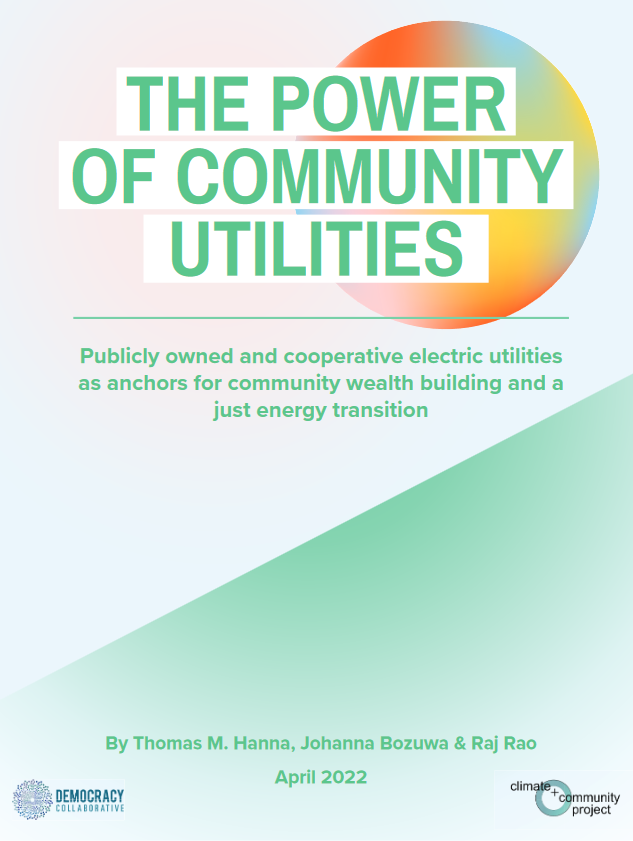
The Power of Community Utilities

By Thomas Hanna, Johanna Bozuwa, and Raj Rao - The Climate and Community Project, April 2022

Publicly and cooperatively owned electric utilities (community utilities) have the potential to demonstrate what an equitable, clean energy system looks like in the United States. They could become powerful “anchor institutions” in their community by grounding their decisions in democratic governance and community partnership, affordable energy and community wealth building, and access to renewable energy.

The United States urgently needs to transition off of fossil fuels and onto clean sources of energy (especially renewable energy) to maintain a livable climate. As of 2020, only around 20% of US electricity generation is from renewable energy sources. Energy utilities – the companies that run our power systems – have enormous control over the scope and scale of the transition, but have often dragged their feet or even fought against clean energy. Not only does their inaction imperil the very future of humanity, but it directly harms families – often Black, Indigenous, low income, or otherwise marginalized – who live in the shadow of toxic power plants. The current US energy system is dirty and expensive. 31% of households in the country have to make the choice between buying groceries or paying their energy bills. In response, communities across the country are beginning to mobilize to demand an energy transition.

We have a powerful tool to accelerate the energy transition in a way that builds community wealth and energy justice in our communities: publicly and cooperatively- owned energy utilities. In this report, we refer to these types of utilities as “community utilities” because they are owned by the local community. Around thirty percent of households in the United States get their energy from community utilities. This is no small part of our energy system. As non-profit utilities without faraway shareholders that are ultimately accountable to the local community, these utilities have the potential to be an example for what an equitable, clean, and democratic energy system could look like. Collective action and organizing to push community utilities toward the intersections of clean/ renewable energy and community development can be more tractable than in corporate utility areas because community utilities’ mandate is to provide a public good, not to maximize profits for shareholders.

Community utilities and cooperatives have a radical history. In the early days of electrification one hundred years ago, residents across the country rose up against profiteering private utilities who provided poor (or nonexistent) service at high prices by creating their own publicly and cooperatively owned utilities. In the state of Nebraska, for instance, they kicked all private utilities out of the state for good. To this day, there are no private utilities providing electricity to Nebraskan homes. This cause was, in turn, taken up by national leaders. For instance, Franklin D. Roosevelt started the Rural Electrification Administration (REA) after rural communities pushed for access to light in their regions. Before that, corporate actors didn’t want to enter rural areas because they didn’t see how they could profit from such unpopulated land. The REA program took electrification from ten to ninety percent in ten years as groups of farmers banded together to start their own electric cooperatives, run on cooperative principles. However, today some community utilities have forgotten their past and are not living up to their potential. Many still rely on fossil fuel energy and some have even pushed back against important climate resiliency approaches like rooftop solar. In some places, democratic governance structures have deteriorated (or been manipulated by powerful interests) and residents don’t even know that they actually own their utility. It is time to reignite the radical history of community utilities to herald the transition to a genuinely democratic, equitable, and clean energy system.

Download a copy of this publication here (PDF).

Solving the Climate Crisis with Nuclear Energy Won’t Work

By Robert Pollin - Dollars & Sense, March/April 2022

Russia’s invasion of Ukraine is—as of this writing, in late March—an ongoing calamity. As of now, it is impossible to predict how it might end, and what all its costs will be. We do know, as of now, that many thousands of people are dead, and millions of lives are being wrecked.

In addition to these most brutal consequences, the war must force us to rethink many issues that—with no exaggeration—reach to the core of how we can envision future prospects for life on earth. I will consider only one such question now. That is: What role should nuclear energy play in advancing a workable global climate stabilization project?

In the initial phase of its invasion on February 24, the Russian military seized control of the Chernobyl nuclear power plant, which is located about 60 miles north of Kyiv in Ukraine. In 1986, when Ukraine was still part of the Soviet Union, Chernobyl was the site of the most severe nuclear power plant accident in history. An explosion blew the lid off one of the plant’s four operating nuclear reactors. This released radioactive materials into the atmosphere that spread throughout the region. Despite this disaster, the other three reactors at Chernobyl continued operating until 2000.

The other three reactors did cease operating in 2000. And the site still houses more than 20,000 spent fuel rods. These rods must be constantly cooled, with the cooling system operating on electricity. If the system’s electrical power source were to malfunction, the spent fuel rods could become exposed to the air and catch fire. This would release radioactive materials into the atmosphere. Once released, the radioactive materials could again spread throughout the region and beyond, as they did in 1986. This is a low-probability but by no means a zero-probability scenario.

On March 3, the Russian miliary also took control of the Zaporizhzhia nuclear plant, the largest in Europe. According to a March 4 report on NPR, “Russian forces repeatedly fired heavy weapons in the direction of the plant’s massive reactor buildings, which housed dangerous nuclear fuel.” All military actions at or near the plant create further danger of the plant’s operations becoming compromised. As with Chernobyl, this could then lead to radioactive materials being released into the atmosphere.

Nuclear disasters at both Chernobyl and Zaporizhzhia are therefore active threats right now. In addition, the war is compromising the security systems that operate to protect both sites. The fact that both sites have become combat zones means that they are more vulnerable to attacks from non-state actors, including terrorist organizations of any variety. The aim of such organizations in breaching security at Chernobyl or Zaporizhzhya would almost certainly include gaining access to materials that would enable them to produce homemade nuclear weapons. At the least, they would be positioned to threaten the release of radioactive materials.

Amid Rolling Blackouts, Energy Workers Fight For Clean Public Power In South Africa

By Casey Williams - In These Times, March 31, 2022

Can South Africa transition from a reliance on coal to clean power while maintaining jobs? The energy workers fighting for a just transition think so.

The lights went out around Johannesburg on a Monday morning in November 2021, not to flicker back on until early that Friday in some areas. It marked the last rolling blackout of a year troubled by more outages than any in recent memory. The fate of Eskom, the beleaguered power utility behind the crisis, is now at the center of South Africa’s struggle for a just energy transition — a break from fossil fuels without leaving behind frontline communities or energy workers.

As a public company, Eskom has a constitutional mandate to guarantee electricity as a basic right. But the utility struggles to meet that mandate with its aging equipment, staggering debt, corruption and rules that require it to break even, which drive exorbitant rate hikes. Moreover, the electricity running through Eskom’s wires comes almost entirely from coal, smothering the country’s eastern coal belt in deadly pollution and adding planet-warming emissions to the atmosphere — and putting the utility at odds with South Africa’s decarbonization commitments and global calls for renewable energy. South Africa, the 26th-largest country by population, ranks 14th in carbon output worldwide and is responsible for 1% of global emissions, because of this reliance on coal.

Few believe Eskom will survive in its current state, and what comes next is the subject of a high-stakes debate — and is about more than the climate. The state-owned company employs 45,000 workers and supports 82,000 coal jobs in a country where more than a third of the population is out of work. Eskom is a union shop, as are South Africa’s biggest coal mines.

The government’s plan, already underway, is to invite private companies into the energy sector on the dubious grounds that clean energy is bound to win in a competitive market. The powerful miners and metalworkers unions oppose privatization, which they worry will hobble their organizations, if not eliminate the jobs they’re entrusted to protect. 

The unions have reason to worry. European multinationals have installed most of South Africa’s wind and solar capacity so far, importing technicians and hardware. The local jobs that come with them are often low-paid and temporary, vanishing once plants get up and running. Workers with permanent jobs, meanwhile, have struggled with for-profit energy companies over the right to strike.

While some union leaders and workers have responded to the threat of privatization by defending coal mines and the union jobs they offer, unions also say they support decarbonization efforts. There are currents within the labor movement organizing for a just transition to turn Eskom into a unionized, public and clean power utility, run by and for the South African people.

This tug-of-war holds lessons for workers everywhere: The South African labor movement has largely succeeded in making the public debate about ownership and power— about who owns energy resources and who decides how they’re used — rather than simply about renewables versus coal. Still, the temptation for labor to double down on coal jobs remains strong as the South African economy flags and unemployment spikes, emblematic of how hard it can be to fight for long-term goals if jobs are under threat.

Can a Just Energy Transition Occur Under Capitalism?

End the addiction to fossil fuel- support the Ukrainian resistance

By Alan Thornett - Red Green Labour, March 24, 2022

Putin’s merciless invasion of Ukraine – which is his next step in the restoration of the Russian empire – has been stalled by the remarkable popular resistance that has been mounted against it. The southern port city of Mariupol is been flattened by Russian artillery and is facing a humanitarian catastrophe but has refused to surrender. On the other hand, the invaders have been pushed back on several fronts.

The Ukrainian resistance has relied heavily on both Western economic sanctions and Western military aid including hand-launched anti-tank and surface to air missiles without which Putin’s blitzkrieg might have been unstoppable. The economic sanctions have not just put Putin under pressure at home, but they have given the population the confidence to resist such an overwhelming force.

As the Russians have met much stronger resistance than they expected they have resorted to ever more indiscriminate, long-range bombardment of the civilian population with missiles launched from ships in the Black Sea and from Russia itself. The result of which has been a rapid escalation of civilian casualties. Putin has thousands of planes and missiles, of course, and could wipe Ukraine off the map. But whether that would be politically sustainable (or survivable for him at home) is another matter.

Russia is now a brutal kleptocracy, with Putin as the new Stalin. Anti-war demonstrators facing up to 16 years in jail and opposition politicians, who oppose war, driven into exile. Ten million people, a quarter of the population, are internally displaced and with almost five million already refugees abroad. Many thousands, mostly civilians, are dead. EU countries, to their credit, have opened their borders, suspended visa requirements, and taken in millions of people. This is in sharp contrast to Boris Johnson’s miserable Little Englander government that has been running around in circles in a (very successful) attempt to give refuge to as few people as possible.

Pages

The Fine Print I:

Disclaimer: The views expressed on this site are not the official position of the IWW (or even the IWW’s EUC) unless otherwise indicated and do not necessarily represent the views of anyone but the author’s, nor should it be assumed that any of these authors automatically support the IWW or endorse any of its positions.

Further: the inclusion of a link on our site (other than the link to the main IWW site) does not imply endorsement by or an alliance with the IWW. These sites have been chosen by our members due to their perceived relevance to the IWW EUC and are included here for informational purposes only. If you have any suggestions or comments on any of the links included (or not included) above, please contact us.

The Fine Print II:

Fair Use Notice: The material on this site is provided for educational and informational purposes. It may contain copyrighted material the use of which has not always been specifically authorized by the copyright owner. It is being made available in an effort to advance the understanding of scientific, environmental, economic, social justice and human rights issues etc.

It is believed that this constitutes a 'fair use' of any such copyrighted material as provided for in section 107 of the US Copyright Law. In accordance with Title 17 U.S.C. Section 107, the material on this site is distributed without profit to those who have an interest in using the included information for research and educational purposes. If you wish to use copyrighted material from this site for purposes of your own that go beyond 'fair use', you must obtain permission from the copyright owner. The information on this site does not constitute legal or technical advice.