You are here

renewable energy

Learning About a Just Transition

Hoodwinked in the Hothouse: Examining False Corporate Schemes advanced through the Paris Agreement

People's Utility Justice Playbook​

By Yesenia Rivera and Johanna Bozuwa - Energy Democracy Project, October 2021

Have you ever wondered who is in charge of your electricity? And why?

The People’s Utility Justice Playbook has two components:

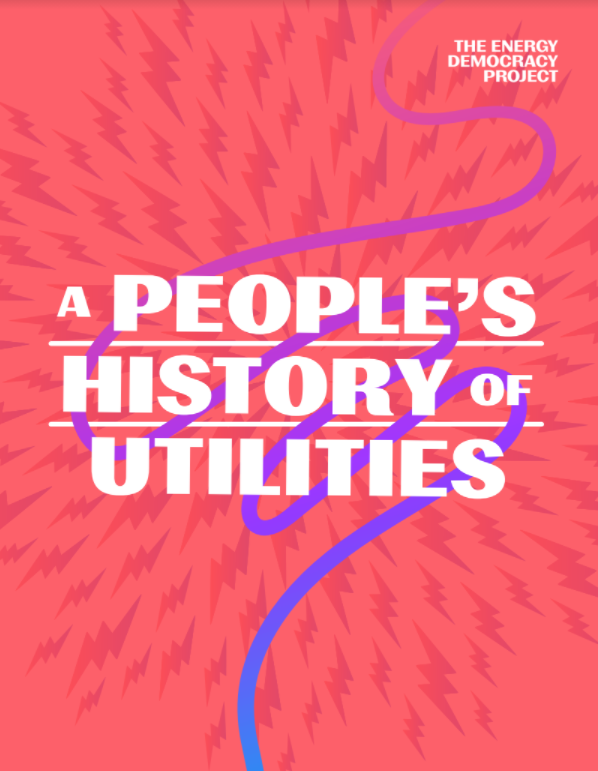
  1. a “History of Utilities” report to summarize the history of utilities for everyone to understand how our current energy system originated.
  2. a “People’s Utility Justice Playbook” to expose the tactics from electric utilities that are undermining community’s efforts, so we can build our organizing strength—to not only fight back but also to build the democratic energy system for climate justice.

This is the basic information we need to fight back against energy utilities attempting to slow or stop progress toward economic and climate justice.

History of Utilities​

Electric utilities have expanded into almost every aspect of our lives to become one of the most powerful and concentrated industries on Earth. To have a better understanding of what we’re fighting against, we first need to learn about the history of energy utilities! This PDF summarizes the entire timeline and how the rise of energy democracy came about.

People's Utility Justice Playbook

In order to fight the industry-owned utilities’ tactics, we need our own strategies for combat!

We have our very own playbook sourced from energy justice activists on the ground. They suggest strategies and tactics they employ when fighting against utilities that anyone fighting against utilities could use!

Read the History (PDF).

Read the Playbook (PDF).

The Green Jobs Advantage: How Climate Friendly Investments are Better Job Creators

By Joel Jager, et. al. - World Resources Institute, International Trade Union Confederation, and The Global Commission on the Economy and Climate, October 2021

As part of their COVID-19 recovery efforts, many governments continue to fund unsustainable infrastructure, even though this ignores the urgency of addressing climate change and will not secure longterm stability for workers.

Our analysis of studies from around the world finds that green investments generally create more jobs per US$1 million than unsustainable investments. We compare near-term job effects from clean energy versus fossil fuels, public transportation versus roads, electric vehicles versus internal combustion engine vehicles, and nature-based solutions versus fossil fuels.

Green investments can create quality jobs, but this is not guaranteed. In developing countries, green jobs can provide avenues out of poverty, but too many are informal and temporary, limiting access to work security, safety, or social protections. In developed countries, new green jobs may have wages and benefits that aren’t as high as those in traditional sectors where, in many cases, workers have been able to fight for job quality through decades of collective action.

Government investment should come with conditions that ensure fair wages and benefits, work security, safe working conditions, opportunities for training and advancement, the right to organize, and accessibility to all.

Read the text (PDF).

Shuler: Good Union Jobs Are Key to a Clean Energy Future

By Liz Shuler - AFL-CIO, September 17, 2021

AFL-CIO President Liz Shuler delivered the following remarks virtually at the Long Island Offshore Wind Supply Chain Conference:

Thank you so much for that wonderful introduction, Congressman [Tom] Suozzi. Thank you for your strong voice for working families in your district but for all working families, and for chairing the House labor caucus.

Good morning to all of you! Even though I’m Zooming in, I’m so happy to be joining you today—sounds like you have a great crowd in person and online. Hello to my labor friends—John Durso, Roger Clayman. I heard Chris Erickson is there and everyone from all walks of life who care about our climate.

I got fired up hearing your intro Congressman. I’m inspired because I see the future: that win-win-win is right there for us to grab it, and a modern, resilient and inclusive labor movement is what will help us meet the challenges of the climate crisis.

New York, I don’t need to tell you that working people are seeing and feeling the impacts of climate change. Ida recently flooded the New York transit systems and parts of Long Island saw record rainfall. 

It’s happening all across the country. Wildfires. Heat waves. Climate change is already here, happening in every community and every ZIP code. From your local news reports to the recent IPCC report, you’re hearing the alarm: we have to transition to a clean energy future. The question is how? 

The answer: with good, union jobs. It’s why we are building a labor movement that will meet the moment.

Just look at how our movement, government, industry leaders and environmental groups have worked together to bring offshore wind to the Atlantic Coast. Our progress working together shows that the way to respond and adapt to the climate crisis is through a high-road strategy with good, union jobs. 

That’s the only way we can meet the urgency in front of us. 

Labor is Leading: Building the Climate Jobs Movement Now!

Illinois Now Boasts the ‘Most Equitable’ Climate Law in America. So What Will That Mean?

By Brett Chase and Dan Gearino - Inside Climate News, September 17, 2021

Illinois is now the first Midwestern state to set climate-fighting targets for phasing out coal and natural gas in favor of cleaner energy sources like wind and solar power.

The bill that Gov. J.B. Pritzker signed into law on Wednesday sets a goal for Illinois to move to 100 percent clean energy by 2050.

The new law promises thousands of new jobs in clean energy, with an emphasis on hiring people of color. It sets priorities for closing sources of pollution in so-called environmental justice communities. And it gives almost $700 million over five years to subsidize three Northern Illinois nuclear power plants owned by Exelon. 

The law was pushed through by a coalition of environmental, community and religious activists who held more than 100 community meetings over the last three years with thousands of people around the state. That process was in sharp contrast to what happened five years ago, when utility companies dominated the writing of the state’s last major energy law. 

After Years of Grassroots Efforts, Illinois Passes Nation-Leading Climate and Equity Bill

By Renner Barsella and Hannah Lee Flath - Sierra Club, September 15, 2021

SPRINGFIELD, IL -- Today, Governor Pritzker signed the Climate and Equitable Jobs Act (SB2408) into law, marking one of the nation’s most groundbreaking advancements in climate justice and workforce transition. 

“This landmark legislation is a historic step forward for climate justice in Illinois, the Midwest, and the nation. As the largest polluter in the Midwest, and historically a major coal-producing state, Illinois is now on course to show what a just transition to a clean energy future can look like, lifting up workers and communities while achieving our climate goals,” said Sierra Club Illinois Director Jack Darin. “We have shown not only that jobs, justice, and climate are inextricably linked, but also that there are tangible policy solutions here that could be a useful model for lawmakers in DC and across the country. Sierra Club unequivocally opposes nuclear energy, and though this bill includes difficult compromises, it overwhelmingly supports true clean energy resources like wind, solar, and energy efficiency, putting Illinois on track to replace all retiring dirty energy, including Exelon’s nuclear fleet, with 100% clean energy ”

Sierra Club joined other environmental advocates with the Illinois Clean Jobs Coalition in support of the Climate and Equitable Jobs Act, which sets bold targets to: 

  • Put Illinois on a path to 100% renewable energy by 2050 by increasing Illinois’ Renewable Portfolio Standard to 40% by 2030, 50% by 2040, and setting an ultimate goal of 100% clean energy by 2050, generating approximately $10 billion for Illinois renewables. 

  • Prioritize clean energy investments, job training, hiring, ownership, and new business creation in BIPOC, low-income, and environmental justice communities through some of the most progressive programs in the nation, including: 

    • a $50 million/year expansion to the Illinois Solar for All Program launched under the Future Energy Jobs Act, 

    • over $80 million/year to build a network of workforce hubs and contractor development programs, 

    • over $35 million/year for business development grants and low-cost inclusive capital access, 

    • minimum diversity and equity requirements for all renewable energy projects and support for BIPOC contractors. 

  • Completely decarbonize Illinois’ energy sector by 2045 with retirement tiers for coal and gas plants based in part on plants’ proximity to environmental justice communities and local pollution impacts. This approach marks an important shift in climate policy that prioritizes emissions reductions first from plants with the worst environmental justice impacts rather than a singular focus on greenhouse gas emissions.

  • Create just transition programs for communities and workers impacted by power plant and mine closures, including a Displaced Energy Worker Bill of Rights to support job training and placement needs, scholarship funds, and health care support. 

  • Tackle Illinois’ heavily polluting transportation sector by committing millions over the next decade to expanding access to and adoption of electric vehicles, public transit, and medium-duty and heavy-duty vehicles with the objective of 40% of the benefits going to environmental justice and economically disadvantaged communities. 

  • Install rigorous new ethics standards with restrictions and transparency into utility finances and lobbying activities. 

Renewable Energy companies seen as barriers to a successful public energy transition

By Elizabeth Perry - Work and Climate Change Report, September 8, 2021

Recent issues of New Labor Forum include articles promoting the concept of energy democracy, and bringing an international perspective. In “Sustaining the Unsustainable: Why Renewable Energy Companies Are Not Climate Warriors” (New Labor Forum, August), author Sean Sweeney argues that renewable energy companies “are party to a “race to the bottom” capitalist dynamic that exploits workers – citing the example of alleged forced Uyghur labour in China-based solar companies, and the offshoring of manufacturing for the Scottish wind industry. He also argues that “large wind and solar interests’ “me first” behavior is propping up a policy architecture that is sucking in large amounts of public money to make their private operations profitable. They are sustaining a model of energy transition that has already shown itself to be incapable of meeting climate targets. In so doing, these companies have not just gone over to the political dark side, they helped design it.”

The theme of the Spring New Labor Forum was A Public Energy Response to the Climate Emergency , and includes these three articles: “Beyond Coal: Why South Africa Should Reform and Rebuild Its Public Utility”; “Ireland’s Energy System: The Historical Case for Hope in Climate Action”; and Mexico’s Wall of Resistance: Why AMLO’s Fight for Energy Sovereignty Needs Our Support .

The author of Sustaining the Unsustainable is Sean Sweeney, who is Director of the International Program on Labor, Climate & Environment at the School of Labor and Urban Studies, City University of New York, and is also the coordinator of Trade Unions for Energy Democracy (TUED). In August, TUED convened a Global Forum, “COP26: What Do Unions Want?” – with participation from 69 unions, including the Scottish Trades Union Congress (STUC), the UK Trades Union Congress (TUC), the International Transport Workers Federation (ITF), Trade Union Confederation of the Americas (TUCA), the UK’s Public and Commercial Services Union (PCS), and Public Services International (PSI). Presentations are summarized in TUED Bulletin 111, (Aug. 18), and are available on YouTube here .

How Green is Blue Hydrogen?: Study Finds Hydrogen Produced with CCS Produces High Emissions

Pages

The Fine Print I:

Disclaimer: The views expressed on this site are not the official position of the IWW (or even the IWW’s EUC) unless otherwise indicated and do not necessarily represent the views of anyone but the author’s, nor should it be assumed that any of these authors automatically support the IWW or endorse any of its positions.

Further: the inclusion of a link on our site (other than the link to the main IWW site) does not imply endorsement by or an alliance with the IWW. These sites have been chosen by our members due to their perceived relevance to the IWW EUC and are included here for informational purposes only. If you have any suggestions or comments on any of the links included (or not included) above, please contact us.

The Fine Print II:

Fair Use Notice: The material on this site is provided for educational and informational purposes. It may contain copyrighted material the use of which has not always been specifically authorized by the copyright owner. It is being made available in an effort to advance the understanding of scientific, environmental, economic, social justice and human rights issues etc.

It is believed that this constitutes a 'fair use' of any such copyrighted material as provided for in section 107 of the US Copyright Law. In accordance with Title 17 U.S.C. Section 107, the material on this site is distributed without profit to those who have an interest in using the included information for research and educational purposes. If you wish to use copyrighted material from this site for purposes of your own that go beyond 'fair use', you must obtain permission from the copyright owner. The information on this site does not constitute legal or technical advice.