

You are here

transportation infrastructure

We Stand in Solidarity with Railroad Workers

Rail Workers May Strike Next Month

By Paul KD - Tempest, August 12, 2022

Paul KD: President Biden just appointed a Presidential Emergency Board to help resolve the current negotiations around a national rail contract. What is the PEB, and what is its role in the negotiations?
Ross Grooters: A PEB is a U.S. president-appointed group of three mediators. These three people typically have experience in labor case law and mediation. They will look at the merits of the United Rail Unions’ Coordinated Bargaining Coalition proposal and the National Carriers’ Conference Committee proposal, and from there they have 30 days to make a non-binding contract recommendation based on their findings. Their recommendation should occur in the middle of August (the 18th, I believe).

PKD: What can rail workers do to put pressure on the PEB? What are the unions and the companies doing to lobby the PEB, and the Biden Administration more broadly?

RG: Both the unions and the companies are waging narrative battles in the press. It’s a tale as old as labor and capital. While it’s important, at least as far as rank and file railroad workers are concerned, I believe the PEB is the wrong point of pressure. What’s done is done and we can’t necessarily impact the PEB recommendation directly. Besides both the unions or the carriers (railroad companies) can reject the PEB recommendation. I believe this is a likely outcome. Once this occurs there is a 30 day cooling-off period before a work stoppage—lockout or strike—could occur. The timeline for this is mid to late September. Because of this I believe our best course of action is to continue building support for a strike. Organize our locals and community support, and hold rallies. Under the Railway Labor Act, an act of Congress can force us back to work. Our congressional members would then legislate an agreement—that’s where we can lobby. Until that happens, we have the ability to threaten a work stoppage. We need to leverage that power.

Mick Lynch on the Rail Strikes and Climate Crisis

'Public Pressure Works': Postal Service to Boost Electric Vehicle Purchases After Backlash

By Kenny Stancil - Common Dreams, July 20, 2022

Pressure from progressive advocacy groups and lawmakers bore fruit on Wednesday when the U.S. Postal Service announced that it would be making 40% of its new delivery vehicles electric, up from Postmaster General Louis DeJoy's initial plan to electrify just 10% of the mail agency's aging fleet.

The news comes in the wake of a lawsuit filed in late April by a coalition of environmental organizations that accused the USPS of conducting an unlawfully shoddy analysis of the widely condemned plan's climate impacts. More than a dozen state attorney generals and the United Auto Workers (UAW) also sued to halt DeJoy's anti-green and anti-labor procurement scheme pending a comprehensive review of its ecological and public health consequences.

"Public pressure works, and today's announcement from the Postal Service is proof of that," Katherine García, director of the Sierra Club's Clean Transportation for All campaign, said in a statement. "The agency's original plan for a fleet of 90% fossil fuel trucks should have never been a consideration."

"Still, making only half of its delivery fleet electric does not go far enough to address climate change or improve air quality in neighborhoods across the nation," said García. "There is also no guarantee in today's announcement that union workers will be building these pollution-free vehicles."

"This is an opportunity to transform the postal fleet to be 100% union-built electric vehicles," she added. "We won't settle for anything less."

DRACONIAN New Rail Industry Policy WORSENS Supply Chain Crisis, CRUSHES Workers

The Case for Not Flying

By Fabrizio Menardo - Green European Journal, July 7, 2022

Although aviation accounts for 2.8 per cent of global CO2 emissions, its harmful impact rarely rises on the climate action agenda. In a globalised economy with businesses and lifestyles built around air travel, flying can be a hard habit to shake. To Fabrizio Menardo, individuals must make behavioural changes and policymakers must address the socio-economic challenges in the sector to bring travel in line with climate goals.

In 2015, under the famed Paris Agreement, almost every country on Earth pledged to limit the global temperature rise to well below 2 degrees Celsius compared to pre-industrial levels and “pursue efforts” to keep warming to 1.5 degrees Celsius. The latest report of the Intergovernmental Panel on Climate Change (IPCC) shows that greenhouse gas emissions from human activities have already caused around 1.1 degrees of warming, leading to an increase in extreme weather and climate events such as heatwaves, heavy precipitation, and droughts. Many of these impacts will last for centuries, and their magnitude will grow in line with cumulative future emissions. The IPCC estimates that, in order to achieve a 67 per cent probability of staying below 1.5 degrees Celsius, our cumulative CO2 emissions from the beginning of 2020 must remain below 400 billion tonnes. Current annual CO2 emissions stand at around 35 billion tonnes

Transforming Transportation–from Below

By Jeremy Brecher - Labor Network for Sustainability, July 2022

People are acting at the local and state level to create jobs, reduce greenhouse gas pollution, and equalize transportation by expanding and electrifying public transit, electrifying cars and trucks, and making it safe to walk and bike. It’s a crucial part of building the Green New Deal from Below.

More than a quarter of greenhouse gases [GHGs) emitted in the US come from transportation – more than from electricity or any other source.[1] Pollution from vehicles causes a significant excess in disease and death in poor communities. Lack of transportation helps keep people in poor communities poor.

Proposals for a Green New Deal include many ways to reduce the climate, health, and inequality effects of a GHG-intensive transportation system. “Transit Oriented Development” (TOD), “smart growth,” and other forms of metropolitan planning reduce climate-and-health threatening emissions while providing more equal access to transportation. Switching from private vehicles to public transit reduces GHG emissions by more than half and substantially reduces the pollution that causes asthma and other devastating health effects in poor communities. Changing from fossil fuel to electric vehicles also greatly reduces emissions. Expanded public transit fights poverty and inequality by providing improved access to good jobs. And expansion of transit itself almost always creates a substantial number of good, often union jobs. Every $1 billion invested in public transit creates more than 50,000 jobs.[2]

Plans for a Green New Deal generally include substantial federal resources to help transform our transportation system.[3] The 2021 “bipartisan” Infrastructure Investment and Jobs Act provided $20 billion over the next five years for transit projects. But meanwhile, efforts at the community, local, and state level have already started creating jobs reducing transportation pollution – models of what we have called a Green New Deal from Below.[4]

These Green New Deal from Below programs are often characterized by multiple objectives – for example, protecting the global climate, improving local health, providing jobs, and countering inequality. And they often pursue concrete ways to realize multiple goals, such as “transit-oriented development” that builds housing near transit to simultaneously shift travel from cars to public transit and to expand access to jobs and urban amenities for people in low-income communities.

Addressing U.S. Manufacturing and Service Capacity/Gaps and Technical Standards

By David W. Cash - Labor Energy Partnership, June 2022

This paper attempts to analyze the existing offshore wind (OSW) supply chain and value chain capacity and gaps in U.S. manufacturing, vessels, ports, workforce development and standards. It further identifies opportunities and constraints in meeting goals of equity as the domestic OSW sector develops across all these dimensions. As the Biden administration notes, the development of the OSW sector offers the prospect not only to reduce emissions at scale, but also to seize the opportunity to create jobs along the value chain, create union and high-wage jobs, reduce U.S. sector uncertainties and drive equity, especially in overburdened and vulnerable communities.

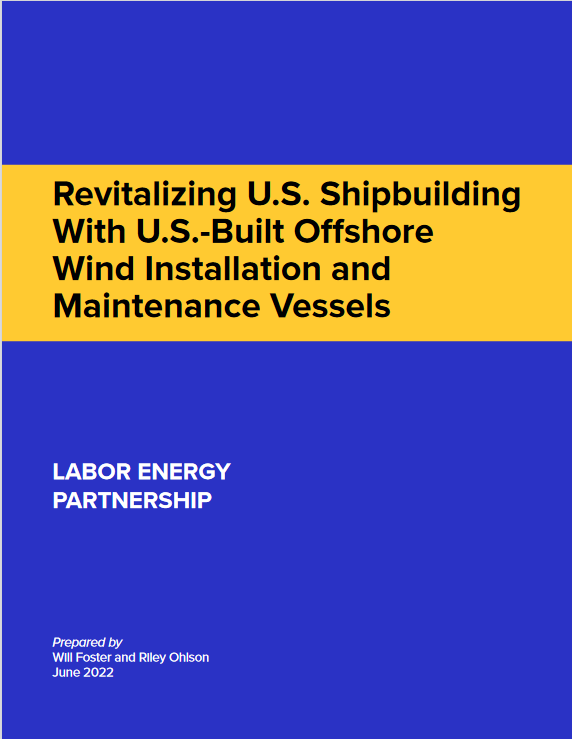
Revitalizing U.S. Shipbuilding With U.S.-Built Offshore Wind Installation and Maintenance Vessels

By Will Foster and Riley Ohlson - Labor Energy Partnership, June 2022

This paper assesses the opportunities and challenges for developing a fleet of Jones Act-compliant vessels for installation, maintenance and service of offshore wind infrastructure in the U.S., in consultation with shipbuilding unions.

Stimulating commercial shipbuilding activity is critical to facilitating OSW deployment while demonstrating the potential for this deployment to support and grow good manufacturing jobs.

Arguably, the greatest challenge facing sustained OSW development is neither technical nor financial but political. Many American workers, particularly those in industries tied to fossil fuels, are deeply skeptical of the prospects of a just transition and the fundamental ability for renewable energy production to support middle-class jobs.

Rally Against New Attendance Policy

Pages

The Fine Print I:

Disclaimer: The views expressed on this site are not the official position of the IWW (or even the IWW’s EUC) unless otherwise indicated and do not necessarily represent the views of anyone but the author’s, nor should it be assumed that any of these authors automatically support the IWW or endorse any of its positions.

Further: the inclusion of a link on our site (other than the link to the main IWW site) does not imply endorsement by or an alliance with the IWW. These sites have been chosen by our members due to their perceived relevance to the IWW EUC and are included here for informational purposes only. If you have any suggestions or comments on any of the links included (or not included) above, please contact us.

The Fine Print II:

Fair Use Notice: The material on this site is provided for educational and informational purposes. It may contain copyrighted material the use of which has not always been specifically authorized by the copyright owner. It is being made available in an effort to advance the understanding of scientific, environmental, economic, social justice and human rights issues etc.

It is believed that this constitutes a 'fair use' of any such copyrighted material as provided for in section 107 of the US Copyright Law. In accordance with Title 17 U.S.C. Section 107, the material on this site is distributed without profit to those who have an interest in using the included information for research and educational purposes. If you wish to use copyrighted material from this site for purposes of your own that go beyond 'fair use', you must obtain permission from the copyright owner. The information on this site does not constitute legal or technical advice.
