You are here

transportation infrastructure

A Vision for Scotland’s Railways

By staff - Unity Consulting, ASLEF, RMT, TSSA, and Unite the Union, October 29, 2021

Scotland cannot meet its environmental obligations without a world-class rail service that shifts people and goods from cars and lorries onto trains.

This requires a service that is fully staffed, with affordable fares, stations that are accessible and trains that are clean, green and attractive.

What is needed is an ambition for Scotland’s railways that is expansive, that encourages people to make rail their first travel choice and increases freight capacity.

Our long-term vision for Scotland's railways:

  • It should be a publicly operated and governed system run as public service and not for private profit
  • A system that helps Scotland meet its wider environmental and public policy ambitions
  • A railway that is supported by public subsidy
  • Is fully staffed
  • That reinvests in rail infrastructure, to help grow the economy.
  • Takes ScotRail (and the Serco operated Caledonian Sleeper) back under public ownership permanently
  • A railway that is part of a wider integrated public transport system with through ticketing
  • Is part of an industrial strategy that recognises rail services are a vital part of Scotland’s economy helping create jobs and growth
  • Has a democratic regulatory and governance structure
  • Has a cross representation of Scottish society and rail interests at the heart of decision making
  • Has representation from all four trade unions on the board of the new operator
  • Has local political representatives on the board
  • Has passenger representatives on the board

Read the text (PDF).

Unions and Climate Activists Find Common Cause in Opposing Airport Expansion

By Dayton Martindale - Truthout, September 27, 2021

Airport employees and community allies protest a proposed expansion of Los Angeles International Airport on September 14, 2021; image by author.

“Are you scared you’re going to lose all your jobs ’cause there will be no planes?”

The audience chuckled at MSNBC host Chris Hayes’s first question for Sara Nelson, international president of the Association of Flight Attendants, at a March 2019 special on the Green New Deal. Nelson, an ardent climate advocate, dismissed the notion out of hand: “We still have to get around.” The real threat to flights, she insisted, is an increase in extreme weather events. It is climate inaction, then, that could keep planes from flying, rather than climate action.

Across the Atlantic, the messaging is notably different. Environmentalists across the U.K. and France have campaigned against airport expansions, and the Swedish language now has a word (flygskam) for the climate shame felt by those who fly. In August 2019, Swedish climate change activist Greta Thunberg chose to ride a boat to New York to reduce emissions and draw attention to the crisis.

So, will we have to keep any airplanes on the ground? The answer is complicated, depending on how quickly certain technologies become widespread, how willing we are to tolerate financial and environmental costs of jet fuel alternatives, and whether we aim to eliminate greenhouse gas emissions entirely or merely reach “net-zero” emissions (in which scenario we would continue to emit, but attempt to offset the climate impact through carbon capture and storage).

But there is a growing consensus that even in technologically optimistic scenarios, some constraints on demand will be necessary to curtail the expected growth in flights over the decades to come. Many climate activists argue that because these technologies are uncertain, we should start reducing flights as soon as possible. And some early indications — such as an ongoing union-led fight against an airport expansion in Los Angeles — suggests that the climate movement’s most powerful ally against rampant growth in air travel may be labor.

Few demonstrators at the Los Angeles International Airport (LAX) during a September 14 rally held greenhouse gas emission foremost in their minds as they decried the proposed expansion. The 50 or so protesters — most wearing the shirt of either SEIU United Service Workers West (SEIU-USWW) or Unite Here Local 11 — were more vocal about issues such as health care, wages, and the impact of air pollution and traffic congestion at their jobs and in their neighborhoods. The two unions, representing thousands of food, custodial and passenger service employees at the airport, were joined by Sunrise LA and other community and environmental groups outside a meeting of the Los Angeles Board of Airport Commissioners (BOAC).

An SEIU-USSW press release argues that the current plans to expand LAX “ignore the needs of workers at the airport as well as those who are most impacted by it: nearby neighborhood residents,” but they do not oppose the expansion outright. Instead, the labor groups want to see a community benefits agreement — an enforceable contract between the airport and community groups that allows workers and residents to provide substantive input, ensuring any airport development respects economic and environmental justice. If this demand is not met, SEIU-USWW President David Huerta tells Truthout, the union “could transition into direct opposition.”

Any solution must ensure worker voices are heard, says Sunrise LA spokesperson Josiah Edwards. Airport employees kept LAX running through the pandemic for inadequate pay, and already bear a heavy environmental burden. That they are not invited to the BOAC’s closed-door meetings is “a clear instance of environmental injustice,” Edwards says.

Defend and Transform: Mobilizing Workers for Climate Justice

By Jeremy Anderson - Global Labour Column, September 8, 2021

Mobilizing the global labour movement for climate justice and just transition is one of the defining challenges of our times. However, for workers in many sectors, it is unclear how climate issues will affect them specifically, and how they should respond. To date, much of the debate around just transition has focused on workers in industries that are facing job losses. These struggles are important. But in order to build a transformational vision that can mobilize workers in all sectors from the ground up, we need to understand a wider array of industry perspectives.

In this essay, I will discuss three issues. First, I will make the case for why climate justice and just transition are fundamental issues for the labour movement. Second, I will review debates around just transition, and particularly the contrast between worker focused and structural transformation approaches. I will argue that we need to build a bridge between the two perspectives, particularly in scenarios where it is important to engage workers about the future of their specific industries. Third, I will analyse three different scenarios from the transport sector that illustrate the various challenges that workers face: public transport as an example of industry expansion, aviation as an example of industry contraction, and shipping as an example of industry adaption.

Please provide EV Charging Access for All in the 2022 CALGreen Code

Open Letter - various organizations, September 2021

We are a broad statewide coalition of 90 organizations, companies, and individuals, advocating for better and more equitable access to Electric Vehicle (EV) charging infrastructure in California. Recognizing that over half of California’s greenhouse gas emissions come from transportation, the state has set a clear path to electrify California’s light duty vehicle fleet. California’s built environment, however, fails to provide sufficient or equitable access to the EV charging infrastructure required to make this necessary transition. Since November of 2020, we have been involved in the CALGreen stakeholder engagement process, and from the beginning our mandate has been to ensure that every new multi-family housing unit with parking has access to some level of residential EV-ready charging. 
Read the text (PDF).

Simple Solutions Can Safeguard Against Catastrophic Train Events

By Staff - Sierra Club Illinois Chapter, August 10, 2021

“Just because an industry can do something doesn't mean an industry should be doing it!” says Fritz Edler, a veteran railroader and railroad safety activist based in Washington, D.C.

Edler should know: He has broad knowledge about infrastructure, energy, environmental impact, and economics for heavy (freight) and light (passenger) rail in national and international contexts. He also headed the international defense effort for rail workers who were scapegoated after the horrific 2013 Lac-Mégantic, Quebec, volatile oil train wreck.

A special guest at La Coalition's campaign planning meeting in August, Edler shared insights on what the public can do to safeguard against catastrophic train events:

  1. Oppose precision scheduled railroading (PSR). PSR jeopardizes engineer and public safety by encouraging risky industry decision-making and focusing exclusively on lowering the operating ratio to satisfy Wall Street and hedge fund investors. PSR is now the subject of Congressional inquiries. 
  2. Demand sane scheduling and uninterrupted rest time. This will mitigate out-of-control crew fatigue. 
  3. Oppose longer trains. Technological advances allow the operation of longer and heavier trains than ever before, yet safety standards do not address these changes. Longer, heavier trains shift costs to trackside communities in multiple ways. They greatly increase wear and tear on rail infrastructure without requiring increased inspection and maintenance. Longer trains (100+ cars, over 1 mile long) also are significantly more likely to block railway crossings—which inconveniences the public and risks delaying first responders up to 15 minutes.
  4. Require emergency response plans (including fire and hazmat) for all changes in freight traffic, and publicly review the adequacy of the plans.
  5. Demand a minimum of a two-member crew on every train. Some operations require more workers to adequately protect both crew and trackside communities. The optimal number is three to five engineers on a train.
  6. Regulate railroads as the public utilities they have historically been. Limit hedge funds’ power and Wall Street’s involvement in the industry because they promote profits over public safety.
  7. Demand appropriate maintenance and oversight of railroad corridors.
  8. Demand restoration of meaningful whistle-blower protections. These should include significant penalties for evasion and misconduct. Whistle-blower protection is essential for guaranteeing railway safeguards.
  9. Support railroad upgrade efforts that include critical safety and operation improvements for both freight and passenger service. Upgraded railroad crossings are a prerequisite for most expanded and improved rail passenger services and higher-speed freight services—for safety and public convenience. 
  10. Support railroads as a vital part in America's Green Transportation future. Press legislators to support the Green New Deal and high-speed rail legislation, which guarantee the inclusion of rail projects that advance freight and passenger services. 

Last, Edler recommended that the public be skeptical when considering support for new advances in railroading, such as remotely operated trains. It’s important to avoid new problems in an already compromised industry. 

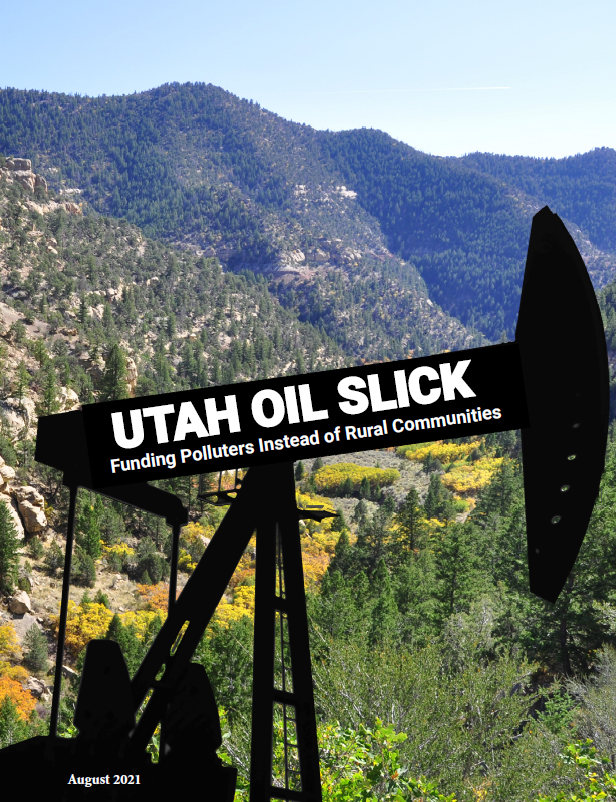
Utah Oil Slick: funding polluters instead of Rural Communities

By Deeda Seed and Adair Kovac - Center for Biological Diversity, et. al., August 2021

Every year Utah receives tens of millions of dollars in federal lease revenues and royalties from oil, gas and mineral extraction as a way to help mitigate the impacts of drilling and mining. Even before scientists linked fossil fuels to the climate crisis, Congress intended this money to be used to help rural communities experiencing rapid growth and infrastructure challenges. The influx of new workers and increased drilling and mining take a toll on communities.

This report from the Utah Clean Infrastructure Coalition shows that, since 2009, the little-known board charged with distributing this public money has funneled more than $109 million to projects that promote or expand fossil fuel extraction in violation of the federal Mineral Leasing Act. That includes more than $2.2 million approved after a state audit found the board was using the public funds improperly.

We examined dozens of public records — including the 2020 audit of the Permanent Community Impact Fund Board by the Utah Legislative Auditor General, meeting minutes, audio tapes and project documents — and found that:

  • Since 2009 the Permanent Community Impact Fund Board, or CIB, has issued $109 million in grants and low- or no-interest loans — all of it public money — to finance road construction, engineering studies, attorney fees and other costs to enable fossil fuel development on public and private land. Beneficiaries include well-connected private firms trying to get approval for the proposed $1.5 billion Uinta Basin Railway.
  • Over the past two years small towns, cities and special improvement districts in two counties have identified more than $60 million for community improvement projects that have not yet been funded. Unfunded projects include water and sewer services, recreation centers, road improvements and public safety equipment. Over this same period, the CIB gave more than $48 million in grants to fossil-fuel related projects.
  • The Utah Legislature failed to oversee the board’s activities. Even worse, in 2021 it changed state law to allow mineral lease revenues and royalties to finance fossil-fuel infrastructure projects, which is illegal under federal law. The new law followed the 2020 state audit criticizing the board’s spending and haphazard decision-making.
  • County governments and local agencies continue to seek public funding for projects that facilitate fossil fuel extraction and enrich private corporations over community needs. Since the audit, Uintah County commissioners approved seeking $39 million in public funds to help a private, Ogden-based oil company build a 640-acre oil refinery in eastern Utah.3 The proposed $1.4 billion Uintah Advantage refinery would have the capacity to refine 40,000 barrels of oil a day, and it may also include a rail yard for the proposed Uinta Basin Railway.

The CIB must stop funding fossil fuel development projects. The Utah Legislature should oversee the board’s grant and loan-making process to ensure it complies with the Mineral Leasing Act, which requires these public funds be used to mitigate harm inflicted on communities by oil, gas and mineral extraction and forbids using the money for economic development. Rural communities should call on legislators to ensure that infrastructure needs are met and public money is spent properly.

As Utah and the western United States experience the devastating consequences of climate change in the form of intense heat, drought and wildfires, it is even more critical that the CIB stop siphoning public funds away from much-needed community projects to finance dangerous fossil fuel extraction that worsens the climate crisis.

Read the text (PDF).

Reclaiming Hydrogen for a Renewable Future: Distinguishing Fossil Fuel Industry Spin from Zero-Emission Solutions

By Sasan Saadat and Sara Gersen - Earth Justice, August 2021

To chart a course toward a safer climate and more habitable planet, we must rapidly reduce emissions of greenhouse gases across our society. The biggest contributor to greenhouse gas emissions is the burning of fossil fuels. Consequently, the clearest path to reducing emissions is to switch from fossil fuels to renewable, zero-emission energy in our transportation, buildings, and power generation (sectors that are collectively responsible for about 75% of United States’ greenhouse gas emissions). This transition would make significant strides in eliminating the devastating public health impacts of pollution throughout the life cycle of fossil fuels—pollution that is most severely concentrated in Black, Brown, Indigenous, and poor communities. A just transition will also require careful policy design and meaningful engagement from frontline communities. Renewable energy, energy efficiency, and electrification are zero-emission solutions that eliminate both greenhouse gases and health-harming air pollution. To meet the scale and urgency of the climate crisis will require deployment of renewable resources on an unprecedented scale— ultimately achieving 100% clean power generation—and a complete transition to efficient, electric models for things like household appliances and cars.

As we electrify everything that can feasibly plug into a clean power grid, “green hydrogen” is a promising tool for transitioning to renewable energy in sectors that lack a viable route to direct electrification. Green hydrogen is hydrogen produced by using 100% renewable electricity to split water molecules.

To understand the potential role of green hydrogen, consider the challenges of cutting climate pollution from one hard-to-electrify sector: maritime shipping. Maritime travel is difficult to decarbonize because battery-powered ocean-going vessels will not be able to handle long-haul voyages across the ocean, at least for the foreseeable future. The hope for green hydrogen is that it may store energy from clean electric resources like wind and solar in a fuel that could be used to propel large, long-haul ships. This vision is at least a decade away from reality, if it overcomes the challenges to cost-effective production and efficient on-vessel storage. Still, it offers a path to displacing the highly polluting bunker fuel currently relied on to move much of the world’s goods across oceans.

Read the text (Link).

Combatting Climate Change, Reversing Inequality: A Climate Jobs Program for Texas

By Lara R. Skinner, J. Mijin Cha, Hunter Moskowitz, and Matt Phillips - ILR Worker Institute, Cornell, July 26, 2021

Texas is currently confronted by three major, intersecting crises: the COVID-19 public health pandemic and ensuing economic crisis; a growing crisis of inequality of income, wealth, race and power; and the worsening climate crisis, which continues to take its toll on Texans through hurricanes, major flood events, wildfires, debilitating heat waves and the significant economic cost of these extreme weather events. These crises both expose and deepen existing inequalities, disproportionately impacting working families, women, Black, Indigenous and people of color (BIPOC) communities, immigrants, and the most vulnerable in our society.

A well-designed recovery from the COVID-19 global health pandemic, however, can simultaneously tackle these intersecting crises. We can put people to work in high-quality, family- and community-sustaining careers, and we can build the 21st century infrastructure we need to tackle the climate crisis and drastically reduce greenhouse gas emissions and pollution. Indeed, in order to avoid the worst impacts of the climate crisis, it is essential that our economic recovery focus on developing a climate-friendly economy. Moreover, there are significant jobs and economic development opportunities related to building a clean energy economy. One study shows that 25 million jobs will be created in the U.S. over the next three decades by electrifying our building and transportation sectors, manufacturing electric vehicles and other low-carbon products, installing solar, wind and other renewables, making our homes and buildings highly-efficient, massively expanding and improving public transit, and much more.

Conversely, a clean, low-carbon economy built with low-wage, low-quality jobs will only exacerbate our current crisis of inequality. The new clean energy economy can support good jobs with good benefits and a pipeline for historically disadvantaged communities to high-quality, paid on-the-job training programs that lead to career advancement. Currently, the vast majority of energy efficiency, solar and wind work is non-union, and the work can be low-wage and low-quality, even as the safety requirements of solar electrical systems, for example, necesitate well-trained, highly-skilled workers.

Read the text (PDF).

Transit Equity Network Calls on Congress to Pass Legislation that Truly Supports Accessible, Safe and Equitable Transit in Support of H.R.3744

By Judy Asman - Labor Network for Sustainability, July 20, 2021

The network of transit riders, community organizations, environmental groups, and labor unions responsible for organizing Transit Equity Day annually on Rosa Parks’ birthday to declare transit equity as a civil right have issued an Open Letter to Congress in support H.R. 3744, the “Stronger Communities Through Better Transit Act,” drafted by Rep. Henry C. (Hank) Johnson (D: GA-04) and introduced to the House Committee on Transportation and Infrastructure in early June. Twenty-five organizations have signed on to the letter including the Amalgamated Transit Union, Institute for Policy Studies Climate Policy Program, the Sierra Club, the NAACP Niagara Falls Branch, Central Florida Climate Action, Pittsburghers for Public Transit, and the Labor Network for Sustainability.

“We see transit equity as a civil right, workers’ right and climate-justice issue; and are committed to ensuring equitable access to public transit throughout the United States. Expanding public transit can help combat the causes of climate change and also fight economic injustice by providing greater accessibility in marginalized communities and ample training and job growth for transit workers,” the letter says. It adds:

“H.R. 3744, would authorize $20 billion annually from fiscal years 2023 through 2026 in operating assistance to transit agencies to improve frequencies, extend service hours, or add new high-frequency transit service. It also aims to prioritize that service to disadvantaged communities, areas of persistent poverty, and places with inadequate transit services.

“Workers and communities need better access to affordable, reliable public transit to meet essential needs and to help address climate disruption. Our economy will not grow without it. Communities of color will continue to be disproportionately left behind—today, people of color comprise 60 percent of transit ridership. Transit workers will continue to shoulder the pressures that come with infrequent bus service, lack of safety in transition beyond the COVID-19 pandemic, and possible job loss when new technologies are implemented without proper worker training. The Stronger Communities Through Better Transit Act will not single-handedly ensure transit equity; however, it is a critical step in securing a more reliable, safe, and frequent transit future for communities across the country.”

Turbulence Ahead: What LAX’s Expansion Means for the City of Los Angeles’ Legacy on Racial Equity and Environmental Justice

By staff, editor, et. al - SEIU United Service Workers West, June 2021

Right now, Los Angeles International Airport (LAX) is charging ahead on an expansion project of a scale not seen for decades. Los Angeles World Airports (LAWA), the organization that owns and operates LAX, quietly released a draft Environmental Impact Report late last year that reveals a project with a host of alarming implications for communities near the airport. If the City of Los Angeles and its elected officials are serious about leadership on environmental justice and equity, resolving the issues presented by this project will be critically important.

As it stands, the proposed development is poised to worsen traffic in an area already infamous for it, expose thousands of new residents to the noise of one of the busiest airports in the world, and intensify the air quality impact of a facility that is already a statewide leader in air pollution. Worse still, these outcomes are set to be concentrated within Black and Brown communities near LAX that already grapple with a longstanding history of environmental racism—communities that have suffered disproportionately from the health and economic fallout of the COVID pandemic.

LAWA’s current approach signals that the airport is not only failing to adequately protect the community from the consequences of LAX’s largest expansion in decades, but is, in effect, concealing the real, long-term effects of that expansion as it rushes toward approval as early as this year. The City of Los Angeles, LAWA, and the airlines that will occupy the new terminals have an obligation to do better and ensure that this project is carried out equitably, that it will not become another sad chapter in the story of environmental injustice in South Los Angeles and the continued exploitation of essential workers as the city emerges from the pandemic.

In this report, we take a deeper look at the proposed development and what the draft Environmental Impact Report does and doesn’t reveal about the consequences of LAWA’s plans for the airport. We will contextualize this project and what it means for workers, families and communities—particularly communities of color—as well as the direction of the City of Los Angeles as a whole. Finally, we will lay down a foundation for how the airport can approach this project as a real, positive opportunity for the region, and not a cautionary tale of corporate greed and bureaucratic complicity in the making. In the coming years, the City of Los Angeles will prepare to host major events—the Super Bowl, the 2028 Summer Olympics, the World Cup—and enjoy global attention. It is critical that the city and its leaders take every opportunity to be a leading model for an equitable and just economy. With the whole world watching, showing how LAX’s development can be done without harm to communities of color will be an excellent place to start.

Read the text (PDF).

Pages

The Fine Print I:

Disclaimer: The views expressed on this site are not the official position of the IWW (or even the IWW’s EUC) unless otherwise indicated and do not necessarily represent the views of anyone but the author’s, nor should it be assumed that any of these authors automatically support the IWW or endorse any of its positions.

Further: the inclusion of a link on our site (other than the link to the main IWW site) does not imply endorsement by or an alliance with the IWW. These sites have been chosen by our members due to their perceived relevance to the IWW EUC and are included here for informational purposes only. If you have any suggestions or comments on any of the links included (or not included) above, please contact us.

The Fine Print II:

Fair Use Notice: The material on this site is provided for educational and informational purposes. It may contain copyrighted material the use of which has not always been specifically authorized by the copyright owner. It is being made available in an effort to advance the understanding of scientific, environmental, economic, social justice and human rights issues etc.

It is believed that this constitutes a 'fair use' of any such copyrighted material as provided for in section 107 of the US Copyright Law. In accordance with Title 17 U.S.C. Section 107, the material on this site is distributed without profit to those who have an interest in using the included information for research and educational purposes. If you wish to use copyrighted material from this site for purposes of your own that go beyond 'fair use', you must obtain permission from the copyright owner. The information on this site does not constitute legal or technical advice.

