You are here

class struggle

As Big 3 Auto Contracts Expire: Hurried Line Speeds and Horrible Hours

By Keith Brower Brown - Labor Notes, July 25, 2023

David Sandoval remembers when he and his co-workers had a whole 72 seconds to assemble their sections of each seat for the Ford F-150, back when he started at a Michigan parts plant in 2004.

Today, 60 seconds is the deadline managers give each team racing at a dozen stations: to bolt the frame together, lay electronics, add heating and cooling gear, set cushions, and attach trim. Robotic lifting arms help on only one or two steps; handheld tools and elbow grease must do the rest. Each crew is told to clear 680 seats in a 10-hour shift.

That harsh speedup makes it small wonder that repetitive motion injuries are piling up for U.S. auto workers, while the Big 3 auto companies—Ford, General Motors, and Stellantis (formerly Chrysler)—posted $250 billion in profits in just the last four years.

On September 14, union contracts expire for 144,000 Big 3 workers. A company-wide strike at one of the three looks likely, especially after United Auto Workers members elected a reform slate to lead their union. The new president, Shawn Fain, has pledged a contract campaign and a strike–if needed–to end wage tiers, and to put workers at the wheel of the transition to electric vehicles (EVs).

To understand how that contract fight starts from conditions on the shop floor, Labor Notes interviewed workers at each of the Big 3 companies and an independent parts supplier.

From the Midwest to the South, auto workers say that their plant managers have seized on the pandemic and the EV transition to push an unsafe work pace, longer shifts and more of them, and divisions between workers. Meanwhile, some company executives are threatening layoffs and are openly preparing for a strike by stocking inventory and hiring temporary workers.

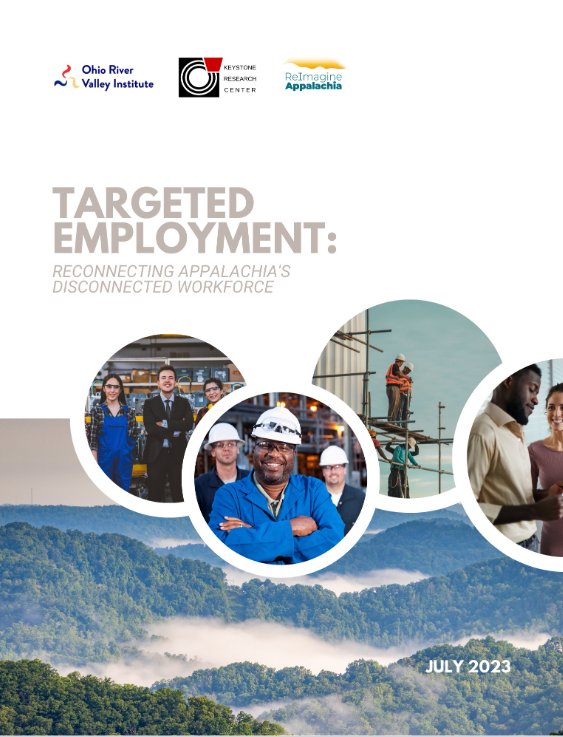
Targeted Employment: Reconnecting Appalachia’s Disconnected Workforce

By Claire Kovach, Stephen Herzenberg, Amanda Woodrum, and Ted Boettner - ReImagine Institute, Keystone Research Center, Ohio River Valley Institute, July 25, 2023

The Appalachian region has long suffered from not having enough good paying jobs. Even when the unemployment rate is low, too many Appalachians are disconnected from the workforce entirely due to a myriad of factors. The result has been a long-term structural unemployment problem that has persisted for decades, with too many Appalachian adults out of the workforce entirely and unable to secure a decent paying job where they live.

A federal job subsidy program that is targeted at breaking down barriers to employment – such as improving the skills and experience of potential workers to meet current employer demands in their local labor market – and connecting them with a job could not only boost incomes and improve the livelihood of thousands of Appalachians but also give people self-esteem, a source of identity, and feel more connected to their community.

This report examines the economic conditions of Appalachia with a particular focus on the Appalachian counties of four states—Kentucky, Ohio, Pennsylvania, and West Virginia—that comprise the footprint of ReImagine Appalachia and the Ohio River Valley Institute. This includes describing how Appalachia has been a “region apart” from the rest of America, including its history of resource extraction and exploitation, the collapse of the steel industry, and now coal, that has led to large employment losses in the area, and how the region’s uneven development has led to chronically low rates of employment, disenfranchisement from the labor market and even loss of hope underpinning the opioid epidemic from which the Appalachian region was particularly hard hit.

Download a copy of this publication here (PDF).

UAW Begins Big 3 Negotiations in a BIG WAY

Rail Worker FIRED on BULLSH*T Charges

By Union Jake and Adam Keller with Michael Paul Lindsey and Max Alvarez - Valley Labor Report, July 20, 2023

Cop City and the Escalating War on Environmental Defenders

By Basav Sen and Gabrielle Colchete - In These Times, July 13, 2023

The fight in Atlanta over Cop City, a massive police training facility, has turned into ground zero for overlapping crises facing our country: the climate emergency, vast political and economic inequality, ever-militarizing police forces and systemic racism. 

If we want a democracy healthy enough to solve these crises, it’s worth paying attention to what is happening in the South River Forest.

On May 31, in a disturbing move shortly before Atlanta’s City Council approved more funding for the facility, Georgia law enforcement arrested three members of the Atlanta Solidarity Fund, which provides activists with legal support and bail money. 

Organized bail support for activists is a longstanding tradition, exemplified by the historical precedent of churches and community groups raising funds to bail Martin Luther King, Jr. and other civil rights leaders out of jail. Now, however, the authorities are deeming such acts ​“money laundering” and ​“charity fraud.” 

In reality, the fund was targeted for supporting the Stop Cop City movement, which opposes the police training facility. 

Many in the community fear the Cop City facility will be used to train police in counterinsurgency, further militarizing an already armed and equipped force. In a city with wide wealth and income disparities, more militarized policing fits into what community activist Micah Herskind describes as ​“the state’s retreat from the provision of social welfare and the interrelated build-up of policing and imprisonment to manage inequality’s outcomes.” 

The facility is largely funded by the corporate-backed Atlanta Police Foundation (APF), whose donors include Amazon, JP Morgan Chase, Home Depot and Wells Fargo. Militarized policing is a growing concern in the United States, and corporate-funded militarized policing raises further unease about law enforcement becoming directly beholden to corporate interests. 

As local resident Brad Beadles put it, ​“When private corporate donors are able to fund militarized training facilities for the police, they are essentially buying off the police. They are making it clear who the police work for.”

Biological hazards in the working environment

By staff - International Labour Organization, July 13, 2023

The ILO released a report Biological Hazards in the Working Environment in 2022. The report contains a survey which calls on governments to respond and to ensure that employers and trade unions in their countries also respond. The ILO is now circulating the survey directly to trade unions and employers to ensure that it gets more response.

The promotion of safe and healthy working environments has been a constant objective of the International Labour Organization (ILO) since it was founded in 1919. The ILO has adopted a significant body of international instruments and guidance documents to promote the safety and health of workers and assist constituents in strengthening their capacities to prevent and manage workplace hazards and risks.

An important step forward in this respect was taken during the 110th Session (2022) of the International Labour Conference when the Occupational Safety and Health Convention, 1981 (No. 155), and the Promotional Framework for Occupational Safety and Health Convention, 2006 (No. 187), were recognized as fundamental Conventions within the meaning of the ILO Declaration on Fundamental Principles and Rights at Work. 1 Accordingly, all ILO Members, even if they have not ratified the Conventions in question, have now an obligation, arising from the very fact of membership in the Organization, to respect, to promote and to realize, in good faith and in accordance with the Constitution, the principles concerning the fundamental rights which are the subject of those Conventions.

Download a copy of this publication here (link).

Chemicals and climate change in the world of work: Impacts for occupational safety and health

By staff - International Labour Organization, July 5, 2023

Climate change has profound impacts on, and synergies with the world of work, especially regarding the sound management of chemicals. Many chemicals that are produced and utilized in the workplace can have impacts on the environment and climate, with climate change in turn impacting the ability to safely store, transport and use chemicals.Appropriate climate change adaptation and mitigation measures are needed as a matter of urgency.

The inclusion of a ‘safe and healthy working environment’ as an ILO fundamental principle and right atwork (FPRW) provides a framework for action to tackle emerging risks to workers from climate change,through a systems approach to managing occupational safety and health (OSH). Addressing harmful chemical exposures in the working environment through effective OSH policies and practices are a top priority for advancing climate change agendas and ensuring decent working conditions.

Download a copy of this publication here (link).

NLRB SLAMS Warrior Met for ILLEGAL BARGAINING PRACTICES

Storytelling on the Road to Socialism: Episode 16: A Teacher Speaks

By Candace Wolf - Storytelling on the Road to Socialism, July 4, 2023

On this episode, a teacher and former president of the Washington DC Teachers' Union tells the story of her work in the classroom as a radical teacher

Music:

  • The Internationale - Alistair Hulett
  • To Be Young, Gifted and Black - Nina Simone
  • Socialism is Better -words & music by Bruce Wolf; performed by Bruce Wolf, Noah Wolf, Gaby Gignoux-Wolfsohn

Stop Cop City Week of Action Showed Movement’s Strength Amid Rampant Repression

By Cody Bloomfield - Truthout, July 1, 2023

Much of the South River Forest, or as activists call it, Weelaunee People’s Park, has been clear cut. In a token gesture to the community, the city talked about opening a handful of trails in slivers of remaining public land. But driving past the original site of the occupation, there isn’t a tree in sight to hang a hammock on. At nearly 5:30 pm on a Saturday, three bulldozers rumble across the land, rearranging splintery piles of red dirt. Shadowbox Studios, also licensed to use the site, has completed construction. Ringing the perimeter of both, cop cars lurk, waiting for signs of trouble. I started counting in my head, then had to switch over to tally marks. Even taking photos is de facto forbidden; I was followed and then pulled over while trying to take photos from the street. By my count, 26 police vehicles were surrounding the site. The only sign of the previous occupation was a downed yellow tower, charred at the base, with “Defend the Atlanta Forest” written in green paint. In a tragic echo of the activists’ thriving mutual aid camps, the cops set up a couple tents of their own, where they could eat snacks out of a few metal trays and retreat to shade no longer provided by the Atlanta forest.

Coming into the week of action that took place June 24-July 1 — a week of protests, targeted boycotts and joyful celebration in nature designed to call national attention to Cop City — the threat of police repression weighed heavily on activists’ minds.

At Saturday’s opening carnival, one Atlantan, who wished to remain anonymous, was hard at work spray painting more t-shirts. Wearing handmade pinecone earrings and blue paint flecked combat boots, he painstakingly laid out foam letters as stencils. His own shirt said, “I can’t protest Cop City.” But upon request, he’d also make “I can protest Cop City” shirts.

“It’s about [addressing] the fear,” he explained. “Having solidarity with the people who are too afraid to protest. There’s the uncertainty and financial risk. It’s hard to evaluate risk — police stormed a protest downtown advertised as a vigil. I’m really rolling the dice about whether people will be holding hands or burning cars, or whether people holding hands will be attacked by police.”

Pages

The Fine Print I:

Disclaimer: The views expressed on this site are not the official position of the IWW (or even the IWW’s EUC) unless otherwise indicated and do not necessarily represent the views of anyone but the author’s, nor should it be assumed that any of these authors automatically support the IWW or endorse any of its positions.

Further: the inclusion of a link on our site (other than the link to the main IWW site) does not imply endorsement by or an alliance with the IWW. These sites have been chosen by our members due to their perceived relevance to the IWW EUC and are included here for informational purposes only. If you have any suggestions or comments on any of the links included (or not included) above, please contact us.

The Fine Print II:

Fair Use Notice: The material on this site is provided for educational and informational purposes. It may contain copyrighted material the use of which has not always been specifically authorized by the copyright owner. It is being made available in an effort to advance the understanding of scientific, environmental, economic, social justice and human rights issues etc.

It is believed that this constitutes a 'fair use' of any such copyrighted material as provided for in section 107 of the US Copyright Law. In accordance with Title 17 U.S.C. Section 107, the material on this site is distributed without profit to those who have an interest in using the included information for research and educational purposes. If you wish to use copyrighted material from this site for purposes of your own that go beyond 'fair use', you must obtain permission from the copyright owner. The information on this site does not constitute legal or technical advice.