You are here

climate change

California Weighs Help for Oil Workers in Green Future

By Anne C Mulkern - Energy Wire, January 31, 2022

California officials are brainstorming how to help oil industry workers as the state moves to phase out fossil fuels and replace gasoline-powered vehicles with electric cars.

Democratic Gov. Gavin Newsom’s office and legislators are talking to unions representing industry workers, and a new state Assembly document outlines potential solutions. But it’s a complex quandary, raising questions about whether to guarantee workers their current salaries and benefits as their jobs disappear.

“One of the major hurdles in transitioning existing fossil fuels activities to clean energy ones has been the potentially negative economic consequences to workers and communities,” according to a document from the Assembly Office of Policy and Research obtained by E&E News. “As the state implements its ambitious climate goals, there is an opportunity to assist workers impacted by the transition to a green economy.”

Nearly 112,000 people work in 14 fossil fuel and ancillary industries in California as of 2018, according to a report last year from the Political Economy Research Institute (PERI) at University of Massachusetts, Amherst. The total includes oil and gas extraction operations, and support activities, and sectors such as fossil-fuel-based power generation.

What California decides to do about oil industry workers has the potential to ripple beyond the nation’s most populous state, said Catherine Houston, legislative, political and rapid response coordinator with United Steelworkers District 12.That union represents many oil industry workers.

“California typically takes the lead in a lot of these types of things, and we become an example for other states across the nation,” Houston said. “So whatever we do can potentially serve as a federal model.”

Romanian Power Move: Retraining for a Just Transition from coal

By L. Michael Buchsbaum - Energy Transition, January 27, 2022

Following advice from the World Bank, most of Romania’s coal mines started shuttering in 1997. But this pivotal sector’s collapse left hundreds of thousands unemployed with few resources to help them transition to new careers. Only now, as the nation’s last underground mines prepare to close and Bucharest plots their lignite phase-out, are so-called “Just Transition” retraining programs and other projects finally being implemented. Next in the on-going Romanian Power Move series, lead blogger and podcaster, Michael Buchsbaum, reviews the nation’s rocky steps towards a “just” coal transition.

Romania’s black heart: Jiu Valley

After more than a century of mining, by the late 1970s some 180,000 miners were still busy wringing coal out of 14 mining complexes throughout Romania’s Jiu Valley. That changed dramatically beginning in 1997 when – following the restructuring programs imposed by the World Bank – many of the nation’s mines started closing. In a short time, some 90% of the region’s jobs were gone.

Though older and mid-career miners could retire early, as the sprawling mining operations closed, many young people fled. Since the region’s mono-industrial towns were built to house the coal miners who fueled the local economy: good work for most meant getting out. Some 40% of Jiu’s population did just that in the decade before Romania joined the EU in 2007.

“This lack of alternatives was the main issue that brought about negative consequences in the community,” related Roxana Bucata, a journalist and first year PhD candidate at the Central European University in Vienna focusing on energy transitions.

Throughout 2019 and 2020, as a Master’s student studying Just Transitions, Bucata traveled to the region to research how coal’s continuing demise was impacting the Jiu’s population.

Her interviews with local residents found “a general lack of trust towards any kind of authority or regional national union trade management. There’s been a lot of damage here,” she continued.

Now at the end of 2021, less than 4,000 miners are still pulling coal out of the valley’s four struggling deep mines. And with at least two more closures looming in 2022, most remaining workers are just hoping to stay on long enough to qualify for pensions or early buy-outs.

“We need something to replace mining jobs with,” Lucian Enculescu, the leader of the Livezeni ‘Libertatea 2008’ union said to the Guardian recently. “Anything.”

Why We Need to Be Able to Say No at Work

By Kristof Calvo and Marguerite van den Berg - Green European Journal, January 26, 2022

For most of us, life revolves around our jobs. As a result, efforts to improve people’s lives have focused on improving working conditions rather than challenging the centrality of work in our lives. Sociologist Marguerite van den Berg sets out to do just this in her recent book Werk is geen oplossing [Work is Not a Solution]. In this conversation with Belgian green politician Kristof Calvo, she explains how workers can recognise and assert their power.

Kristof Calvo: You write that everyone is tired and that no one has time, yourself included. Where did you find the time to write this book?

Marguerite van den Berg: I had a six-month fellowship at the Netherlands Institute for Advanced Study, and that gave me time to work on the book. But the pandemic shook things up. Suddenly everything that makes life worth living stopped – except for the work. I had to deal with that craziness. Suddenly I felt even greater urgency to write the book.

Every author has their own method. How did you work? With fixed days for writing or by finishing a short piece each day?

I already had some parts on paper, but I wrote as much as I could in the mornings. Our kids were still at home when my fellowship started in February 2021, but things improved from May onwards.

In your book, you argue for a different view: a shift from “I am tired” to “We are exhausted”. Is this the essence of your story?

Yes. I wanted to show that everyone is struggling on a personal level. Few dare to mention to anyone other than those close to them that they are worried about how they will get through the next week. I felt compelled to acknowledge this collective feeling of exhaustion as well as its political dimension. I specifically did not want to reduce it to the vulnerability and precariousness of certain groups. Exhaustion does not only occur on the “margins”; it is happening across the full breadth of society.

Your message is clear. You don’t spare anyone in your analysis.

I address everyone directly by using “we”. Where I make a distinction, as when I speak of a “boss”, it’s a deliberate choice; I’m not referring to the person but rather the hierarchies at work that demand more and more from us.

Labor Vision TV Green & Healthy Schools Initiative. Climate Jobs Rhode Island

By Autumn Guillotte, Erica Hammond, Mike Roles, Priscilla De La Cruz, and Justin Kelly - Labor Vision RI, January 25, 2022

Richmond Progressive Alliance Listening Project, Episode 2: At Our Expense

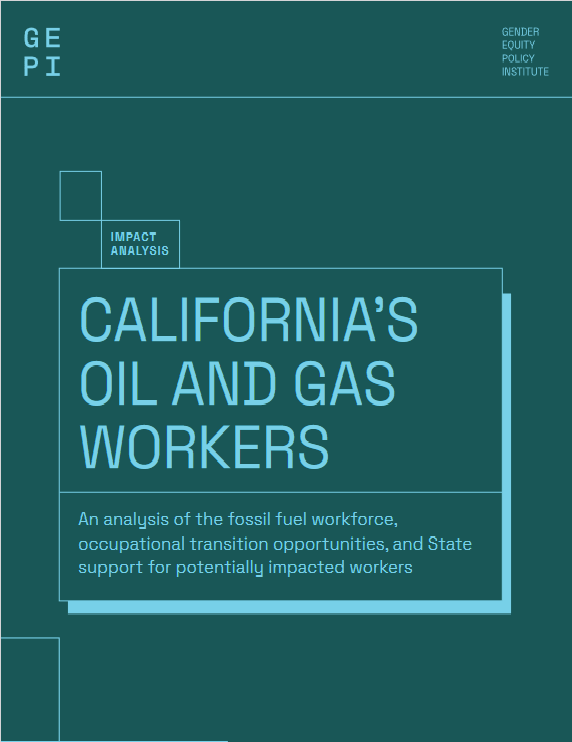
Impact Analysis: California’s Oil and Gas Workers

By Staff - Gender Equity Policy Institute, January 23, 2023

California’s ambitious climate goals, supported by state and federal investment, will create enormous economic opportunity over the coming decades. To meet the 2045 target of carbon neutrality, a 100% clean electric grid, and a 90% reduction in oil consumption and refinery production, the state will need to modernize its electrical grid and build storage capacity to meet increased demand for electricity. Carbon management techniques, plugging orphan wells, and the development of new energy sources such as geothermal will all come into play, providing economic opportunities to workers and businesses alike. Reducing use of polluting fossil fuels will likewise result in significant health benefits to Californians, especially to communities disproportionately burdened by polluting enterprises and proximity to freeways.

Supported by state investment and federal funding through the Infrastructure Investment and Jobs Act and the Inflation Reduction Act, the actions necessary to tackle the challenges of climate change are projected to create 4 million new jobs in the state. California is investing in developing the clean energy workforce, with an equity commitment to recruit and train historically disadvantaged and under- represented communities.

Decarbonizing the economy and accelerating the adoption of clean energy is necessary if we are to preserve a habitable planet. Progress to a carbon neutral future is already well underway in the state. Wind and solar power are less expensive than natural gas or coal powered electricity. A large majority of Californians are concerned about climate change and support action to address its impacts.

However, as with all sectoral economic change, some industries will grow and thrive, while others will shrink, leaving some of their workers behind. Labor unions and trades groups are rightly concerned that workers are not forced to abandon skills developed over their careers and thrown into an inhospitable labor market with no support.

Thus, a key challenge in meeting California’s climate action goals is to devise a fair, equitable, and empirically-based policy to provide support for workers at risk of unemployment and income loss as many factors combine to reduce demand in state for oil and gas products.

Beyond the Green New Deal: A Discussion with Monica Atkins of the Climate Justice Alliance

5 things Canada could defund to pay for an epic just transition: We could raise $180 billion a year to fund life-giving public goods by defunding five destructive areas of government spending

By Angele Alook, Emily Eaton, David Gray-Donald, Joël Laforest, Crystal Lameman, and Bronwen Tucker - The Breach, January 20, 2023

These days, anyone proposing ambitious new social programs—not to mention a generation-defining agenda like the Green New Deal—is bound to be met with a particular refrain of concern-trolling: “but how are you gonna pay for it?”

The most effective way to combat this is to point to tangible and truly giant expenditures that actively harm our communities—and which too often remain politically invisible. 

For decades, Canadian neoliberalism has ushered in an era of austerity, but the impacts haven’t landed equally. We’ve seen budget cuts for working people and the environment—borne most disproportionately by Black, Indigenous, and other racialized people and communities that are made vulnerable in our society. On the other hand, fossil fuel companies, the military, police, large corporations, and the wealthiest families have all actually received more support from the government. 

We have starved public goods, land, and life in order to feed Big Oil, corporate profits, and the security that capitalist growth requires.

But there are plenty of options to pay for a new direction: taxes on high earners and polluting firms, cutting military expenditure, long-term investment in green infrastructure, to name a few. The real issue is political will and political power. 

The money is there we just need to seize it

Just think about the impressive government policies put in place in the span of weeks when the COVID-19 pandemic first hit. This crisis has shown us that, when it comes down to it, the money and policy tools are there. And it is worth pointing out to anyone who asks this question that what we do not spend on climate action, adaptation, and upholding Indigenous sovereignty today will make this work much more expensive later on.

Including the large flows of public money as part of what’s up for debate helps to open up an accessible and potentially transformative conversation about what we could build instead. By asking tangibly what it would look like for the police to have less power over our communities—and particularly Black and Indigenous communities—we can start a public conversation about imagining and building a truly safe world.

The “refund” part of this strategy would include supporting many solutions, from universal public transit, to direct Treaty-based funding for Indigenous Nations, to affordable energy-efficient public housing, to community-owned renewable energy, to Canada forgiving illegitimate debts and paying reparations abroad to make space for a globally just transition. 

The exact demands can and should be made more specific to communities as they organize. In most of these cases, as we phase out funding for programs that are not serving communities, there are also other programs that will need to be built up at the same time. For example, we need mental health support and public housing alongside the defunding of police and prisons, as many abolitionist groups like Movement for Black Lives and The Red Nation have sketched in more detail.

The following is a non-exhaustive list of $180 billion a year in public money in Canada that could be cut, shifted, and phased out to lessen harm and free up both money and the public imagination towards a decolonial and just transition. 

Winning even one-quarter of this amount in the next few years would free up more than five times what the federal government was planning to spend each year on climate- related infrastructure and programs as of 2021. 

These figures are taken from a 2017 to 2019 average where possible to avoid potential anomalies in government spending during the beginning of the COVID-19 pandemic. For context, in 2019 the federal, provincial, and municipal governments together spent a total of $750 billion a year.

Richmond Progressive Alliance Listening Project, Episode 1: Lay of the Land

Unions and Climate Change: Toward Global Public Goods

Pages

The Fine Print I:

Disclaimer: The views expressed on this site are not the official position of the IWW (or even the IWW’s EUC) unless otherwise indicated and do not necessarily represent the views of anyone but the author’s, nor should it be assumed that any of these authors automatically support the IWW or endorse any of its positions.

Further: the inclusion of a link on our site (other than the link to the main IWW site) does not imply endorsement by or an alliance with the IWW. These sites have been chosen by our members due to their perceived relevance to the IWW EUC and are included here for informational purposes only. If you have any suggestions or comments on any of the links included (or not included) above, please contact us.

The Fine Print II:

Fair Use Notice: The material on this site is provided for educational and informational purposes. It may contain copyrighted material the use of which has not always been specifically authorized by the copyright owner. It is being made available in an effort to advance the understanding of scientific, environmental, economic, social justice and human rights issues etc.

It is believed that this constitutes a 'fair use' of any such copyrighted material as provided for in section 107 of the US Copyright Law. In accordance with Title 17 U.S.C. Section 107, the material on this site is distributed without profit to those who have an interest in using the included information for research and educational purposes. If you wish to use copyrighted material from this site for purposes of your own that go beyond 'fair use', you must obtain permission from the copyright owner. The information on this site does not constitute legal or technical advice.