You are here

climate justice

Greens must back striking British Airways workers to build the coalition we need for a just transition

By Matthew Hull - Bright Green, July 3, 2022

A quiet revolution is underway. Across two weeks and through three days of industrial action by the RMT trade union, the British public may have rediscovered what it feels like to take the side of organised workers against a recalcitrant UK government.

Amid soaring bills and prices, and with the Tory government steadfastly refusing to put people’s lives before profits, it is easy to understand why sympathy for striking workers is growing.

Of course it would be easy to overstate this case. Trade unionism never left these shores, and the power of militant unions like the RMT has been built up over years of hard organising work.

Equally, it would be presumptuous in the extreme to argue that one still-ongoing dispute could undo decades of neoliberal policies designed to mute and muzzle trade unions.

Nevertheless, something is taking hold. Polls revealed that striking railway workers have the undisputed support of a majority of people in the UK, should they opt for further industrial action. What’s more, that support has grown with every media performance by the RMT’s general secretary Mick Lynch, whose directness and refusal to pander to the nonsense so typical of broadcast media has proved a winning combination.

This progress is precious, and it is our responsibility as trade unionists and the broader Left to preserve and expand it.

For Greens and environmentalists, the response to the RMT strikes so far has an additional, special resonance.

In June, hundreds of environmental justice campaigners joined RMT members on picket lines, raised money for their national dispute fund, and made their public support for the strikes impossible to ignore. This included many Greens across England and Wales, led by the party’s Trade Union Group. The Greens were the only UK parliamentary party to be unambiguously supportive of the RMT’s actions.

Defending and expanding national and municipal railway networks is centrally important to winning a just transition to a zero-carbon economy. Without massively increasing our capacity to move around using collective and sustainable modes of transport, the work of the environmental justice movement is over before it has begun.

In this process, protecting jobs and improving the pay, conditions and security of workers on our railways is key. There can be no just and fair transition to a zero-carbon world without worker empowerment.

Environmental justice campaigners and Greens should take this insight and apply it to workers’ struggles across all
sectors.

Rutgers Educators Fight for Climate-Safe New Jersey

By staff - Labor Network for Sustainability, July 2022

<

The faculty and graduate worker union at Rutgers University has stepped out to oppose a plan to haul liquified fracked gas across southern New Jersey. The Star-Ledger has just published an op ed by two union leaders explaining why:

A proposal to transport liquified fracked gas on trains and in trucks through densely populated Camden, Philadelphia and southern New Jersey threatens enormous harm across the region. As Rutgers-Camden faculty, we stand with Camden residents and community groups in opposing this dangerous and potentially catastrophic proposal.

Our faculty and graduate worker union at Rutgers believes in “bargaining for the common good”; a labor strategy that builds community-union partnerships to achieve a more equitable and sustainable future. As this project demonstrates, our lives and well-being are deeply interconnected. We are stronger when we organize together with our partners against threats to our communities, our environment, and our collective future. We must work together to make our communities safer and more sustainable. Opposing the transport of LNG is one way to address these concerns, given the risks of the proposed plan and the carbon emissions associated with LNG.

The opinion piece was written by Jovanna Rosen, assistant professor of Public Policy at Rutgers-Camden and a member of the Rutgers AAUP-AFT Climate Justice Committee and Jim Brown, associate professor of English at Rutgers-Camden and president of the Camden Chapter of Rutgers-AAUP-AFT.

All Climate Politics is Global

By Paul Atkin - Greener Jobs Alliance, June 30, 2022

As revealed in this Oxfam Report, the poorest 50% and middle 40% of the global population have a minimal or declining carbon footprint. The top 10%, and even more the top 1%, already have carbon footprints that are unviable and are increasing so fast that they will have bust us through the 1.5C limit on their own by 2030.

The top 10% are people who are on more than £125,000 a year. Most of them live in the Global North, but are a minority even here. The working class in the Global North, is overwhelmingly in the middle 40%.

The strategy of the ruling class in the Global North is primarily to sustain their own wealth and power. 

  • Some of them are in denial about climate change as a result.
  • Even those that recognise reality can only envisage a green transition which prioritises their own consumption standards by keeping the bottom 50% impoverished. Carbon offsetting by keeping the global majority in their place.
  • Hence the failure to transfer investment to the Global South and the prospect that the 350 carbon bombs identified by the Guardian will be dropped; because it is profitable to do so.
  • This underlines the paradox of the debate about “stranded assets”, as assets are only stranded if there is a viable transition. If there isn’t, they stay profitable until everything collapses around us; which will always be the stronger motivation for companies operating on quarterly profit returns. The notion that Fossil Fuel capital will be more motivated by social responsibility than profits runs counter not only to the record of its counterparts in the tobacco and asbestos industries, but also its own record in covering up its own research on the climate impacts of its operations from the 1950s onwards. They knew. They covered it up. Now that we know, they greenwash instead.
  • As they recognise that climate breakdown will create social and political crises on an unimaginable scale, from waves of climate refugees to possible war in the Arctic, they are prioritising military spending over solving the problem. The US government is spending 14 times as much on its armed forces as it planned to do on domestic climate measures – and then didn’t agree to. They have committed $40 billion to stoke the war in Ukraine rather than seek a peace deal; while climate transition funding for the Global South is reluctantly dispensed through an eye dropper.

What that means is an immediate future dominated, not by win-win global cooperation to solve our problems and build a sustainable society, but by wars and crises that make doing so ever more difficult. Campaigning against these is an urgent priority for anyone committed to Just Transition. 

Why Climate campaigners should support the rail unions

By Paul Atkin and Tahir Latif - Greener Jobs Alliance, June 23, 2022

What is the link between climate action and stopping the decline of public transport?

From the RMT: “We want a transport system that operates for the interests of the people, for the needs of society, and our environment – not for private profit”.

This government is failing on the climate crisis. It has no integrated transport plan, is not realising the need to address aviation and motoring and to prioritise public transport. It favours private companies which make vast profits rather than making transport affordable and our air breathable.

Why are our railways being subjected to a ‘managed decline’ just when we need them the most?

From the TUC “Network Rail plans to cut annual expenditure by £100 million, mainly through the loss of 2,500 rail maintenance jobs. RMT analysis of Network Rail data finds that this will lead to 670,000 fewer hours of maintenance work annually. Network Rail responsibilities include track maintenance – essential to avoiding fatal accidents like Hatfield, which was the result of the metal tracks fatiguing”. 

The government is committed to following free market ideology, the ‘logic’ of which produces a managed decline of much-needed rail services, imposing a 10% annual cut to the running costs of the railways (and even more on the buses in London, with 20% of services threatened).

Meanwhile £27Bn is planned to be spent on roads. This can only increase car use, with negative effects on air pollution, carbon emissions, congestion, accidents, inhibition of active travel and hitting commuters hard in the pocket while boosting the profits of the fossil fuel companies.

No Climate Justice Without Workplace Justice!

By Tahir Latif Secretary, Greener Jobs Alliance - Greener Jobs Alliance, June 23, 2022

The industrial action currently being taken by the RMT is a source of hope and inspiration for workers across the country. But it is also action aimed at a more sustainable transport system that works for people and planet. The Greener Jobs Alliance fully endorses the statement set out here, produced by the Climate Justice Coalition.

“The Climate Justice Coalition stands in solidarity with RMT members taking industrial action to protect their pay, jobs and working conditions, and the wider fight to protect a public transport system for people – social need – not private greed. Billions are being cut from our transport system at a time when we should be increasing investment to ensure a fully public, affordable, and integrated transport system. Rail is critical to decarbonising the transport sector; £27 billion for more new roads and cutting duty on domestic aviation is the wrong way round.

Our railways are already being impacted by the effects of climate change, putting additional demands on a stretched workforce providing an essential public service. This action by the Government is symptomatic of their disregard for the concerns of climate, environment and workers.

As a coalition representing groups within climate and environmental campaigns, faith, race and social justice groups, and trade unions, we call on you all to support this struggle. This includes adding our voices to resist the anti-trade union and worker narrative being driven by the Government in the mainstream media and publicise that it is their inaction and behaviour that is detrimental to people, not workers seeking justice.

Inaction on climate change is harming innocent people across the globe. Protecting the rights of workers and living standards must be a priority for the climate justice movement in fighting for a Just Transition to a zero-carbon economy.

We stand with the RMT to fight for their aims, and to campaign for a better deal for workers and a fairer, climate just, society.”

America’s Biggest Public Pension Fund Is Slow-Walking Corporate Climate Action, Report Charges

By Sharon Kelly - DeSmog, June 16, 2022

CalPERS says it needs to hold onto billions in fossil fuel shares in order to push polluters in the right direction – but a new report details a pattern of voting against climate proposals.

Does engaging with oil and gas giants by remaining invested in them – keeping a “seat at the table” – help in the fight against climate change? 

A new report suggests not very much – at least judging by the record of the California Public Employees’ Retirement System (CalPERS).

The report by environmental group Fossil Free California takes the public pension fund to task for its results to date, highlighting its history of pushing “the importance of corporate engagement on climate change” in public statements, while simultaneously voting against climate measures in shareholder meetings.

The report details dozens of votes against climate measures by CalPERS this year — including votes against greenhouse gas reduction targets at Royal Dutch Shell, against reporting and reducing greenhouse gas emissions at BP, and against pushing big banks to get in line with international “net zero by 2050” strategies.

In fact, CalPERS has voted against every climate resolution at major American and Canadian banks so far this year, the report claims.

The report also casts doubt on one of the biggest accomplishments of CalPERS’ engagement strategy – the election of several new members to ExxonMobil’s board of directors last year, nominated by the activist investment firm Engine No. 1. The report faults Engine No. 1’s directors for voting against two recent proposals to set greenhouse gas targets that would account for the pollution caused by the fossil fuels ExxonMobil sells, and to produce a report on low-carbon business plans.

“Despite their best efforts, CalPERS and [California’s other major pension fund] CalSTRS have failed to persuade fossil fuel companies to reduce their greenhouse gas emissions, increase their renewable energy production, or transition from fossil fuels to renewable energy,” the report concludes. “By opposing climate proposals at the very companies they claim to influence, the funds’ shareholder activism is not only ineffective – it’s undermining climate action.” 

California lawmakers are currently considering a bill that would spur these pension funds, which invest retirement funds for state employees – including many, like the state’s firefighters, who are today on the front lines of the climate crisis – to drop their investments in fossil fuel producers.

The fund has an estimated $7.4 billion worth of fossil fuel investments that the bill would require them to shed. In April, its board voted to oppose that law, arguing that it would lose its “seat at the table,” only to be replaced by investors that “may not have the same interest in long-term sustainability as CalPERS”..

CalPERS declined comment on Fossil Free California’s new report.

Against climate change, against dictatorship: a message from Cairo

By the Egyptian Campaign for Climate and Democracy - Egypt Solidarity, June 2022

Egypt Solidarity Initiative has received the following message from Egyptian activists who have been involved for many years in campaigns for democracy, trade union and human, and environmental justice. We are publishing this on their behalf because the level of repression prevents the publication of an open appeal from inside the country.

This November the COP 27 conference will be held in the tourist town of Sharm El-Sheikh in the Sinai Peninsula, in Egypt. The governments of the world have broken nearly all the promises made in the Glasgow COP 26. We are all inching closer to a climate catastrophe, but political leaders and major corporations are too immersed in their competition for resources, markets and geopolitical dominance to take the necessary measures to save our planet.

It is becoming clearer every day to millions of people across the globe that only a grassroots movement can force through actual change.

Yet the COP 27 conference is taking place in an isolated heavily policed tourist resort with only one major road in and out, and hotels that are required to charge rates that might push the entire COP beyond the means of many grassroots organisations, particularly those from poorer countries. The Egyptian government has announced that there will be space for opposition during the conference, but what they actually mean is that activists will be offered fake ‘astroturfed’ protests in which state-affiliated NGOs demonstrate near the convention centre to deliver the impression of an independent local civil society. No real Egyptian opposition activists will be allowed near Sharm El-Sheikh during the conference. It would be a shame if genuine global grassroots movements are fooled into taking part in such a state-orchestrated charade.

While the Egyptian government is preparing to host COP27, thousands of people, among them human rights defenders, journalists, peaceful protesters, lawyers, opposition politicians and activists continue to suffer in Egyptian jails in brutal conditions, solely for exercising their rights to freedom of expression, association or peaceful assembly, without legal basis or following grossly unfair trials. Egypt is an African country and part of the Global South. But Egypt is also a country ruled by a brutal and corrupt military dictatorship. The regime of Abdelfattah El-Sisi, will present itself during the conference and in the months leading to it, as championing the needs and demands of the Global South in general and the African continent in particular. This is a great lie. The only thing this regime represents is the military junta that has been in power since 2013.

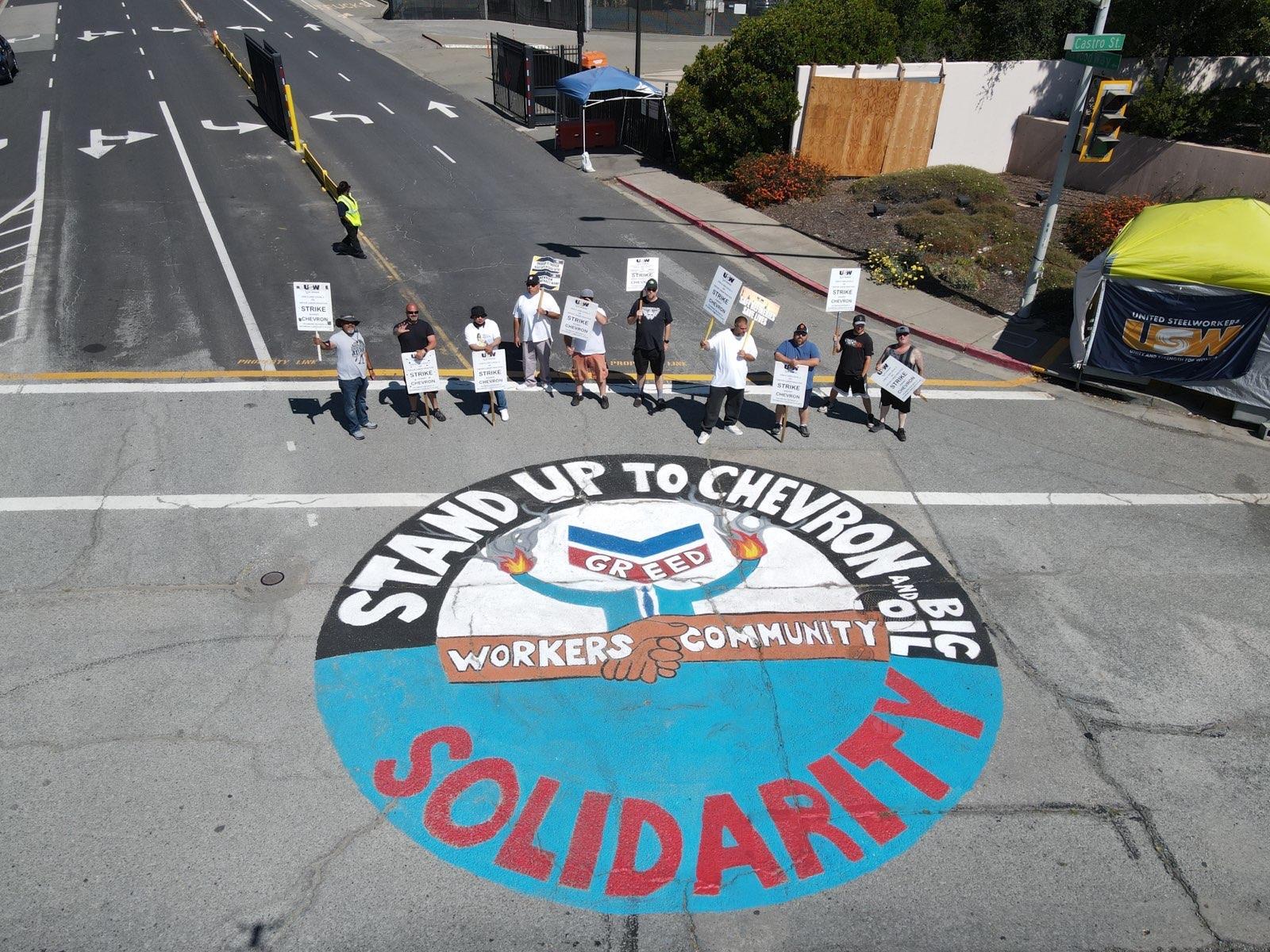
Anti-Chevron Day 2022 in Richmond, CA

Are Refinery Workers Climate Enemies? - Part 2

By That Green Union Guy - IWW Environmental Union Caucus, May 25, 2022

For context and background, see part one, here. Unlike the first installment, this second response has ommitted the comments that preciptated it, for the sake of clarity, as well as the fact that the author tried to echo the rebutted points in the response. It should be noted that only one individual has expressed outright opposition to showing solidarity with striking refinery workers. It's a foregone conclusion that the overwhelming majority of the IWW does not share this one individual's view.

First of all, let me be clear: my position is that humanity must collectively phase out burning fossil fuels for energy, transportation, and locomotion as rapidly as possible.

That said, nobody seriously believes we can collectively cease burning fossil fuels in a single day, so the likelihood is that the burning of them will continue for some time (I aim to make that as little time as possible).

Regardless of how long it takes, no oil refinery is going to simply shut down just because large masses of people, even 3.5% of the population demand it. It’s not even technically possible, let alone economically or politically possible. Most of the Environmental Justice and Climate Justice organizations (other than a few ultra-sectarian extremists) get this, and they’ve crafted their demands accordingly.

While there’s a degree of variation among the various organizing, most of them call for the following:

  1. No new extraction of new fossil fuel sources;
  2. Rapid phase out of existing fossil fuel sources;
  3. Managed decline of the existing fossil fuel supply chain;
  4. Just transition for any and all affected workers in the entire fossil fuel supply chain;
  5. Repurposing of equipment for non fossil fuel burning purposes;
  6. Bioremediation of damaged ecosystems across the extraction supply chain;
  7. Reparations for the affected communities and tribes.

Supporting refinery workers involved in a strike is not in any way contradictory to the above demands.

Climate Justice and Class Struggle: Online Screening Event

By staff - IWW Ireland, May 18, 2022

Climate Justice and Class Struggle: Scheduled Screening to take place HERE on

Tuesday May 24, 2022 @ 1800 hours GMT

Global May Day is a project for grassroots labour unions and initiatives supporting labour struggles to make our work more visible and support each other across borders.

This year we chose to draw attention to the ecological crisis we all face and tilted a series of events around Climate Justice and Class Struggle.

A crisis brought about by the endless search for profit margins by capitalist interests. A crisis which will see wars raging worldwide, making the poorest of us suffer the earliest and most.

The global ecological crisis is an issue for the working class worldwide and already there are many of us engaged in fighting against its impacts in our local areas.

This coming Tuesday May 24, 2022 we will host and online screening of a number on important environmental struggles currently taking place around the world. It is vital that each of these campaigns be highlighted and supported.

To take part in this online screening event as part of the Global May Day events, please tune in online HERE on Tuesday May 24, 2022 at the following time @ 1800hours GMT

To find out more about Global May Day 2022 reports, you can click on the following link HERE

#1World1Struggle

#globalmayday2022

Pages

The Fine Print I:

Disclaimer: The views expressed on this site are not the official position of the IWW (or even the IWW’s EUC) unless otherwise indicated and do not necessarily represent the views of anyone but the author’s, nor should it be assumed that any of these authors automatically support the IWW or endorse any of its positions.

Further: the inclusion of a link on our site (other than the link to the main IWW site) does not imply endorsement by or an alliance with the IWW. These sites have been chosen by our members due to their perceived relevance to the IWW EUC and are included here for informational purposes only. If you have any suggestions or comments on any of the links included (or not included) above, please contact us.

The Fine Print II:

Fair Use Notice: The material on this site is provided for educational and informational purposes. It may contain copyrighted material the use of which has not always been specifically authorized by the copyright owner. It is being made available in an effort to advance the understanding of scientific, environmental, economic, social justice and human rights issues etc.

It is believed that this constitutes a 'fair use' of any such copyrighted material as provided for in section 107 of the US Copyright Law. In accordance with Title 17 U.S.C. Section 107, the material on this site is distributed without profit to those who have an interest in using the included information for research and educational purposes. If you wish to use copyrighted material from this site for purposes of your own that go beyond 'fair use', you must obtain permission from the copyright owner. The information on this site does not constitute legal or technical advice.