You are here

ecosocialism

Death or Renewal: Is the Climate Crisis the Final Crisis?

By Wayne Price - Anarkismo, July 13, 2021

Classical socialists, both anarchists and Marxists, have written of the eventual end of capitalism--either through a popular revolution creating a new society or through the self-destruction of capitalism. Global warming raises the question of whether humanity is now facing such a possible total crisis, of choosing between socialism or social ruin.

Recently a friend sent me an article by Simon Lewis, a professor of global change science at the University College of London. Its title (Lewis 2021) was, “Canada is a warning: more and more of the world will soon be too hot for humans” and its subtitle was, “Without an immediate global effort to combat the climate emergency, the Earth’s uninhabitable areas will keep growing.

This led me to think of the apocalyptic warnings of the socialist tradition, the most well-known, perhaps, being Rosa Luxemberg’s “socialism or barbarism.” In 1878, Friedrich Engels wrote that the bourgeoisie was “a class under whose leadership society is racing to ruin…If the whole of modern society is not to perish, a revolution in the mode of production and distribution must take place, a revolution which will put an end to all class distinctions.” (Engels 1954; 217-8) Capitalism’s “own productive forces…are driving the whole of bourgeois society towards ruin or revolution.” (228)

Marx began his 1848 Communist Manifesto by claiming, “The history of all hitherto existing society is the history of class struggles…that each time ended, either in a revolutionary re-constitution of society at large, or in the common ruin of the contending classes.” (2013; 60-61) So, there is an historic choice between “revolutionary re-constitution” or “common ruin.” (This raising of two possible outcomes seems to be contradicted by the Manifesto’s later statement—about the capitalist class, “Its fall and the victory of the proletariat are equally inevitable.” [73] I will not discuss whether Marx was a determinist, and, if so, of what kind.)

This was also an anarchist concept, integrating the problems of capitalism and its state. In 1898, Peter Kropotkin concluded The State--Its Historic Role, "Death--or renewal! Either the State for ever, crushing individual and local life, taking over in all fields of human activity, bringing with it all its wars and domestic struggles for power...which only replace one tyrant by another, and inevitably at the end of the development there is--death! Or the destruction of States, and new life starting again in thousands of centers on the principle of the lively initiative of the individual and groups and that of free agreement. The choice lies with you!” (1987; 60)

Power, Workers, and the Fight for Climate Justice

By Tara Olivetree (Ehrcke) - Midnight Sun, July 12, 2021

Power

Who has more power than Shell Oil? This is one of the first questions a climate activist should ask themselves, because without finding an answer, we can’t win.

The power of the fossil fuel industry is massive. Fossil fuel companies are worth at least $18 trillion in stock equity, which represents about a quarter of total global stock markets. These vast resources and their outsized share of the world economy allow the industry to continually assert their interests, no matter the destruction this entails. They do so through any means available, of which there are many.

The notorious work of Exxon in first understanding, and then deeply misrepresenting, the science on climate change is one example. After generously funding its own climate research, and being told explicitly in 1977 that global warming due to the burning of fossil fuels was likely to lead to a two- to three-degree increase in global temperatures, Exxon embarked on an industry-wide quest to promote doubt in the science. This lengthy “fake news” campaign cost millions of dollars, and arguably set back the climate movement by decades.

However, the power of the fossil fuel industry goes well beyond the manipulation of global public thought. From the time of the industrial revolution in the 19th century, the history of modern capitalism has been replete with wars fought over fossil fuels. These have served to maintain strategic interests and, just as importantly, the profits of fossil fuel companies. A map of twentieth-century imperial conquest would show the disproportionate number of wars waged in the Middle East, where the world’s largest and cheapest oil deposits lie. As Alan Greenspan, a former chair of the US Federal Reserve, stated about one of these wars: “I am saddened that it is politically inconvenient to acknowledge what everyone knows: the Iraq war is largely about oil.”

How, then, do we go about exerting equivalent force, in order to dismantle the fossil fuel industry within the limited timeline outlined by scientists, while at the same time building an equitable, habitable, and just society?

There are a number of competing answers to this question. 

The Sydney “Green Bans” Show How We Can Transform Our Cities

By Kurt Iveson - Jacobin, July 10, 2021

In the 1970s, trade unions in Sydney began imposing “green bans” on property developments that were going to cause social and ecological harm. The movement should be an inspiration for challenges to the power of big business everywhere.

Fifty years ago, in June 1971, the New South Wales branch of the Builders Labourers Federation (NSWBLF) voted to ban construction of a luxury housing development in the Sydney harborside suburb of Hunters Hill. Their bulldozer-driving comrades in the Federated Engine Drivers and Firemen’s Association followed suit. The goal was to protect Kelly’s Bush, one of the last undeveloped areas of bushland on Sydney Harbour.

Over time, the tactic they used came to be known as a “green ban,” distinguishing it from a more conventional “black ban.” While trade unions imposed the latter in disputes over wages and conditions, green bans blocked construction on projects that were environmentally or socially destructive, or that threatened sites with heritage value.

The Kelly’s Bush green ban resulted from an unlikely alliance. Hunters Hill was a wealthy suburb, and most residents had little to do with the workers’ movement. Earlier that month, however, the Battlers for Kelly’s Bush — a resident action group — held a meeting of over six hundred people. It called on the unions to protect the bushland.

The NSWBLF was militant, proudly working-class, and maligned by respectable opinion. It was led by socialists and communists. Yet the union found common cause with the middle-class Battlers for Kelly’s Bush.

NSWBLF secretary Jack Mundey explained the union’s decision in a 1973 interview:

What is the good of fighting to improve wages and conditions if we are going to choke to death in polluted and planless cities? We are fighting for a shorter working week. If we get it, we still have to live in these cities. So “quality of life” should not just become a cliché. It should become a meaningful thing, and the workers should be concerned about every aspect of life — not just their working conditions.

Developer AVJennings attempted to circumvent the green ban by using nonunion labor. The NSWBLF hit back. Union members employed at another Jennings site sent a telegram to the developer’s head office: “If you attempt to build on Kelly’s Bush, even if there is the loss of one tree, this half-completed building will remain so forever, as a monument to Kelly’s Bush.”

The NSWBLF executive backed up their members’ threat. In August, AVJennings shelved their development plans. Kelly’s Bush remains untouched to this day.

Read the rest here.

Green Left Show #14: Why nuclear is NOT a climate solution

What Might an Ecosocialist Society Look Like?

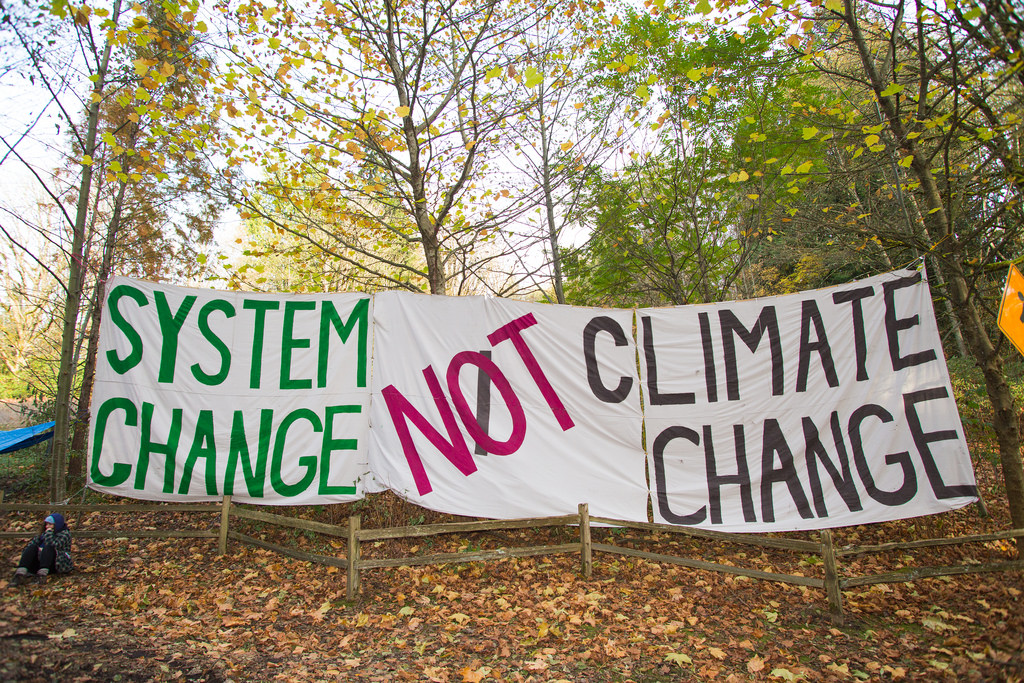
By David Klein - System Change not Climate Change, June 27, 2021

Why can’t the problems that ecosocialism would solve also be remedied within the current global capitalist system?

Before describing possible features of a future ecosocialism, it is worthwhile to consider why such a system is even needed. Why can’t the problems that ecosocialism would solve also be remedied within the current global capitalist system? Part I of this essay addresses that question by summarizing recent scientific reports on the state of the climate and extent of the ecological crisis; reviewing available methods and technologies that could be used to address the climate and ecological crises; and briefly describing capitalism’s structural inability to provide solutions at the scale of the crises. Part II then takes up the subject of the title, ecosocialism, along with strategies to move in that direction. 

Part I: Context and Background

The threat to life on Earth posed by the climate and ecological crises can hardly be overstated. A 2019 Nature article warned that up to a million species of plants and animals are on the verge of extinction, and a United Nations study the same year identified global warming as a major driver of wildlife decline. Much of the devastation to date was catalogued in the 2020 WWF Living Planet report, which recorded a 68 percent decline in the population of vertebrates around the world, in just the past five decades. More succinctly, scientists report that Earth is experiencing a sixth mass extinction. (The previous mass extinction, 66 million years ago, ended the dinosaurs).

The scale of the environmental crisis is unprecedented in human history. At stake are human civilization and billions of lives. An article last year in Proceedings of the National Academy of Sciences predicted that for every additional 1̊C rise beyond the 2019 global average, a billion people will be forced to abandon their locations or endure insufferable heat. The paper warns that under a scenario of increasing emissions, areas now home to a third of the world’s population could experience the same temperatures as the hottest parts of the Sahara within 50 years. 

Summing up the findings of some 150 scientific studies, a 2021 paper authored by 17 scientists warned that the “scale of the threats to the biosphere and all its life forms –- including humanity –- is in fact so great that it is difficult to grasp even for well-informed experts.” Adding further urgency, 101 Nobel laureates released an open letter in April 2021 in which they wrote, “We are seized by the great moral issue of our time: the climate crisis and commensurate destruction of nature.” The laureates called for a worldwide fossil fuel non-proliferation treaty

Global heating is driven by greenhouse gases in the atmosphere, and yet emissions continue at high levels despite the chorus of promises by “climate leaders” in governments. In 2020 global emissions decreased by a meager 5.8 percent due to Covid-19 lockdowns, but they were already on the rebound by the end of the year. For the current year, 2021, the International Energy Agency (IEA) forecasts the second largest annual increase in history of greenhouse gas emissions, as global economies recover from the Covid-19 recession. In May 2021 a record-breaking monthly average concentration of 419 parts per million (ppm) of CO2 was measured in Mauna Loa, Hawaii, breaking the previous May 2020 record of 417 ppm. 

The drivers of ecocide, more generally, include not only climate change, but also habitat destruction, toxic dumping, plastic pollution in the oceans, radiation poisoning, and other customary byproducts of the global capitalist economy. All of this destruction continues unabated despite the flood of warnings from scientists, lobbying by environmental activists, and even warnings from institutions deeply rooted in the capitalist economy. 

Consider, for example, that in May 2021 the IEA released an unprecedented call to the world to rapidly reach zero emissions in its report, Net Zero by 2050: A Roadmap for the Global Energy Sector. Widespread news coverage and expressions of optimism followed. Yet from February to the end of April 2021, the Biden administration approved nearly 1200 drilling permits on federal lands, along with more than 200 offshore permits, and defended in court the ConocoPhillips Willow project in Alaska, which is expected to emit 260 million metric tons of CO2 during the next 30 years, the equivalent of 66 coal-fired plants. And Biden is far from alone among world leaders in his support of fossil fuel expansions.

The Red Deal: Indigenous Action to Save our Earth

By Susan Rosenthal - The Bullet, June 23, 2021

Indigenous people have been fighting to survive for centuries. Recently, their struggles have become more militant, more global, and less isolated, aligning with other anti-racist and anti-colonial movements, and leading the environmental movement.

The growing challenge that Indigenous people pose to capitalist rule can be measured by the increasing use of military force to suppress their rebellions and by the targeted murders of Indigenous activists.

In Canada, the portion of Indigenous people incarcerated in federal facilities rose from under 18 per cent in 2001 to over 30 per cent in 2020. Indigenous women are just 4 per cent of the Canadian population, yet form an astonishing 42 per cent of all female prisoners in federal custody.

Imprisoning an adult in Canada costs about $10,000 per month, a minuscule sum compared with the profits that flow from exploiting Indigenous lands. Speaking for all capitalists, the president of Brazil remarked, “Where there is Indigenous land, there is wealth underneath it.”

10 reasons why climate activists should not support nuclear

By Simon Butler - Climate and Capitalism, June 23, 2021

In a recent Guardian article, Jacobin magazine’s founding editor Bhaskar Sunkara declared that “If we want to fight the climate crisis, we must embrace nuclear power.” He praised nuclear as a clean and reliable and suggested that opponents of nuclear power are either gripped by “paranoia … rooted in cold war associations” or are relying on “outdated information.”

I disagree entirely. Here are 10 reasons why nuclear power is still no solution for climate change.

1. Nuclear is dangerous. Building many new nuclear power plants around the globe means a higher risk of unpredictable Fukushima-type accidents. We know more extreme weather events are locked in due to climate change, adding to the danger as time passes.

What if a nuclear power plant had been in the path of Australia’s huge bushfires in 2020? What nuclear power plant could withstand super typhoons like the one that flattened Tacloban City in the Philippines in 2013? What if a nuclear plant was submerged by unexpectedly massive floods, like those in Mozambique for the past three years in a row?

Planning for a hotter future means switching to safer, resilient technologies. Building more nuclear power plants in this context is reckless.

2. Nuclear wastes water. Nuclear power is an incredibly water-guzzling energy source compared with renewables like solar and wind. We know climate change-induced droughts and floods will make existing freshwater shortages a lot worse. So it’s a bad idea to waste so much water on more nuclear.

Uranium mining can also make nearby groundwater unusable forever. Half of the world’s uranium mines use a process called in-situ leaching. This involves fracking ore deposits then pumping down a cocktail of acids mixed with groundwater to dissolve the uranium for easier extraction. This contaminates aquifers with radioactive elements. There are no examples of successful groundwater restoration.

Transformation is Not a Metaphor

By Jevgeniy Bluwstein - Political Georgraphy Institute, June 17, 2021

In this intervention I highlight an element that has been overlooked in this important debate about “progressive environmental futures” (Robbins, 2019, p. 1) – the dismantling of fossil capitalism. More still, I argue that some perspectives in this forum may even distract our attention from a more direct engagement with this – in my view – most urgent question of our time. Ultimately, I suggest that by not engaging this question head on, debates about “transformation” risk rendering it a metaphor.

Here, I am inspired by the influential critique of decolonial scholarship by Tuck and Yang (2012), who insist that “decolonization is not a metaphor.” Tuck and Yang (2012) maintain that while the decolonization of academic and educational institutions through the recognition and integration of alternative knowledges is important, this is not the central objective of decolonization. Writing from a settler-colonial context, the authors suggest that “[u]ntil stolen land is relinquished, critical consciousness does not translate into action that disrupts settler colonialism” (Tuck & Yang, 2012, p. 19). In a settler-colonial context, decolonization thus must go beyond the usual critique of epistemology and beyond calls for decolonizing knowledge and methodologies. Above all, land has to be given back and colonial property relations dismantled.

Although Tuck and Yang's intervention is specific to a settler-colonial context, and thus should not be generalized, it resonates with broader critiques raised against recent trends in decolonial and ontopolitical scholarship. For instance, Chandler and Reid (2020, p. 494) are frustrated with the exuberant attention to the “coloniality of knowledge” at the expense of paying due attention to “the coloniality of real inequalities and injustices in the world.” Relatedly, the late David Graeber sees a lack of engagement with material questions of slavery, class, patriarchy, war, police, poverty, hunger and inequality in scholarship that privileges multiple ontologies of being and epistemologies of knowing (Graeber, 2015).

Drawing on these perspectives about the limits of critique, here, I draw a parallel between decolonization that requires land repatriation and not just the decolonization of knowledge production, and a vision of transformation that requires the rapid, ruptural dismantling of fossil capitalism and not just the transformation of our understanding of socio-ecological limits. In this vein, a vision of transformation that is not a metaphor needs to go beyond questions and critiques of limits, technology, labor and growth (however illuminating they may be), and to engage more directly with political strategy, organization and praxis in the here and now. After all, what matters is “which strategies can actually work to address the environmental and social crises the world faces” (Bliss, 2021, p. 1).

But isn't addressing environmental and social crises exactly what the debate in this forum is ultimately about? Yes and no. Yes, because a post-capitalist future is central to both, a degrowth and a socialist modernist vision, although in different ways. No, because this forum has not touched upon questions of political strategy, organization, and praxis for short-term dismantling of fossil capitalism, even though both camps agree that capitalism is the single biggest obstacle towards progressive environmental futures. Hoping that a future world of degrowth or socialist modernism will get us beyond fossil capitalism by, say 2050, is akin to placing our hopes in not-yet-available negative-emission technologies. Put differently, if net-zero emissions discourses risk leading to mitigation deterrence and becoming a spatiotemporal fix for fossil capitalism (Carton, 2019), can some visions of degrowth or socialist modernism similarly risk leading to transformation deterrence? If these visions do not build on political strategizing for actively dismantling fossil capitalism, I do not see why fossil capitalism cannot continue to fix its crises, to overcome its internal contradictions, and even to appropriate some degrowth or socialist demands.

At TUED Global Forum, Scottish TUC Calls for Public Energy in preparation for COP26 in Glasgow: STUC General Secretary Roz Foyer delivers call for “A People’s Transition to Net Zero”

By Staff - Trade Unions for Energy Democracy, August 16, 2021

On August 11, TUED convened its latest Global Forum, to take up the question: "COP26: What Do Unions Want?"

The Forum saw contributions from COP26 host national center, the Scottish Trades Union Congress (STUC), the UK Trades Union Congress (TUC), the International Transport Workers Federation (ITF), Trade Union Confederation of the Americas (TUCA), the UK’s Public and Commercial Services Union (PCS), and Public Services International (PSI).

Nearly 150 participants joined the call, from 69 unions in 40 countries around the world.

The forum opened with remarks from Roz Foyer, General Secretary of the STUC. As the national trade union center for Scotland, with 40 affiliated unions as of 2020, the STUC represents over 540,000 trade unionists. Based in Glasgow, STUC will play host to trade unionists from around the world at COP26, in partnership with the UK’s TUC. (The recording of Foyer’s full contribution is available here.)

Foyer began by highlighting the STUC’s domestic campaigning priorities in Scotland in preparation for COP26, noting that these “chime in very closely with the TUED approach”:

We are first and foremost striving at the moment to build a genuine people’s recovery from the pandemic, and that people’s recovery that we are calling for is about calling for systematic changes to how our economy is organized, and really shifting the narrative around “private = good, public = bad.” And we’re also wanting to see our economy being rebuilt on a just transition. Everyone talks about a ‘just transition’ for workers, but we don’t believe that that just transition is being carried out by governments at this time. So we want to see a people’s recovery from the pandemic and a people’s transition to net zero.

The Covid crisis and the climate crisis have both brought into sharp focus the fact that the private sector and big business have proven themselves as being totally unable to meet the economic and social challenges that economies across the world now face. I think the writing was already on the wall when ordinary people through their governments were forced to bail out the banks during the financial crisis of 2010. And the latest incarnation of this are the various government rescue plans that we’ve seen across the world during covid, which, however necessary to save jobs in the short term, have really been largely focused on bailing out the bosses and the private sector.

So as we look forward to the vital need to decarbonize and achieve net zero through a Just Transition, it’s quite unthinkable that this could be achieved without massive government intervention, and without the efficiency and accountability that can only be delivered by direct, public sector delivery.

Turning to preparations for COP26, Foyer emphasized that the STUC’s approach is to use COP26 as a campaigning and leveraging opportunity, and as a means to build awareness and working class power, and make demands to government which are rooted in the real material needs of working people in Scotland. Towards that end, STUC has identified three campaign priorities which they will focus on in the months leading up to COP26.

Working less is both necessary and desirable from an environmental perspective.

By Kyle Lewis and Will Stronge - The Ecologist, June 8, 2021

With climate breakdown already at our doorstep, the pressing need to change course from capitalist models of growth has spawned new disciplines and approaches within the field of economics. 

One such approach is referred to as degrowth - a genre of research and activism that has been active for many decades, originally inspired by the political ecology of the French-Austrian  philosopher André Gorz. 

Conviviality

Those who advocate for degrowth define its approach as being- first and foremost- a critique of growth. Economic growth is unsustainable per se, because it is inseparable and cannot be ‘absolutely decoupled’ from greenhouse gas emissions and other negative environmental impacts.

In contrast to accounts that stress the need for ‘green growth’ or ‘socialist growth’, degrowth advocates demand the dethroning of growth as a goal in general and in its place want a political economy focused on using fewer natural resources in order to organise life and work. 

Rather than advancing an economic model destined for austerity, scarcity and recession - which are the socio-economic consequences usually associated with ‘flat’ or ‘non-growing economies’, degrowth and postgrowth advocates argue in favour of economic metrics and objectives that advance alternative modes of living, based on principles of sharing, conviviality, care and the common good. 

Pages

The Fine Print I:

Disclaimer: The views expressed on this site are not the official position of the IWW (or even the IWW’s EUC) unless otherwise indicated and do not necessarily represent the views of anyone but the author’s, nor should it be assumed that any of these authors automatically support the IWW or endorse any of its positions.

Further: the inclusion of a link on our site (other than the link to the main IWW site) does not imply endorsement by or an alliance with the IWW. These sites have been chosen by our members due to their perceived relevance to the IWW EUC and are included here for informational purposes only. If you have any suggestions or comments on any of the links included (or not included) above, please contact us.

The Fine Print II:

Fair Use Notice: The material on this site is provided for educational and informational purposes. It may contain copyrighted material the use of which has not always been specifically authorized by the copyright owner. It is being made available in an effort to advance the understanding of scientific, environmental, economic, social justice and human rights issues etc.

It is believed that this constitutes a 'fair use' of any such copyrighted material as provided for in section 107 of the US Copyright Law. In accordance with Title 17 U.S.C. Section 107, the material on this site is distributed without profit to those who have an interest in using the included information for research and educational purposes. If you wish to use copyrighted material from this site for purposes of your own that go beyond 'fair use', you must obtain permission from the copyright owner. The information on this site does not constitute legal or technical advice.