You are here

ecosocialism

Breaking Things at Work: An Interview with Gavin Mueller

Gavin Mueller interviewed by Harry Holmes - Viewpoint Magazine, May 27, 2021

[Bright Green] Culture editor Harry Holmes interviews Gavin Mueller, author of the newly released Breaking Things at Work from Verso Books. Gavin Mueller is a lecturer in New Media and Digital Culture at the University of Amsterdam and a member of the editorial collective of Viewpoint Magazine.

So first, for those who won’t have read it yet, can you tell us a bit about the book?

The book is essentially thinking about technology from the perspective of labour struggle. The left was in this accelerationist moment for a few years where there was an idea that technologies, particularly those tied to automation in the workplace, were leading to a ‘post-work’ or ‘post-capitalist’ future based on their own course of development. I was troubled by this discourse, which set me off on the research that led to this book.

From my perspective, and what I argue in the book, is that actually quite a lot of these technologies are not leading to a ‘post-work’ future. They are certainly not leading to a ‘post-capitalist’ future. Instead, they are actually weapons that make it difficult for workers to struggle, to establish autonomy at work, and to move the economy in a more egalitarian direction.

I wrote this book to show there is a different way of thinking about technology, one that I argue is more closely aligned to the political self-activity of workers. It also suggests that for those who care about more egalitarian futures we must start politicising technology and having a critical approach to it, rather than assuming it’s developing in a progressive way on its own.

In actually existing struggles both in our contemporary moment and in history, a critical perspective on technology has been there all along. This is why I start the story with the Luddites, who are famous, in quite a pejorative way, for opposing technology. I think there is quite a lot we can understand once we learn their history a little better and relate it to our present condition.

How much is this Luddite approach a strategic one about being able to be in solidarity with workers currently at the sharp end of technology’s impact, for example in an Amazon warehouse, or do you see it as part of a wider approach to technology in general? Is it an opposition to technology per se or a more qualified position based on current workplace struggles?

My political and intellectual influences are these ‘from below’ histories and thinking about struggle from that perspective, as well as being very alive to when there are tensions within the workers’ movement between rank-and-file struggles and the leadership, whether trade union, political party, or intellectual. It’s important to know this history because we have to learn from it.

So I think that’s where I always start, but politics is a sophisticated thing, I don’t think that all politics is oriented on the shop floor. We have to mediate to different levels, but I want to keep that kernel of struggle in our perspective.

We are seeing a lot of encouraging and exciting things. I don’t consider myself that old, but things that have never happened in my life before are happening – like lots of people identifying as socialist. We see these impressive electoral challenges, but they don’t quite ever get over the finish line. One reason for this is the base is still quite depoliticised and fragmented.

My idea of how you solve that problem is really to recognise the ways in which people are already engaged in struggle, particularly people in these incredibly exploited positions. There’s always resistance. But that resistance doesn’t always get amplified, it doesn’t always get connected or articulated with other forms of resistance. To me, that’s something that has been missing from these left-wing political challenges.

Maybe launching out a lot of policy proposals can be very exciting and interesting, but it doesn’t seem to quite do what we’ve hoped it would do. One reason for this is it still has this top-down perspective of ‘we are going to help you out.’ A lot of people don’t relate to that, they don’t believe in it, or they don’t hear those messages because I don’t think we’ve done the work of really building a base that will then get attached to policies and start actually informing policies. So that’s one reason I really orient the politics of the book in these struggles, because it is important to do at this moment.

My belief is we need to meet people where they are, which for most people is in the everyday struggles they have at work and in their wider life. Technology is a huge part of that, and often something many people already have already a critical approach to. They don’t like the way it is, they want things to be changed. They don’t want to hear a science fiction story about the robots allowing them to stay at home all day. I don’t think that will resonate. So that is a big motivation for the book. It’s an intellectual perspective I have, but I do think there is political value in it as well.

Labour on the farm

By Chris Smaje - Small Farm Future, May 26, 2021

The first draft of A Small Farm Future had a chapter called ‘Labour on the farm’ which didn’t make the final version. I needed to cut the length, and although there were parts of this chapter I was quite attached to, I felt I hadn’t nailed the issues as well as I’d like, so it was easy to spike. Some passages found their way into other parts of the book, but I’d been hoping to make good on the issue in this blog cycle with parts of the deleted chapter and my own more polished thoughts. Trouble is, I still don’t feel I’ve nailed this issue sufficiently. So instead I offer this post as a placeholder for a more distant day when I hope I can offer something more up to scratch.
What I’ll do here instead is provide a few brief thoughts on the topic prompted by a deeper dive I took recently into Francesca Bray’s fascinating book The Rice Economies (University of California Press, 1986) – an old book, but a very good one. Then I’m hoping I can come back in the future with something a bit more expansive.

A key organizing theme in Bray’s book is her contention that wheat in western countries and dryland cereal crops in general offer economies of scale in production that don’t exist in the case of the wet rice cultivation that dominates much of the populous regions of East, South and Southeast Asia. The combination of relatively scarce labour and relatively abundant land in the west (albeit that the latter was too often a function of colonial dispossession) created a dynamic of labour substitution and mechanization geared to increasing the per worker productivity of farming as an economic sector that’s come to be seen as exemplary of agricultural ‘progress’. In the wet rice regions, on the other hand, relatively abundant labour and relatively scarce land created a dynamic of agricultural development where the focus was using more (skilled) labour to increase the per acre productivity of the land.

From this point of departure, Bray unfurls an enormously detailed and sophisticated discussion of poverty, development, mechanization, landownership, credit, state formation, agrarian organization and much else besides which I hope to draw and elaborate from in future posts. But for now I’ll restrict myself to a couple of main points.

In certain situations of economic growth and capitalist development, there can be a compelling logic to agricultural labour substitution of the western kind. People quit the toilsome agrarian life for better paid jobs in industry or services, helping fuel an accumulation of capital and resources that redounds to the net benefit of all.

This is a pretty idealized vision of how capitalism works in practice, but it has a sufficient grain of historical truth to it in western societies to colour notions of a more labour-intensive agricultural future with a sense of regress and misplaced romanticism. Nevertheless, it matters where the accumulated capital and resources go. If labour substitution helps generate extra income that doesn’t find its way back to labourers, then to them there is no benefit. And this is basically what’s happening in the present phase of the global economy.

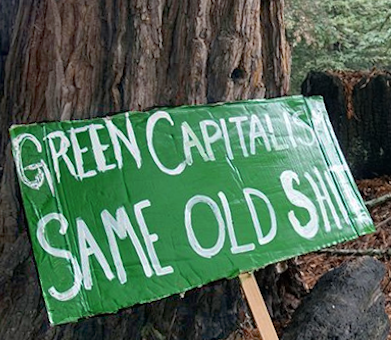
Green Economy, Green Capitalism? The Case Against The Case for Climate Capitalism

By Nick Grover - The Bullet, May 14, 2021

Even now, with a ten-year timeframe left for action, it’s rare for the climate crisis to be treated as the emergency it is. So, credit where due to Tom Rand. In his The Case for Climate Capitalism: Economic Solutions for a Planet in Crisis (Toronto: ECW Press, 2020), Rand calls for a rapid transition away from fossil fuels and toward renewables; he blames the political and business elite for the mess and says they will have to pay the price as markets turn against oil and assets are stranded; he even advocates for expansion of public transit. Where the book gets less refreshing is Rand’s tone toward the people who have been saying these things all along: his secondary enemy, leftists fusing demands for climate action with calls for economic justice.

Rand’s Case for Climate Capitalism aims to preserve and “co-opt” the forces of capitalism to usher in a transition toward green tech. His case is presented as simple pragmatism: the emergency we face affords us no time to discuss economic reforms; we must unite and do what works instead of holding out for a perfect system. His concern is that left ideas like the Green New Deal and Leap Manifesto – which wed strong climate action with job guarantees, labour protections, taxing the rich, and expanding social programs – alienate conservatives and the business class when we need them in our coalition to save the planet.

Sabotage? Good behaviour? Workers’ action? Seeking a strategy to tackle climate change

By Lars Henriksson - People and Nature, May 21, 2021

A review by Lars Henriksson of How to Blow Up a Pipeline: Learning to fight in a World on Fire, by Andreas Malm (Verso, 2021)

What should we do when airy political promises amount to little more than excuses for business as usual, and when the friendly climate protests have not prevented the world from heading towards a burning inferno? Submissively accept doom or take the climate struggle to a new level?

That Andreas Malm does not preach resignation will come as no surprise to those who know the author – activist and socialist since childhood and today well-known in the radical section of international academia. For those unfamiliar with him, the book’s title should dispel all doubt.

To stoically wait for doom is not an option for most of us, even if some claim to have drawn that conclusion. The book’s final section is a reckoning with intellectuals such as Roy Scranton and Jonathan Franzen who flirt with that standpoint.

For the rest of us, who either try to do something, or wish we knew how to do something, the question is: what do we do now? It is this question to which Malm devotes most of his book.

Green Energy, Green Mining, Green New Deal?

Suds and Socialism Forum: Workers and the Environment

Luddism for the age of robotics

By Simon Pirani - The Ecologist, May 7, 2021

Climate breakdown is driven by industrial production, production by machines controlled by people. But can those very people demand a new, low carbon production?

Are the technologies developed by giant capitalist corporations – Walmart’s logistics or Elon Musk’s driverless cars – the foundation on which a post-capitalist society can be built? No way, argues Gavin Mueller in his latest book, Breaking Things At Work: the Luddites were right about why you hate your job (Verso, 2021).

He challenges “Marxist theoreticians” who see “the capitalist development of technology as the means for creating both abundance and leisure”, to be “realised once the masses finally [take] the reins of government and industry”.

Against these technocratic illusions, Mueller proposes “a decelerationist politics: of slowing down change, undermining technological progress, and limiting capital’s rapacity, while developing organisation and cultivating militancy”.

Calls for sustainable and responsible mining for the clean energy transition

By Elizabeth Perry - Work and Climate Change Report, May 6, 2021

An important Special Report by the International Energy Association was released in May: The Role of Critical Minerals in Clean Energy Transitions. Reflecting a mainstream view of the importance of the raw materials for clean technologies such as electric vehicles and energy storage, the IEA provides “ a wealth of detail on mineral demand prospects under different technology and policy assumptions” , and discusses the various countries which offer supply – including Canada. The main discussion is of policies regarding supply chains, especially concerning responsible and sustainable mining, concluding with six key recommendations, including co-ordination of the many international frameworks and initiatives in the area. The report briefly recognizes the Mining Association of Canada’s Towards Sustainable Mining (TSM) protocols as internationally significant, and as one of the first to require on-site verification of its standards. The Towards Sustainable Mining (TSM) initiative was established in 2004, requiring member companies to “demonstrate leadership by reporting and independently verifying their performance in key environmental and social areas such as aboriginal and community engagement, biodiversity conservation, climate change, tailings management.”

On May 5, the Mining Association of Canada updated one of its TSM protocols with the release a new Climate Change Protocol, a major update to its 2013 Energy Use and GHG Emissions Management Protocol. It is designed “to minimize the mining sector’s carbon footprint, while enhancing climate change disclosure and strengthening the sector’s ability to adapt to climate change.” The Protocol is accompanied by a new Guide on Climate Change Adaptation for the Mining Sector, intended for mine owners in Canada, but with global application. The Guide includes case studies of such mines as the Glencore Nickel mine in Sudbury, the notorious Giant Mine in the Northwest Territories, and the Suncor Millennium tailings pond remediation at its oil sands mine in Alberta. The membership of MAC is a who’s who of Canadian mining and oil sands companies / – including well-known companies such as ArcelorMittal, Barrick Gold, Glencore, Kinross, Rio Tinto, Suncor, and Syncrude. Other documentation, including other Frameworks and progress reports, are compiled at a dedicated Climate Change Initiatives and Innovations in the Mining Industry website.

The demand for lithium, cobalt, nickel, and the other rare earth minerals needed for technological innovation has been embraced, not only by the mining industry, but in policy discussions – recently, by Clean Energy Canada in its March 2021 report, The Next Frontier. The federal ministry of Natural Resources Canada is also supportive, maintaining a Green Mining Innovation Initiative through CanmetMINING , and the government joined the U.S.-led Energy Resource Governance Initiative (ERGI) in 2019 to promote “secure and resilient supply chains for critical energy minerals.”

Alternative points of view have been pointing out the dangers inherent in the new “gold rush” mentality, since at least 2016 when Amnesty International released its 2016 expose of the use of child labour in the cobalt mines of the Democratic Republic of Congo. Most recently, in February 2021, Amnesty released Powering Change: Principles for Businesses and Governments in the Battery Value Chain, which sets out specific principles that governments and businesses should follow to avoid human rights abuses and environmental harm. Other examples: MiningWatch Canada has posted their April 2021 webinar Green Energy, Green Mining, Green New Deal?, which states: “The mining sector is working hard to take advantage of the climate crisis, painting mining as “green” because it supplies materials needed to support the “green” energy transition. But unless demand for both energy and materials are curtailed, environmental destruction and social conflicts will also continue to grow.” MiningWatch Canada published Turning Down the Heat: Can We Mine Our Way Out of the Climate Crisis? in 2020, reporting on a 2019 international conference which focused on the experience of frontline communities. Internationally, the Business & Human Rights Resource Centre maintains a Transition Minerals tracker, with ongoing data and reports concerning human and labour rights in the mining of “transition minerals”, and also compiles links to recent reports and articles. Two recent reports in 2021: Recharge Responsibly: The Environmental and Social Footprint of Mining Cobalt, Lithium, and Nickel for Electric Vehicle Batteries (March 2021, Earthworks) and A Material Transition: Exploring supply and demand solutions for renewable energy minerals from the U.K. organization War on Want.

Strike Together: Strengthening the Climate Movement and Trade Unions

By Nicolas Rother - Rupture, May 5, 2021

Leipzig, central bus yard, 15 October, 3:30 am - Normally, the first wave of public buses spreads out all over the city to bring day-time workers to their workplaces and the late shift home. But not today. This autumnal and drizzly Thursday morning is a special one. It’s strike day!

Germany’s second-largest trade union, ver.di, called all drivers of Leipzig’s public transport company, LVB, out for a warning strike. It’s the second within a few weeks. And it’s the second time that the picket line looks very different from what most drivers and their bosses expected. You can see bicycles and cargo-bikes standing by the usually empty bike racks. Roughly 20 other Fridays for Future (FFF) activists and I crawled out of bed in the middle of the night to support the strikers for the second time.

The first time we did this, three weeks before, we felt a bit like aliens. Most drivers were reserved and sceptical when we arrived and unfurled our banner. When we explained that we were there to support them, some openly refused to listen to ‘truants’ and ‘intellectuals’. But we stayed, listened, asked questions and discussed until sunrise.

This time we came again to show that we really care. We brought tea, cake, music and even a burn barrel to break the ice. Still, we had to deal with people who were socialised with Stalinist anti-intellectual propaganda in the German Democratic Republic (GDR, or East Germany) and who had a wide repertoire of hackneyed sayings and jokes about people who go to university. But they were doing this while drinking our coffee and standing around our burn barrel which made us feel that we were more than just supporters, we were actually part of this picket line. Our initiative was necessary because the union was extremely worried about getting bad press for supposedly organising a super-spreader event and wanted everybody to strike from home.

Biden’s Climate Pledge Is a Promise He Cannot Keep

By Howie Hawkins - Solidarity, May 4, 2021

IWW EUC web editor's disclaimer: the IWW does not advoate electralism or endorse political parties, including the Green Party. This article is included to provide a critique of the reformism of the Democratic Party (a similar critique could be offered about the Greens and all other parties).

The climate emergency demands a radical and rapid decarbonization of the U.S. economy with numerical goals and timetables to transform all productive sectors, not only power production (27% of carbon emissions), but also transportation (28%), manufacturing (22%), buildings (12%), and agriculture (10%). It also requires that the U.S. pay its “climate debt” as the world’s largest historical carbon emitter and destroyer of carbon-storing forests, wetlands, and soils. Paying that climate debt would not only be reparations to the Global South for deforestation and fossil fuel emissions by the rich capitalist countries, but also an investment in the habitability of the planet for everyone. This emergency transformation can only be met by an ecosocialist approach emphasizing democratic public enterprise and planning.

Instead, Biden’s plan features corporate welfare: subsidies and tax incentives for clean energy that will take uncertain effect at a leisurely pace in the markets. It does nothing to stop more oil and gas fracking and pipelines for more gas-fired power plants, or to shut down coal-fired power plants. Without out directly saying so, it is a plan to burn fossil fuels for decades to come.

The scale of spending falls pathetically short of what is needed to decarbonize the economy. An effective plan would not only reach zero emissions on a fast timeline. It would also move quickly toward negative emissions. We have to draw carbon out of the atmosphere because we are already well past carbon levels that are triggering dangerous climate change.

Biden’s stated goal of a 50% cut in emissions does not actually cut current emissions in half. His proposed 50% cut is from a baseline of 2005 when emissions were at their peak, not what they are today. Emissions were 6 GtC (gigatons of carbon dioxide) in 2005. Due to a leveling of electric power demand, a trend away from coal to wind, solar, and gas for electric power, and more energy-efficient vehicles, U.S. emissions were down 13% from 2005 by 2019 to 5.1 GtC and, due to the covid contraction, down 21% in 2020 to 4.6 GtC, although emissions are now soaring back up as the economy re-opens. Biden’s goal of 50% below 2005 is 3 GtC per year in emissions instead of 2.5 GtC if 2019 were the baseline, or 2.3 GtC if 2020 were the baseline.

Biden provided no explanation for how the U.S. will get to the precisely stated range of “50% to 52%.” 52% seems to be an arbitrary number pulled out of the air so he can say he is aiming for more than 50%. Greta Thunberg’s video prebuttal to the targets that were to be announced by Biden and the other 40 world leaders at his Earth Day Climate Summit saw right through the staged spectacle. “We can keep cheating in order to pretend that these targets are in line with what is needed, but while we can fool others, and even ourselves, we cannot fool nature and physics… Let’s call out their bullshit.”

Pages

The Fine Print I:

Disclaimer: The views expressed on this site are not the official position of the IWW (or even the IWW’s EUC) unless otherwise indicated and do not necessarily represent the views of anyone but the author’s, nor should it be assumed that any of these authors automatically support the IWW or endorse any of its positions.

Further: the inclusion of a link on our site (other than the link to the main IWW site) does not imply endorsement by or an alliance with the IWW. These sites have been chosen by our members due to their perceived relevance to the IWW EUC and are included here for informational purposes only. If you have any suggestions or comments on any of the links included (or not included) above, please contact us.

The Fine Print II:

Fair Use Notice: The material on this site is provided for educational and informational purposes. It may contain copyrighted material the use of which has not always been specifically authorized by the copyright owner. It is being made available in an effort to advance the understanding of scientific, environmental, economic, social justice and human rights issues etc.

It is believed that this constitutes a 'fair use' of any such copyrighted material as provided for in section 107 of the US Copyright Law. In accordance with Title 17 U.S.C. Section 107, the material on this site is distributed without profit to those who have an interest in using the included information for research and educational purposes. If you wish to use copyrighted material from this site for purposes of your own that go beyond 'fair use', you must obtain permission from the copyright owner. The information on this site does not constitute legal or technical advice.

