

You are here

energy transition

Toward A Green New Future

By Thea Riofrancos and Daniel Aldana Cohen - Socialism 2020, July 26, 2020

Join Thea Riofrancos and Daniel Aldana Cohen for a discussion of the Green New Deal and the future we can build out of our crisis-ridden present. This event is part of the Socialism 2020 Virtual conference. See more at socialismconference.org.

Strike! Audio Commentary by Jeremy Brecher. Fighting the Great Depression from Below

By Jeremy Brecher - Labor Network For Sustainability - July 14, 2020

The United States has entered the deepest economic crisis since the Great Depression of the 1930s. This commentary describes the grassroots movements of the early years of the Great Depression in order to learn something about the dynamics of popular response to depression conditions. These early unemployed, self-help, labor, and other movements helped lay the groundwork for the New Deal and the massive labor struggles of the later 1930s. The next commentaries in this series will portray the grassroots movements of the Coronavirus Depression and ask what they might contribute to the emergence of a Green New Deal and a new labor movement. Subsequent commentaries will compare local and state actions in the early years of the Great Depression to such activities today. These commentaries are part of a series on the Emergency Green New Deal.

Unions Standing Together: A World To Win

Decommissioning California Refineries: Climate and Health Paths in an Oil State

By Greg Karras - Communities for a Better Environment, July 2020

Machines that burn oil are going away. We will burn much less oil, either to prevent the increasing accumulation of pollution impacts that could cause the collapse of human societies as we know them, or as a footnote to the collapse of our societies and economies on which the petroleum fuel chain now feeds. Which path we take matters.

Sustainable energy technologies that are proven, available now, and obviously more economic than societal collapse could replace oil and other fossil fuels. But critical oil infrastructure, permitted mainly in working class communities and communities of color, is still growing. Environmental, economic, and racial injustice weaken societal capacity to break free of this toxic path. Societal capacity to organize—political feasibility—has emerged as the primary barrier to solving our existential pollution crisis.

California has this problem. It hosts the largest oil refining center in western North America. It has the worst air pollution in the nation, and yet it has allowed its oil sector’s critical infrastructure to grow in low-income communities of color, where this pollution is disparately severe compared with the state average. It uses pollution trading—the exchange of money for permits to pollute—leaving communities largely on our own to fight refinery and oil terminal expansion projects.

Communities rose up to stop tar sands projects in many inspiring efforts that for a decade have held to a trickle the flood of cheaper, dirtier oil that refiners sought. But some projects slipped through. The petroleum fuel chain emits more carbon from extracting, refining, and burning fuels made from the oil refined in California than all other activities in the state combined, and as other emissions have begun to decline, its emissions have not.

In fact its emissions increased from 2013–2017 as refiners here increased production for exports that sold for more money than the entire oil sector spent on permits to emit under the state’s carbon trading scheme. They could do that because no refiner faced any limit on carbon emissions from its plant. They still can because politicians caved in to their demand to make carbon trading the only curb on those emissions. Since 2017, state law has prohibited state air officials from setting a carbon-cutting limit on any oil refining plant under this carbon trading scheme.

Governor Brown argued this law was the best “compromise” that was politically feasible. Yet state climate policy has ignored the need, first voiced by the Oil, Chemical & Atomic Workers Union decades ago, for a mandate that assures workers a just transition. Equally important to political feasibility, communities must predict how fast to transition their job and tax bases from oil to sustainable alternatives. But by letting any polluter delay emission cuts at any time, pollution trading makes it harder to make this very prediction.

Read the report (PDF).

Coal Mine Cleanup Works: A Look at the Potential Employment Needs for Mine Reclamation in the West

By Kate French - Western Organization of Resource Councils (WORC), July 2020

The collapse of the coal industry is devastating small communities across the Western United States, but reclaiming these mined lands quickly could create up to 4,800 full-time equivalent jobs per year in the critical two to three year period after mine closure according to our new report, Coal Mine Cleanup Works. The report estimates potential reclamation job creation for four Western coal states (Colorado, Montana, North Dakota, and Wyoming) and provides recommendations for decision makers to ensure cleanup is fully funded and employs the local workforce. 

These findings offer a rare bright light of opportunity for coal communities that are facing massive lay-offs and lost revenue as the coal industry crumbles. Reclamation is one of the few immediately available job opportunities for local workers after a mine shuts down, and the report finds that these jobs are ideally suited for current or former miners.

Coal Mine Cleanup Works key findings include:

  • Surface coal mine reclamation could create up to 4,800 full-time equivalent jobs per year in the critical two to three year period after mine closure. These potential yearly jobs represent up to 65% of the current surface mining workforce in the four-state region. 
  • Reclamation is one of the few immediately available job opportunities for local workers after a mine shut down, and the report finds that these jobs are ideally suited for current or former miners.
  • An important component of a just economic transition is having some immediate job creation solutions, like cleanup jobs, paired with longer-term job solutions.
  • Delayed and underfunded reclamation are the biggest hurdles to getting laid-off miners back on the job doing cleanup work.

Read the text (PDF).

Green Stimulus for Oil and Gas Workers: Considering a Major Federal Effort to Plug Orphaned and Abandoned Wells

By Daniel Raimi, Neelesh Nerurkar, and Jason Bordoff - Columbia Center on Global Energy Policy, School of International and Public Affairs, and Resources for the Future, July 2020

The global economic damages wrought by COVID-19 have dramatically magnified the suffering caused by the deadly virus. US lawmakers have already approved $3 trillion in aid to help offset the economic damage, and additional measures are under consideration. At the same time, the need to invest trillions in economic recovery has prompted calls to “build back better” by making the recovery a greener, less carbon-intensive one.
This paper, a joint effort between Resources for the Future and the Center on Global Energy Policy at Columbia University, examines the potential to boost US employment in the oil and gas workforce while also reducing pollution through a federal program to plug orphaned and abandoned oil and gas wells. These wells can leak methane and other pollutants that contribute to climate change, poor air quality, and other health and environmental risks. This research included interviews with key regulatory and industry officials to present the most up-to-date information on this rapidly evolving issue.

While states and the federal government fund well plugging activities through bonding requirements, industry fees, and other sources, these funds have not historically been adequate to reduce the inventory of orphan unplugged wells. Many of these sites date back to the 19th and early 20th centuries, when regulations including bonding requirements were weak or, in many cases, nonexistent. Estimates for the total number of orphaned and abandoned wells range from several hundred thousand to 3 million, depending on the definition of such wells needing attention. At the same time the oil and gas industry, which has seen employment drop to levels not seen since 2006, appears able to scale up to carry out this work. Labor and equipment are readily available due to the low oil price environment created by the collapse in demand from the coronavirus.

The paper finds:

  • A significant federal program to plug orphan wells could create tens of thousands of jobs, potentially as many as 120,000 if 500,000 wells were plugged. Addressing 500,000 wells would require state, tribal, and federal agencies to identify and prioritize hundreds of thousands of additional wells, most of which are unaccounted for in current inventories of orphaned wells. These inventories indicate that the largest number of orphaned wells are in Pennsylvania.
  • A widespread federal effort to plug orphaned and abandoned oil and gas wells would reduce local air pollution, safety risks, and greenhouse gas emissions at a cost of roughly $67 to $170 per ton of CO2-equivalent, well within the range of other policy options.
  • A significant pool of labor from the oil and gas industry could be deployed toward and benefit from such a program. More than 76,000 direct industry jobs were lost from February to June of 2020, a number that is likely to rise in the months to come. The job losses have been especially acute in rural regions where domestic oil and gas production occurs and where economies are closely tied to industry fortunes, such as the Permian Basin in West Texas and New Mexico, the Marcellus in Pennsylvania and Ohio, the Bakken in North Dakota, and parts of California, Colorado, Louisiana, Oklahoma, and other states. In these regions, this downturn not only affects workers but also funding for schools, infrastructure, public safety, and more, as a prior collaboration between RFF and CGEP found.
  • The costs of plugging and restoring well sites vary widely, and the total outlay of a well plugging program to address the known inventory of 56,600 orphaned wells could plausibly range from $1.4 billion to $2.7 billion. Expanding the program to identify and plug 500,000 wells could plausibly cost between $12 and $24 billion. States have different technical requirements for plugging wells and restoring surface locations, and some wells pose greater risks to groundwater, are harder to access, or are deeper than average. All these factors affect plugging and restoration costs.
  • One potential challenge of a very large program (i.e., addressing hundreds of thousands of wells) is that state regulatory offices would likely need to scale up administrative capacity to oversee such programs.
  • While states and the federal government require oil and gas companies to post bonds or other forms of financial assurance to pay for well plugging in case firms go bankrupt before plugging wells, these bonds often do not cover the full costs. Federal funding could exacerbate this problem if states and companies see it as alleviating their responsibility to plan for future remediation costs adequately. To avoid this, a federal program could prioritize plugging wells abandoned decades ago that were not subject to modern regulatory frameworks.

Read the text (PDF).

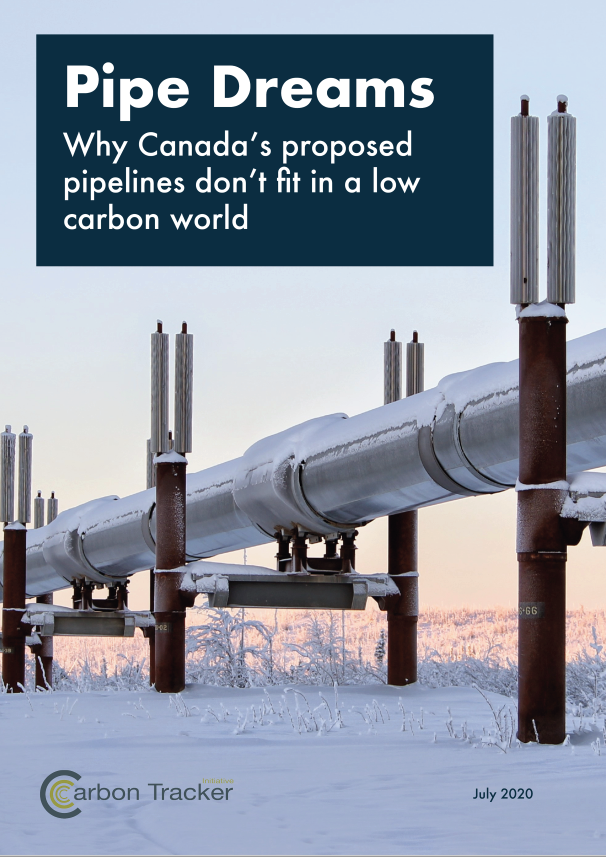
Pipe Dreams: Why Canada’s proposed pipelines don’t fit in a low carbon world

By Axel Dalman and Andrew Grant - Carbon Tracker - July 2020

Carbon Tracker’s modelling shows no new oil sands are needed in a low carbon world.

Prospective pipeline projects represent a significant expansion of capacity, with taxpayer support. However, new pipelines are surplus to requirements under Paris Agreement demand levels.

Canadian authorities face the challenge of trying to reconcile their natural resources development plans with their positioning on climate. Canada has previously having shown leadership on climate change issues, but its government support for pipelines – which are reliant on the failure of the Paris Agreement – risks damaging its credibility.

Key Findings:

Our research has previously shown that no new oil sands projects are needed in a low carbon world. All unsanctioned oil sands projects are uncompetitive under both the International Energy Agency’s 1.7-1.8°C Sustainable Development Scenario (SDS) and c.1.6°C Beyond 2 Degrees Scenario (B2DS).

All proposed new pipelines from Western Canada, in particular Keystone XL and Trans Mountain expansion, are surplus to requirements in a Paris-compliant world. Pipeline capacity may have proved a constraint in recent years, but under SDS, all future oil supplies from Western Canada can be accommodated by upgrades and replacements to existing pipelines, local refining and limited rail freight.

Even if discounts for Canadian crude narrow, new oil sands projects remain uneconomic. Western Canadian heavy oil trades at a steep discount to international benchmarks due to quality and transport challenges, averaging $25 below Brent over the last decade. Even if greater pipeline capacity reduces this to $10 in the future, in line with levels seen during previous periods of unconstrained supply, new projects still remain uneconomic under the SDS. Indeed, even if Canadian heavy oil were to trade at parity with Brent, which is extremely unlikely due to its lower quality, there would still be no new oil sands production under the B2DS and just 120,000 bbl/d would enter the market in the SDS – a level which would be covered by existing rail capacity.

Investors in oil sands face depressed cash flows in a low carbon world of falling oil demand and weak pricing, but will be forced to produce or pay the price due to inflexible “take-or-pay” transport fees for excess new pipeline capacity.

While take-or-pay contracts spread the impacts, pipeline investors still face financial risks as upstream production weakens. Uncontracted capacity will probably remain unused by producers, and contracts may cannibalise tariffs from other pipelines. Even take-or-pay commitments are subject to counterparty risk in a falling oil market.

The Canadian government’s stakes in Keystone XL and Trans Mountain could well prove to be a drain on the public purse. Under the SDS, government tax revenues and the value of the assets are unlikely to reach the levels anticipated at the time of sanction.

Canada’s leadership position on climate change may be undermined by its support for projects reliant on the failure of the Paris Agreement.

Read the report (Link).

Exposing a Ticking Time Bomb: How fossil fuel industry fraud is setting us up for a financial implosion, and what whistleblowers can do about it

By John Kostyack, Karen Torrent, Laura Peterson, and Carly Fabian - National Whistleblower Center - July 2020

In the past several years, U.S. states, cities, counties and individuals concerned about climate change have filed important lawsuits against fossil fuel companies, asserting that the companies are responsible for climaterelated damage due to their carbon pollution. These cases confront “what might be the greatest scam in history,” in the words of historian Naomi Oreskes: the massive disinformation campaign designed to stall action on climate change by persuading decision makers and the public that it is not a problem to be taken seriously.

In this report, the National Whistleblower Center focuses on a related deception that, with a small handful of notable exceptions, is unaddressed in the climate change lawsuits filed to date: the dramatic understatement of risks posed by climate change to fossil fuel companies’ own financial condition and to the economy at large. We describe an important pathway to ensuring proper disclosures of climate risks: collaborative work by whistleblowers, prosecutors and regulators to enforce anti-fraud laws.

This report is a call to action for executives of fossil fuel companies and others with knowledge of improper accounting and disclosure practices, such as external auditors, to take the steps needed to obtain protected whistleblower status and work with the Securities and Exchange Commission (SEC), other regulators and law enforcement officials to help expose and prosecute fraud. For the first time, legal strategies are provided for whistleblowers and others to expose and prosecute climate risk fraud in the fossil fuel industry. This is also the first report to use the methods of professional fraud investigators to identify fossil fuel industry financial disclosure practices that are likely to be fraudulent.

Climate risks—comprised of “transition risks,” the financial risks to some companies due to the world’s shift away from fossil fuels, and “physical risks,” those associated with climate change- related damage to property— uniquely threaten the finances of fossil fuel companies. Fossil fuel companies, fearful of losing access to investment capital and loans, are therefore highly motivated to conceal their exposure to these risks.

Concealment of climate risks is a matter of great public interest because when it is successful, it harms investors, the environment and the economy. Investors who provide capital to these companies suffer because they invest based on a false sense of the companies’ readiness for the transition to a low-carbon economy and for the physical shocks of climate change. This deception undercuts efforts to address climate change because it slows the shift of investments to businesses developing and deploying low-carbon technologies. It harms the economy by leaving financial institutions such as banks and insurers less prepared for the stresses of rapid asset deflation.

Read the report (PDF).

A Fair Climate Policy for Workers: Implementing a just transition in various European countries and Canada

By Pia Björkbacka - The Central Organisation of Finnish Trade Unions SAK, June 26, 2020

Both the Paris Agreement on Climate Change and the target of carbon neutrality by the year 2035 set out in the government programme of Finnish Prime Minister Sanna Marin refer to a just transition for workers towards a low-carbon society. Such a just transition has long been sought by the trade union movement and is an important condition for achieving ambitious climate policy objectives.

The programme of the Marin government states that the government will work with labour market organisations to harmonise economic and labour market policies. Achieving climate objectives will also require co-operation with the social partners, and sectoral assessments in particular.

A just transition has been selected as one approach to reaching the target of a carbon neutral Finland by 2035. The government will pledge to implement emission reduction measures in a socially and regionally equitable way that involves all sectors of society. The government programme envisages establishing a round table on climate policy in Finland under the committee on sustainable development. Bringing together the various actors in society will ensure that climate measures serve the general interests of society and enjoy broad public support.

(Government Programme of Prime Minister Marin 2019)

The implementation of climate policy is causing restructuring in various sectors, meaning that climate policy decisions and actions also have social implications.

The European Commission has estimated that mitigating climate change will create more jobs in the European Union than it will cost (European Commission, 2019), but the changes will be sectoral. Even though labour market restructuring – which is also guided by climate policy - is creating new employment opportunities, it also brings fears of unemployment.

Realising employment opportunities requires substantial investment in employee skills and innovation. It is very important for the benefits and costs of low-carbon restructuring to be evenly shared across various sectors, occupations, population groups and regions. Successfully transitioning to a carbon-neutral society will not only require emission reduction measures and business and energy policies, but also employment, social welfare, education and regional policies.

The principle of a just transition will seek to meet these challenges. This means implementing emission reductions in a way that is fair to workers. It is about creating new, decent and sustainable jobs, in-service training for new employment, and security of earnings. The goal of a just transition is to increase the participation and commitment of workers in deciding policies for mitigating climate change nationally, regionally and within businesses, thereby promoting a smooth transition to a carbon-neutral society.

Read the text (PDF).

It’s Time to Nationalize the Fossil Fuel Industry

Robert Pollin interviewed by C.J. Polychroniou - Truthout, June 26, 2020

The COVID-19 pandemic’s impact on the economy provides a golden opportunity for creating a fairer, more just and sustainable world as it shatters long-held assumptions about the economic and political order. Its impact on the energy industry in particular can boost support for tackling the existential threat of global warming by raising the prospect of nationalizing and eventually dismantling fossil fuel producing companies, a position argued passionately by one of the world’s leading progressive economists, Robert Pollin, distinguished professor of economics and co-director of the Political Economy Research Institute at the University of Massachusetts at Amherst.

C.J. Polychroniou: It has been argued by many that the coronavirus pandemic is a game changer for numerous industries, and could change the way we work and the way we use energy. We could also see the possible return of the social state and thus the end of austerity. First of all, are there any comparisons to be made between the current health and economic crises and what took place during the Great Depression?

Robert Pollin: There is one big similarity between the economic collapse today and the 1930s Great Depression. That is the severity of the downturns in both cases. The official U.S. unemployment rate coming from the Labor Department as of May 2020 was 13.3 percent. But a more accurate measure of the collapsing job market is the number of workers who have applied for unemployment insurance since the lockdown began in mid-March. That figure is 44 million people, equal to about 27 percent of everyone in the current U.S. labor market, employed or unemployed. By contrast, during the Great Recession of 2007-09, official unemployment peaked, and for one month only, at 10.0 percent.

Pages

The Fine Print I:

Disclaimer: The views expressed on this site are not the official position of the IWW (or even the IWW’s EUC) unless otherwise indicated and do not necessarily represent the views of anyone but the author’s, nor should it be assumed that any of these authors automatically support the IWW or endorse any of its positions.

Further: the inclusion of a link on our site (other than the link to the main IWW site) does not imply endorsement by or an alliance with the IWW. These sites have been chosen by our members due to their perceived relevance to the IWW EUC and are included here for informational purposes only. If you have any suggestions or comments on any of the links included (or not included) above, please contact us.

The Fine Print II:

Fair Use Notice: The material on this site is provided for educational and informational purposes. It may contain copyrighted material the use of which has not always been specifically authorized by the copyright owner. It is being made available in an effort to advance the understanding of scientific, environmental, economic, social justice and human rights issues etc.

It is believed that this constitutes a 'fair use' of any such copyrighted material as provided for in section 107 of the US Copyright Law. In accordance with Title 17 U.S.C. Section 107, the material on this site is distributed without profit to those who have an interest in using the included information for research and educational purposes. If you wish to use copyrighted material from this site for purposes of your own that go beyond 'fair use', you must obtain permission from the copyright owner. The information on this site does not constitute legal or technical advice.
