You are here

energy transition

Retooling Our World for the Future

By staff - Adapting Canadian Work and Workplaces to Respond to Climate Change - June 24, 2020

The Coalition of Black Trade Unionists joined Green Jobs Oshawa’s first “Retooling Our World for the Future” Summit; a summit for community leaders, environmentalists, labour and social justice advocates all working towards the common goal of public ownership and repurposing our world and jobs for socially beneficial manufacturing. Here is the link to the video of the summit and a description of the speakers on Youtube.

Decline and Fall: The Size & Vulnerability of the Fossil Fuel System

By Kingsmill Bond, Ed Vaughan, and Harry Benham - Carbon Tracker, June 4, 2020

Renewable costs are below those of fossil fuels. Five years ago, fossil fuels were the cheapest baseload. The collapse in renewable costs means that for 85% of the world, renewable electricity is the cheapest source of new baseload. By the early 2020s it will be every major country. Because of the rise of cheap renewables, the fossil fuel system is ripe for disruption. This disruption will be have profound financial implications for investors as a quarter of equity markets and half of corporate bond markets are ‘carbon entangled’.

Those responsible for our pension schemes should sit up and take notice; but even greater concern should be felt by financial regulators, as they grapple with finding the right tools to manage the risks of a deflating ‘carbon bubble’.

The world faces two contrasting pathways. Either it can secure the ‘trillion dollar green gigafall’, the trillions that can be generated at low cost from the sun and the wind – particularly benefiting the poorest inhabitants of the world currently dependent upon high cost fossil fuel imports. Or it can stay locked into business as usual, tied into a declining industry that both threatens the global economy with the worst effects of a warming planet, and damages investors with losses, low returns and destabilised equity and credit markets.

In Carbon Tracker’s first report, some ten years ago, entitled ‘Unburnable Carbon – are the World’s Financial Markets Carrying a Carbon Bubble’ we highlighted that listed fossil fuel companies have the potential to develop enough reserves to take the world way beyond 3˚C. Our second report, ‘Unburnable Carbon – Wasted Capital and Stranded Assets’, noted that if we can’t burn what we have already found, why continue to invest in the fossil fuel industry’s expansion? Yet today, we know that some $1 trillion is spent annually on expanding supply and this report goes more into these numbers. Before we wind down the fossil fuel system, we need to stop expanding it.

Some argue that ‘fossil fuels will go away of their own accord’ as the result of the rapid progress made by cleaner technologies and the collapse in demand for fossil fuels driven by the terrible COVID-19 epidemic. Unfortunately, as this report makes clear, financial markets are still heavily tied in to the fossil fuel system.

Read the report (PDF).

Moore’s Boorish "Planet of The Humans": An Annotated Collection

By admin - Get Energy Smart Now, April-June 2020

Web Editor's Commentary: We'll just cut right to the chase: Planet of the Humans is an unequivocally horrid film (the fact that it was really the brainchild of that Malthusian quack, Ozzie Zehner, whose dishonesty and bad faith arguments were the target of one of our very earliest commentaries, should be an immediate clue to anyone with any knowledge on the subject of energy transition) and an insult to green anti-capitalists worldwide.

We had originally intended to write a commentary of our own about it, however, as this very extensive bibliography demonstrates, the topic has been covered quite extensively. While this bibliography--for which we've been granted permission to copy on our own site by its author--is extensive, even exhaustive, it is unfortunately not especially well organized (we lack the time and bandwidth to engage in such an effort, and we suspect its author has better things to do as well, so we don't hold it against them).

That said, it is still extremely useful, and in it you'll find ample evidence against the arguments made in the film.

With that in mind, we offer one other addition to this extensive bibliography, and that is a podcast from The Energy Transition Show, specifically Episode 125: Beyond the Planet of the Humans, in which show host, Chris Nelder, and guest, Auke Hoekstra, deconstruct the film's producers' motivations and clearly show that they're making their arguments in bad faith out of a place of bitterness that energy transition, while quite possible, is nevertheless challenging.


For Earth Day 2020, Michael Moore announced 30 days of YouTube access of the Jeff Gibbs written/directed and Michael Moore ‘executive produced’ Planet of the Humans. This free mass release sparked viewership and a discovery that, sigh, this was mediocre propaganda. Like Robert Bryce’s work, this film has the same fundamental flaws:

  • too error-filled for non-educated/knowledgeable people to watch due to misdirection & embedded deceit that might not be evident as the viewer has to be knowledgeable to see the truthiness and deceit.
  • tedious and painful for those already knowledgeable as the core thematics/points aren’t news and it just takes so much effort to wade through the falsehoods and truthiness for having thoughts/perspective that are already out there in discussion.  

This post will provide an updated discussion of some of the better discussions of this boorishly propagandistic mocku-mentary.

A Pathway to a Regenerative Economy

By various - United Frontline Table, June 2020

The intersecting crises of income and wealth inequality and climate change, driven by systemic white supremacy and gender inequality, has exposed the frailty of the U.S. economy and democracy. This document was prepared during the COVID-19 pandemic which exacerbated these existing crises and underlying conditions. Democratic processes have been undermined at the expense of people’s jobs, health, safety, and dignity. Moreover, government support has disproportionately expanded and boosted the private sector through policies, including bailouts, that serve an extractive economy and not the public’s interest. Our elected leaders have chosen not to invest in deep, anti-racist democratic processes. They have chosen not to uphold public values, such as fairness and equity, not to protect human rights and the vital life cycles of nature and ecosystems. Rather, our elected leaders have chosen extraction and corporate control at the expense of the majority of the people and the well-being and rights of Mother Earth. Transforming our economy is not just about swapping out elected leaders. We also need a shift in popular consciousness.

There are moments of clarity that allow for society to challenge popular thinking and status quo solutions. Within all the challenges that this pandemic has created, it has also revealed what is wrong with the extractive economy while showcasing the innate resilience, common care, and original wisdom that we hold as people. Environmental justice and frontline communities are all too familiar with crisis and systemic injustices and have long held solutions to what is needed to not only survive, but also thrive as a people, as a community, and as a global family. We cannot go back to how things were. We must move forward. We are at a critical moment to make a downpayment on a Regenerative Economy, while laying the groundwork for preventing future crises.

To do so, we say—listen to the frontlines! Indigenous Peoples, as members of their Indigenous sovereign nations, Asian and Pacific Islander, Black, Brown and poor white marginalized communities must be heard, prioritized, and invested in if we are to successfully build a thriving democracy and society in the face of intersecting climate, environmental, economic, social, and health crises. A just and equitable society requires bottom-up processes built off of, and in concert with, existing organizing initiatives in a given community. It must be rooted in a people’s solutions lens for a healthy future and Regenerative Economy. These solutions must be inclusive—leaving no one behind in both process and outcome. Thus, frontline communities must be at the forefront as efforts grow to advance a Just Transition to a Regenerative Economy.

A People’s Orientation to a Regenerative Economy offers community groups, policy advocates, and policymakers a pathway to solutions that work for frontline communities and workers. These ideas have been collectively strategized by community organizations and leaders from across multiple frontline and grassroots networks and alliances to ensure that regenerative economic solutions and ecological justice—under a framework that challenges capitalism and both white supremacy and hetero-patriarchy—are core to any and all policies. These policies must be enacted, not only at the federal level, but also at the local, state, tribal, and regional levels, in US Territories, and internationally.

Read the text (PDF).

Putting California on the High Road: a Jobs and Climate Action Plan for 2030

By Carol Zabin, et. al. - University of California, Berkeley Center for Labor Research and Education, June 2020

Over the last 15 years, California has emerged as a national and world leader in the fight to avoid climate disaster, passing a comprehensive and evolving suite of climate measures to accelerate the transition to a carbon- neutral economy. The state has also emerged as a national leader in embracing economic equity as a goal for state policy, charting a path towards a new social compact for shared prosperity in a rapidly changing world. Meaningful commitment to both of these goals—ensuring that all Californians thrive in the transition to a carbon-neutral economy—requires the development and implementation of a bold agenda that aligns California’s ambitious climate and workforce action plans. This report presents a framework for California to advance that agenda.

Assembly Bill 398 (E. Garcia, Chapter 135, Statutes of 2017) required that the California Workforce Development Board (CWDB) present a report to the Legislature on strategies “to help industry, workers, and communities transition to economic and labor-market changes related to statewide greenhouse gas emissions reduction goals.” To fulfill this mandate, the CWDB commissioned the Center for Labor Research and Education at the University of California, Berkeley, to review the existing research in the field and prepare this report. The summary presented here describes the key concepts, findings, and recommendations contained in UC Berkeley’s full work.

The statutory language of AB 398 makes clear that this report should address workforce interventions to ensure that the transition to a carbon-neutral economy:

  • Creates high-quality jobs;
  • Prepares workers with the skills needed to adapt to and master new, zero- and low-emission technologies;
  • Broadens career opportunities for workers from disadvantaged communities; and
  • Supports workers whose jobs may be at risk.

This report presents a comprehensive strategy that identifies roles for state and local climate, economic development, and workforce development agencies in achieving these goals, alongside key partners such as business, labor, community, and education and training institutions. All recommendations align with the CWDB’s Unified Strategic Workforce Development Plan, which has put forth a set of actions to leverage and coordinate the state’s myriad workforce and education programs to support high-quality careers for Californians. In keeping with the statutory directive, the report discussion is further enriched by comments provided to the CWDB through a series of stakeholder meetings held in July and August 2018.

This report builds upon the framework established in California’s 2017 Climate Change Scoping Plan (Scoping Plan), which presents a roadmap of policies and programs to reach the climate protection target in Senate Bill 32 (Pavley, Chapter 42, Statutes of 2016) of a 40 percent reduction in greenhouse gas emissions by 2030 from 1990 levels. The Scoping Plan is organized into sectors based on the state’s major sources of greenhouse gas emissions and corresponding climate action measures: Transportation, Industry, Energy, Natural and Working Lands (including Agricultural Lands), Waste, and Water. This report organizes the available information from existing academic research, economic models, and industry studies for the Scoping Plan sectors and presents for each of them:

  • Information about current labor conditions and the impact on jobs of the major climate measures;
  • Guidance for policymakers, agencies, and institutions that implement climate and/or workforce policy on how to best generate family-supporting jobs, broaden career opportunities for disadvantaged workers, deliver the skilled workforce that employers need to achieve California’s climate targets, and protect workers in declining industries; and
  • Examples of concrete, scalable strategies that have connected effective climate action with workforce interventions to produce good outcomes for workers.

A Fair and Sustainable Economic Recovery Program for California

By Robert Pollin - Political Economy Research Institute (PERI), June 2020
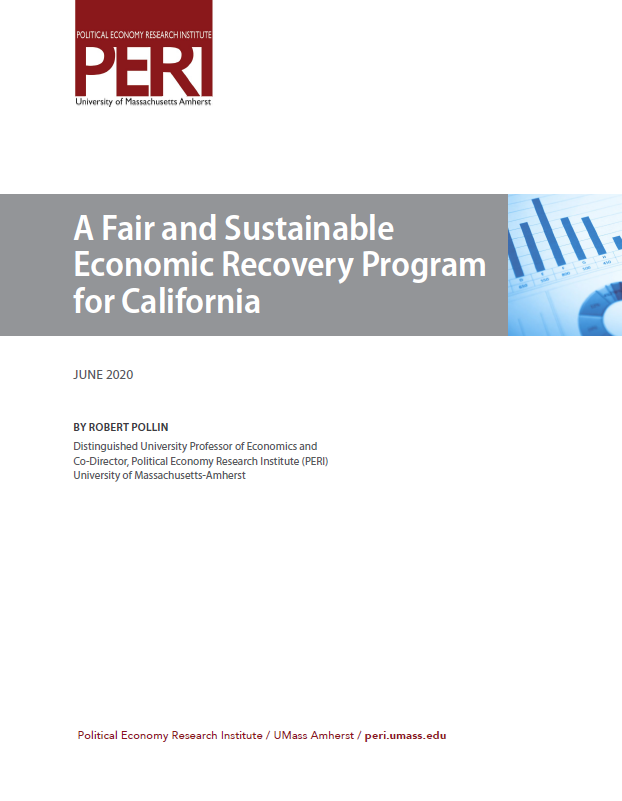
The COVID-19 pandemic has generated severe public health and economic impacts in California, as with most everywhere else in the United States. This report proposes a recovery program for California that is capable of exerting an effective counterforce against the state’s economic collapse in the short run while also building a durable foundation for an economically viable and ecologically sustainable longer-term recovery. This is an anti-austerity recovery agenda, including the following main elements:

Establishing Effective Public Health Interventions. This will generate millions of jobs through allowing the state to recover safely. Some of the industries in which workers have been hardest hit include restaurants and hotels, in-person retail trade, and health care. Workers in these industries all need to be provided with adequate Personal Protection Equipment so they can perform their jobs safely. They also need their rights at work to be fully protected, including the right to paid sick leave.

Upgrading California’s Public Infrastructure. California’s economy would receive a major boost, both in terms of short-run stimulus and longer-term productivity, by undertaking a large-scale public infrastructure investment program now. The study estimates that $25 billion in annual infrastructure investments in California will generate about 315,000 jobs within the state. Roughly half of these jobs will be in the construction industry, including new opportunities for carpenters, electricians, glaziers, plumbers, pipefitters, and construction laborers. Most of the rest of the jobs will be in manufacturing and a range of services.

Clean Energy Investments and High Road Job Creation. This study estimates that public and private investments in California to achieve the state’s mandated emissions and climate stabilization goals are capable of generating about 725,000 jobs in 2020 – 2021 through $80 billion in public and private investments in 2020 – 2021, and larger numbers thereafter to 2030. These investments will entail both: 1) greatly enhancing the state’s level of energy efficiency, including through deep energy retrofits to public buildings; and 2) massively expanding the state’s supply of clean renewable energy sources, starting with solar and wind power. New job opportunities will open for, among other occupations, carpenters, machinists, environmental scientists, secretaries, accountants, truck drivers, roofers and agricultural laborers.

Just Transition for All Displaced Workers. Some workers in California’s oil and gas industry will experience displacement over time through the state’s clean energy transition. This study estimates that about 1,400 oil and gas workers will be displaced per year between 2021 – 2030 and another 1,400 will voluntarily retire each year. All of these workers require Just Transition support, including pension guarantees, health care coverage, wage insurance, and retraining support, as needed. In addition to the oil and gas industry, a substantial share of jobs in hard-hit service industries such as restaurants, hotels and retail are likely to not return in the aftermath of the recession. Workers in these industries also need just transition support, including the extension of 100 percent unemployment insurance, Medicare health insurance coverage while unemployed, wage insurance, and high-road job training and placement support.

Download (PDF).

Future Beyond Fossil Fuels: California’s Just Transition

By staff - Sunrise Movement, May 1, 2020

You may have heard the term ‘Just transition’ floating around, but what does it mean? This webinar will focus on what a just transition means for workers in California, and how the vision of a Green New Deal can guide the much-needed economic recovery from the COVID crisis.

This video features IWW Environmental Unionism Caucus cofounder, Steve Ongerth, speaking on workers, unions, and just transition in Northern California.

A Call for Federal Leadership: Stand with oil sands workers calling for renewable energy

By Lliam Hildebrand - Iron and Earth, March 4, 2020

The workers of Iron & Earth are urging the federal government to show bold leadership to put Canada on the fast track to a net-zero economy now. This week we wrote to Prime Minister Trudeau and Deputy Prime Minister Freeland and asked them to enact a plan that will put us to work building the new economy.

The Teck mine cancellation could represent a historic milestone, marking the moment that Canada shifted collectively towards a prosperous net-zero economy. But in order to move in this new direction, we need visionary federal climate policy that includes urgent investments across the country, with special attention to Alberta and Saskatchewan. Here is the text of our letter:

March 4, 2020

The Right Honourable Justin Trudeau
Office of the Prime Minister of Canada
80 Wellington Street
Ottawa, ON K1A 0A2

The Right Honourable Chrystia Freeland
Deputy Prime Minister of Canada
House of Commons
Ottawa, ON, K1A 0A6

Re: the cancellation of the Teck Frontier project and building the new net-zero economy

Dear Prime Minister Trudeau and Deputy Prime Minister Chrystia Freeland,

Iron & Earth is a not-for-profit organization led by fossil fuel industry and Indigenous workers, whose aim is to help build the policies and infrastructure required to meet climate targets. We are concerned about the increasingly polarized conversation and contexts around energy development in Canada and the significant economic shifts that the recent Teck project cancellation represents. We are writing to urge you to show bold leadership to put us decisively on track to a net-zero economy.

A Better Recovery: Learning the lessons of the corona crisis to create a stronger, fairer economy

By staff - Trades Union Congress - May 20, 2020

A plan to get Britain growing out of the crisis – and stop mass unemployment

The pandemic alone did not cause this economic crisis. It was made worse by a decade of austerity and the government’s failure to strengthen the UK’s economy. Choosing the wrong approach to recovery now risks embedding low growth, long-term unemployment and all the social ills that go alongside.

An investment for growth approach means taking action on six key areas:

  • Decent work and a new way of doing business: New business models based on fairer employment relationships. A fairer share for workers of the wealth they create, with a higher minimum wage and new collective bargaining rights.
  • Sustainable industry: Economic stimulus for a just transition to net zero carbon. Rebuilding the UK’s industrial capacity with modern tech and training in new skills.
  • A real safety net: Reforms to social security to provide help faster and prevent poverty. A job guarantee scheme so everyone can work and long-term unemployment does not take hold.
  • Rebuilding public services: Bringing our public services back to full strength, with decent pay for those who looked after us in the crisis, and a new focus on good jobs and direct employment in social care.
  • Equality at work: Specific actions to make sure women, disabled people and BME groups do not suffer disproportionately from the impact of the coronavirus recession.
  • Rebuilding internationalism: New international rules must prioritise decent jobs and public services for all.

The evidence from the post-war recovery is that this investment for growth recovery plan can pay for itself. Millions of working families with higher disposable income create the economic demand needed for strong growth and healthy public finances. Stronger public services and an effective safety net will support people to start and grow businesses, and will better protect against a future pandemic.

Read the report (PDF).

Labour’s Vision for Economic Recovery

By staff - Canadian Labour Congress - May 13, 2020

Canada is in the midst of the worst unemployment crisis since the Great Depression. Millions of workers have lost their jobs and now face an uncertain future.

Canada’s unions are proposing a set of ambitious initiatives in order to achieve a strong, sustainable and inclusive economic recovery. It is a recovery that places workers directly at the centre of every policy and strategy going forward.

COVID-19 has laid bare the underlying inequalities of our society. The labour movement has been witness to the growing divide between the have and have-nots and is ready to advise on ways to narrow the gulf to ensure fairness for everyone.

By fixing what has long been broken, we can ensure that no one is left behind in the coming phases of recovery.

The guiding principles we propose build on current government efforts to respond to economic disruptions wrought by the pandemic. These priorities aim to ensure that the economic recovery:

  • Focuses on getting Canadians back to work and fully employed in decently paid, productive jobs. As we learned from the Great Recession in 2008, joblessness and labour underutilization will persist without labour market planning, coordination and concerted action by governments.
  • Focuses on public investment in infrastructure, and on renewal and expansion of public services. Amidst general uncertainty, weak consumer demand and high levels of indebtedness, business investment will not, by itself, be the engine of recovery. Strong public investment can lift incomes and economic activity that will, in turn, stimulate business investment.
  • Focuses on being gendered, inclusive and committed to reducing inequality. The pandemic and economic shutdown have worsened insecurity and inequality, which will further slow the recovery if left unchecked. It is time to address the precarity, poor working conditions and wage discrimination in sectors dominated by women, including care work, retail and health services. This work is essential to the health and well-being of our communities and economy.

Canada’s unions reject the failed thinking and economics of austerity. Canadians remember how the Conservative Party of Canada cut spending to balance budgets in 2010, just months after the worst depths of the Great Recession. The government prioritized financial support for banks and corporations, instead of investing in people and communities. Those decisions led to years of sluggish economic growth, persistently high unemployment, growing precarity and insecurity, and rising inequality.

Read the report (PDF).

Pages

The Fine Print I:

Disclaimer: The views expressed on this site are not the official position of the IWW (or even the IWW’s EUC) unless otherwise indicated and do not necessarily represent the views of anyone but the author’s, nor should it be assumed that any of these authors automatically support the IWW or endorse any of its positions.

Further: the inclusion of a link on our site (other than the link to the main IWW site) does not imply endorsement by or an alliance with the IWW. These sites have been chosen by our members due to their perceived relevance to the IWW EUC and are included here for informational purposes only. If you have any suggestions or comments on any of the links included (or not included) above, please contact us.

The Fine Print II:

Fair Use Notice: The material on this site is provided for educational and informational purposes. It may contain copyrighted material the use of which has not always been specifically authorized by the copyright owner. It is being made available in an effort to advance the understanding of scientific, environmental, economic, social justice and human rights issues etc.

It is believed that this constitutes a 'fair use' of any such copyrighted material as provided for in section 107 of the US Copyright Law. In accordance with Title 17 U.S.C. Section 107, the material on this site is distributed without profit to those who have an interest in using the included information for research and educational purposes. If you wish to use copyrighted material from this site for purposes of your own that go beyond 'fair use', you must obtain permission from the copyright owner. The information on this site does not constitute legal or technical advice.

